
Before telling you about the production I was lucky enough to see, let me briefly recap the plot of this opera, which is staged less often than La Traviata, Aida or Turandot.
Ancient Babylon, 6th century BC. King Nabucco destroys Jerusalem, declares himself a god, goes mad, loses power, regains it, and unexpectedly discovers humility. His adopted daughter Abigaille dreams of the throne and of Ismaele, nephew of the King of Jerusalem, who loves not her but Fenena, Nabucco’s daughter. (As usual, the tenor finds himself caught between two women and history’s larger catastrophes.) Nabucco threatens to destroy Jewish people from the face of the earth, while the Jewish High Priest Zaccaria tries to save his people by calling down upon the king thunder, lightning and assorted Old Testament punishments, locusts included. Fortunately, Verdi composed Va, pensiero sull’ali dorate (“Fly, thought, on golden wings”), and for this chorus of Hebrew captives alone, audiences have happily forgiven Verdi certain inconsistencies in the plot for nearly two centuries.
Or, shorter still: Nabucco is the story of a ruler who decided he was a god. Unfortunately for him, he was not. The music, however, turned out to be sublime, and the chorus, giving voice to the people, remains immortal.
Strange, isn’t it, how the shorter the plot summary becomes, the more contemporary it sounds?
I have seen this opera many times: at the Arena di Verona, the Roman amphitheatre in Verona built around AD 30; at the charming neoclassical opera house in Piacenza on Via Verdi; and even in Israel, in the middle of the desert, where the backdrop was Masada, the ancient fortress overlooking the south-western shore of the Dead Sea, built around 25 BC and still regarded by Jews as a symbol of last resistance, national dignity and the determination to die free rather than live in slavery. (There, after the professional singers had repeated the chorus three times in response to applause right in the middle of the performance, the conductor turned towards the audience and raised his baton. Six thousand people rose as one and began singing too. Not everyone knew the words, and not everyone sang in tune, but emotionally, especially given the geographical proximity to the opera’s setting, it was overwhelming.)
For all the differences in staging and scenery, those productions shared two constants: Daniel Oren, the internationally renowned Israeli conductor specialising in Verdi, was on the podium, and the role of Zaccaria was sung by Paata Burchuladze. Maestro Oren is currently preparing to conduct Aida in Verona, while Paata Burchuladze, as you already know, is now singing in a place wholly unsuited to singing.
The production currently running at La Scala may be called significant for a whole series of reasons. Judge for yourselves.
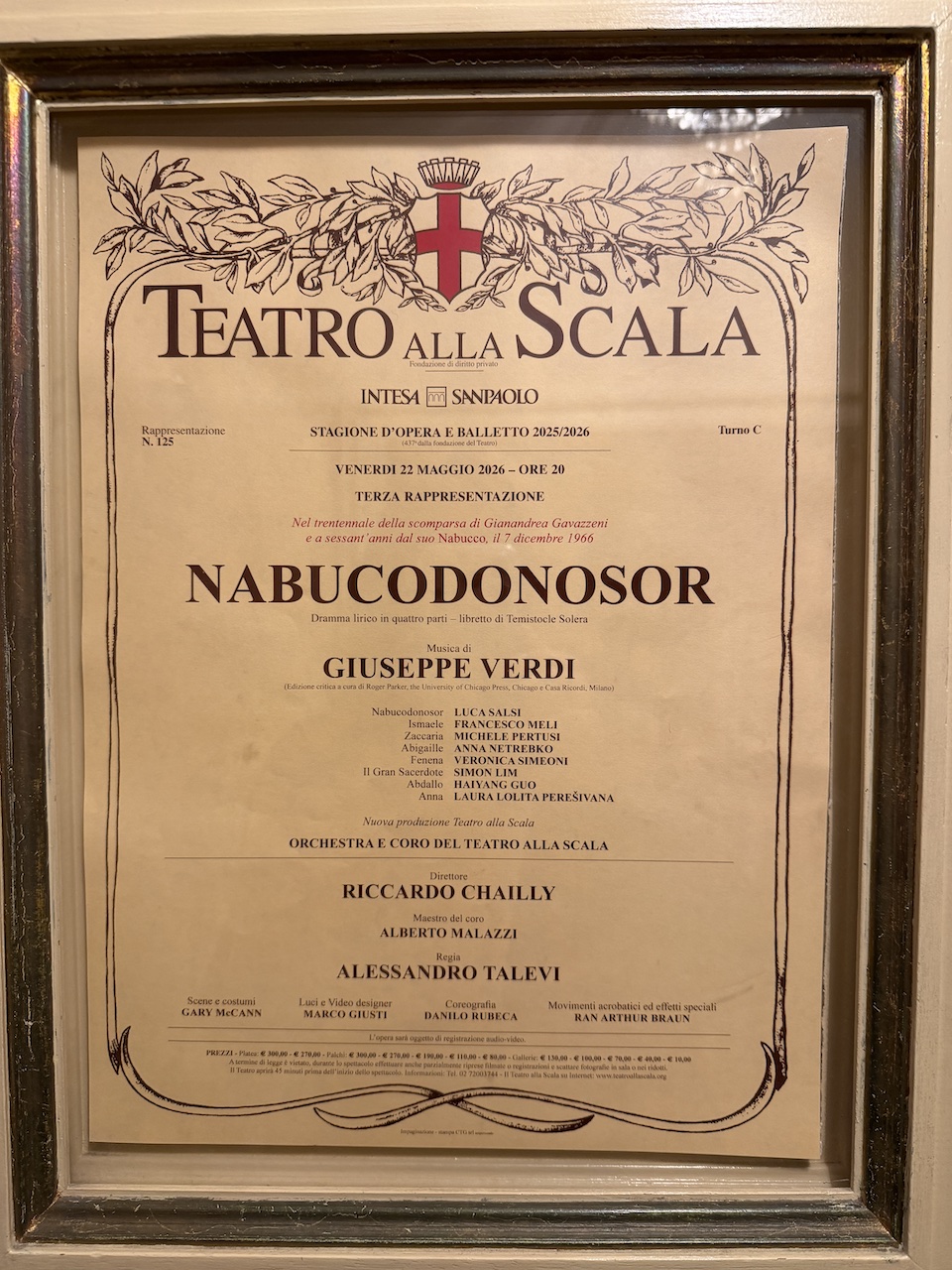
Nabucco, Verdi’s third opera, became his first major triumph. It premiered at La Scala on 9 March 1842, with the composer himself seated at the harpsichord. (The opera firmly entered the repertoire under the title Nabucco, first used in 1844: the unwiedly name “Nebuchadnezzar” from the libretto was shortened and Italianised, although theatre posters continued to use the full form.)
The new production marks Alessandro Talevi’s directing debut at La Scala. At the same time, it is Riccardo Chailly’s final operatic production as the theatre’s Music Director and his tenth encounter with Verdi, excluding the Requiem. The opera is performed in the critical edition prepared by musicologist Roger Parker, who restored a number of details from Verdi’s original score, published by the University of Chicago Press and Casa Ricordi.
In addition, the production includes, for the first time in modern staged performance, the divertissement Verdi composed for the opera’s 1848 Brussels production at La Monnaie. Rediscovered in 2021 by the Danish scholar Knud Arne Jürgensen, it had previously only been performed in concert form.
Finally, this Nabucco is dedicated to the conductor Gianandrea Gavazzeni, who worked at La Scala for nearly fifty years: it marks both the thirtieth anniversary of his death and sixty years since, on 7 December 1966, he restored the opera to La Scala’s stage. Quite a collection of anniversaries.
As he prepares to leave La Scala, Riccardo Chailly seems determined to enjoy himself. In recent years he has increasingly turned to works he had never previously conducted, without paying much attention to “political context”. This was true of Boris Godunov in 2022, and this season of both Lady Macbeth of Mtsensk and Nabucco. (I would not have been surprised if Nabucco, too, had triggered demands for cancellation, as Boris Godunov once did. But this time, that did not happen.)
With such a cast, there is hardly any need to dwell on the vocal side of the performance: both the solo numbers and the many ensembles, so beloved by Verdi singers and so demanding technically, were excellent. The orchestra was magnificent throughout, and the audience repeatedly burst into applause for both the players and Chailly whenever possible.
Most of all, naturally, after that famous chorus. And the reason is not only musical. For Italian audiences of the 1840s, the chorus very quickly became an allegory for Italy itself, much of which was then under Austrian domination. This even though in 1842 Verdi was not yet the “official composer” of the Risorgimento, the Italian national liberation movement against foreign rule. The audience proved more perceptive than the composer himself! Later, Va, pensiero became almost a second Italian national anthem. The most powerful symbolic moment came at Verdi’s funeral in 1901, when an enormous crowd in Milan spontaneously sang the chorus under Arturo Toscanini’s direction. From that point onward, it entered Italy’s collective memory as one of the country’s defining musical symbols.
But who exactly is Alessandro Talevi, the first South African ever admitted into the holy of holies of Italian opera?
Now based in Turin, he was born in Johannesburg, where he studied music and art history at the University of the Witwatersrand, universally known simply as Wits. (If the name means nothing to you, its alumni include Nelson Mandela and Nobel Prize-winning writer Nadine Gordimer.) He later studied piano accompaniment at London’s Royal Academy of Music. This matters to me because it means Talevi works with singers not merely intuitively but professionally, which perhaps explains why he built his career primarily as an opera director. Looking through his substantial list of productions, I naturally paid particular attention to his Eugene Onegin in Santa Fe.
Critics frequently note his affinity for psychological theatre and for rethinking the classics without descending into blunt-force Regietheater. Even when relocating the action into abstract or symbolic settings, he retains respect for the opera’s musical dramaturgy. Talevi has acquired the reputation of being neither a scandal-seeking deconstructionist ready to destroy a work for the sake of a concept, nor a museum-style traditionalist. He occupies a rare middle ground in today’s opera world. Personally, I find this position both understandable and appealing. Having seen Nabucco, I am inclined to agree with these assessments, even though the Financial Times praised the production mainly for its musical qualities while finding the staging less convincing, detecting in it a certain science-fiction aesthetic.
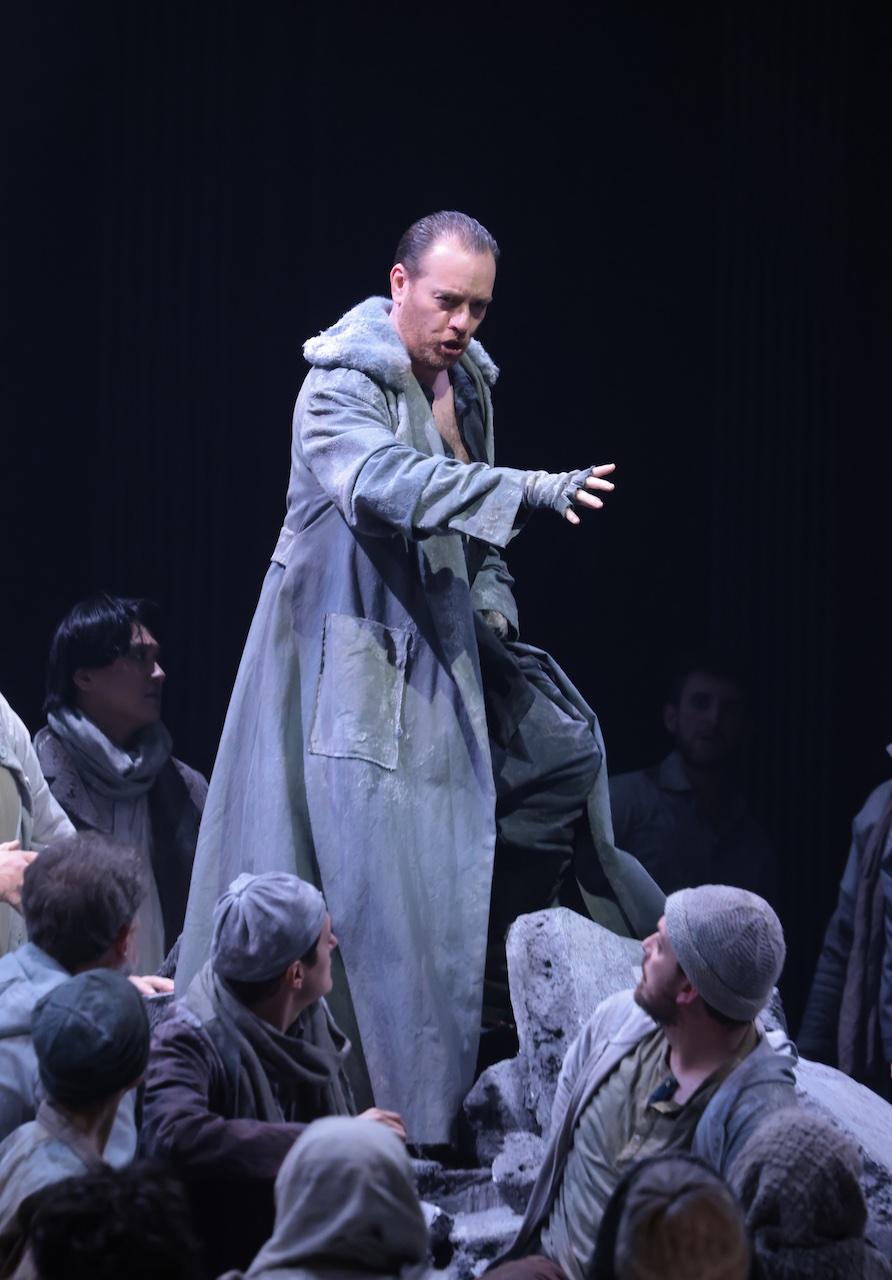
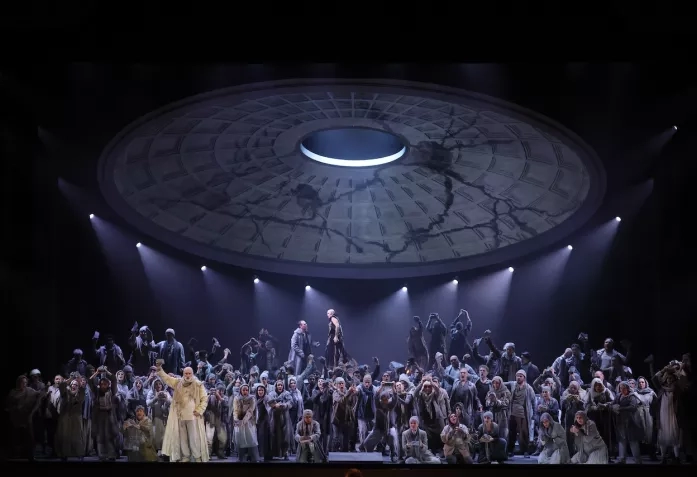
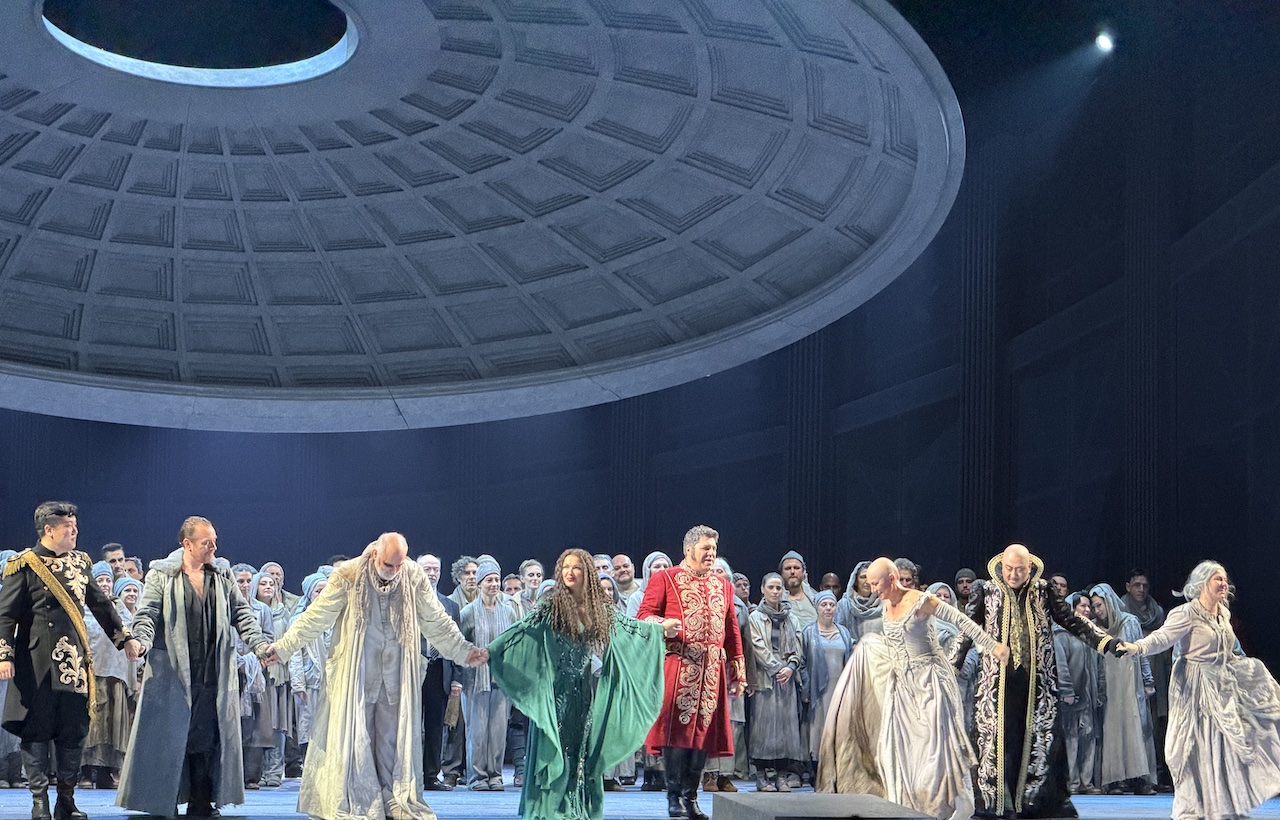
Personally, I did not see it that way, unless one chooses to interpret one of the production’s central scenic elements as a flying saucer: a massive circular dome, cracked and pierced by an opening at its centre. I would venture to suggest that Alessandro Talevi, who has spoken in interviews of his refusal to anchor the story in any single historical period and of his wish to make it universal, had something else in mind, and something greater than merely the dome of Solomon’s destroyed Temple in Jerusalem. To my mind, the circle here symbolises power, eternity and celestial order; the cracks suggest spiritual and political collapse; while the opening at the centre resembles an eye or a vortex linking the earthly world to some higher power and ultimate judgement. And if one looks for a more contemporary association in this image, one thinks of Israel’s “Iron Dome” – a defence system in which, as reality has also shown, breaches remain possible.
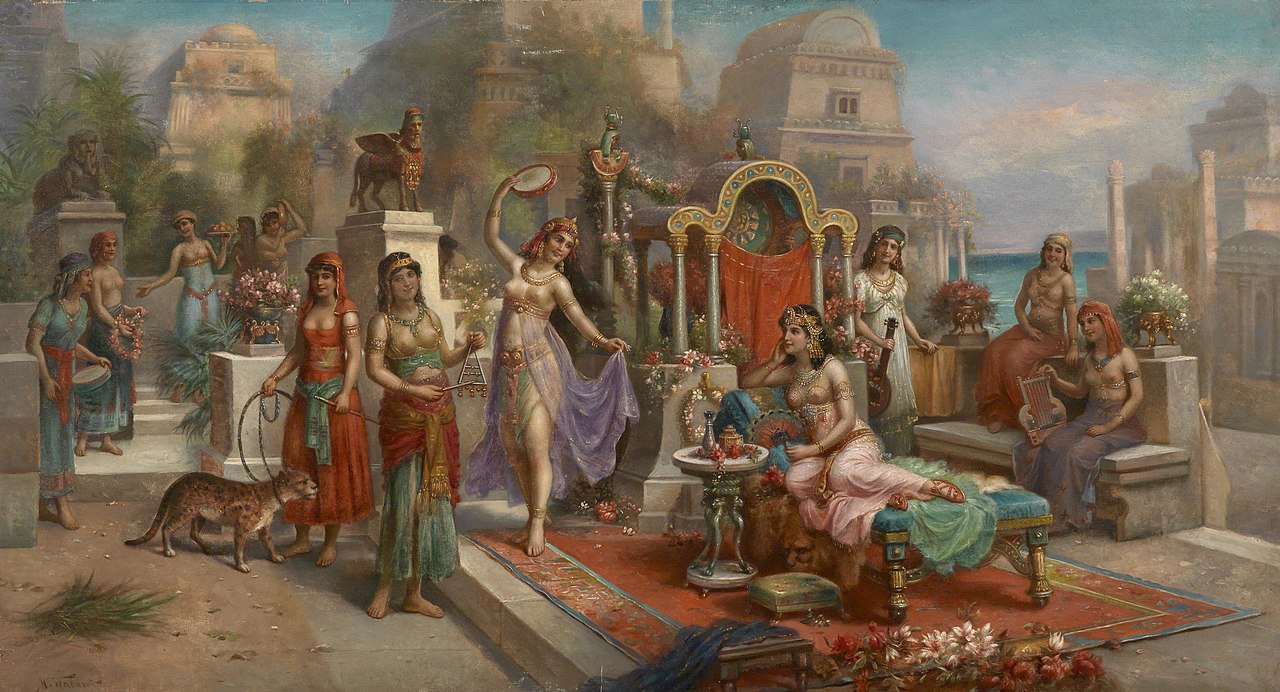
The added divertissement, a roughly ten-minute ballet sequence entitled Semiramide featuring a magnificent cello solo, is not only musically beautiful but important symbolically. It reminds the audience of the Hanging Gardens of Semiramis, supposedly built by Nebuchadnezzar II beside his palace in Babylon and later completely destroyed. Interestingly, these gardens are the only one of the Seven Wonders of the Ancient World whose location remains unknown and whose very existence is still disputed.
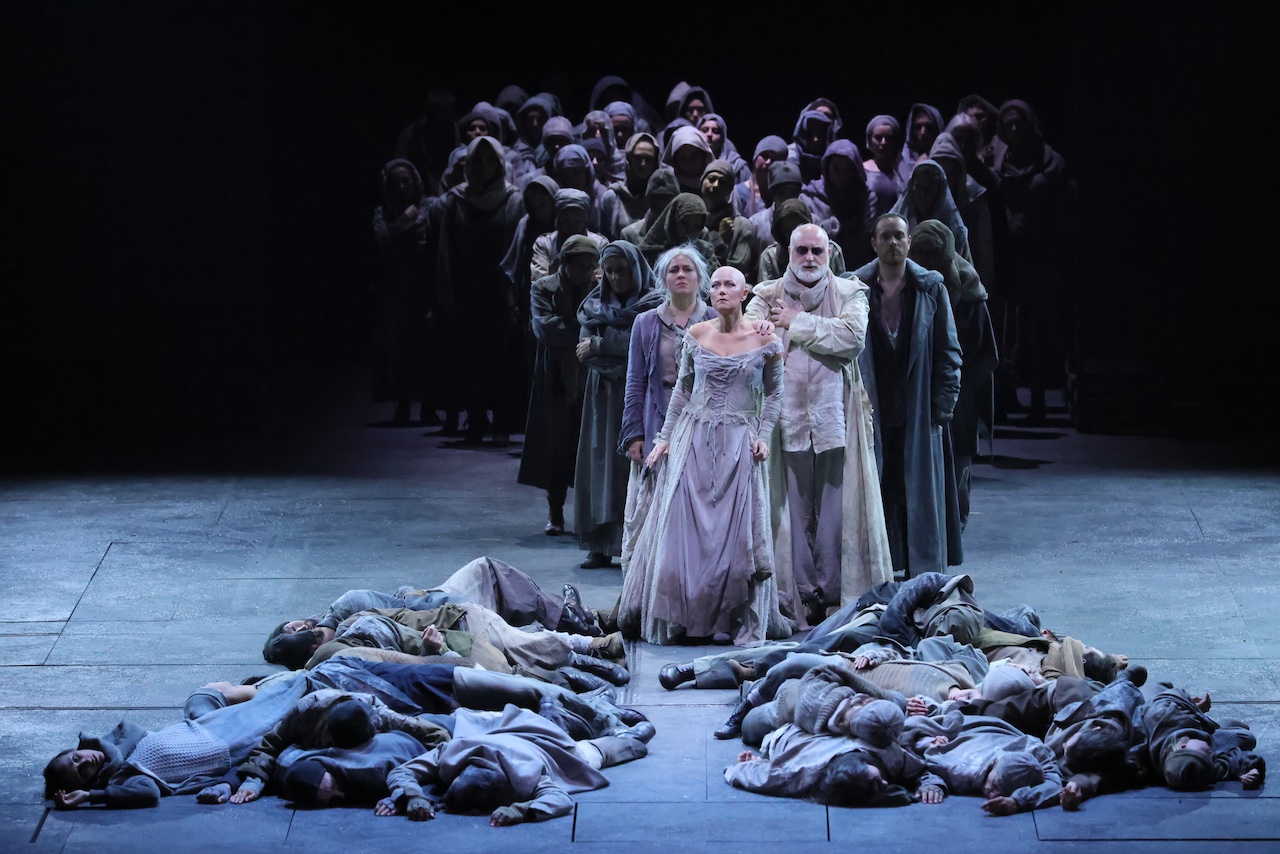
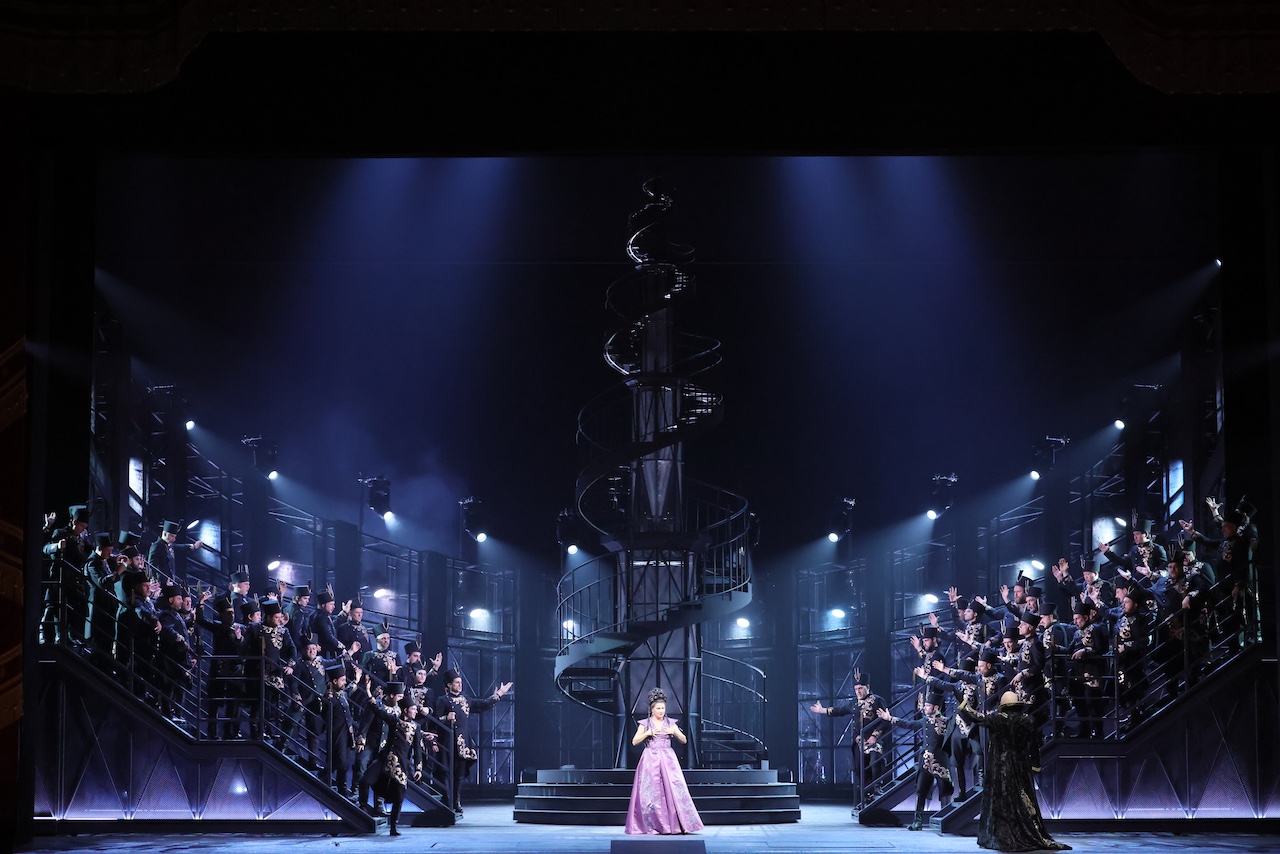
The production contains other striking symbols too. One of the most memorable is the staircase that rises from beneath the stage and seems to pierce the dome above. How could one not think here of the biblical Jacob, who dreamed of a ladder standing upon the earth while reaching heaven, with angels ascending and descending upon it: a symbol of the connection between man and God, revelation, and the path between earthly and heavenly realms?
It is precisely at this moment that Nabucco, consumed by rage and madness, agrees to Abigaille’s demand that the Jews be destroyed and cries out: “A morte, a morte / Tutto Israel sia tratto!” (“To death, to death – let all Israel be condemned!”)
One may also reflect on why Fenena appears in the production with her head shaved. For European audiences, the image immediately evokes the women publicly humiliated after the Second World War as collaborators and traitors. To me, this is dramaturgically fascinating because Fenena, in Verdi, is not morally a traitor at all. She sides with the oppressed people out of conviction and love. The staging therefore creates a double effect: the crowd onstage perceives her as a betrayer, while the audience understands the injustice of that stigma and sees in her a publicly humiliated outsider, trapped between hostile camps.
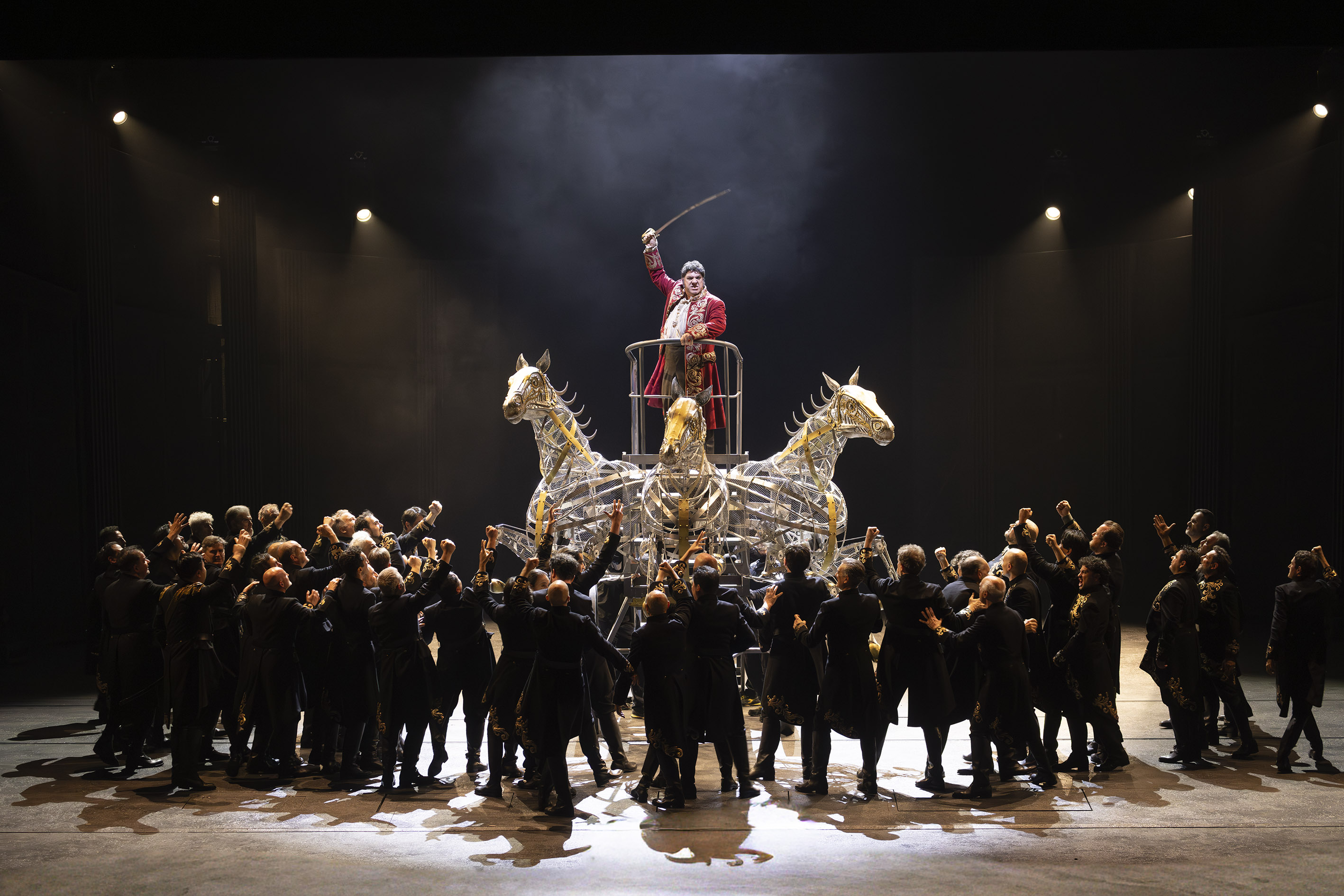
The ending, too, is powerful. Nebuchadnezzar attempts to balance on a tightrope, only to fall. How distant this figure is from the king who entered the stage at the beginning of the opera riding a chariot drawn by three horses – steel? golden? fiery? All the other characters suddenly seem like tiny pawns beside an enormous black figure that may be interpreted as an allusion to Osiris, the Egyptian god of rebirth, ruler of the underworld and judge of the dead.
I must also praise the subtle work of costume designer Gary McCann. The powerful are dressed in bright, luxurious costumes that sharply contrast with the poor grey clothing of the crowd representing the oppressed people. Yet their seemingly limitless power ultimately proves fragile and transient once the people stand up and begin to sing together.
P.S. If my article has left you disappointed that you cannot see the production yourself, do not despair: on 29 May at 19:45, the performance will be streamed live on LaScalaTV.



Federica Brunelli May 26, 2026
Sikorsky May 26, 2026
Alexandra Trifler May 26, 2026