I have already written about Giuliano da Empoli’s book, winner of the Académie française’s Grand Prix du Roman, and about its film adaptation, which prompted almost opposite reactions from Russian-speaking audiences and everyone else. And, I confess, I thought the subject was closed. But when Pierre Massaux invited me to come and see his production, I did not hesitate for long. Even though the performance was going to be in German, which I do not speak, and St Gallen really is at the other end of the country.
I first became acquainted with this Belgian director and playwright back in the summer of 2022, when he took the risk of staging in St Gallen A Short Story of the Anti-Christ by the nineteenth-century Russian philosopher and theologian Vladimir Solovyov (1853–1900), which he considered highly topical. For context, it forms part of the philosophical work War, Progress, and the End of History: Three Conversations. Published a year before Solovyov’sdeath, it was regarded by many as his testament, or even a prophecy. Its protagonist is the Antichrist of the twenty-first century, the embodiment of evil, who becomes President of the United States of Europe, then Roman Emperor, and convenes an ecumenical council in Jerusalem. His life ends in downfall, defeat and death. Given that one of the main characters in The Wizard of the Kremlin is Vladimir Putin, well... parallels suggest themselves. I mean the topicality of the subject, of course. What else could I possibly mean?
True to his directorial style, Pierre Massaux has once again dispensed with sets and other stage effects, not so much out of a love of minimalism as out of concern that anything ‘extraneous’ might undermine the production’s truthfulness and distract the audience from what he considers essential: the word, the gesture, genuine emotion.
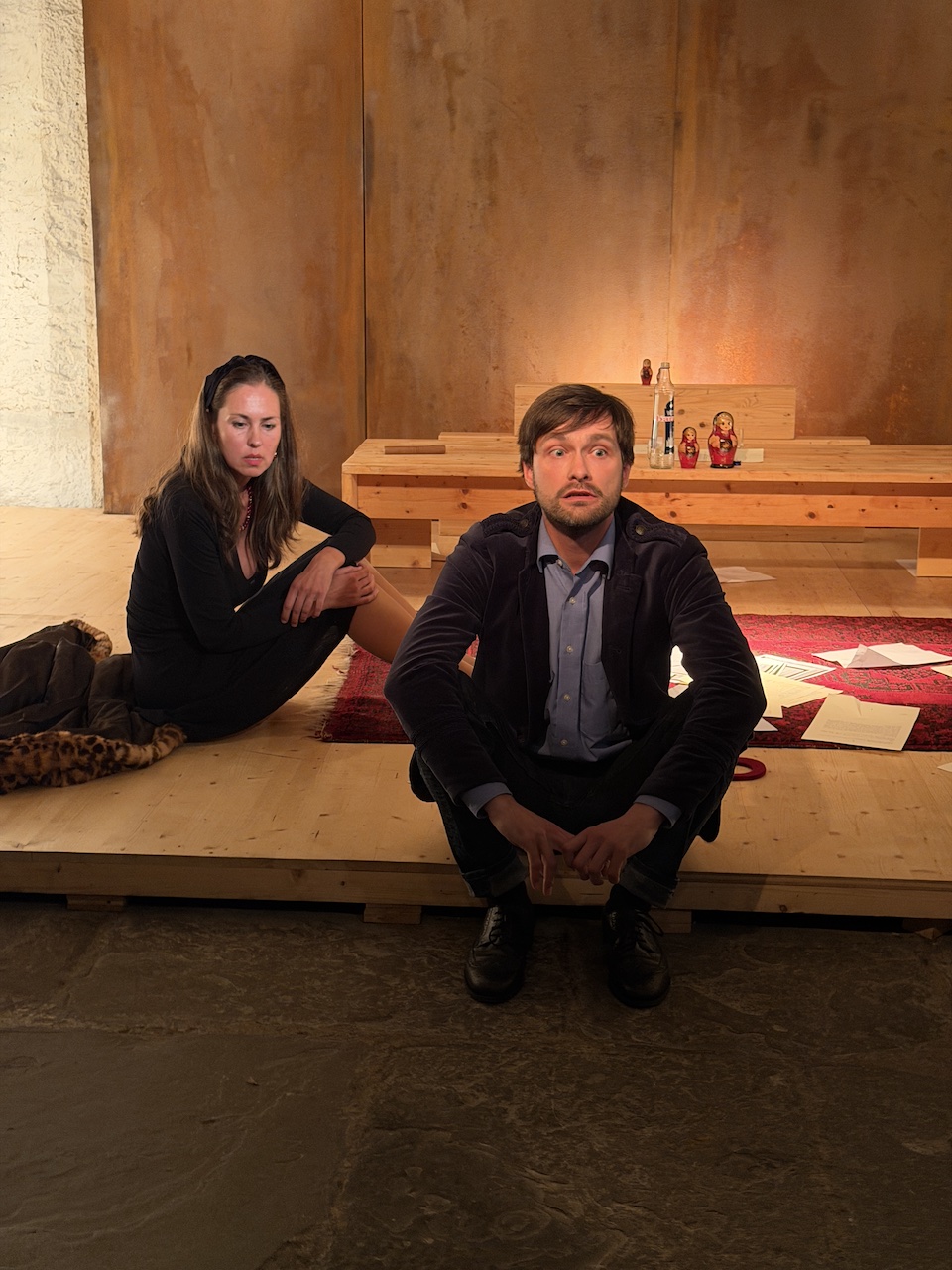
The cast, too, has been reduced to a minimum. Of the book’s numerous characters, only two remain on stage: Vadim Baranov, a reality-TV producer who becomes the Russian president’s enigmatic adviser, the protagonist and narrator; and Xenia, his partner and lover, who eventually becomes the mother of their daughter Anya.
This is an important point that will certainly strike anyone who has read the book and seen the film: in the novel, Xenia is a secondary character, important primarily to Baranov’s ‘personal storyline’, whereas in the film her role has deliberately been expanded considerably. In materials accompanying the film, director Olivier Assayas said explicitly that, like many readers, he felt Xenia’s character ‘deserved more development’, and so her role was expanded for the screen. In Gaumont’s official synopsis, Xenia is already described as the one woman who remains beyond Baranov’s control, seemingly offering him the possibility of escaping the dangerous game of power.
Baranov and Xenia are played by St Petersburg natives Ekaterina Belova, who moved to Germany in 1992, and Alexei Sinitsin, who left for Georgia in September 2022 and moved from there to Germany a year later. For both of them, The Wizard of the Kremlin represents a kind of debut, though in different ways. For Ekaterina, a medical translator and co-founder of a non-profit organisation supporting young musicians, it is her first time on stage altogether. For Alexei, a graduate of the Russian State Institute of Performing Arts in St Petersburg whose career had been developing successfully, it is his first production in German, a language he is still learning, both in the theatre and at the Berlin restaurant where he found work and where his acting commitments are treated with understanding. As you will have guessed, all this gave me an additional reason to make the trip to St Gallen. The evening turned out to be... theatrical.
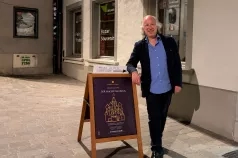
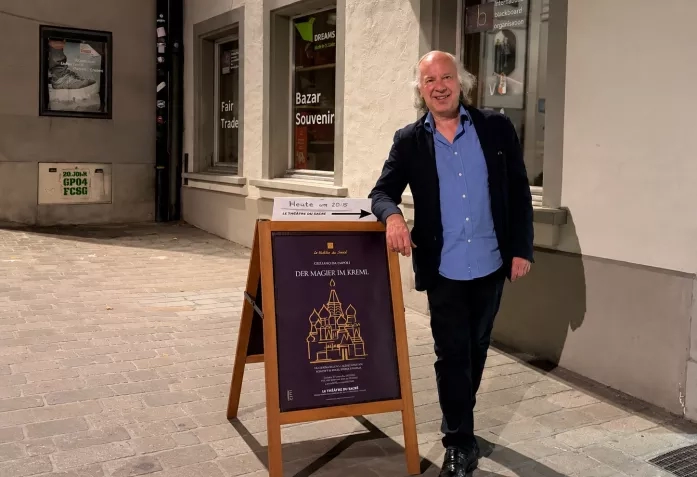
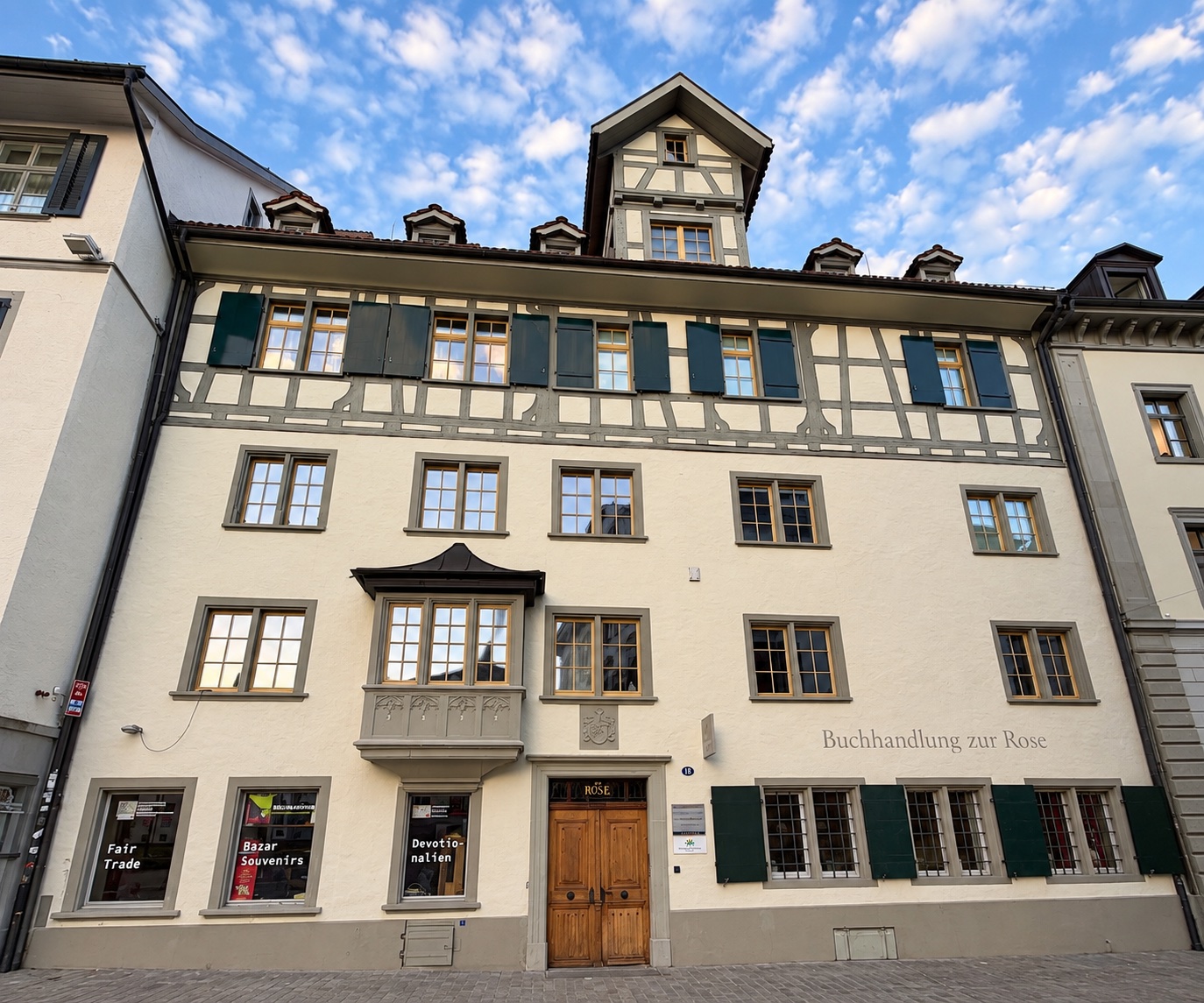
...The square in front of the Cathedral of St Gall and St Otmar was deserted. The old half-timbered houses, with their projecting bay windows so characteristic of St Gallen, looked even more decorative in the artificial glow of the street lamps and the natural light of the full moon that had risen above the cathedral’s Baroque towers. To the left, outside a building with nothing to identify it as a theatre, stood Pierre Massaux, waiting for the audience. On a Sunday evening, with the working week about to begin, there were painfully few spectators. But the director did not look disheartened. ‘There were more on other days,’ was all he said, smiling and spreading his hands.
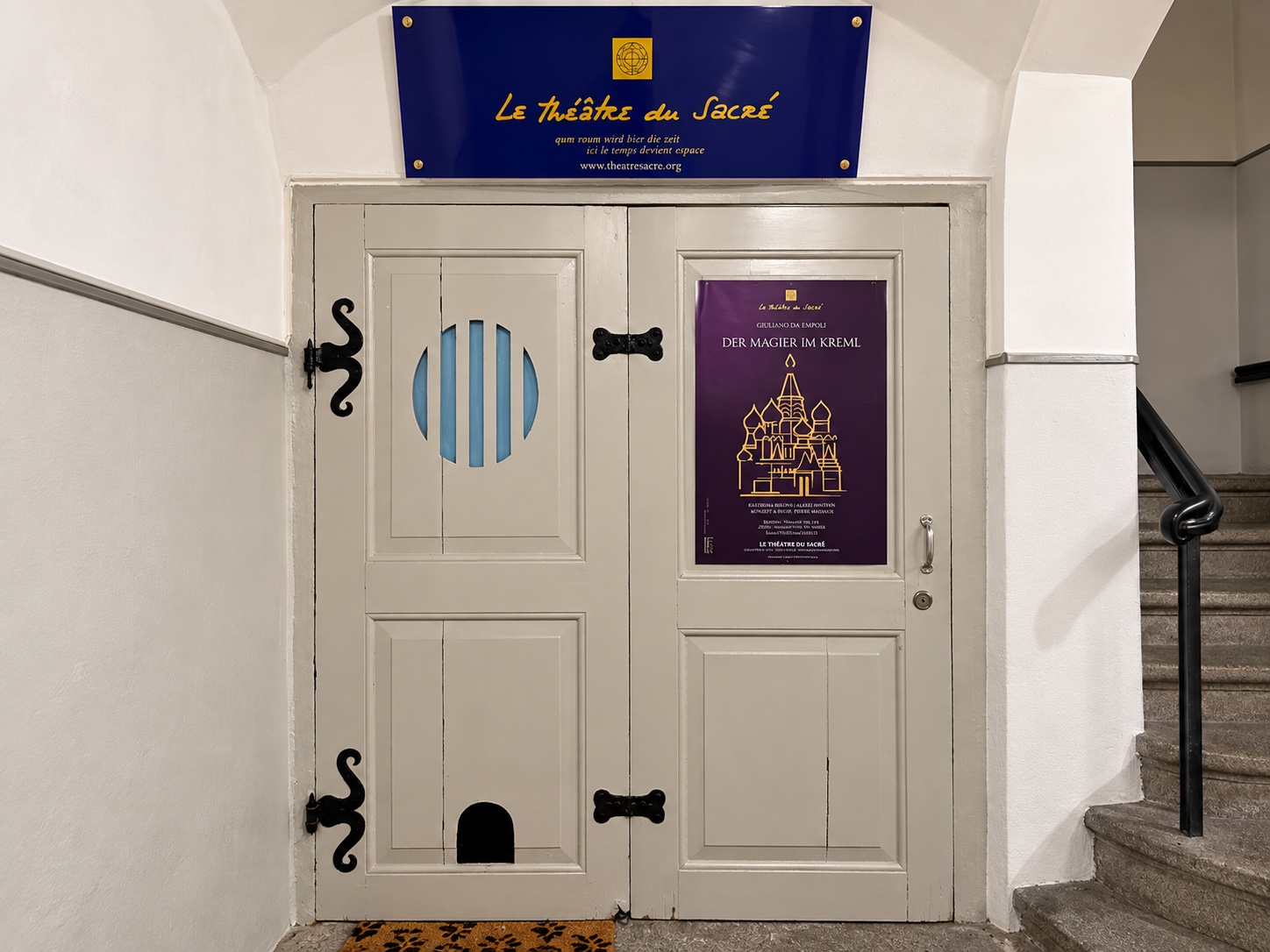
At precisely 8.15 p.m., having waited for the cathedral bell to strike the quarter hour, he locked the heavy door from the inside and handed me a programme, modest but printed on good-quality, heavy paper and containing everything an audience member might need to know, right down to a short note on Yevgeny Zamyatin. I then followed him down into the basement, home to Le Théâtre du Sacré. Pierre Massaux rents the space with the help of a cantonal subsidy and an anonymous ‘benefactor’. The motto above the door leading down to the basement reads, ‘Here time becomes space’, as if bringing together two of the three classical dramatic unities: time and place. The third, action, is soon added.
And there, in the almost empty but very professionally arranged and welcoming auditorium, I, as a spectator, suddenly felt not a sense of exclusivity, no, that is not the right word, but of intimacy: the actors were speaking directly to me. And isn’t that what matters most in the theatre?
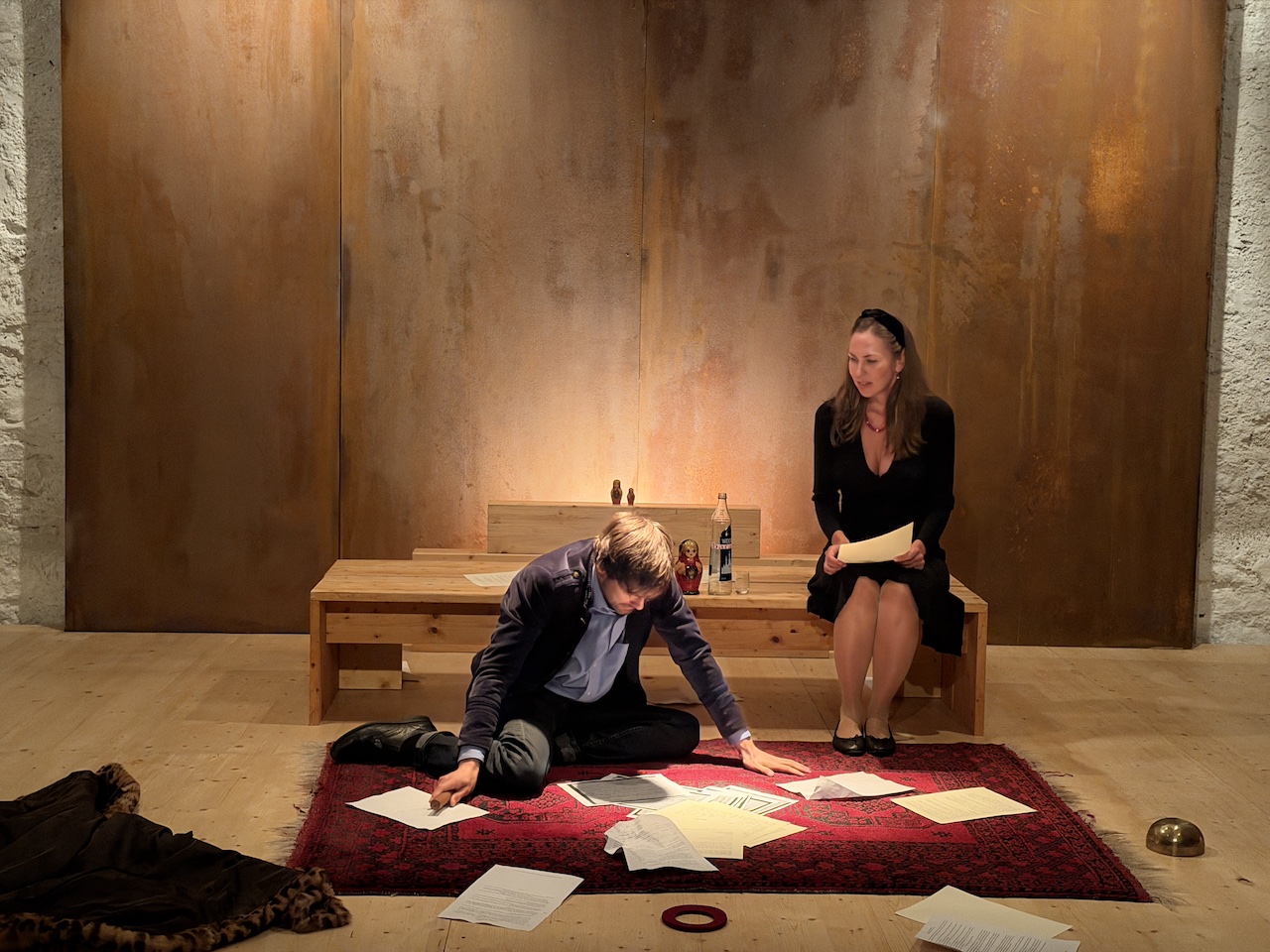
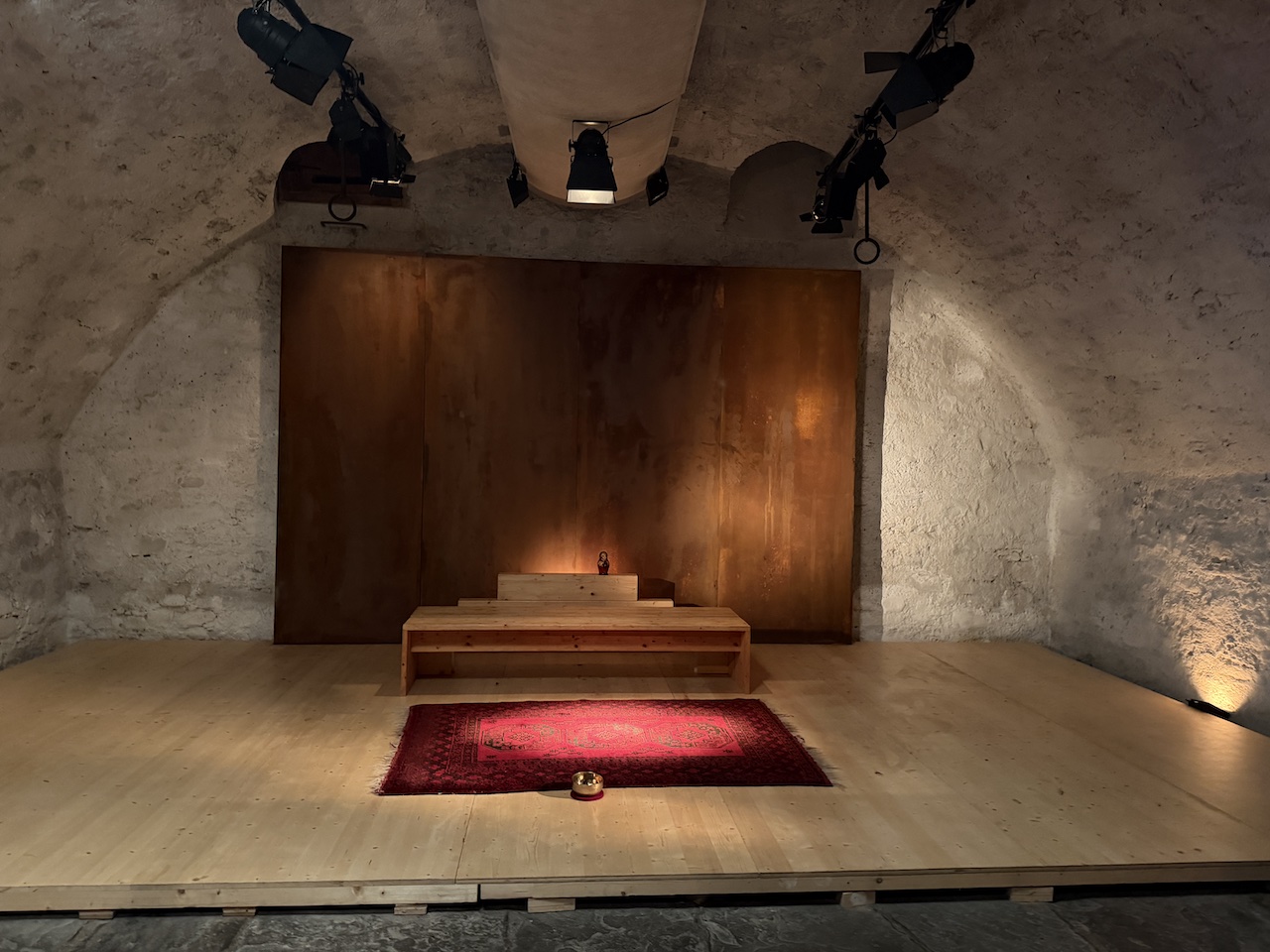
A wooden bench, a matryoshka doll on it, a small rug in front: that is the entire set. The silence, broken only by the sound effect of a crackling fire, is suddenly shattered by the overture to Mozart’s The Magic Flute. Now I am intrigued. (Incidentally, my instinctive sense that this was no run-of-the-mill recording was confirmed later, when a tenor’s voice was heard: it turned out to be the great Fritz Wunderlich as Tamino in the legendary 1964 recording with the Berlin Philharmonic conducted by Karl Böhm.)
Vadim Baranov makes corrections to sheets of paper scattered across the rug, while Xenia, who affectionately calls him ‘the new Rasputin’, becomes the first reader of his latest text, which she shares with the audience. (Pierre Massaux assured me that Ekaterina Belova knows all her lines by heart, and that during rehearsals they had to make sure she did not raise her head and look into the auditorium too often, so that she remained in character.) As conceived by the director, Ekaterina/Xenia and Alexei/Vadim alternate between German and Russian, so the Russian president’s now legendary threat to ‘wipe out the enemies in the shithouse’ does not get lost in translation. Nor do his comparison of the work of intelligence officers with that of journalists, or his unexpected reference to Stanislavski in a conversation with Baranov: did not your Stanislavski say, he asks, that technique alone is not enough and that true creativity requires surprise? Baranov then begins to suspect that ‘Putin belongs to what Stanislavski called the breed of great actors’.
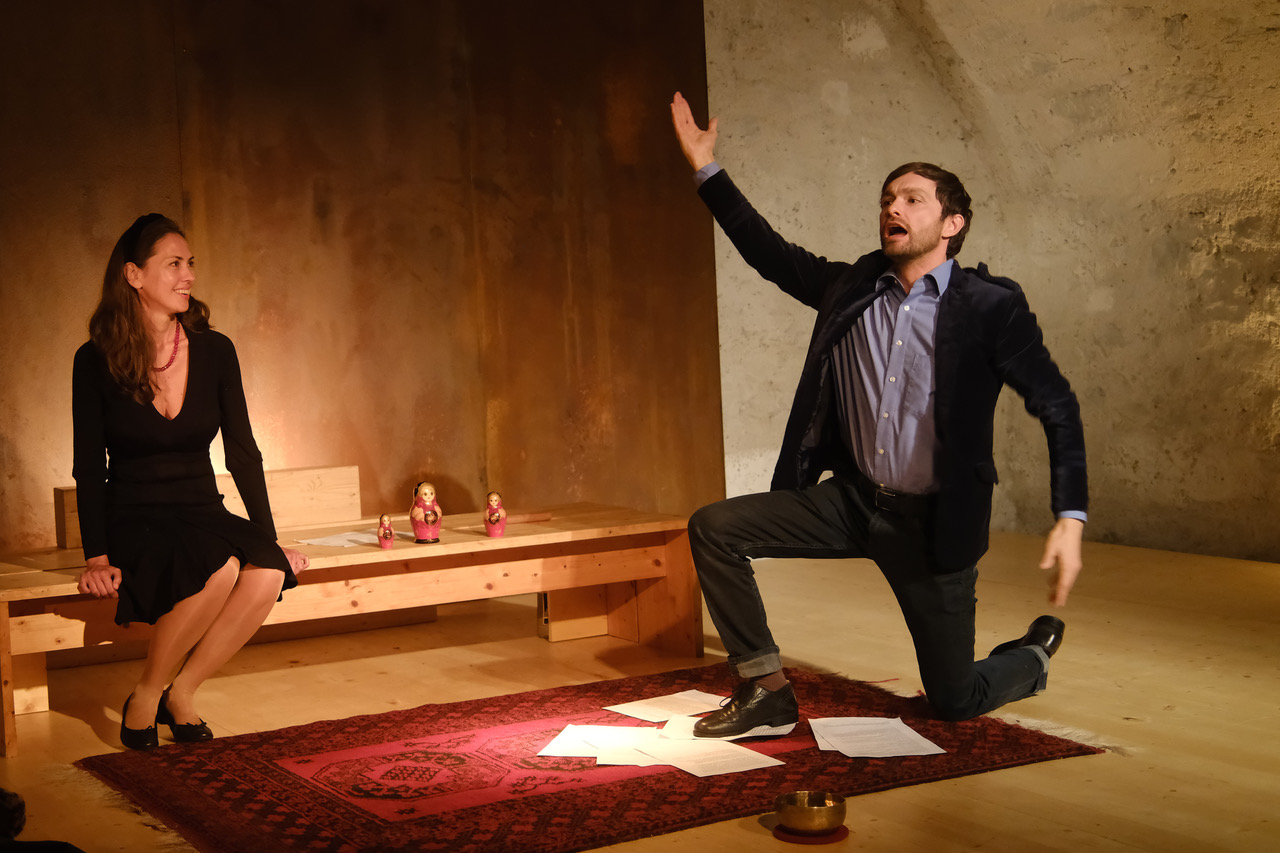
...‘Amateur theatre!’ some will say dismissively after reading this. Not so fast! From what I observed, in their respect for the author’s text and for the audience, their attention to detail and their meticulous work on diction and stage movement, Pierre Massaux and his colleagues could teach a thing or two to many of those who consider themselves professionals. So, if you have the opportunity, come and support them on 16, 17 or 18 October. Passionate people always need support! You will find all the practical information on the Théâtre du Sacré website and I look forward to hearing your impressions.