
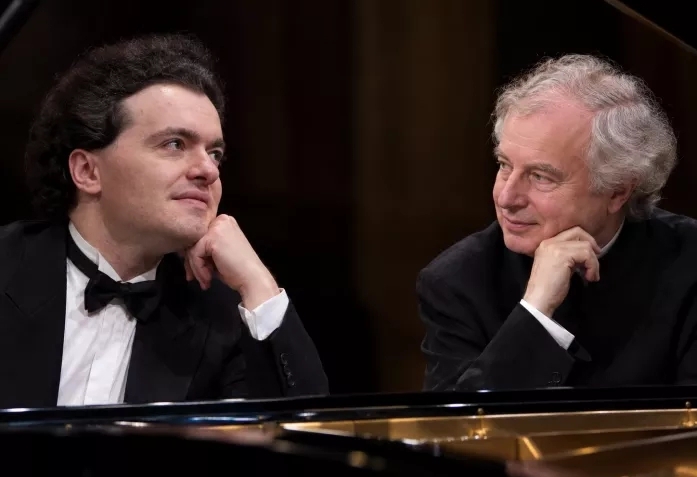
Four years ago, Evgeny Kissin and Sir András Schiff were already going to appear together at Victoria Hall, performing works by Mozart, Schumann, Smetana and Dvořák. But the concert had to be cancelled. The forthcoming one will repeat that programme, with one significant addition: Schumann’s Bilder aus Osten (Pictures from the East). Obviously, when two musicians of this calibre come together, repeating the programme hardly means repeating the concert, or the emotions it evokes.
“András Schiff and I had met many times, in Verbier and elsewhere, and had even played together, though not as a duo: we played Smetana’s Sonata for two pianos, eight hands,” Evgeny Kissin told me in 2022. “Knowing myself, I think it was he who suggested that we give concerts together. As for the programme, well, partners put one together in the usual way: each makes suggestions and they discuss them until they reach an agreement.”
The piano duet is one of the oldest forms of instrumental chamber music. The two performers may sit side by side at a single instrument or each at a separate piano, but either way it is a musical dialogue, requiring not only impeccable ensemble playing but also the rare ability to listen to one another. Such a dialogue is particularly fascinating when the musicians involved have personalities as distinctive as Kissin and Schiff.
The programme opens with Mozart’s Sonata in D major for Two Pianos, K. 448, a work that seems tailor-made for two virtuosos meeting on equal terms. Written in Vienna in November 1781, it was first performed on 23 November at the Auernhammer family home by Mozart himself and his pupil Josepha Auernhammer. It is one of only two completed works Mozart wrote for two keyboards without orchestra. Here, neither piano is relegated to the role of accompanist: the musical ideas pass continually from one to the other, turning the performance into a virtuoso conversation.
This sonata also acquired an unexpected kind of posthumous fame. It was used in the celebrated 1993 experiment that gave rise to the term “Mozart effect”: students who had listened to K. 448 subsequently performed somewhat better on certain spatial-reasoning tasks. The researchers themselves later stressed that they had never claimed Mozart increased intelligence in general; what they had observed was a short-lived effect on a particular type of task. The sonata itself, of course, hardly needs science to prove its worth.
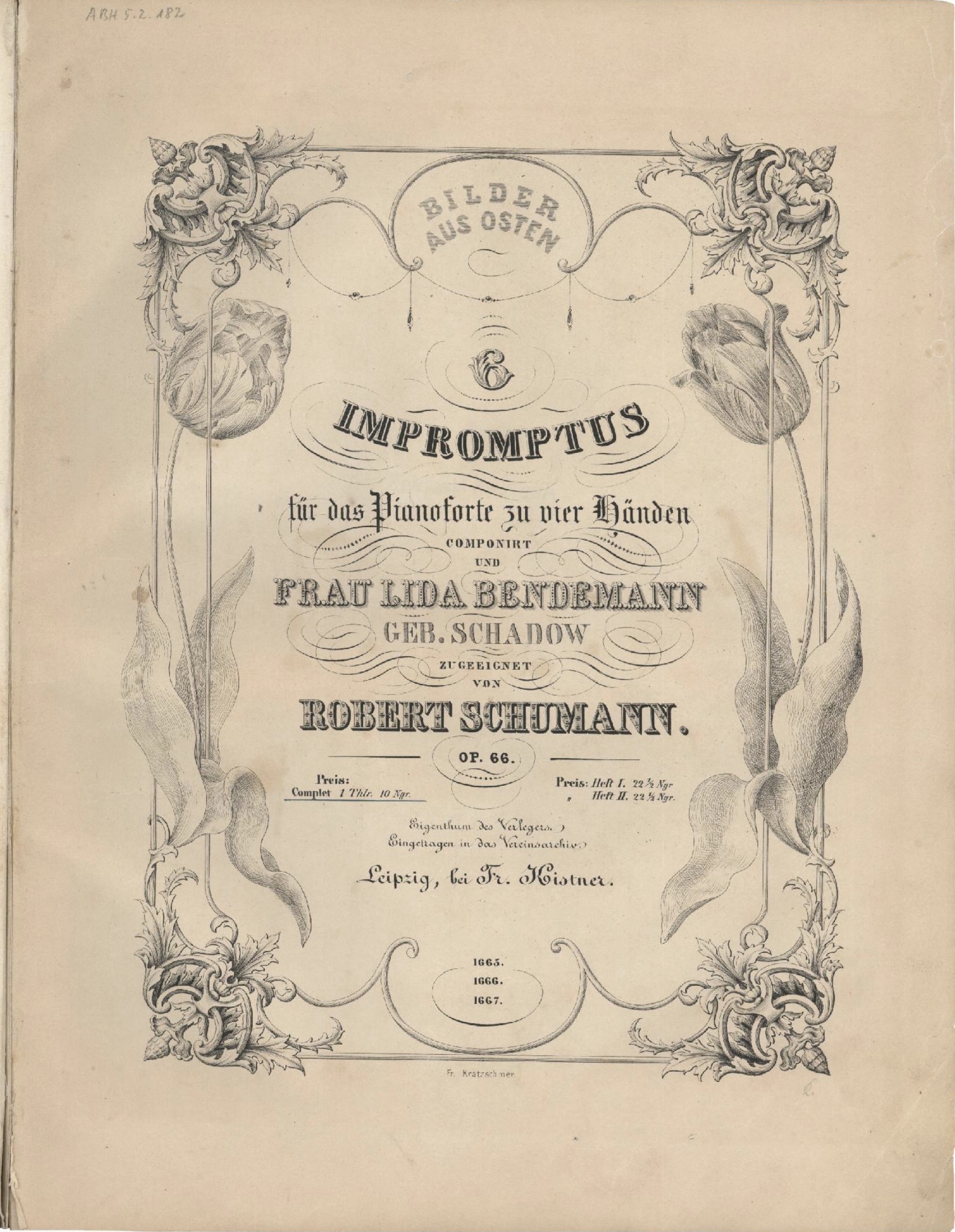
Title page of the first edition. F. Kistner, Leipzig, 1848. © Brahms-Institut an der Musikhochschule Lübeck, CC0 1.0.
Schumann is represented by two works. The Andante and Variations in B-flat major, Op. 46, which featured in Kissin and Schiff’s programme four years ago, is now joined by Bilder aus Osten (Pictures from the East), Op. 66, six pieces for piano four hands.
And here one of the programme’s hidden threads begins to emerge. Schumann’s “East” is neither a geographical location nor simply a source of exotic colour. His inspiration came from the Maqamat of the medieval Arab writer al-Hariri, a cycle of tales in rhymed prose about the adventures of Abu Zayd, which Schumann read in the German translation by the poet and Orientalist Friedrich Rückert. This wanderer, adventurer and master of words so captured Schumann’s imagination that the composer himself acknowledged Abu Zayd’s influence on the distinctive character of the music. The result is an unexpected connection across centuries and borders between a nineteenth-century German Romantic and medieval Arabic literature.
There is another connection. Bilder aus Osten was written in 1848, four years after Robert and Clara Schumann’s concert tour of the Russian Empire. In St Petersburg and Moscow, Clara was the star; Robert himself was still relatively little known, although his wife included his works in her programmes. It would not be long before attitudes towards his music in Russia changed dramatically. In the second half of the nineteenth century, Schumann became a major influence on Russian composers. Balakirev’s circle, later known as the “Mighty Handful”, was no exception: Rimsky-Korsakov recalled that Glinka and Schumann were among the composers particularly admired by the group.
On 21 June 1966, at the Aldeburgh Festival, Sviatoslav Richter and Benjamin Britten performed the cycle as a piano duet, Richter playing primo and Britten secondo. The recording survives and can still be found on YouTube; it remains one of the notable recorded interpretations of Bilder aus Osten. Schiff, too, has known Pictures from the East for many years. As early as 1981, he performed the cycle with his fellow Hungarian Peter Frankl; their recording was later included in a 1991 collection of Schumann’s works for piano four hands. One can only hope that Schiff and Kissin’s performance will also be recorded, giving posterity something to compare.
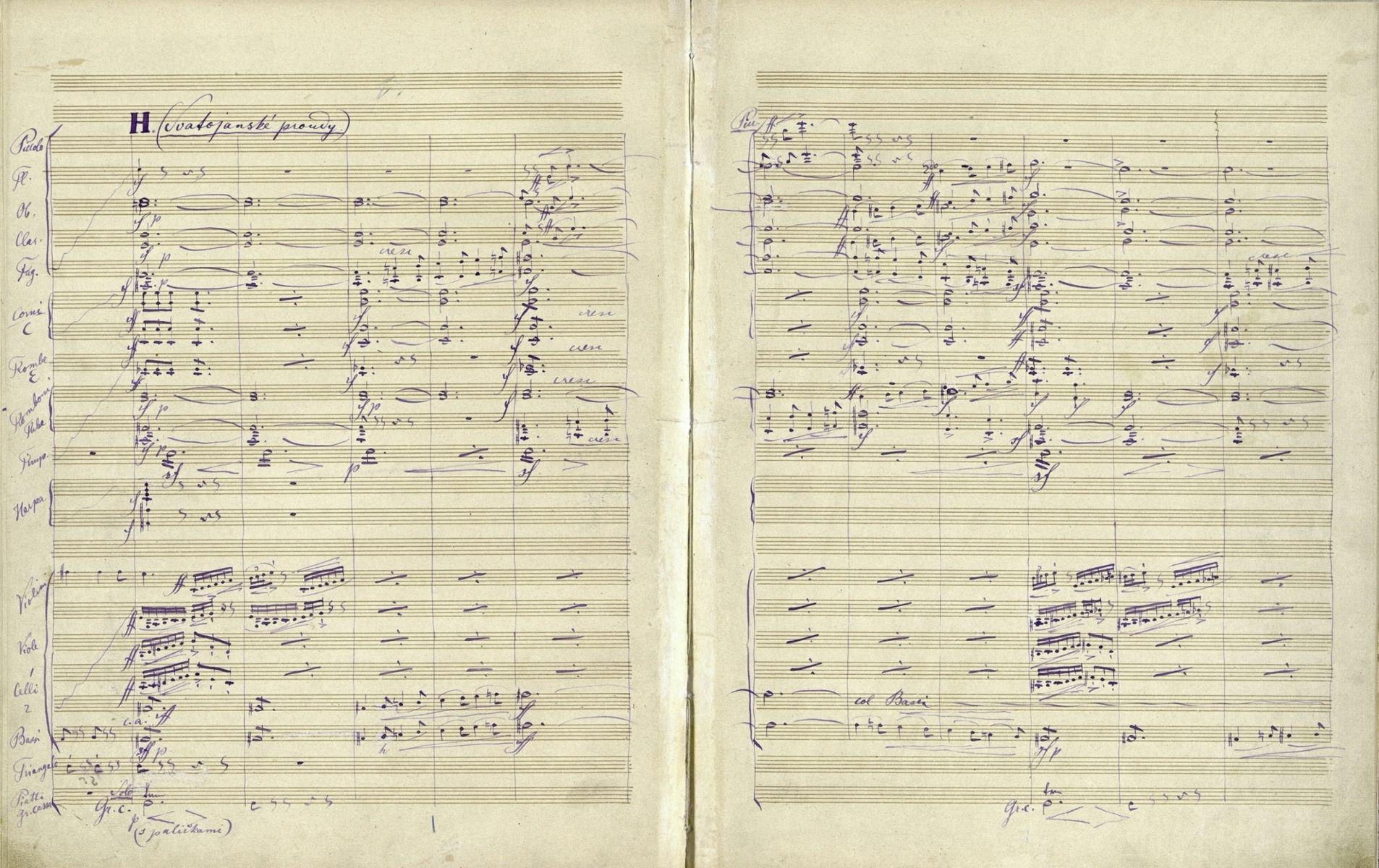
After the interval come two Czech composers, Smetana and Dvořák. And here we encounter another, perhaps even more unexpected, musical connection.
The principal theme of Bedřich Smetana’s Vltava is familiar even to those who may not know the title of the symphonic poem. Its melodic origins have been linked to the old Italian song La Mantovana, which emerged around 1600 and subsequently spread across Europe in numerous variants. One of these reached Bohemia and found an echo in Vltava; another, transmitted through Romanian musical tradition, became associated with the melody of Hatikvah, “The Hope”, which would later become Israel’s national anthem.
Today, that musical connection carries an additional resonance.
On 6 November 2025, Sir András Schiff took to the stage of the Grande salle Pierre Boulez at the Philharmonie de Paris to perform Beethoven’s Piano Concerto No. 5 with the Israel Philharmonic Orchestra under Lahav Shani. The concert was interrupted several times by pro-Palestinian activists: there were shouts, leaflets were scattered, flares were lit inside the hall and clashes broke out. Videos that subsequently circulated widely on social media show Schiff on stage, watching the events unfold.
We can only guess what Schiff was feeling as he watched. He was in Budapest into a Jewish profoundly affected by the Holocaust. Schiff’s father lost his first wife and four-year-old son at Auschwitz; his mother was deported in 1944 and only narrowly escaped being sent to the same camp.
Evgeny Kissin, for his part, wrote a will while still a child in which he asked for these words to be engraved on his gravestone: “Here lies Evgeny Kissin: son of the Jewish people, servant of music.”
I have, of course, no grounds for suggesting that the pianists themselves attach any such significance to their choice of this work, particularly as the programme had been drawn up before the tragic events of 7 October 2023. But music has an extraordinary capacity to gather new associations without shedding the old ones. Smetana’s Czech river and Israel’s “Hope” are linked by a melody that began its journey across Europe centuries before either work came into being.
The programme will conclude with a selection of Antonín Dvořák’s Slavonic Dances from Opp. 46 and 72. Today they are firmly associated with the brilliance of orchestral sound, yet Dvořák originally wrote both sets for piano four hands. Kissin and Schiff are thus returning them to their original form.
Four years ago, I called my article about Kissin and Schiff’s concert “Four Hands and Two Pianos”. The title would work just as well today. But now it seems to suggest something more. The programme itself becomes a journey of sorts: from Mozart’s Vienna to Schumann’s imagined East, from Smetana’s Bohemia to Dvořák’s Slavic world. Music, literary images and melodies travel from country to country and century to century, taking on new meanings while carrying the memory of what came before. And all of it, yes, with four hands and two pianos.
I hope you will not miss the opportunity to hear this concert. The last remaining tickets are still available here.




Bernard October 13, 2026
Sikorsky October 13, 2026
Federica Brunelli October 13, 2026
Sikorsky October 13, 2026