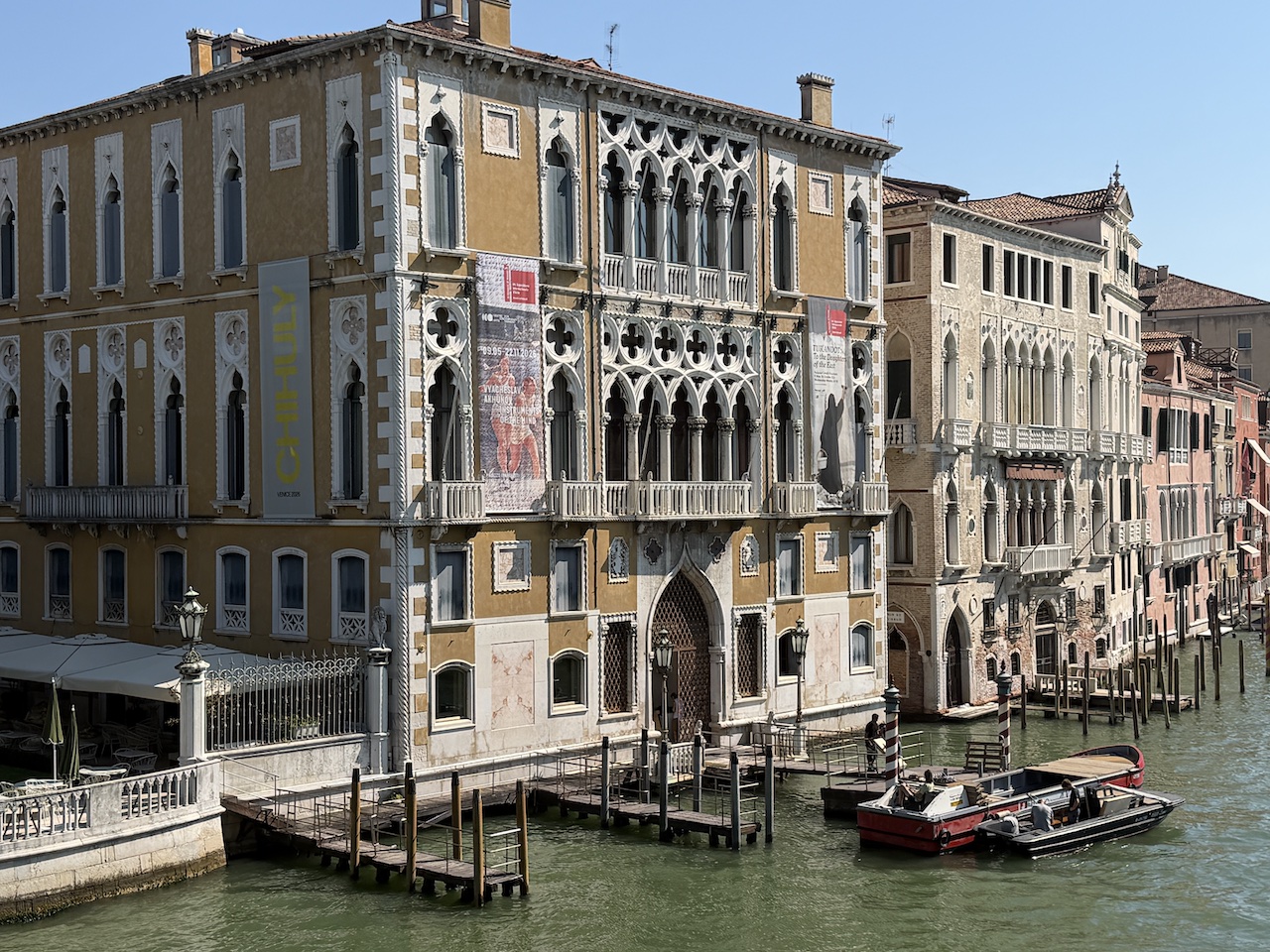
Going to Venice for three days with the express intention of seeing the entire Biennale and three films in competition at the Mostra di Venezia is already, you will agree, an ambitious plan. But I managed even more, and I want to tell you about one exhibition I had not planned to see. I spotted it entirely by chance. As my vaporetto sailed along the Grand Canal beneath the Accademia Bridge, I noticed a huge poster on the façade of Palazzo Franchetti, which the Venetian Institute of Sciences, Letters and Arts uses as an exhibition venue. The name on it naturally caught my attention. I went online, and after reading just a few lines about Vyacheslav Akhunov, I knew I simply had to see for myself how Soviet Conceptualism would look against the backdrop of sumptuous Venetian neo-Gothic architecture.
Although Vyacheslav Akhunov is clearly regarded as something of a ‘national treasure’ in Uzbekistan, he himself identifies as a Kyrgyz-Uzbek artist – he was born in 1948 in Osh, the second-largest city in Kyrgyzstan, on Stalin Street. He also points out in interviews that, while he spent the first thirty years of his life in Kyrgyzstan and formed there as an artist, he became a contemporary artist in Moscow, where he studied at the Surikov Institute. It was as a student that he began taking notes from lectures on Marxism-Leninism and Scientific Communism directly over sewing patterns in a dressmaker’s album that happened to be at hand. These sewing patterns covered with Marxist-Leninist lecture notes were later shown at the Moscow Biennale and are now held in a museum. They also became the basis for one of the central methods of Akhunov’s art: the mantra.
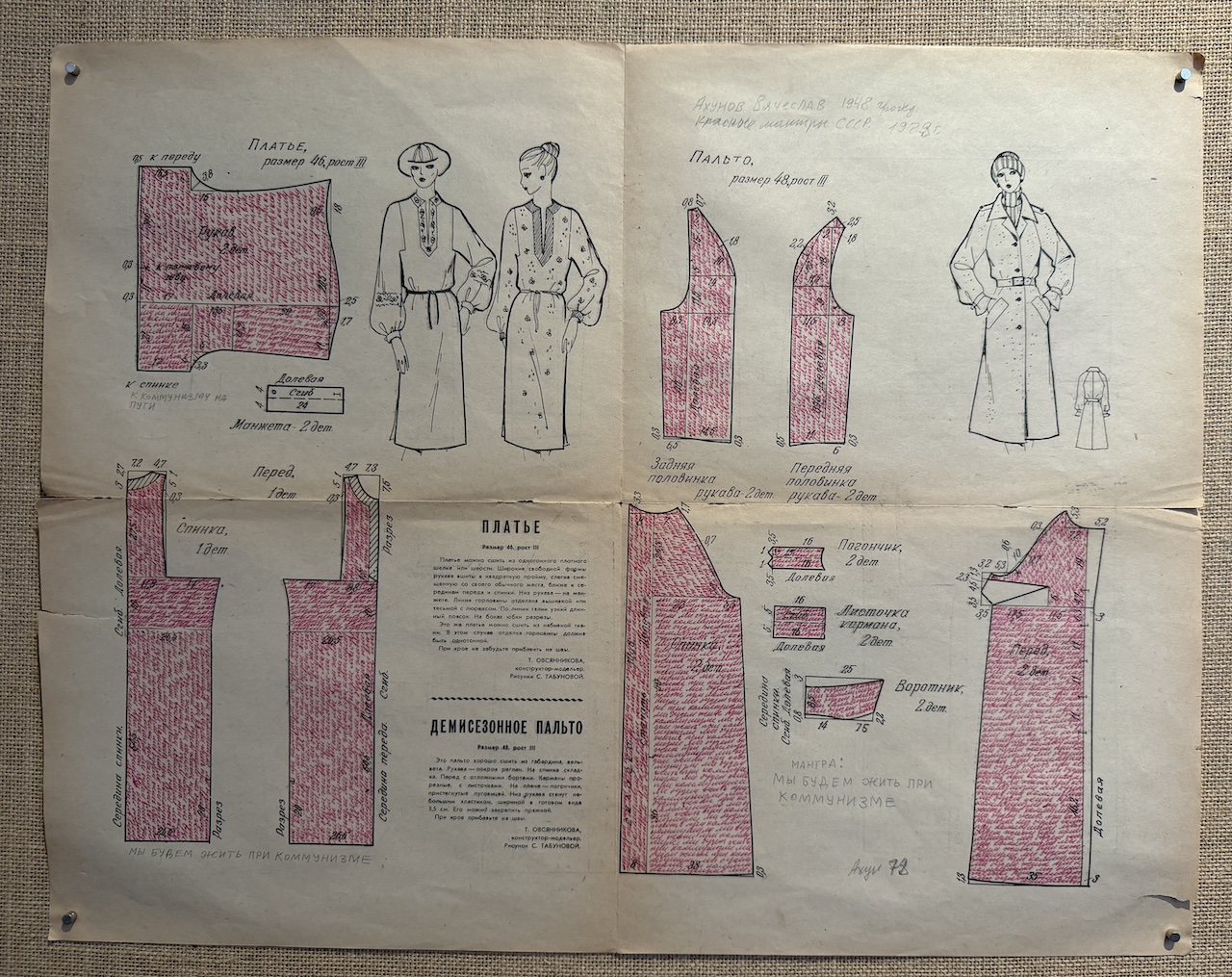
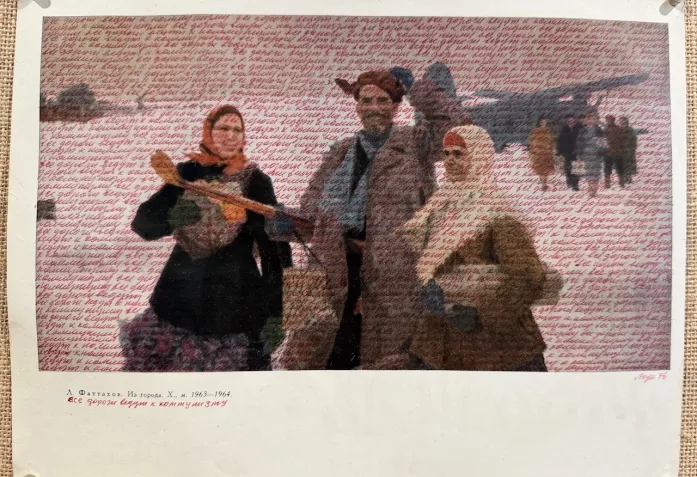
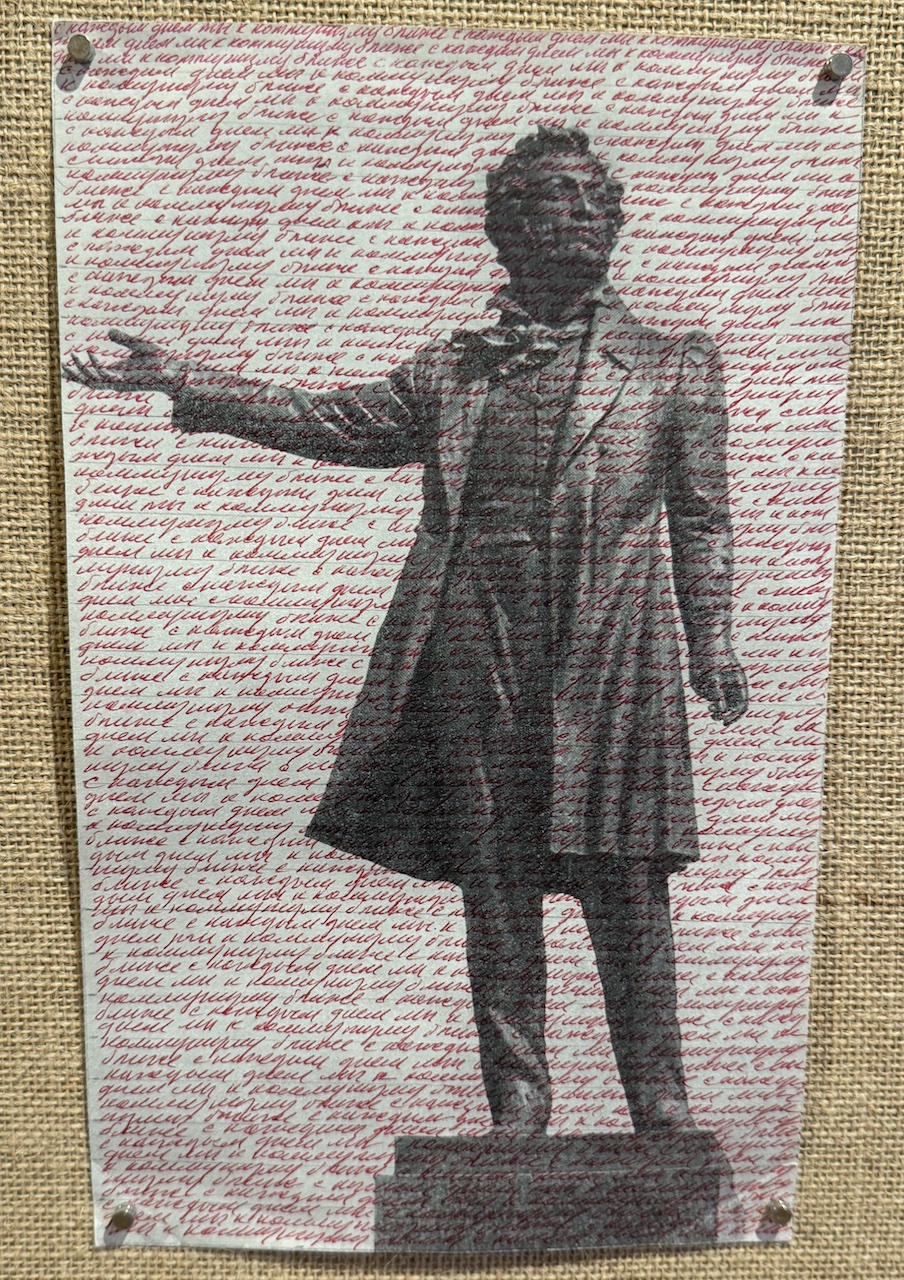
Indeed, from 1974 onwards, repeated text became one of Akhunov’s artistic methods. Handwritten words appear again and again over drawings, magazine and newspaper pages, sewing patterns, albums and books. This is both a way of working with the cultural material of everyday life and a kind of experiment on consciousness: what happens between hand, brain and language when the same formula is reproduced endlessly? But in Akhunov’s work, a traditional spiritual practice also takes on a political dimension: the principle of the mantra proves unexpectedly close to the endlessly repeated ideological formulas and slogans of the Soviet era. That is why the title Instruments of the Mind operates on several levels at once: language can be an instrument of consciousness, but it can also become an instrument for shaping it. The mantra is one of the keys to the entire exhibition. Another «device» is equally apparent: Akhunov takes the painfully familiar language of socialist propaganda and turns it against itself, pushing images of power, and of reverence for it, to the point of absurdity. And one certainly does not need to have a ‘Soviet past’ to understand and feel it.
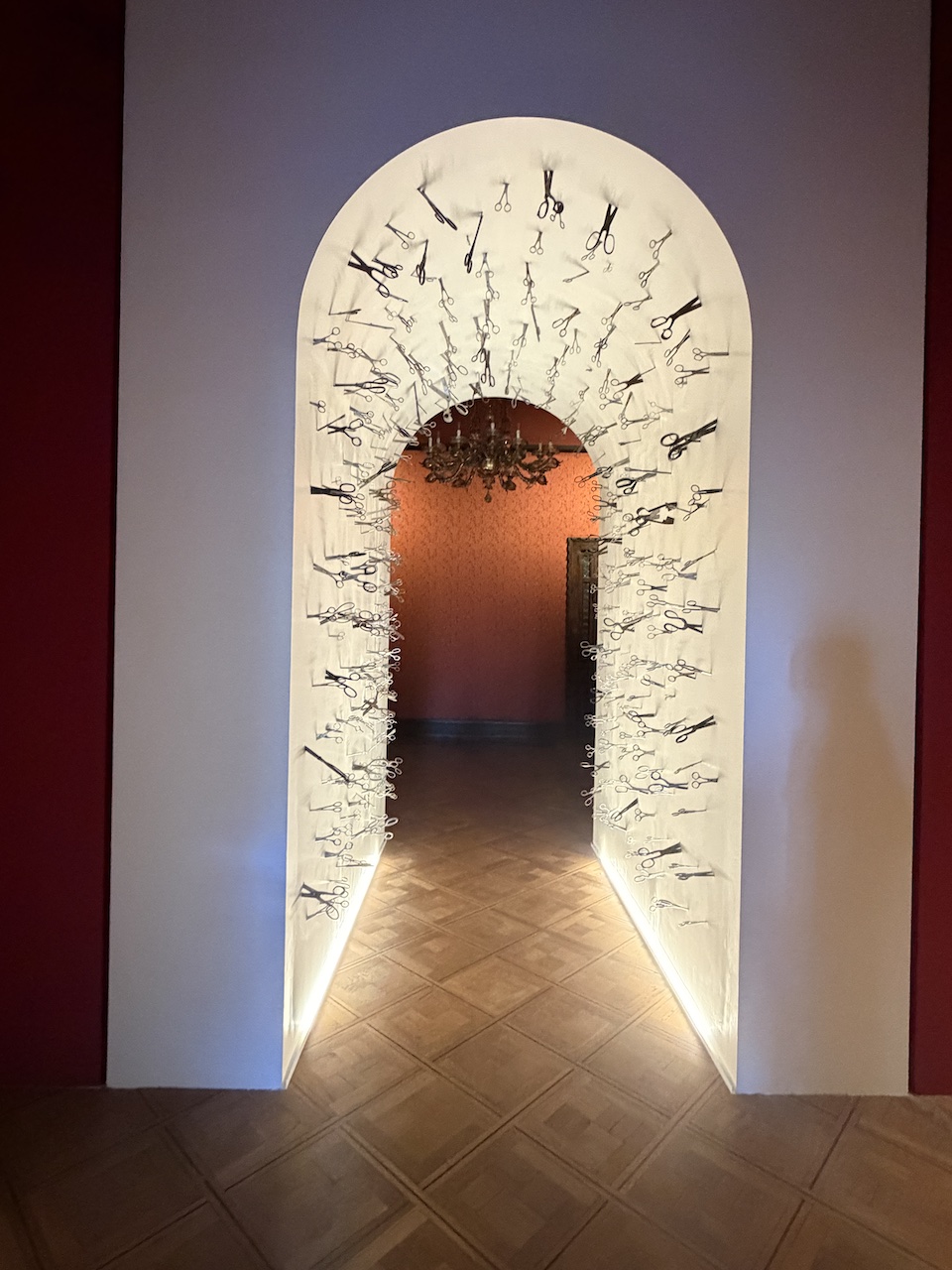
The very notion of the past is rather fluid at this exhibition: many of the works were conceived during the Soviet period but have only now taken physical form. A perfect example is Triumphal Arch, which opens the exhibition. Akhunov conceived it back in 1979, but it was not realised until 2026. The arch is made from scissors of various sizes, while a ribbon barrier blocks the passage through it. This deliberately absurd structure instantly evokes the grand ceremonies of the Soviet era, when red ribbons were cut to inaugurate projects that could then remain unfinished or abandoned for years because of bureaucracy and endless delays. But Triumphal Arch can suggest other meanings too: the risk of injuring oneself on the scissors while trying to pass through this emblem of power, for instance, or the scissors themselves as a tool for cutting history to ribbons until all that remains is a version convenient to those in power.
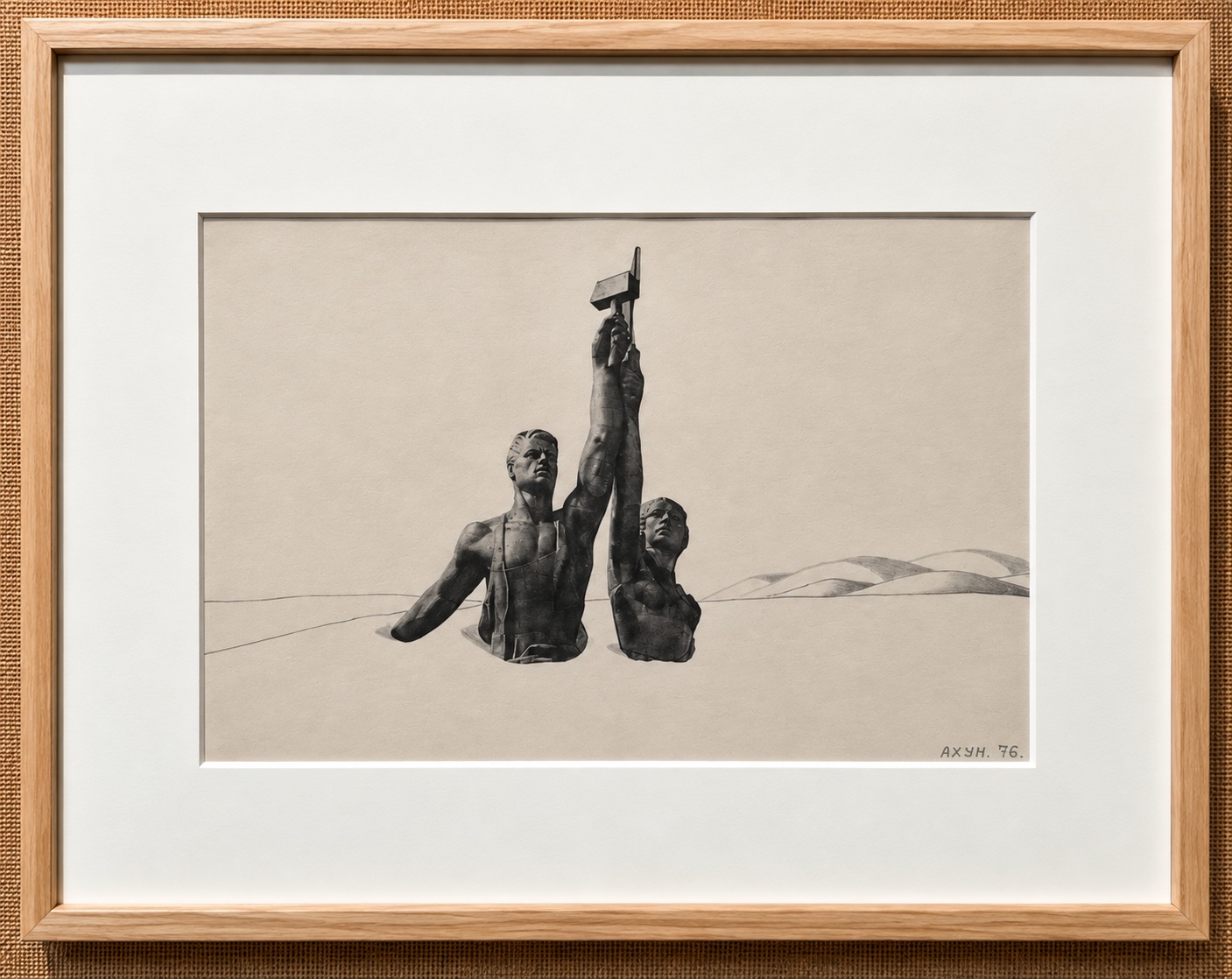
Akhunov plays with time even more strikingly in the series Desert of Oblivion (1970–1990) and Art-Cheology of the USSR (1975–1986). In the first, he takes images of Soviet sculptures cut from magazines and partially submerges them in desert landscapes. The monuments of a utopian ideology seem gradually to be disappearing beneath the sand: they are literally sinking into oblivion. But look at these sand-covered figures from a slightly different angle and suddenly you are witnessing an archaeological excavation. For Akhunov, archaeology is by no means an abstract metaphor: as a boy, he accompanied his father, the artist Urumbay Akhunov, on the South Kyrgyz Archaeological Expedition of the Soviet Academy of Sciences. In Art-Cheology of the USSR, the present becomes the past, yet the emerging ‘lost civilisation’, supposedly dating back to prehistoric times, is unmistakably Soviet. One need only look at the familiar figures of Vera Mukhina’s Worker and Kolkhoz Woman jutting out of the shifting sands.
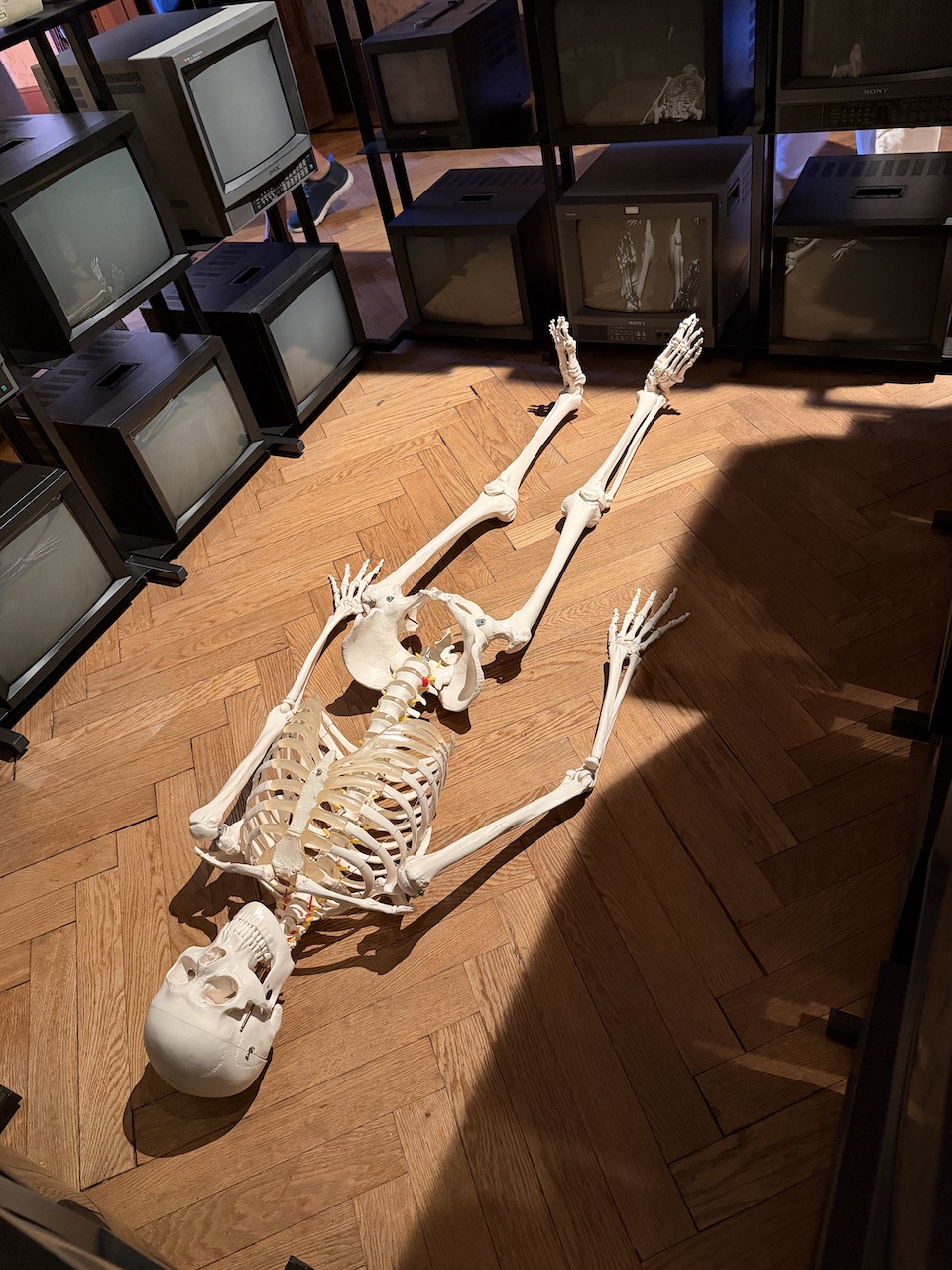
This thread continues in House of Eternity / Sarcophagus. It originated in a 1986 drawing of a tomb containing a model skeleton surrounded by television monitors. In 2026, the idea became an installation resembling a burial chamber raised above ground, into which the viewer can peer.
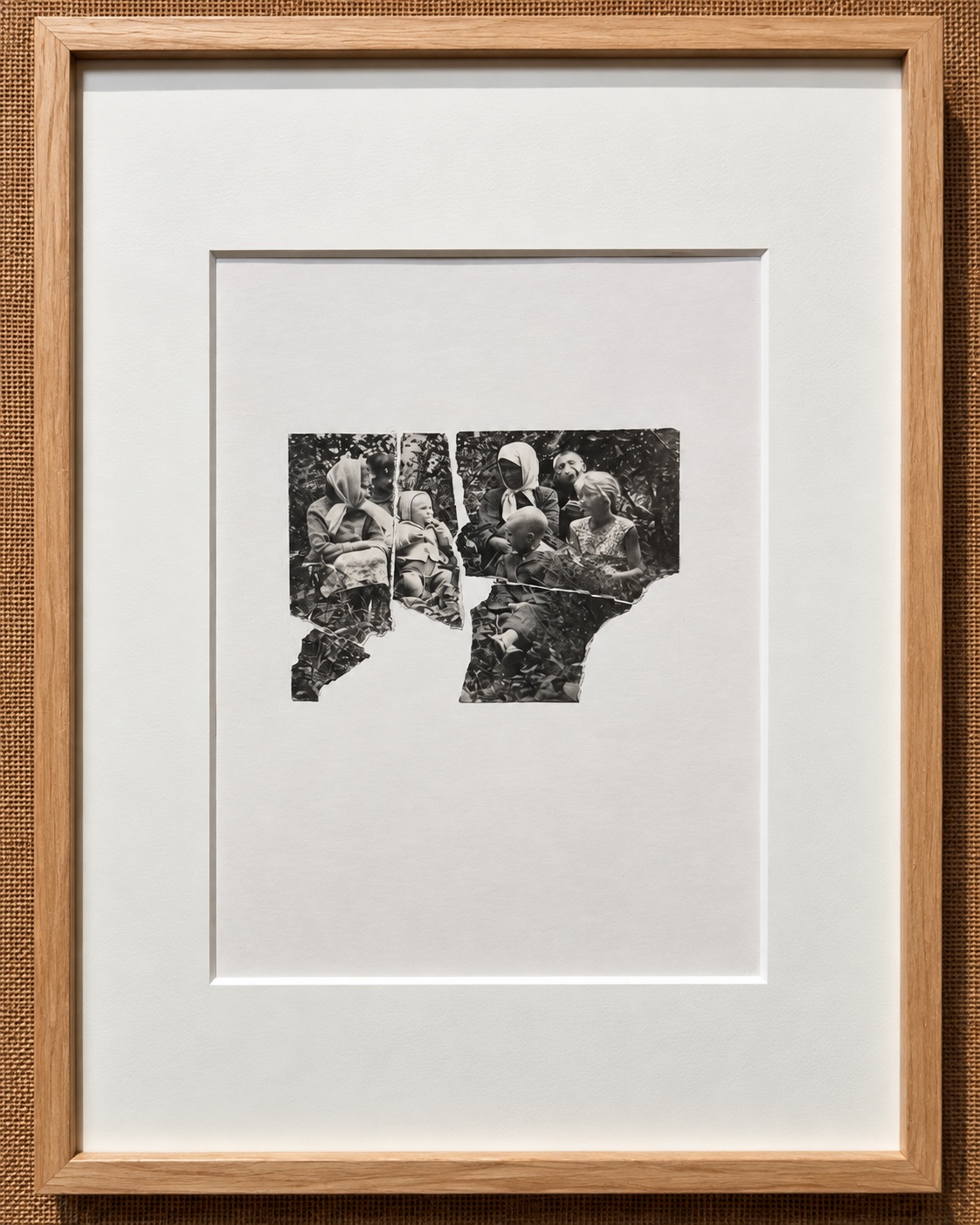
Akhunov returned to the theme of oblivion much later as well. In the series Worn and Erasure of Memory (2021) and In Memory (Of) (2023–2024), he literally erases fragments of family archive photographs, magazine images, illustrations and handwritten texts. In Akhunov’s work, then, memory does not simply disappear of its own accord: it can be erased with one’s own hands. And forgetting, as we know, can be selective too: some events and facts can be preserved, others destroyed.
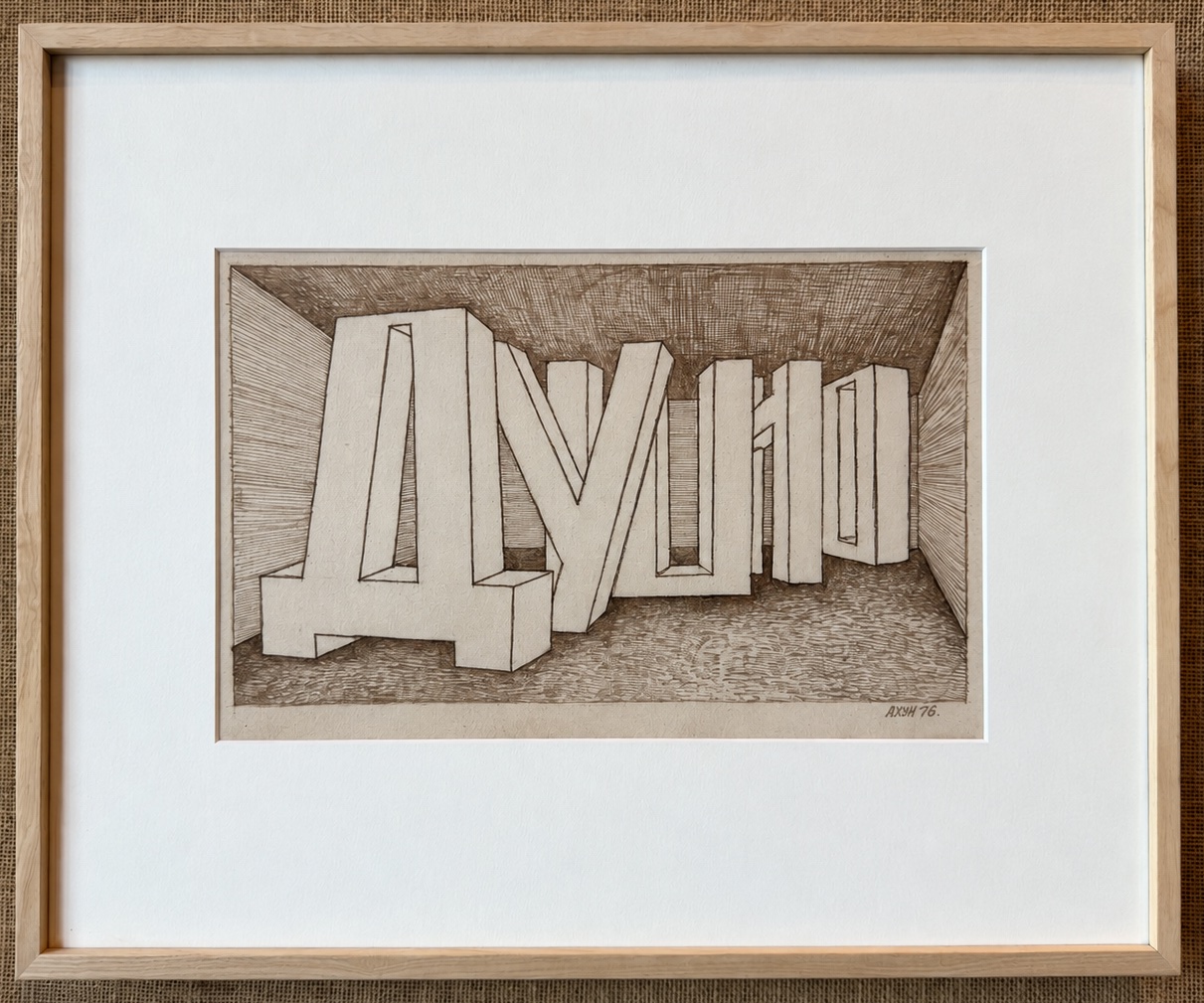
Another vast area of Akhunov’s work is his handmade books. Since the 1970s, he has created more than sixty of them, filled with texts, drawings, collages, notes and sketches. The Alphabet project (1975–1976) was ostensibly devoted to the early Soviet campaigns to eradicate illiteracy, but its ingenious visual play with letters makes even those who can read perfectly well stop and look more closely, solve some of the puzzles and ponder the meaning of others.
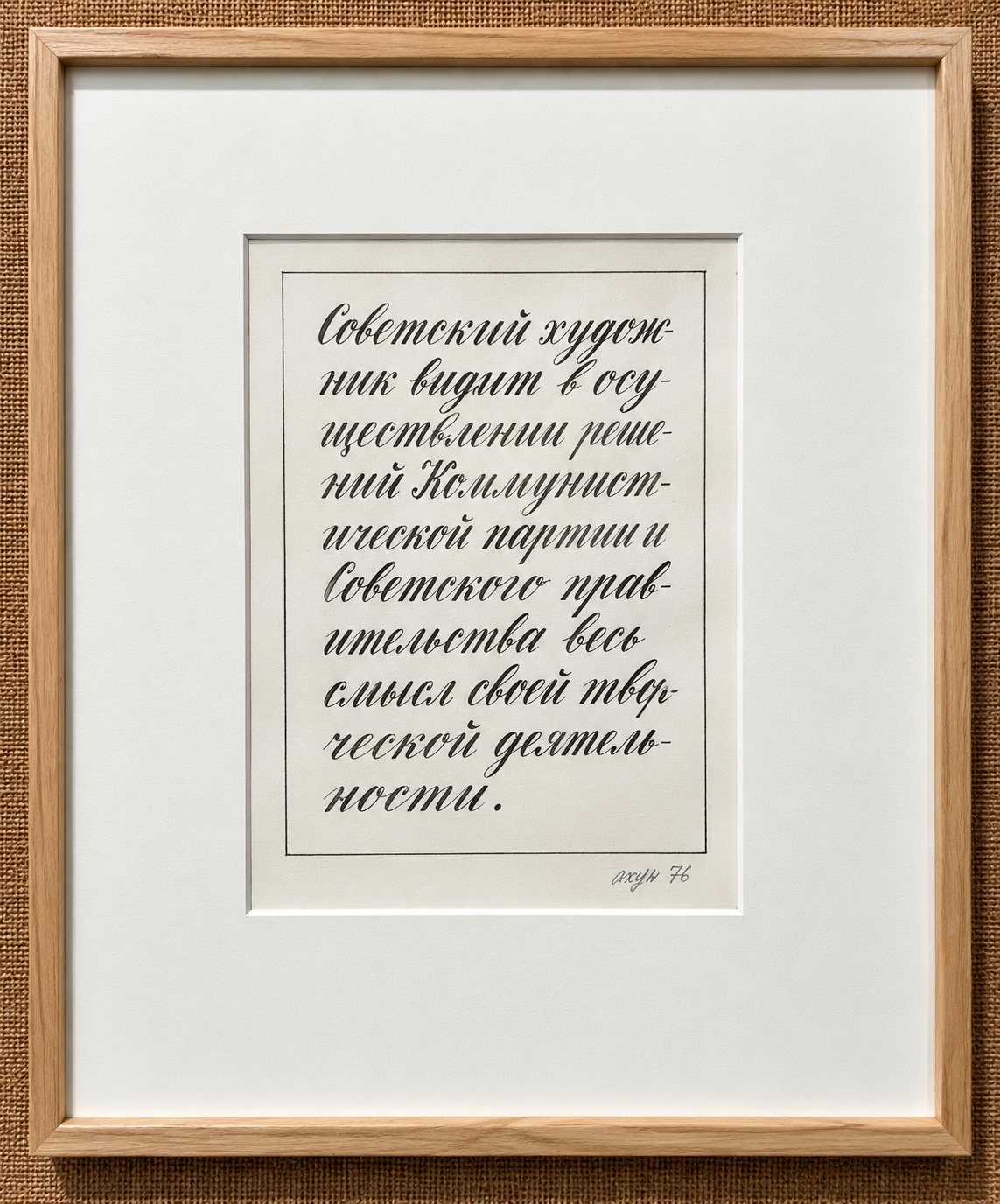
In Instruction (1976), the focus shifts to the educational and disciplinary system of the USSR Union of Artists, with its orders, directives and instructions. One of these reads: ‘The Soviet artist sees the entire purpose of his creative activity in carrying out the decisions of the Communist Party and the Soviet government.’ Reading these texts is both funny and sad. And a little frightening.
Particularly expressive is the 1m² project (1976/2007), which grew out of the 1976 drawing Pocket Exhibition of Kazimir Malevich and Wassily Kandinsky. Eight empty matchboxes become a miniature portable exhibition, bearing reproductions of works by Malevich and Kandinsky measuring just 4.8 × 3.5 cm. Such a pocket museum made it possible to circumvent the strict official ban on the public display of works of the Russian avant-garde in the USSR, while the idea of carrying a personal museum of the avant-garde literally in one’s pocket stood in sharp contrast to Soviet monumentality.
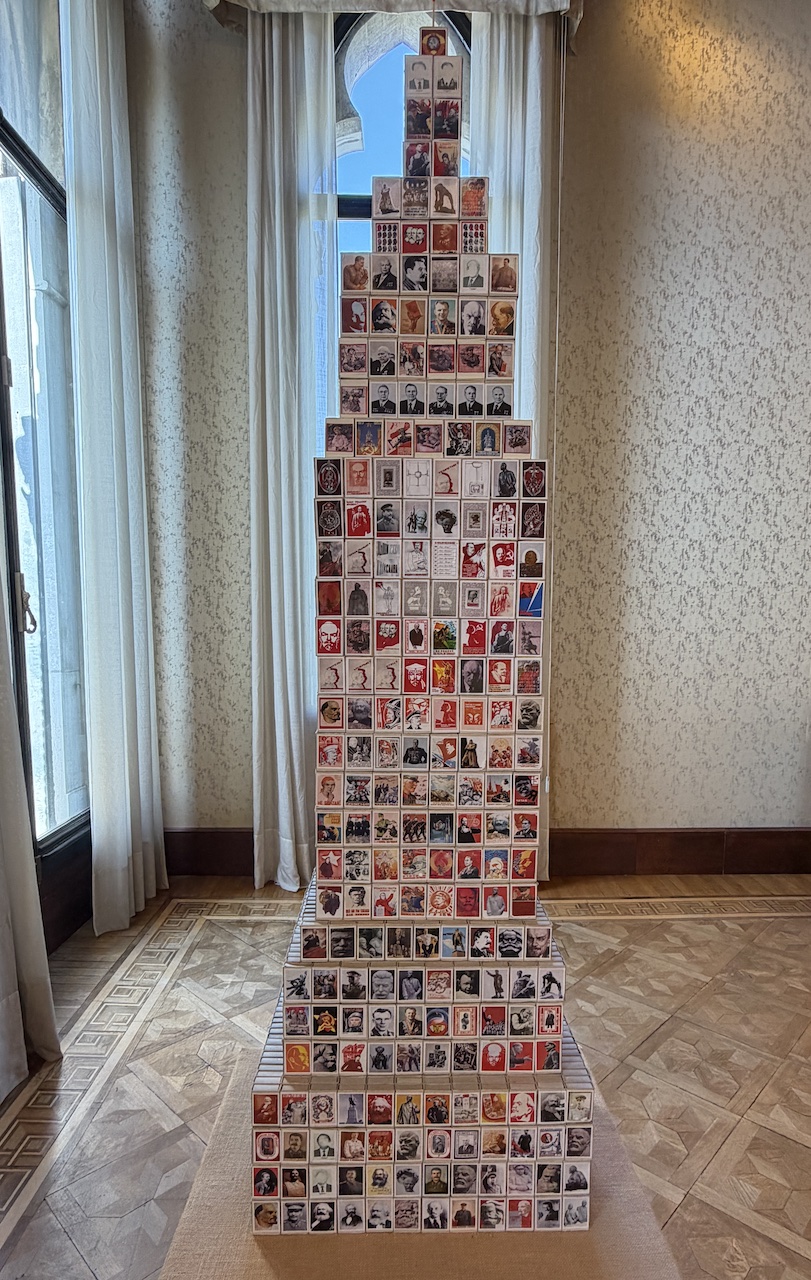
The matchbox later becomes a metaphor for power too. In Monument to a Match (2011), a tower of matchboxes stacked one on top of another resembles a skyscraper. Take a moment to examine the portraits on them: prominent figures of the Soviet era, political leaders, military commanders and heroes who once seemed all-powerful. Yet crowning the tower is a single match: an utterly simple and slightly comic symbol of absolute power.
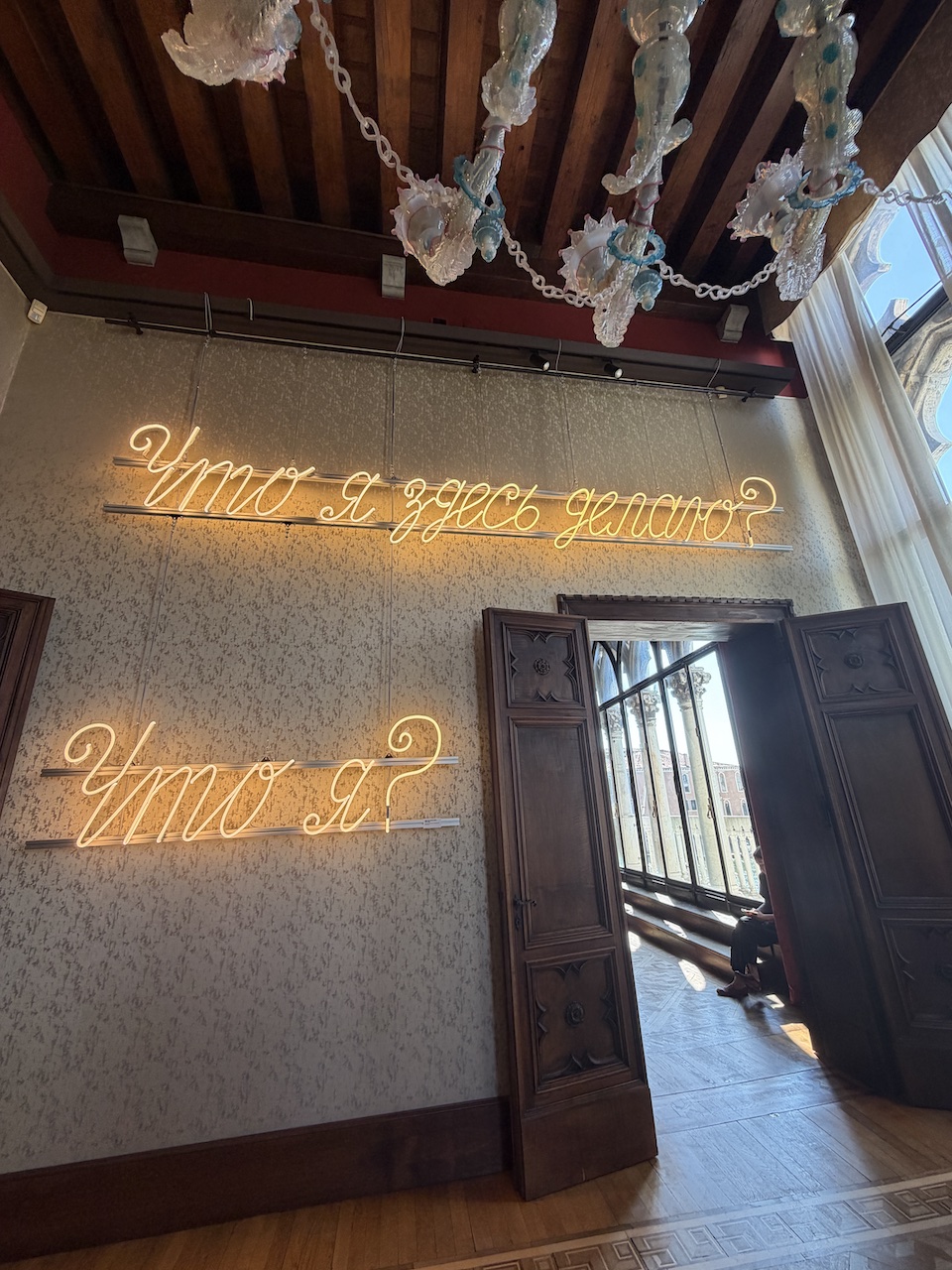
The 1979 drawing What Am I Doing Here? became the basis for a new neon work. The phrase sounds at once like a rhetorical question and an invitation to a silent mantra. A question Akhunov asked himself in 1979 sounds strikingly contemporary today and reaches well beyond its original Soviet context.
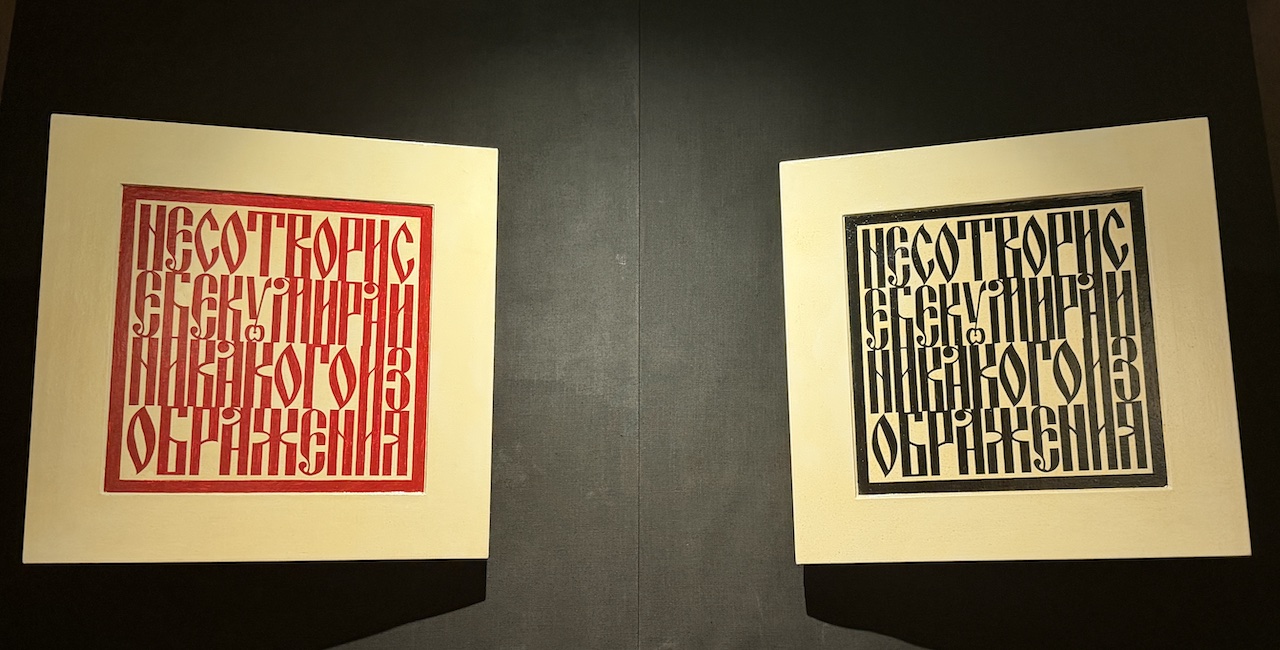
The dialogue with the Russian avant-garde is particularly explicit in Icons, which engages with Kazimir Malevich’s Black Square. Akhunov’s black and red ‘icons’ are the same dimensions as Malevich’s original canvas and bear a quotation from Exodus. The biblical prohibition against making idols sets up a rather audacious argument both with Black Square itself and with Malevich’s faith in the future of non-objective art.
Another intriguing work is the Meteorite series (1977), conceived for the anniversary of the October Revolution: a meteorite was to crash through the roof of the exhibition space. Its point of departure was the true story of a meteorite that struck a house in Alabama in 1954 and injured Ann Elizabeth Hodges.
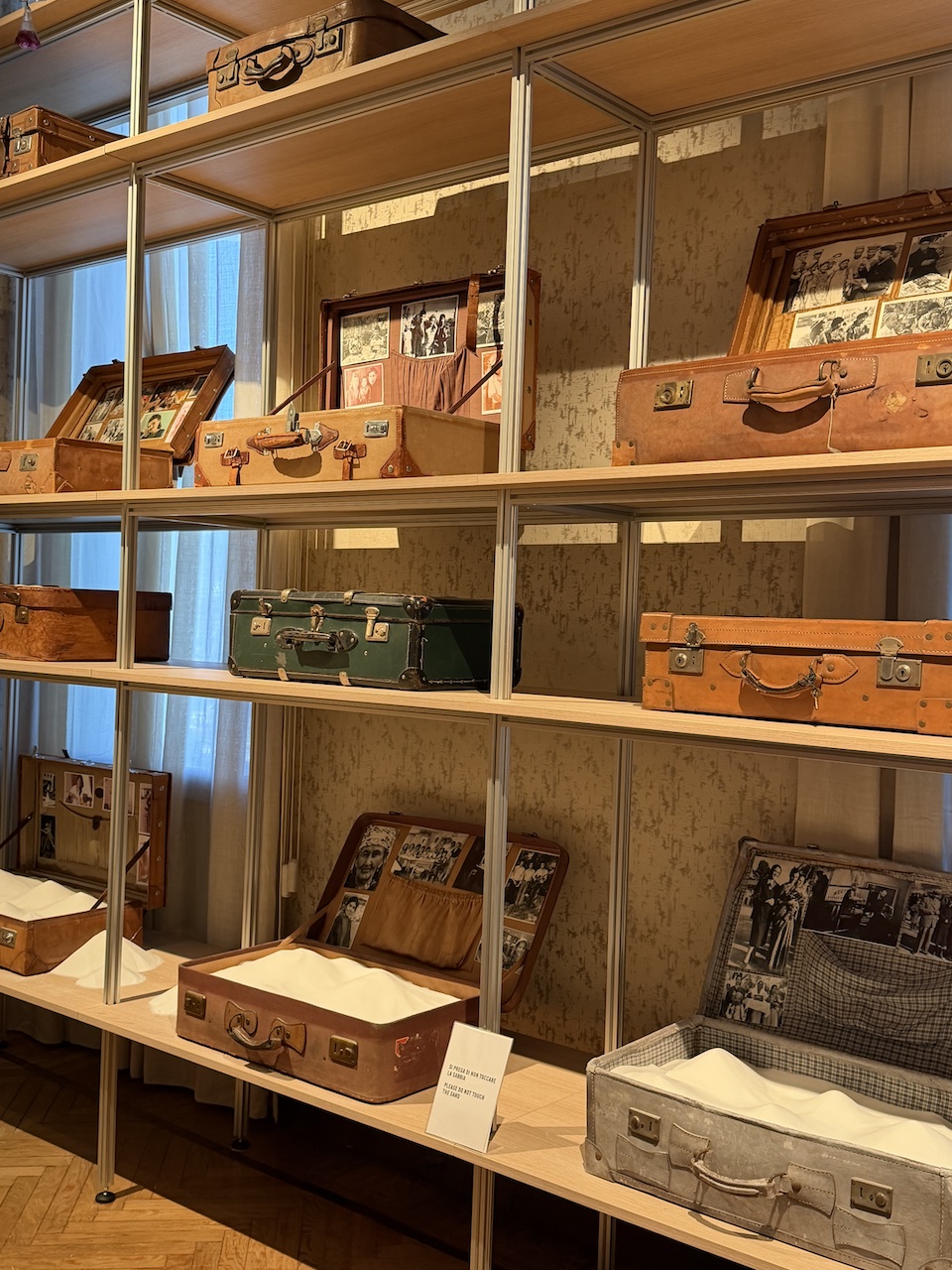
But not everything in Akhunov’s work is directly political. There is also travel, the East, the desert, movement between cultures. And here the suitcase becomes the central object. In the installations Suitcases and Shifting Sands (1974/2026) and the triptych Suitcases Filled with Sand (1993), the suitcases really are filled with sand. The sand here represents the desert, the timeless landscape of the East, and serves as a reminder of how time gradually buries the past, while the suitcase is a metaphor for perpetual movement, whether forced or voluntary.
Finally, one project realised much later returns the viewer to the spiritual dimension of Akhunov’s work. In 1982, he drew a design for a long, dark, narrow tunnel in which a strip of light penetrates through a crack, although the exit itself cannot be seen. In 2026, the work was realised for the first time as a site-specific installation. Here Soviet history recedes altogether. In the Sufi tradition, the way out of darkness is found first and foremost within one’s own consciousness, through inner transformation and movement towards the light, nur.
What becomes particularly clear at the Venice exhibition is that what we have here is not merely a collection of ingenious conceptual works. Archaeology, the desert, Soviet slogans, books, archives, the Russian avant-garde and works that waited half a century to be realised all converge on a single theme: memory and the ways in which it can be controlled by the state, by history and by the individual.
The Venice Biennale continues until 22 November, so there is still time to discover Vyacheslav Akhunov’s work and see much else that is beautiful and fascinating.




Лазарь Фрейдгейм October 08, 2026
Sikorsky October 08, 2026
Rachel Babecoff October 11, 2026
Sikorsky October 11, 2026