
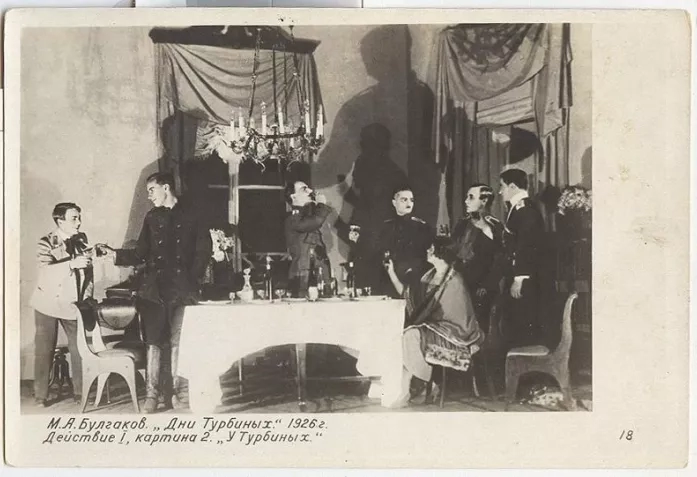
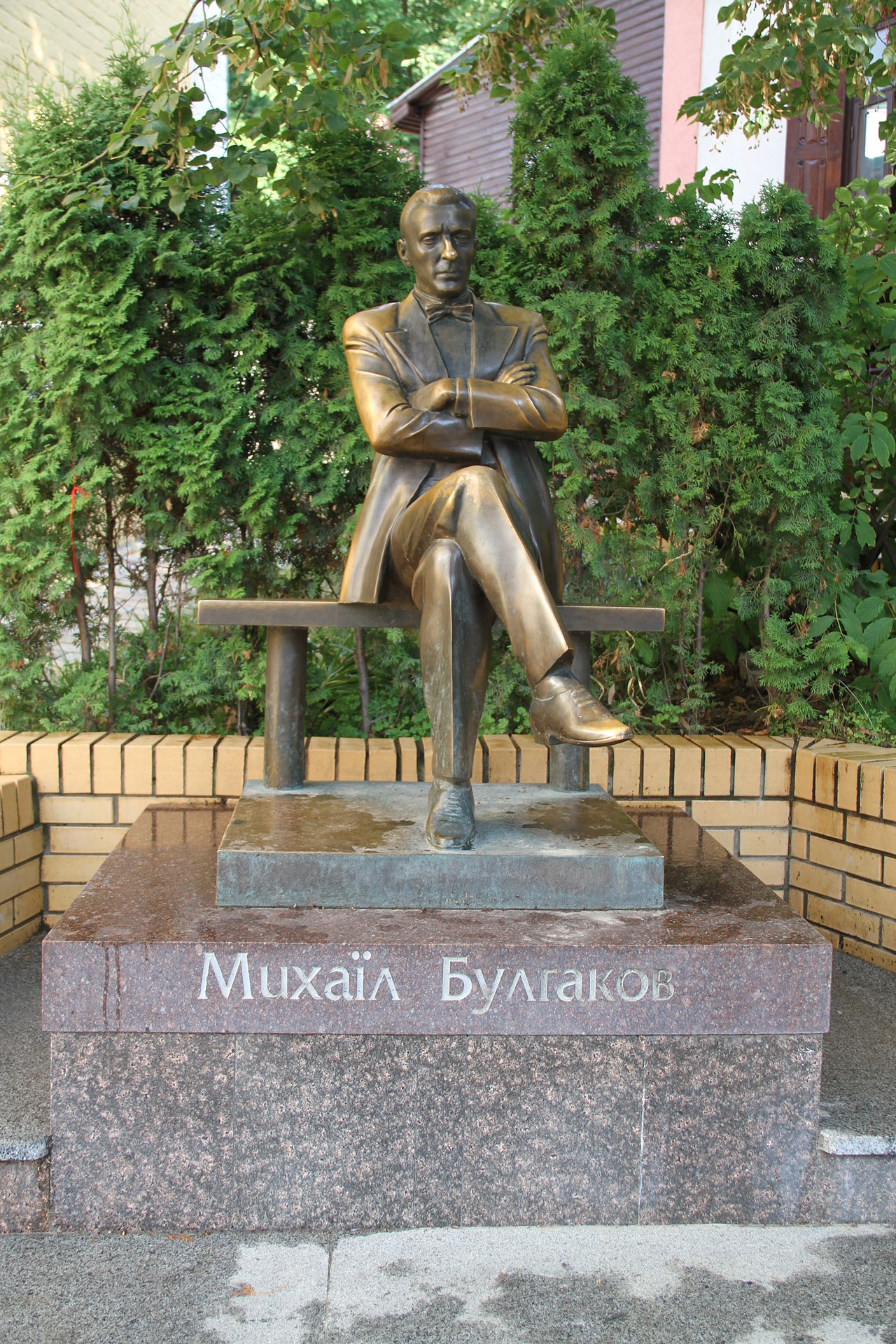
I should say at once that I adore Mikhail Bulgakov. I have read and reread everything he wrote, and I know The Master and Margarita almost by heart. I have become so close to its characters that no screen adaptation has ever seemed faithful enough to the author’s vision. So I was saddened by the news that his monument in Kyiv had been dismantled. This is a difficult and painful subject, but I will venture to raise it because my position is well known: as early as 24 February 2022, I publicly spoke out against the war, but also against hatred and in favour of preserving common sense. My position has not changed since then.
I may be told that people suffering under bombardment have more pressing concerns than the Russian language and literature. I understand and accept that, but the facts tell a different story. On 4 June this year, the official Kyiv city portal published the following:
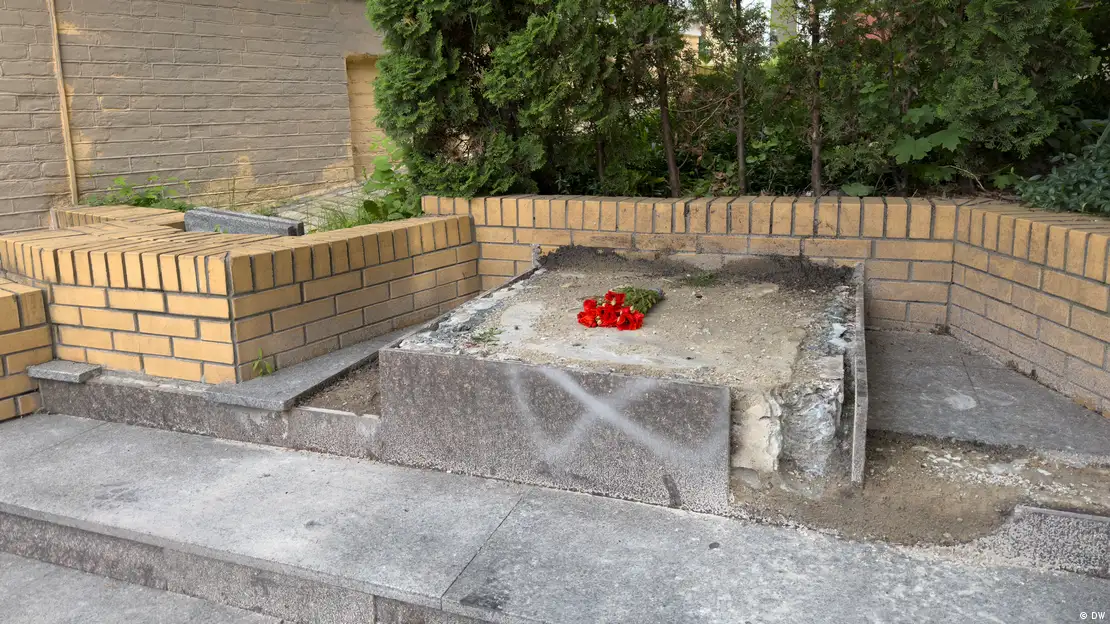
“A monument to Mikhail Bulgakov on Andriyivskyy Descent has been dismantled in the capital. The monument was handed over for safekeeping to the heir of the sculptor Mykola Rapai.
According to the Department for the Protection of Cultural Heritage of the Kyiv City State Administration, the heir had previously approached the interdepartmental working group responsible for organisational and legal measures to remove commemorative objects associated with the history and culture of Russia and the USSR, asking that her father’s work be transferred to her for private safekeeping.
The decision to remove the monument from the capital’s public space was adopted by Kyiv City Council on 18 December 2025.
The dismantling was based on an expert conclusion by the Ukrainian Institute of National Memory classifying objects dedicated to the Russian writer Mikhail Bulgakov as symbols of Russian imperial policy. The conclusion was prepared in accordance with the Law of Ukraine ‘On the Condemnation and Prohibition of Propaganda of Russian Imperial Policy in Ukraine and the Decolonisation of Toponymy’.
According to the conclusion, Mikhail Bulgakov is included among those individuals whom Russian propaganda uses to glorify Russian imperial policy, and objects associated with them are subject to removal from public space.”
If Ukrainian experts and officials find the time to address such questions, they clearly consider them important. Then they can and should be discussed.
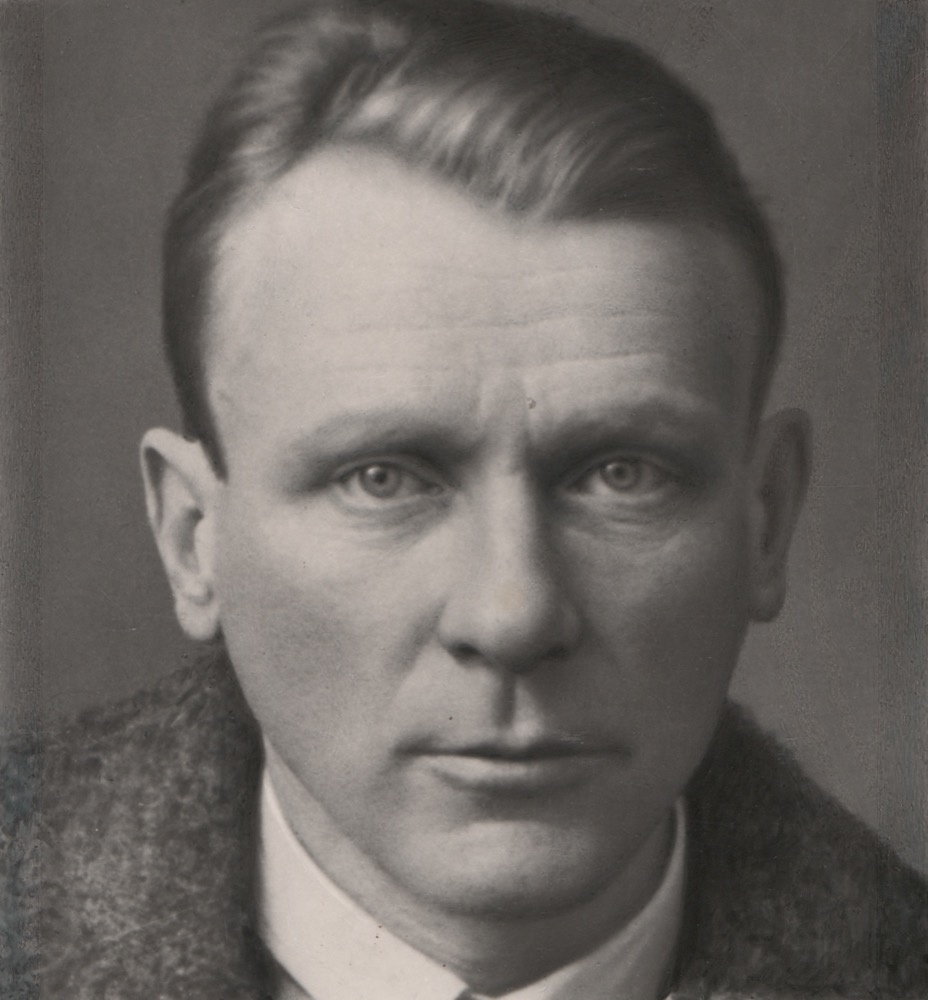
At the beginning of this year, looking back at the Sochi Olympic Games, I was already questioning whether any government can claim exclusive rights over a national culture, and whether it makes sense to punish representatives of that culture, including Mikhail Bulgakov, because their names and works are used for propaganda purposes, most often posthumously. In my view, the answer to both questions is no. A cultural figure, and in this case a writer, belongs neither to a state nor to a language, a city or a country: he belongs to literature. Nor can he resist being used for one purpose or another, especially from beyond the grave. Mikhail Bulgakov and his play The Days of the Turbins provide an excellent case in point.
“I was born in the city of Kyiv in 1891. I studied in Kyiv and in 1916 graduated from the university’s medical faculty, qualifying as a doctor with honours,” Mikhail Bulgakov wrote at the beginning of an autobiography barely a page long, composed in October 1924 and published in the final volume of the five-volume edition of his collected works issued in Moscow in 1990. He went on: “At the end of 1921 I arrived in Moscow without money or possessions, intending to remain there for ever. I suffered for a long time in Moscow; to make a living I worked as a reporter and columnist for newspapers and came to hate these undistinguished occupations. Along the way, I came to hate editors too. I hate them now and shall hate them to the end of my life.”
And so it was. Not for nothing does Staff Captain Myshlaevsky say to the young cadet Nikolka Turbin in The Days of the Turbins: “What are you shoving newspapers at me for, cadet? I’d hang the whole damned newspaper rabble of yours from the same branch!”
Against this background of political chaos, people are trying to understand to whom they should swear allegiance, what they should fight for and whether any of it is worth dying for. The full range of views emerges through the Turbins and the people who gather in their home, where they are accustomed to living, loving, arguing, drinking wine, singing romances to the guitar, listening to the chiming clock, welcoming friends and provincial relatives, and where History bursts in to the sound of gunfire outside the windows. The chaos in the streets is matched by the chaos in people’s minds, something Bulgakov conveys brilliantly, not, mind you, in his own voice, but through his characters: Russian officers, the Hetman of Ukraine, Petliura’s men, German military personnel, officer cadets and Haidamaks, soldiers of the Ukrainian forces.
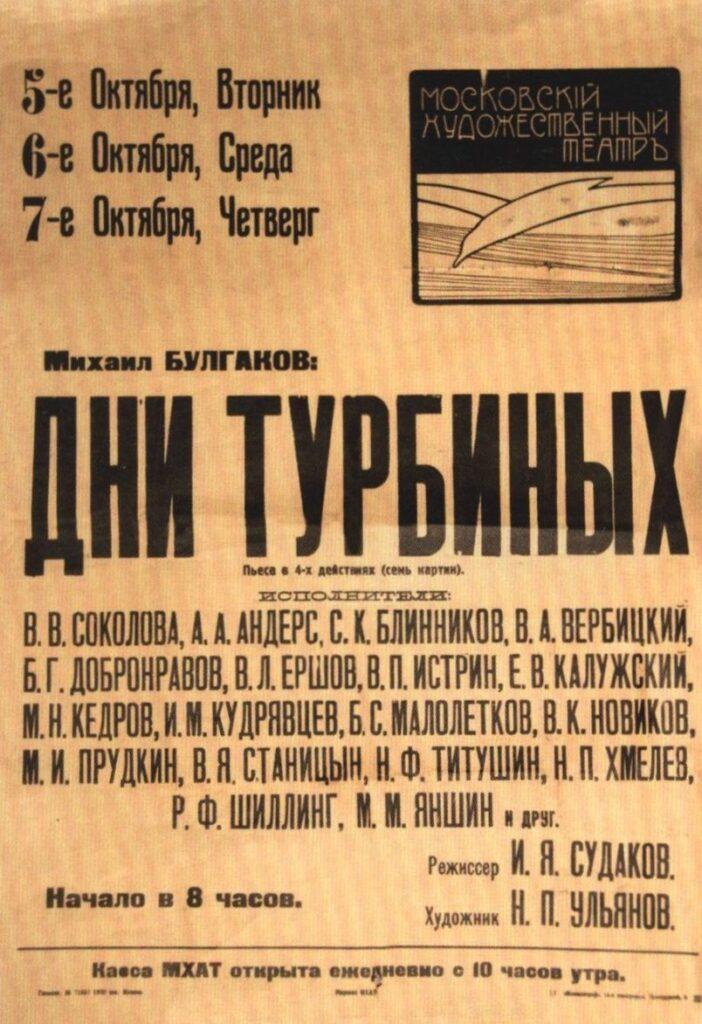
It is worth remembering that the troubles surrounding The Days of the Turbins – the very trial of Bulgakov that, in a sense, continues to this day – began even before its premiere. “The numerous comments made in the spring of 1926 after the dress rehearsal prompted yet another revision of the play, which by the premiere on 5 October 1926 had acquired the necessary ideological contours. In the finale, ‘The Internationale’ could be heard offstage, ‘growing louder and louder’, while Myshlaevsky, a White Army captain, made his choice in favour of the new regime. Despite this obvious compromise, The Days of the Turbins was met with a campaign of persecution against both the theatre and the playwright. Bulgakov’s play was authorised only for the Moscow Art Theatre, yet even there it was removed from the programme several times,” writes Alexander Smeliansky, one of Russia’s foremost theatre historians, on the Moscow Art Theatre website.
I tried to reread the play as objectively as possible, to understand whom it might have offended and why. And offend it did. It is remarkable how little the feelings and the arguments have changed over the past hundred years.
In 1926, one of the main objections raised by the newly established Soviet authorities was that the White officers, those who fought against the Bolsheviks in the Russian Civil War, were portrayed as human beings capable of arousing sympathy, rather than as caricatured class enemies. The play was consequently accused of “propagandising the White movement”, bourgeois sympathies and counter-revolutionary tendencies. At the same time, Stalin is known to have seen The Days of the Turbins at the Moscow Art Theatre repeatedly; according to a widely cited account, at least fifteen times, although the precise number of his visits has never been conclusively established.
Stalin himself explained his view of the play. At a meeting with Ukrainian writers on 12 February 1929, an unedited transcript of which is available in the Electronic Library of Historical Documents, he argued that even such “tough, steadfast” people as Turbin and those around him were ultimately forced to acknowledge their powerlessness before the Bolsheviks, and described The Days of the Turbins as “the greatest demonstration in favour of the all-crushing power of Bolshevism”. Obviously, Stalin understood perfectly well that Bulgakov himself had intended no such message: “I think that the author, of course, did not want this; he is not to blame for it.” You must admit, it is a striking example of how those in power can adapt to their own ideology even a work that was never intended to glorify them.
The Ukrainian participants in the meeting emphatically rejected Stalin’s interpretation. The transcript even records an interjection by Lazar Kaganovich, one of Stalin’s closest associates, who headed the Communist Party of Ukraine from 1925 to 1928: “The Ukrainians disagree. (Noise, conversations.)” They explicitly demanded that the play be withdrawn: “We want our incursion into Moscow to result in this play being taken off.” Stalin defended the play, yet as early as March a decision was taken to remove not only The Days of the Turbins but all Bulgakov’s plays from the repertory of Soviet theatres. Of course, one cannot claim that this happened at the demand of the Ukrainian writers, but the similarity between the arguments of 1929 and 2026 is striking.
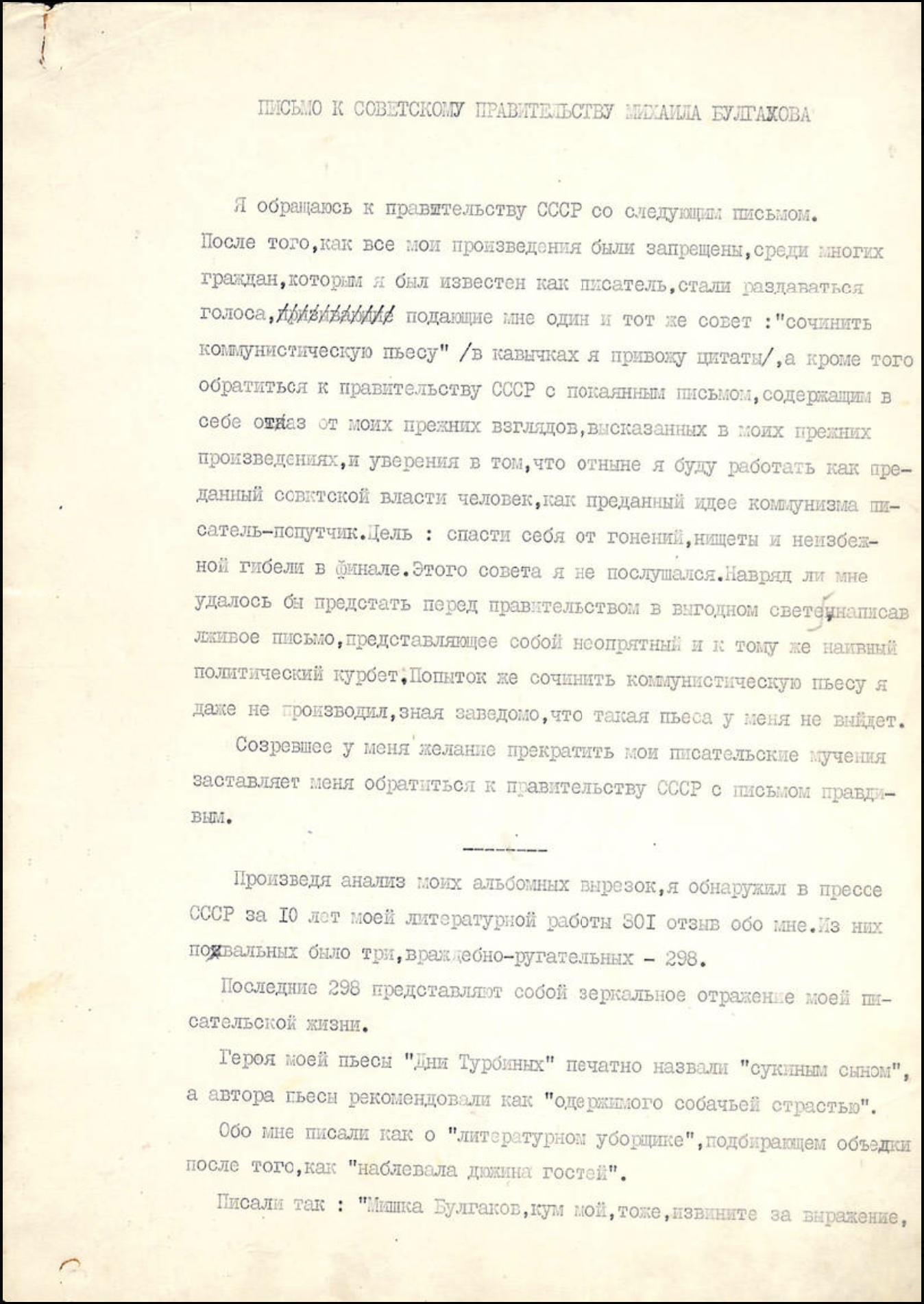
On 28 March 1930, driven to despair, Bulgakov wrote to the Government of the USSR, effectively putting the matter in stark terms: either let me work or let me leave. On 18 April, Stalin unexpectedly telephoned him. “Perhaps it is true that you are asking to go abroad? Have we really become so tiresome to you?” Bulgakov replied: “Lately I have thought a great deal about whether a Russian writer can live outside his homeland. And it seems to me that he cannot.” “You are right. I think so too,” Stalin replied, and asked Bulgakov where he would like to work. Soon afterwards he was given a position at the Moscow Art Theatre.
In 1932, The Days of the Turbins returned to the stage, but that did not make Bulgakov a free writer. Bans, censorship and the inability to publish a substantial part of what he wrote plagued him until his death, while The Master and Margarita, the novel that has made his name known throughout the world, was not published in his lifetime. It is therefore particularly paradoxical to see Bulgakov as a convenient symbol of imperial state policy: he himself suffered greatly at the hands of his own country’s state machinery.
Yet those willing to take offence at Bulgakov can be found on both sides of today’s border – and beyond.
Ukrainians, of course, may have the most grievances against Bulgakov. Bulgakov was strongly opposed to the Ukrainian national movement; Petliura’s men are portrayed without the slightest sympathy; and the abundant Ukrainian dialogue in the text can at times seem caricatured, although it is given without translation, apparently because the author had no doubt that Russian-speaking readers would understand it perfectly well.
It is hardly surprising that many Ukrainians today, and by no means Ukrainians alone, may flinch on reading a scene such as this:
“STUDZINSKY: We shall always defend the Russian Empire!
NIKOLKA: Long live Russia!
SHERVINSKY: Let me say something! You have misunderstood me! The Hetman will do exactly as you suggest. Once we have managed to beat off Petliura and the Allies have helped us defeat the Bolsheviks, then the Hetman will lay Ukraine at the feet of His Imperial Majesty, the Emperor Nikolai Alexandrovich…”
Admittedly, Shervinsky’s grandiloquence is immediately punctured by Myshlaevsky’s next line: “Which Alexandrovich? And he says I’m the one who’s drunk…”
Yet if one reads The Days of the Turbins attentively, the list of those who might take offence grows longer.
In the last century, the play could outrage Bolsheviks no less than Ukrainians, and even today it is capable of outraging some Russians. Consider this speech alone by Colonel Alexei Turbin: “If your Hetman, instead of putting on this damned farce of Ukrainisation, had started forming officers’ corps, there wouldn’t have been a whiff of Petliura in Little Russia. And that’s not all: we could have swatted the Bolsheviks in Moscow like flies. And this was the very moment! They say they’re eating cats there. The bastard could have saved Russia! […] We lost the war! Now we have something else, something more terrible than war, more terrible than the Germans, more terrible than anything in the world: we have the Bolsheviks.”
But the Hetman does not save Russia. As Petliura’s forces approach, forces Alexei Turbin calls a “black fog”, he flees to Germany disguised in a German uniform. By then, his aide-de-camp Prince Novozhiltsev, the commander of the Volunteer Army with his entire staff, and Elena Turbin’s husband, the universally despised Colonel Talberg, have already fled, leaving the others to their fate.“When there is a catastrophe, everyone becomes very nimble indeed,” observes the German general von Schratt. ‘Even if the Germans leave Ukraine, the Entente will occupy it and restore the Hetman. Europe needs a Hetman-ruled Ukraine as a cordon against the Moscow Bolsheviks,’ Talberg reasons before fleeing.
Jews may take offence at Bolbotun, commander of Petliura’s 1st Cavalry Division, who holds forth about “Yid Communists”. Then again, Jews no longer take offence at such trifles, whereas Communists very well might. Tatars, for their part, may take offence at Maxim, the school supervisor who is somewhat reminiscent of Chekhov’s Firs in The Cherry Orchard. This is how he reacts to the havoc wreaked in the institution entrusted to his care: “There have been all sorts, for the Tsar and against the Tsar, crazed soldiers too, but smashing desks… […] Tatars, nothing but Tatars…”
Bulgakov was clearly not overly concerned about the feelings of posterity. But literature, it seems to me, does not exist to avoid offending anyone. So what follows: should we stop reading?
No, The Days of the Turbins is not a pacifist manifesto. But one thing is perfectly clear: war in this play brings neither greatness nor happiness to anyone. It destroys the home, turns yesterday’s neighbour into an enemy and forces people to choose between their convictions and their lives. And how can one not shudder today on reading Alexei Turbin’s words to the officer cadets, “Whom do you intend to defend?”, or his description of the “generals and the whole staff rabble”: “They will make you fight your own people. And when your heads have been smashed in, they’ll run abroad.” Or Myshlaevsky’s anguished cry: “I’ve been fighting since 1914. What for? For the fatherland? Is this a fatherland, when they’ve abandoned me to disgrace?!” Or the play’s final two lines, as The Internationale sounds offstage, drawing ever nearer:
“NIKOLKA: Gentlemen, this evening is a great prologue to a new historical drama.
STUDZINSKY: For some, a prologue; for others, an epilogue.”
And how can one not feel affection and sympathy for the awkward, naive provincial Lariosik, who behind the cream-coloured curtains of the Turbins’ home forgets all the horrors of the Civil War and confesses: “I’m terribly tired of shooting. I don’t like it…”
Which of these characters should we regard as the “voice of the author”? I would not presume to say. But it was precisely this multiplicity of voices that ran counter to the prevailing ideological demand of the time, which prescribed “singing in unison”. Incidentally, this genre of ideologically correct ‘choral singing’ is alive and well today and has spread far beyond Russia. It can be tough for anyone who dares to sing a ‘solo part’.
A hundred years later, The Days of the Turbins once again speaks to us of Kyiv, war, fear, choice, human dignity and the home that people try to preserve while the familiar world collapses around them.
And here lies the paradox. In Russia today, people are put on trial for speaking out against the war. So what is Bulgakov being put on trial for in Ukraine? For having had the “wrong” attitude towards the Ukrainian national movement a hundred years ago? Because his Kyiv does not correspond to the way Kyiv sees itself today? For the words spoken by his characters? Or was a writer supposed to foresee which views of national history would be deemed correct a century later?
Of course, Ukraine, now in the fifth year of the full-scale war launched by Russia, has every right to decide whom it wishes to see commemorated in its streets and squares. Within Ukraine itself, however, views of who deserves honour and who deserves condemnation are far from uniform, and debates over the politics of historical memory continue, including the controversy surrounding the dismantling of Bulgakov’s monument. Russia itself has turned history, language and culture, traditionally regarded as instruments of “soft power”, into instruments of war, and it would be absurd to expect a society at war to remain dispassionate towards them.
But having the right to dismantle a monument does not mean one necessarily has to exercise it. Bulgakov was not a general in an army that captured Kyiv, not an official implementing a policy of Russification, not a state ideologue. He was a writer.
I am not suggesting that we should ignore what Bulgakov wrote and thought about Ukraine. But we should read everything. Not pluck convenient quotations out of context, not turn a writer into either a saint or a political symbol, but read him. Argue with him. Be outraged by him. And acknowledge the stature of the literature he created.
I sincerely feel sorry for those who, for transient ideological reasons, deprive themselves of the pleasure of discovering and engaging with a great writer, all the more so because history has already demonstrated the impotence of bans when it comes to Bulgakov.
A monument can be dismantled. A street can be renamed. A writer can be declared a symbol of a foreign empire, his books removed from libraries, his plays no longer performed, translations prohibited. But people cannot be forbidden to read and love great books because, as Bulgakov himself wrote, “manuscripts don’t burn”.



Alexandra Trifler October 05, 2026
Silberstein October 05, 2026
Sikorsky October 05, 2026
Лазарь Фрейдгейм October 05, 2026
Sikorsky October 05, 2026
Philippe Lüscher October 06, 2026
Sikorsky October 06, 2026