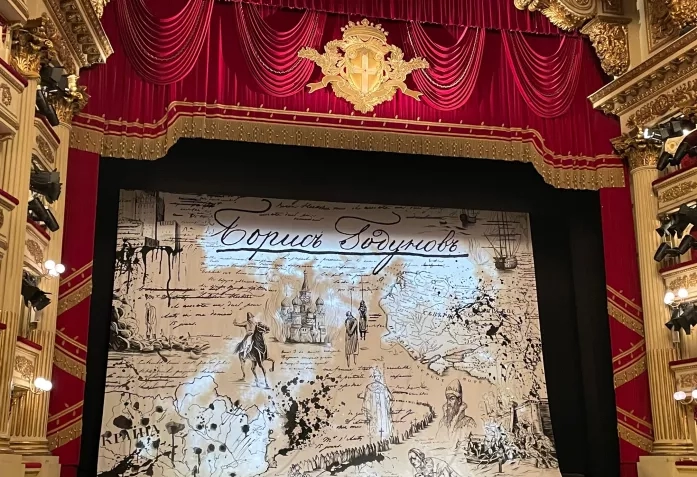
“…and the darkness will fall”

27.12.2022
Photo © N. Sikorsky

Despite everything, this is still a season of light and gifts; of lux and luxury. So I decided to combine the two by going to La Scala for Boris Godunov. I know this opera by heart; I have seen it… I no longer remember how many times, in all kinds of productions, including at the Grand Théâtre de Genève and at Opernhaus Zürich. Yet the first production for me was the 1948 staging at Moscow’s Bolshoi Theatre, still alive today and unmatched in sheer spectacle: sumptuous costumes and sets, real church bells suddenly ringing out, and a real horse wandering across the stage, followed by a man ready to deal with the consequences of any possible “incident”. The performance lasted four and a half hours, and every minute was worth it.

I also decided to travel to Milan in order to express my support for this theatre. You may know that on the eve of the opening night – with Boris Godunov, of all works – the walls of the theatre were splashed with red paint, the colour of blood. You may also know that La Scala’s music director, Riccardo Chailly, responded to the Ukrainian consul’s demand that the production be cancelled: “We all stand with the Ukrainian people as we await the end of the conflict, but politics and its consequences cannot dictate terms to culture.” He also reminded that on 4 April 2022 a free performance of Rossini’s Stabat Mater had taken place in this very theatre, and that the 380,000 euros raised had been donated to Ukrainian refugees. Bravo, Maestro!

At the centre of Modest Mussorgsky’s masterpiece stands a historical figure whom the historian Nikolai Karamzin subjected to a form of historical due diligence in his monumental History of the Russian State. Boris Godunov became the first “elected” Tsar after Tsarina Irina, heir to the late Fyodor I, withdrew to a convent. (Yes, one must always look for the woman!) After forty days of vacancy, the Zemsky Sobor – an assembly first convened by Ivan the Terrible and composed of the Orthodox Patriarch and the Boyar Duma – begged Boris to accept the throne. After a week of theatrical reluctance, he agreed to accept both the office and the “supreme power” that came with it.
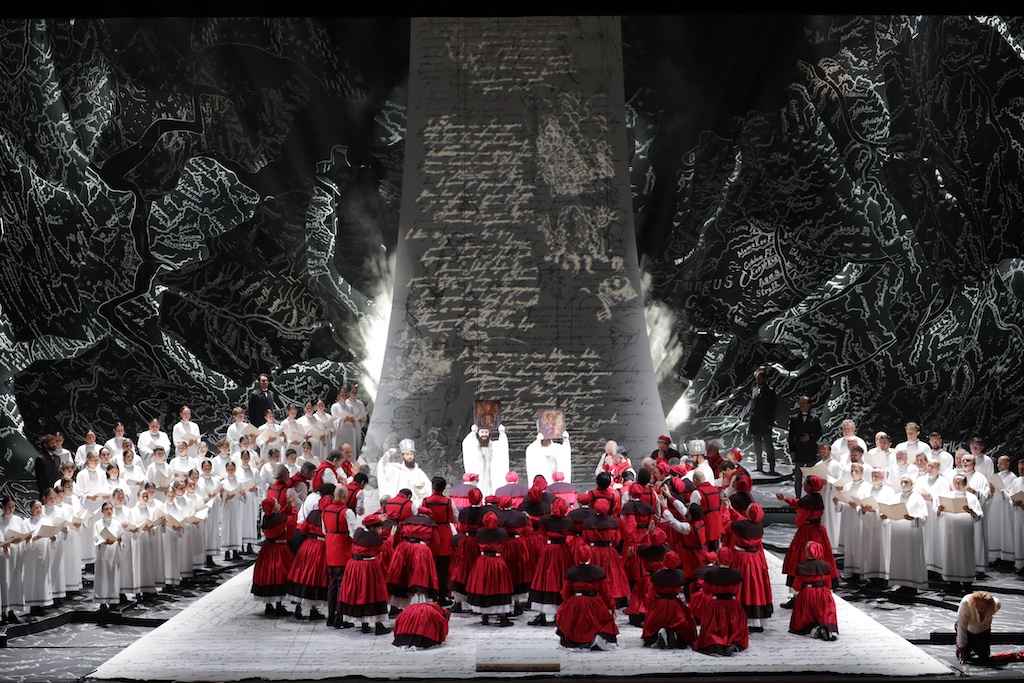
Photo : Brescia e Amisano ©Teatro alla Scala

His life inspired the poet Alexander Pushkin, whose monuments are now being dismantled in Ukraine. It is worth recalling that Pushkin wrote Boris Godunov in 1825, the year of the Decembrist uprising, at his estate in Mikhaylovskoye, where he had been exiled for excessive freethinking and a tendency towards atheism. This verse drama was published in 1831 yet remained banned until 1866. Why censor a work devoted to a historical figure? Perhaps because of the subtitle Pushkin gave it: A Dramatic Tale, A Comedy about the Real Misfortune of the Muscovite State, about Tsar Boris and about Grishka Otrepyev. Read that subtitle carefully: it contains all the keys to understanding the work.

Inevitably, the current context shaped my perception of the Milan production as disaster has struck my country of origin – a disaster of its own making. As Tsar Vladimir clings to his throne and remains as close to the Patriarch Kirill today as Boris once was to Iov. As all the “Grishkas” and other “imposters” capable of sowing chaos in the minds of obedient citizens are eliminated or imprisoned indefinitely, while Ivan the Terrible continues to be glorified as the “gatherer of the Russian lands”. Only the word “comedy” no longer applies here: the circus known as the electoral system and limitless corruption no longer amuse anyone.

There are roughly half a dozen versions of Mussorgsky’s Boris Godunov. Teatro alla Scala chose the 1869 version – somewhat shorter, and without the love story between the imposter Grishka and the beautiful Polish noblewoman Marina Mniszech. Naturally, this decision was made long before the war in Ukraine began, yet today it seems particularly apt, as it underlines the deeply macho character of Russian society. Women in the production are merely secondary figures of little consequence. Another major omission in this version is the popular uprising included in the second version of the opera prepared by Nikolai Rimsky-Korsakov in 1872. And these are far from the only parallels with the present day.
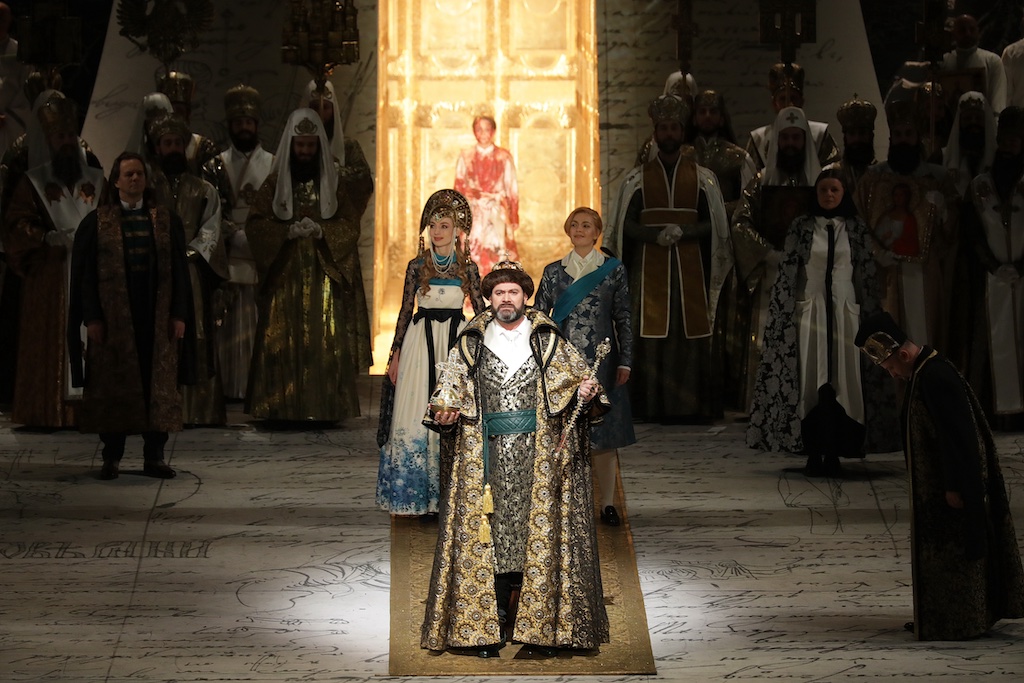
Ildar Abdrazakov as Boris Godounov Photo: Brescia e Amisano ©Teatro alla Scala

The distance separating the Tsar from “his” people is clearly established by Pushkin and Mussorgsky in the opening scene of their respective works and is superbly reflected by the Danish director Kasper Holten. Indeed, it is even intensified: although Boris stands at the centre of attention, he is physically absent. As soon as the curtain rises, the audience sees extras (choristers) tearing up handwritten pages: history is about to be rewritten once again. While Boris is being entreated indoors, protected by the Kremlin walls, the crowd freezes outside – it is February 1598. The pristav first distributes portraits of Boris, then icons. The crowd’s plea, “To whom are you abandoning us, our father?”, is replaced by “Gloria!”. Everything is perfectly orchestrated, in every sense of the word.

I am particularly grateful to Kasper Holten for the absence of the slightest caricature, the slightest vulgarity throughout the three-hour performance – something exceedingly rare nowadays. The striking coronation scene, with all the splendour of the Orthodox rite, the golden gates opening and the carpet unfurling before the new monarch, cannot help but evoke Vladimir Putin’s inauguration broadcast by television channels across the world. And for once I was not troubled by the fact that Boris’s golden robes (worn by Ildar Abdrazakov, magnificent as ever and enthusiastically applauded by the audience) were replaced with an almost contemporary suit: because the opera suddenly feels utterly contemporary.

The new Tsar’s very first words – “My soul is in pain” – immediately plunge us into the eternal debate about the “peculiarities of the Russian soul” (equally eternal, perhaps?) and its deviations from normality. One slightly regrets the absence of the candle during Pimen’s scene (beautifully performed by the Estonian bass Ain Anger), the candle that is supposed to go out to mark the end of the story. Yet I am willing to concede that this choice has its own logic, because the story is not, in fact, over. The giant scrolls succeeding one another at the back of the stage like pages of History turning over and back again are a magnificent scenic invention.
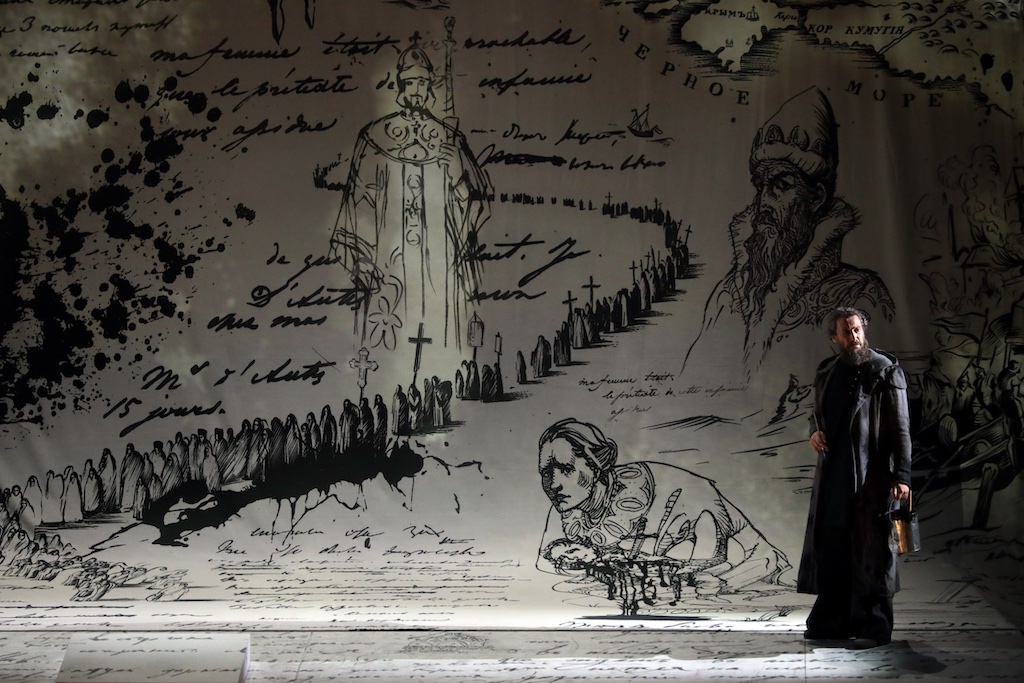
Ain Anger as Pimen Photo: Brescia e Amisano ©Teatro all Scala

And how can one fail to think of what we are experiencing today during the Lithuanian border scene, which even visually separates Cyrillic Russia from Latin Europe? The pristav reads out the decree according to which all those attempting to flee Moscow must be arrested and searched. But too late: Grishka has managed to escape. Like so many after him. (I would like to congratulate the Russian bass Stanislav Trofimov, whom I heard for the first time and who is magnificent as Varlaam.)

The only real weakness of the production, in my view, is the scene involving Yurodivy, the Holy Fool, crucial in the opera. The role of this strange figure, whose name is translated either as “the Innocent” or, in Italian, as Il folle in Cristo, lasts just a few minutes of stage time. Yet during the golden age of the Bolshoi theater it was entrusted only to the finest tenors, because it demands a combination of an exceptionally tender, but never sugary, timbre, artistic perfection, and interpretative depth: it is this miserable “madman” who dares confront the all-powerful Tsar. One truly has to be mad to attempt such a thing!

I was somewhat disappointed by Yaroslav Abaimov’s performance as Yurodivy and by the directions he had clearly received from the stage director: in my opinion, the Holy Fool should not be looking out at the audience, but directly into Boris’s eyes, forcing him to look away as visions of blood-covered boys are appearing before him. Presented in Soviet schools as the vox populi, the Holy Fool embodies the conscience that eventually catches up even with the most conscienceless among us.

Watching this scene, one thing struck me: usually it is the moment when the Holy Fool accuses Boris of murdering the little Tsarevich that makes the audience’s hair stand on end. But this time it was his macabre prophecy that pierced my heart like the knife entering Boris’s back a few scenes later:

«Soon the darkness will fall,
Black, impenetrable darkness.
Woe, woe to Russia.
Weep, Russian people,
Hungry people!»

Chilling.

Every Russian speaker, even without having read Boris Godunov in full, knows the final line following the announcement of the “sudden death” of Boris and his children-heirs, Pushkin’s final stage direction: “The people remain silent.” Silent, or perhaps indifferent. Here we are confronted with that eternal silence which eventually turns innocent lambs into a dangerous frock.

Those who call for a boycott of Russian culture should, in my opinion, do precisely the opposite and disseminate it by every possible means, because nothing and no one exposes the weak points of this country with such piercing clarity as its great classical works. Some say that art and culture are powerless in the face of war. I see instead their remarkable resilience. Bravi tutti, grazie mille. Viva la musica, viva la poesia!
Comments ()

avatar

Kounitsyna December 27, 2022

Je suis aussi allée à la Scala . Et je suis très déçue de la mise en scène, de l’orchestre et des chanteurs .
avatar

bivaldi December 27, 2022

Merci chère Nadia pour cet excellent compte rendu de la partie musicale et scénographique de “Boris Godounov”. Tu nous éclaires aussi de tes commentaires historiques et politiques. L’œuvre de Modeste Moussorgski inspirée du drame de Pouchkine ne fait que raconter la rupture entre un dirigeant autocrate et son peuple , et en cela elle est universelle. Et dans ces moments incertains j’aime me rappeler la devise de Genève “Post tenebras lux”
avatar

Gui December 27, 2022

La lumière éclairera les pleurs et la futilité de cette guerre : 100'000 familles en deuil de chaque côté. Tout ça pour ça. L'histoire essaiera d'expliquer comment la relation entre l'Ukraine et la Russie en est arrivée là et pourquoi Poutine n'a pas trouvé d'autres moyens pour éviter la guerre. Est-ce que cette guerre aura un gagnant au delà des marchands d'armes ? ou, plus probablement, deux perdants ? Quand les 2 parties vont-elles enfin dialoguer ?
avatar

joulik December 27, 2022

Quand ma mère, née à Moscou en 1910, a vu à la télévision Vladimir Poutine apparaître au pied des monumentales portes du Kremlin le jour de son intronisation, elle qui, alors âgée de moins de dix ans, avait survécu à la révolution de 1917 et à la guerre civile, s'est exclamée de son fauteuil de retraitée: "Mais il est tout petit!" Pour sa part, mon médecin genevois, qui avait aussi suivi l'intronisation du nouveau tsar en costume de commis-voyageur, pourtant bon connaisseur de la Russie et de son système, m'avait fait part de ses impressions: "A voir l'extrême-tension de ses traits, je ne lui donne pas six mois au pouvoir". Par chance, ses diagnostics médicaux sont plus sûrs que ses évaluations politiques... Pour revenir à Boris Godounov et à votre excellent compte rendu de sa représentation au "Theatro alla Scala", parmi les nombreuses versions de ce drame historique, l'une de celles qui m'ont le plus marquées est son interprétation par Vladimir Volkoff dans sa trilogie des "Faux tsars" - Les Faux tsars (1989) , "Les Hommes du tsar (1992) et "Le Grand Tsar Blanc (1995), parue aux éditions Fallois/L'Age d'Homme. Non seulement l'auteur du "Retournement" et du "Montage", spécialiste de la désinformation, restitue toute la complexité de ce drame dans son contexte historique, mais comme pour la représentation de Milan, il est impossible de ne pas y voir les liens avec l'actualité la plus brûlante - comme si, à défaut de se répéter, l'Histoire ne recelait pas depuis toujours ses propres invariants. Si nul ne peut prévoir où va la Russie aujourd'hui, avec le cumul des crimes de part et d'autre, les chances de réconciliation entre "frères ennemis" et l'espoir de voir un gouvernement mieux disposé envers l'Ouest rétrécissent comme peau de chagrin. Même si l'actuel tsar en complet-veston venait ä tomber, quelles garanties a-t-on que ses successeurs seront meilleurs? La prise du pouvoir par les bolchéviques, sensée mettre fin au régime autocratique, a-t-elle abouti à autre chose qu'à la plus terrible des guerres civiles? Comme la vieille de Syracuse disait à ceux qui voulaient la chute de Denys le tyran, "mieux vaut faire avec celui-là, car on ne sait pas si les suivants ne seront pas encore pires." Meilleurs voeux malgré tout pour la nouvelle année à toutes et à tous. Несмотря ни на что, всего наилучшего в новом году всем.
avatar

Sikorsky December 27, 2022

Merci beaucoup d’avoir partagé vos réflexion et bonne année à vous aussi!
avatar

Association des Amis de la Mer d'Azov December 27, 2022

Vous plaisantez ou quoi? Les crimes sont russes. Point barre.
avatar

Gouffon December 27, 2022

Justifier la culture russe ,et de sa diffusion, en face des atrocités commise par l'armée russe, par des soldats qui n'ont pas la moindre idée de Godounov et de blanchir l'agression russe c'est ce "foutre de la gueule" des non slaves.
avatar

Sikorsky December 27, 2022

Monsieur, je ne sais pas où avez-vous trouvé dans mon texte le “blanchissement de l’agression”. Je vous invite à le relire tranquillement
avatar

gouffon December 27, 2022

Madame, je vous respecte pour votre travail et parcours mais comprenez que la culture russe que l'on veut absoudre face au dérives du pouvoir poutinien est,en ce qui me concerne, utilisée par le Kremlin pour valider la mort de l'Ukraine indépendante.Toute l'histoire russe est convoquée pour justifier cette guerre d'agression depuis Pierre le Grand et plus si nécessaire. En oubliant que le culture ukrainienne existait avant la russe et niée depuis tous les tsars et autres autocrates.
avatar

Sikorsky December 27, 2022

Monsieur, encore une fois: vous exprimez votre opinion et c’est votre droit. Mais ne m’accordez pas les propos que je ne tienne pas. Un lecteur objectif ne trouvera pas dans mon texte le blanchissement de l’agression.
avatar

Adam Leben December 28, 2022

Ni la culture russe -ni l'ukrainienne d'ailleurs - n'a pas besoin de "justification". Elle existe. Elle rayonne. Elle fait partie du patrimoine mondial. Comme les cultures allemande, grecque, chinoise, turque ... etc. Vouloir enterrer (ou brûler) Goethe et Bach en 1939 aurait été aussi absurde que de "boycotter" Pouchkine et Moussorgski en 2022. Tout ce qui élève et enrichit l'âme et l'intelligence est une arme (qui ne tue pas) conte la dictature et 'obscurité. Donc merci à Madame pour l'article.
avatar

Sikorsky December 28, 2022

Merci beaucoup de m’avoir compris!
avatar

avocat Santschi December 28, 2022

Bravo pour votre excellent article. Certains de vos commentateurs (que vous remettez poliment en place) démontrent l'ignorance encyclopédique de l'Occident sur tout ce qui concerne la Russie. Je suis en train de relire (en russe bien sûr) les oeuvres complètes de Pouchkine (l'édition en 5 vol. de 1994), qui avait une grande sympathie pour l'Ukraine, et qui était constamment victime de la censure, (comme TOUS les auteurs, que ce fût en prose, en vers, ou en travaux scientifiques). Personne, que ce fût sous Nicolas Ier ou sous Staline, n'avait le droit de rien publier sans passer par la commission de censure. Les bribes d'inédits qui y ont échappé montrent que tout le monde savait comment ça se passait, mais que personne n'osait se rebeller. RIEN n'a changé, que ce soit sous Staline ou sous Vladimir Vladimirovitch. On ne changera pas l'âme russe, qui a ses beautés et ses défauts, comme tous les autres peuples, et il faudra évidemment attendre que les USA cessent d'entretenir cette guerre fratricide par leurs envois d'armes. J'apprécie toujours de vous lire.
avatar

Sikorsky December 28, 2022

Merci, cher Monsieur. Ce qui touche à l'émotionnel devient souvent irrationnel...
avatar

Ceilteach December 28, 2022

"il faudra évidemment attendre que les USA cessent d’entretenir cette guerre fratricide par leurs envois d’armes", je ne comprends pas, donc il faudrait selon vous laisser le champ libre à Poutine pour mettre le grappin sur le peuple "frère" ukrainien, qui montre, et avec quel courage, qu'il ne veut pas de cette domination? C'est ça votre "solution" à la tragédie actuelle? Et si vous demandiez putôt à Poutine de retirer ses troupes d'un pays qui n'est pas le sien et d'entamer des négociations sérieuses (pas fixer des diktats) avec son voisin pour régler d'égal à égal leurs différents?!
avatar

Pierre-Olivier Mojon December 28, 2022

À l'évidence, l'immense culture russe est immortelle et l'actuel gouvernement de la Russie ne représente absolument pas ces valeurs ni cet héritage, ce sont juste des barbares non civilisés ayant décidé délibérément de mener une guerre vaine de grande ampleur, très cruelle et dévastatrice. L'Histoire dit que la Rus' de Kiev, ancêtre de la Russie, fut fondée vers l'an mille de l'ère chrétienne par les Varègues, navigateurs et commerçants Vikings originaires de Scandinavie (de redoutables guerriers aussi). En ce XXIe siècle et après bien des vicissitudes, les descendants de la Rus' de Kiev et des Cosaques zaporogues ont choisi librement la voie de l'Occident, cela mérite-t-il cette terrible guerre? Même si la plus grande partie de l'Ukraine fut effectivement conquise sur l'empire turc par les tsars russes et notamment par le général Souvarov (cf. la Crimée et la prise d'Izmaïl dans l'actuel Budjak voisin de la Roumanie), les Ukrainiens souhaitent maintenant fonder un Etat réellement moderne et démocratique, faut-il leur en vouloir à ce point pour ça? Vladimir Poutine est plus proche des excès d'Ivan IV que de la noblesse de Pierre le Grand, à cette différence qu'il ne sera jamais un tsar, car un vrai chef sait reconnaître ses erreurs (Ivan IV frappé de désespoir après avoir tué son propre fils). Le paradoxe, c'est que dans Vladimir et Volodymir, il y a le mot "mir" qui signifie "paix" et que nous en sommes très loin dans la situation actuelle.
The content of this field is kept private and will not be shown publicly.

Plain text

About the author

Nadia Sikorsky

Nadia Sikorsky grew up in Moscow where she obtained a master's degree in journalism and a doctorate in history from Moscow State University. After 13 years at UNESCO, in Paris and then in Geneva, and having served as director of communications at Green Cross International founded by Mikhail Gorbachev, she developed NashaGazeta.ch, the first online Russian-language daily newspaper, launched in 2007.

In 2022, she found herself among those who, according to Le Temps editorial board, "significantly contributed to the success of French-speaking Switzerland," thus appearing among opinion makers and economic, political, scientific and cultural leaders: the Forum of 100.

After 18 years leading NashaGazeta.ch, Nadia Sikorsky decided to return to her roots and focus on what truly fascinates her: culture in all its diversity. This decision took the form of this trilingual cultural blog (Russian, English, French) born in the heart of Europe – in Switzerland, her adopted country, the country distinguished by its multiculturalism and multilingualism.

Nadia Sikorsky does not present herself as a "Russian voice," but as the voice of a European of Russian origin (more than 35 years in Europe, 25 years spent in Switzerland) with the benefit of more than 30 years of professional experience in the cultural world at the international level. She positions herself as a cultural mediator between Russian and European traditions; the title of the blog, "The Russian Accent," captures this essence – the accent being not a linguistic barrier, not a political position but a distinctive cultural imprint in the European context.

Events
Most read

A Russian accent in an Art Brut collection? I certainly did not expect to encounter one at the exhibition Écrits d’Art Brut at the Fondation Jan Michalski. It all began with a sheet of paper dated December 1938, covered with Russian, French and English words, which which evoked a vague sense of someone's tragedy, encoded in chaotic lines and symbols.

On 17 June, people in the Italian capital will be reading Dostoevsky’s «White Nights». That is the premise of La tempesta silenziosa (The Silent Storm), an initiative conceived by the writer Alessandro Baricco and organised by Rome’s Department of Culture as part of the city’s Day of Remembrance programme.