
“…and the darkness will fall”
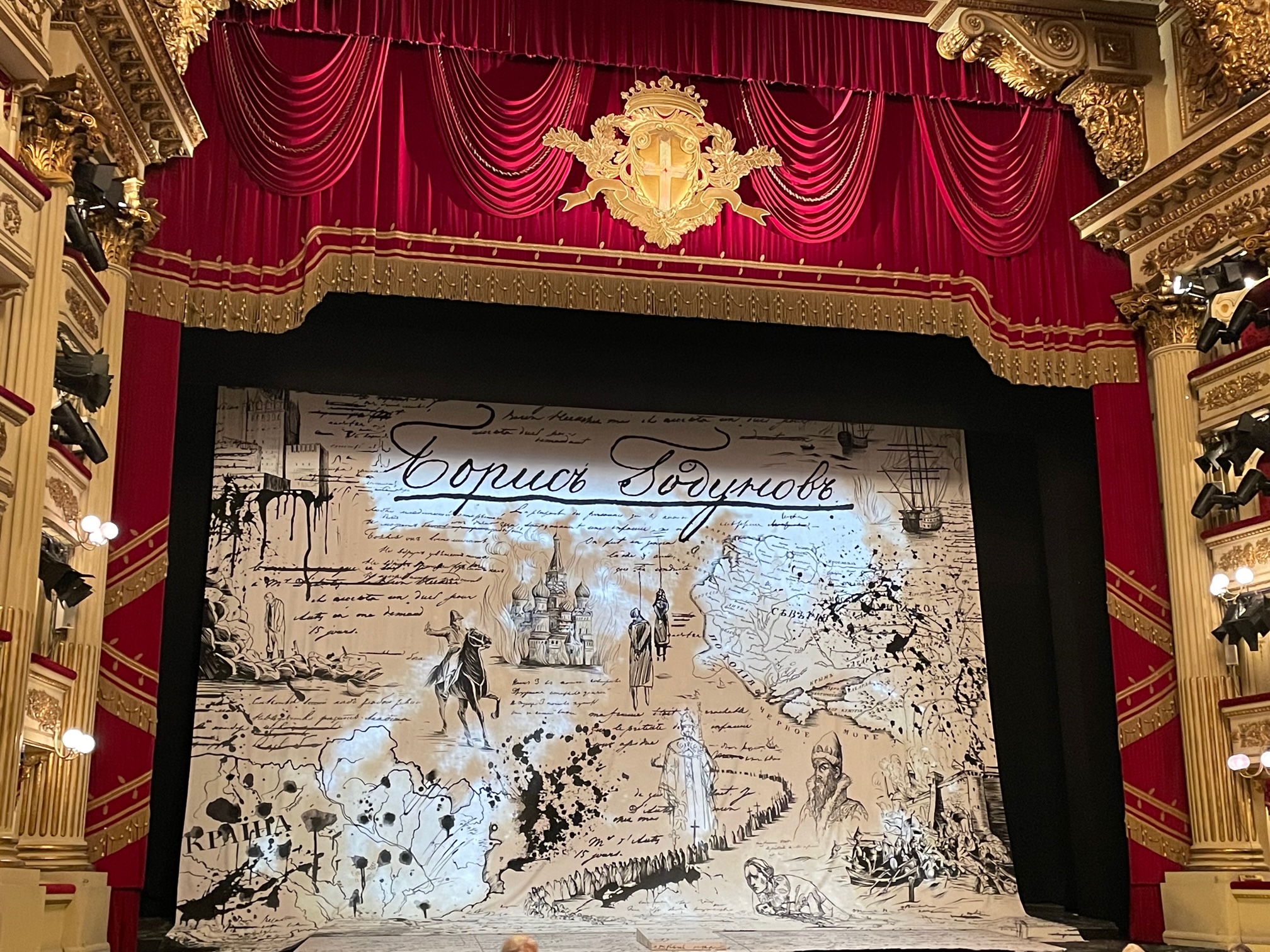
Despite everything, this is still a season of light and gifts; of lux and luxury. So I decided to combine the two by going to La Scala for Boris Godunov. I know this opera by heart; I have seen it… I no longer remember how many times, in all kinds of productions, including at the Grand Théâtre de Genève and at Opernhaus Zürich. Yet the first production for me was the 1948 staging at Moscow’s Bolshoi Theatre, still alive today and unmatched in sheer spectacle: sumptuous costumes and sets, real church bells suddenly ringing out, and a real horse wandering across the stage, followed by a man ready to deal with the consequences of any possible “incident”. The performance lasted four and a half hours, and every minute was worth it.
I also decided to travel to Milan in order to express my support for this theatre. You may know that on the eve of the opening night – with Boris Godunov, of all works – the walls of the theatre were splashed with red paint, the colour of blood. You may also know that La Scala’s music director, Riccardo Chailly, responded to the Ukrainian consul’s demand that the production be cancelled: “We all stand with the Ukrainian people as we await the end of the conflict, but politics and its consequences cannot dictate terms to culture.” He also reminded that on 4 April 2022 a free performance of Rossini’s Stabat Mater had taken place in this very theatre, and that the 380,000 euros raised had been donated to Ukrainian refugees. Bravo, Maestro!
At the centre of Modest Mussorgsky’s masterpiece stands a historical figure whom the historian Nikolai Karamzin subjected to a form of historical due diligence in his monumental History of the Russian State. Boris Godunov became the first “elected” Tsar after Tsarina Irina, heir to the late Fyodor I, withdrew to a convent. (Yes, one must always look for the woman!) After forty days of vacancy, the Zemsky Sobor – an assembly first convened by Ivan the Terrible and composed of the Orthodox Patriarch and the Boyar Duma – begged Boris to accept the throne. After a week of theatrical reluctance, he agreed to accept both the office and the “supreme power” that came with it.
His life inspired the poet Alexander Pushkin, whose monuments are now being dismantled in Ukraine. It is worth recalling that Pushkin wrote Boris Godunov in 1825, the year of the Decembrist uprising, at his estate in Mikhaylovskoye, where he had been exiled for excessive freethinking and a tendency towards atheism. This verse drama was published in 1831 yet remained banned until 1866. Why censor a work devoted to a historical figure? Perhaps because of the subtitle Pushkin gave it: A Dramatic Tale, A Comedy about the Real Misfortune of the Muscovite State, about Tsar Boris and about Grishka Otrepyev. Read that subtitle carefully: it contains all the keys to understanding the work.
Inevitably, the current context shaped my perception of the Milan production as disaster has struck my country of origin – a disaster of its own making. As Tsar Vladimir clings to his throne and remains as close to the Patriarch Kirill today as Boris once was to Iov. As all the “Grishkas” and other “imposters” capable of sowing chaos in the minds of obedient citizens are eliminated or imprisoned indefinitely, while Ivan the Terrible continues to be glorified as the “gatherer of the Russian lands”. Only the word “comedy” no longer applies here: the circus known as the electoral system and limitless corruption no longer amuse anyone.
There are roughly half a dozen versions of Mussorgsky’s Boris Godunov. Teatro alla Scala chose the 1869 version – somewhat shorter, and without the love story between the imposter Grishka and the beautiful Polish noblewoman Marina Mniszech. Naturally, this decision was made long before the war in Ukraine began, yet today it seems particularly apt, as it underlines the deeply macho character of Russian society. Women in the production are merely secondary figures of little consequence. Another major omission in this version is the popular uprising included in the second version of the opera prepared by Nikolai Rimsky-Korsakov in 1872. And these are far from the only parallels with the present day.
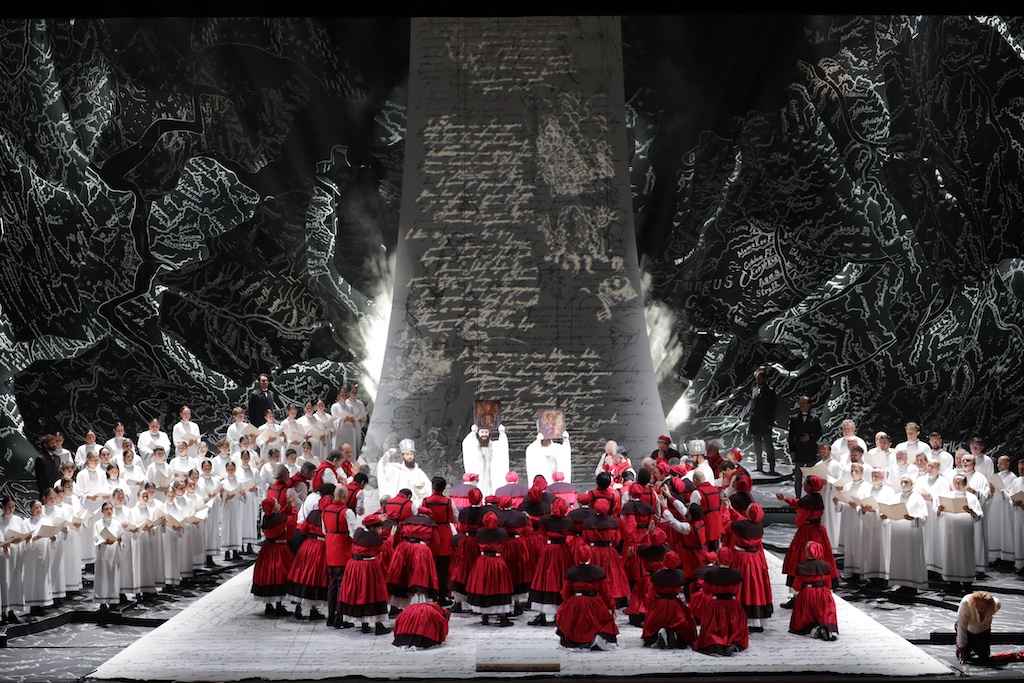
The distance separating the Tsar from “his” people is clearly established by Pushkin and Mussorgsky in the opening scene of their respective works and is superbly reflected by the Danish director Kasper Holten. Indeed, it is even intensified: although Boris stands at the centre of attention, he is physically absent. As soon as the curtain rises, the audience sees extras (choristers) tearing up handwritten pages: history is about to be rewritten once again. While Boris is being entreated indoors, protected by the Kremlin walls, the crowd freezes outside – it is February 1598. The pristav first distributes portraits of Boris, then icons. The crowd’s plea, “To whom are you abandoning us, our father?”, is replaced by “Gloria!”. Everything is perfectly orchestrated, in every sense of the word.
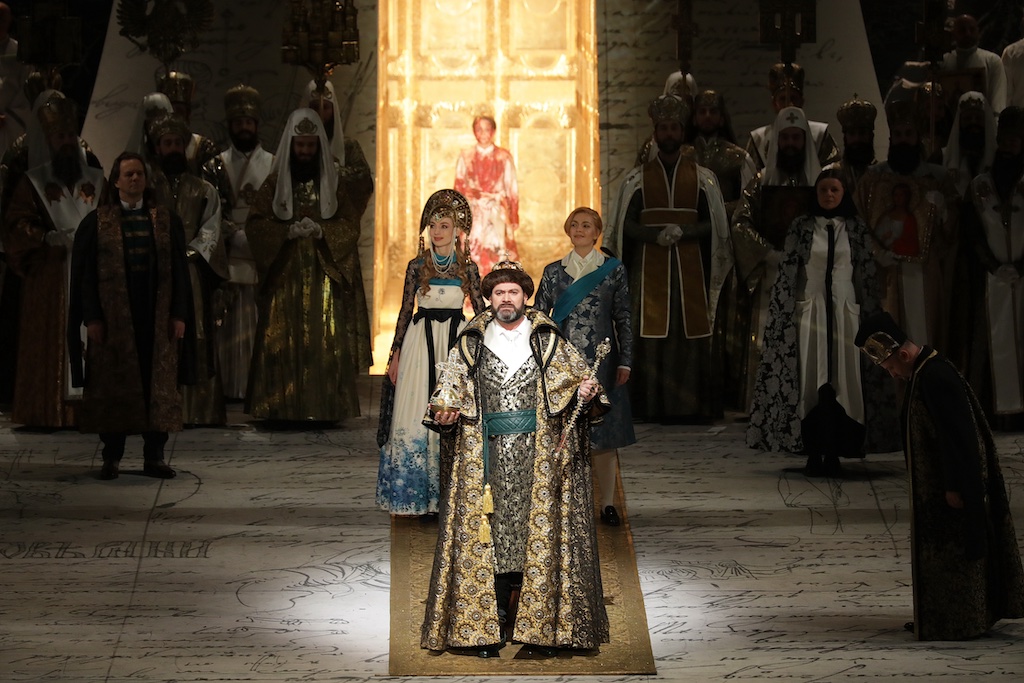
I am particularly grateful to Kasper Holten for the absence of the slightest caricature, the slightest vulgarity throughout the three-hour performance – something exceedingly rare nowadays. The striking coronation scene, with all the splendour of the Orthodox rite, the golden gates opening and the carpet unfurling before the new monarch, cannot help but evoke Vladimir Putin’s inauguration broadcast by television channels across the world. And for once I was not troubled by the fact that Boris’s golden robes (worn by Ildar Abdrazakov, magnificent as ever and enthusiastically applauded by the audience) were replaced with an almost contemporary suit: because the opera suddenly feels utterly contemporary.
The new Tsar’s very first words – “My soul is in pain” – immediately plunge us into the eternal debate about the “peculiarities of the Russian soul” (equally eternal, perhaps?) and its deviations from normality. One slightly regrets the absence of the candle during Pimen’s scene (beautifully performed by the Estonian bass Ain Anger), the candle that is supposed to go out to mark the end of the story. Yet I am willing to concede that this choice has its own logic, because the story is not, in fact, over. The giant scrolls succeeding one another at the back of the stage like pages of History turning over and back again are a magnificent scenic invention.
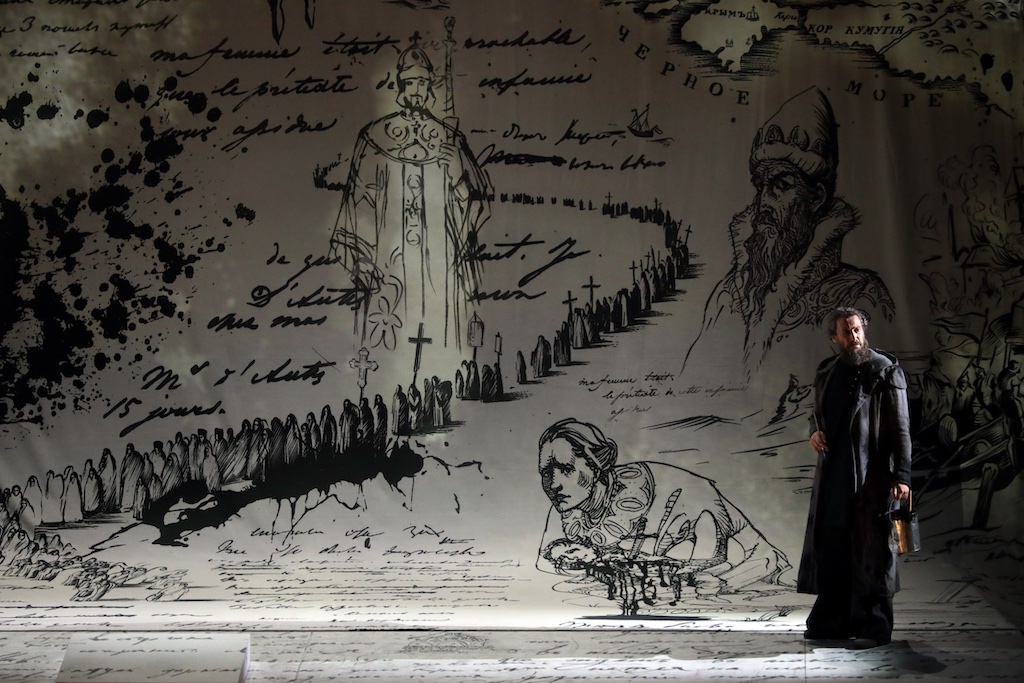
And how can one fail to think of what we are experiencing today during the Lithuanian border scene, which even visually separates Cyrillic Russia from Latin Europe? The pristav reads out the decree according to which all those attempting to flee Moscow must be arrested and searched. But too late: Grishka has managed to escape. Like so many after him. (I would like to congratulate the Russian bass Stanislav Trofimov, whom I heard for the first time and who is magnificent as Varlaam.)
The only real weakness of the production, in my view, is the scene involving Yurodivy, the Holy Fool, crucial in the opera. The role of this strange figure, whose name is translated either as “the Innocent” or, in Italian, as Il folle in Cristo, lasts just a few minutes of stage time. Yet during the golden age of the Bolshoi theater it was entrusted only to the finest tenors, because it demands a combination of an exceptionally tender, but never sugary, timbre, artistic perfection, and interpretative depth: it is this miserable “madman” who dares confront the all-powerful Tsar. One truly has to be mad to attempt such a thing!
I was somewhat disappointed by Yaroslav Abaimov’s performance as Yurodivy and by the directions he had clearly received from the stage director: in my opinion, the Holy Fool should not be looking out at the audience, but directly into Boris’s eyes, forcing him to look away as visions of blood-covered boys are appearing before him. Presented in Soviet schools as the vox populi, the Holy Fool embodies the conscience that eventually catches up even with the most conscienceless among us.
Watching this scene, one thing struck me: usually it is the moment when the Holy Fool accuses Boris of murdering the little Tsarevich that makes the audience’s hair stand on end. But this time it was his macabre prophecy that pierced my heart like the knife entering Boris’s back a few scenes later:
«Soon the darkness will fall,
Black, impenetrable darkness.
Woe, woe to Russia.
Weep, Russian people,
Hungry people!»
Chilling.
Every Russian speaker, even without having read Boris Godunov in full, knows the final line following the announcement of the “sudden death” of Boris and his children-heirs, Pushkin’s final stage direction: “The people remain silent.” Silent, or perhaps indifferent. Here we are confronted with that eternal silence which eventually turns innocent lambs into a dangerous frock.
Those who call for a boycott of Russian culture should, in my opinion, do precisely the opposite and disseminate it by every possible means, because nothing and no one exposes the weak points of this country with such piercing clarity as its great classical works. Some say that art and culture are powerless in the face of war. I see instead their remarkable resilience. Bravi tutti, grazie mille. Viva la musica, viva la poesia!