Bookshelf

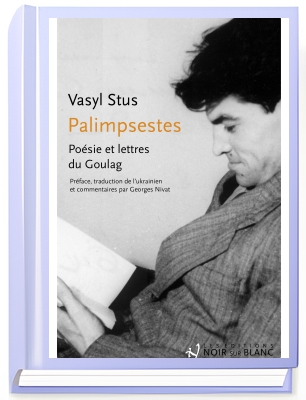
Vasyl Stus : Palimpestes. Poésie et lettres du Goulag. Editions Noir sur Blanc. Mise en vente : 12 mars 2026   608 pages • 28 Euros • 33,60 CHF

Traduction de l’ukrainien, préface et commentaires par Georges Nivat.

Un événement littéraire et éditorial : la première traduction en français du grand poète ukrainien du XXe siècle Vasyl Stus.

 L’Ukraine s’incarne dans deux figures majeures : Taras Chevtchenko (1814-1862), père de la poésie nationale, exilé par le tsar, et Vasyl Stus (1938-1985), poète dissident, persécuté par le régime soviétique. Dès 1965, Stus dénonce les répressions contre les artistes, ce qui lui vaut l’exclusion de l’université. Ses premiers recueils paraissent avant son arrestation en 1972.

Condamné à dix ans de Goulag, il endure l’extrême violence des camps de l’Oural et de la Kolyma. Cette épreuve forge une voix poétique unique, héritière de Rimbaud, Celan, Mandelstam. En captivité, il traduit Rilke et Goethe et compose son chef-d’œuvre, Palimpsestes, où se mêlent douleur et quête de liberté.

Ce volume réunit ses poèmes, des lettres et le bouleversant « Cahier du camp », transmis clandestinement. Mort en détention en 1985, Stus incarne la résistance culturelle face à l’Empire soviétique. Sa voix prophétique affirme la dignité d’une langue et rappelle que la poésie peut être un espace de liberté absolue, même au cœur du Goulag.

 Vasyl Stus (1938-1985) est l’une des figures majeures de la dissidence ukrainienne sous le régime soviétique. Né en Volhynie, il grandit dans le Donbass avant de s’engager, dès 1965, dans le mouvement intellectuel et politique pour la liberté en Ukraine. Poète d’une intensité rare, il publie son premier recueil en 1970, mais ses œuvres sont rapidement interdites par le pouvoir soviétique. Arrêté à deux reprises, il passe de longues années au Goulag, où il rédige son chef-d’œuvre Palimpsestes et traduit Rilke et Goethe en ukrainien. Il meurt en 1985 dans le camp de Perm-36, après une grève de la faim.

Aujourd’hui, son œuvre est étudiée dans les écoles et universités, et Stus incarne la résistance de la langue et de la culture ukrainiennes face à l’oppression russe.

About the author

Nadia Sikorsky

Nadia Sikorsky grew up in Moscow where she obtained a master's degree in journalism and a doctorate in history from Moscow State University. After 13 years at UNESCO, in Paris and then in Geneva, and having served as director of communications at Green Cross International founded by Mikhail Gorbachev, she developed NashaGazeta.ch, the first online Russian-language daily newspaper, launched in 2007.

In 2022, she found herself among those who, according to Le Temps editorial board, "significantly contributed to the success of French-speaking Switzerland," thus appearing among opinion makers and economic, political, scientific and cultural leaders: the Forum of 100.

After 18 years leading NashaGazeta.ch, Nadia Sikorsky decided to return to her roots and focus on what truly fascinates her: culture in all its diversity. This decision took the form of this trilingual cultural blog (Russian, English, French) born in the heart of Europe – in Switzerland, her adopted country, the country distinguished by its multiculturalism and multilingualism.

Nadia Sikorsky does not present herself as a "Russian voice," but as the voice of a European of Russian origin (more than 35 years in Europe, 25 years spent in Switzerland) with the benefit of more than 30 years of professional experience in the cultural world at the international level. She positions herself as a cultural mediator between Russian and European traditions; the title of the blog, "The Russian Accent," captures this essence – the accent being not a linguistic barrier, not a political position but a distinctive cultural imprint in the European context.

Most read

The decision of the Music Society of La Chaux-de-Fonds not to cancel the concert by Elisabeth Leonskaja and The Jerusalem Quartet, scheduled for 22 March, has turned what would have been an ordinary cultural event into a victory of reason and professionalism. I will explain why and present an exclusive interview with the outstanding pianist.

Let me clarify at the outset: this is not about a specific musical composition, but about an ensemble formed just over a year ago which, after a successful debut in Zurich, is now preparing to demonstrate its artistry in Geneva.

The personal relics of the last King of Italy, preserved within the family until today, will be presented to the public in Geneva for the first time. This month, Piguet Hôtel des Ventes will offer at auction a unique collection of orders of chivalry and decorations that belonged to Umberto II (1904-1983). They will be exhibited in the Maison’s salons from 12 to 15 March, before being offered to collectors during the auction week beginning on 16 March.