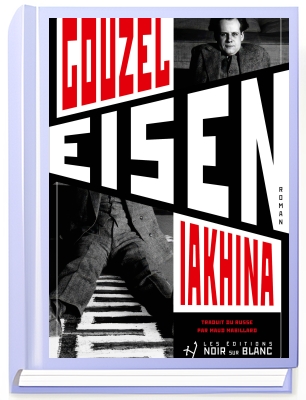
The first and only book by Joël Dicker that I have read is his “American” detective novel The Truth About the Harry Quebert Affair (La vérité sur l'affaire Harry Québert), which was awarded the Grand Prix of the Académie française and the Prix Goncourt des lycéens in 2012. The success was widely echoed in the press: the French newspaper Le Figaro described Dicker as “the discovery of the literary season”, the Belgian Le Soir as a “wonderful surprise of the literary season”, the Swiss magazine Hebdo, still in publication at the time, as a “shell-like young man”, who does not open up in interviews and reveals nothing personal, while the website swissinfo, newly created shortly before, called him a “highly gifted creation of Romandy’s literary scene”. A year later, Joël Dicker was recognised as the best-selling writer in French-speaking Switzerland, and the novel was translated into around forty languages, including Russian.
Not everyone may know that Joël Dicker was born on 16 June 1985 in Geneva, into what The Guardian described as “a close-knit Jewish family” with Russian and Italian roots. In one interview, he said that his great-grandfather, Yakov Moiseïevich Diker, later Jacques Dicker, was born in Bessarabia, was sent to Siberia by court order, but escaped and found refuge in Switzerland in 1906, becoming a lawyer, a socialist politician and a member of the National Council. It is known that Jacques Dicker was one of the organisers of a major anti-fascist demonstration held in Geneva in 1932. On a massive stone in Plainpalais, next to the Uni Mail university building, an inscription reads: “To the victims of 9 November 1932. Never again.” That day, the military opened fire on peaceful demonstrators, killing thirteen people and wounding sixty-five.
As to the future writer, he studied at the Madame de Staël school. At nineteen, like many young Swiss, he went to Paris, where he attended acting classes at the Cours Florent and studied Eastern languages. In 2010, Joël Dicker graduated from the University of Geneva with a law degree but did not follow in his grandfather’s footsteps, having felt a pull towards writing from an early age.
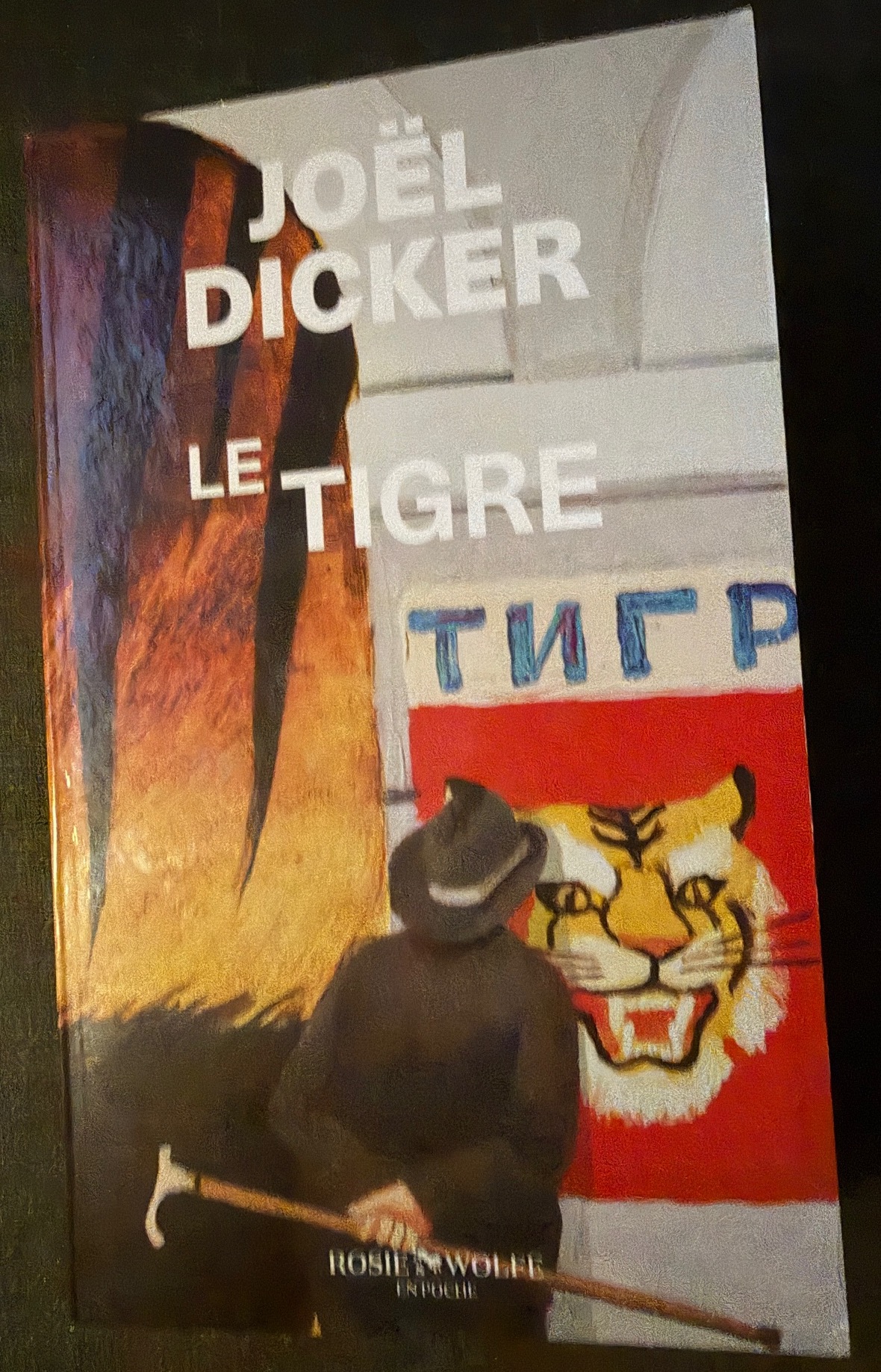
Recently, I came across a small book that caught my attention thanks to the Russian word “tiger” on its cover and the following text on the back: “In 1903, a terrible event shook the Russian Empire: an entire village was wiped out by a tiger. The predator does not seem inclined to stop there. It intensifies its attacks and spreads terror as far as Saint Petersburg.”
Yes, in that very style of newspaper chronicle with a detective twist. How could I not buy it? I then discovered that The Tiger was written by Joël Dicker at the age of nineteen and published in 2005 by the Swiss publisher l’Hèbe as a short story. The small volume, released last year by Rosie & Wolfe, also includes another story written at the same time, The Panther. For those who may be surprised by such “animal” titles, it is worth noting that at the age of ten Joël Dicker founded a newspaper devoted to animal life, La Gazette des Animaux, which he produced for the following seven years, printing the issues on his home computer. His interest in animals has not waned since: in 2024 he published the novel A Wild Animal, and in 2025 The Very Catastrophic Visit to the Zoo.
This tiny pocket-sized book, perfectly suited to a handbag, contains 87 pages printed in large type with generous spacing. Fifty of them are taken up by The Tiger, and in the preface to this reissue the author defines the form of his work as “hybrid: a very long short story or a very short novel”. In my view, it clearly does not qualify as a novel, but that is beside the point. In the same preface, Joël Dicker recalls his youth and explains that it is not by chance that The Tiger is set in the Russian Empire: “at that time, I discovered, fascinated, the classics of Russian literature, especially Dostoevsky and Gogol. It was then, immersed in those books, that I began to write a story about the pursuit of a tiger that devours people.”
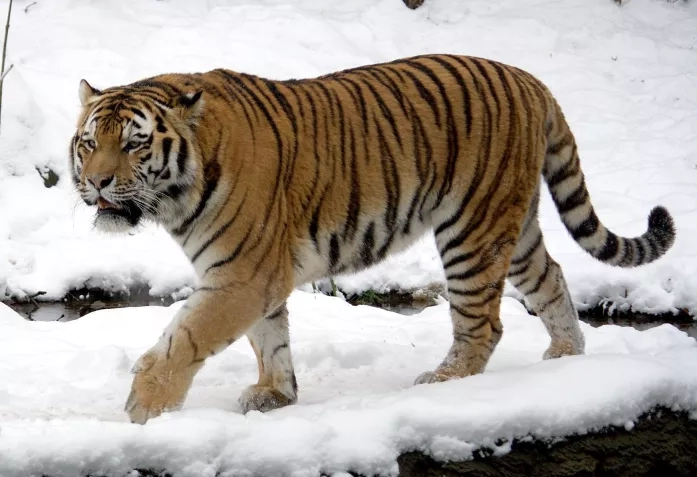
For my part, the connection does not seem obvious: the tiger is not the first animal one associates with Russia ; usually a bear springs to mind, but I’ll accept that. I even wondered whether the choice of animal might have been influenced by the fact that, as part of one of Vladimir Putin’s many publicity campaigns, within a programme to protect Amur, or Siberian, tigers in 2008, the Russian head of state personally placed a collar to what was supposedly a wild animal. Who knows.
I looked into it: Wikipedia contains no information about tiger attacks in 1903. Among the main events of that third year of the twentieth century in the Russian Empire were a grand costume ball at the Winter Palace, political demonstrations in Baku, the shooting of a workers’ demonstration in Zlatoust, a pogrom in Kishinev, Kolchak’s polar expedition, a general strike in the South, the split of the Russian Social Democratic Labour Party into Bolsheviks and Mensheviks, and many other things, but not a word about a tiger. So let us chalk it up to artistic invention both the story itself, which reached the Russian capital through the account of two wandering monks who had discovered a devoured village, and the settlements said to have fallen victim to the predator, Tibié, Skolkele and Pritit, for which I found no trace of real existence.
For the first half, I read the text with a smile, so many clichés does it gather about the peasant village, the terrible frosts, the endless train journeys, and the inevitable lard for supper. I was equally amused by the unexpected reference, in such a narrative, to a “new economic policy in Siberia”, and by the philosophical element: as the story unfolds, it emerges that the tiger attacks only those who fear it. I also smiled at the the young author’s rather approximate understanding of autocracy: according to Joël Dicker, Nicholas II, concerned that the tiger would drive all investors away from this scarcely developed region, does not merely order the problem solved, but bargains, declaring: “Every man has his price.” The expeditions of professional hunters return, when they return, empty-handed. In the end, following the example of tsars in Russian fairy tales, the sovereign promises the brave man who manages to bring the tiger’s head to the palace not half his kingdom nor his daughter’s hand in marriage, but gold equal to the weight of the tiger. It should be noted that an adult Siberian tiger can weigh up to 300 kilograms, so it is clearly worth it.
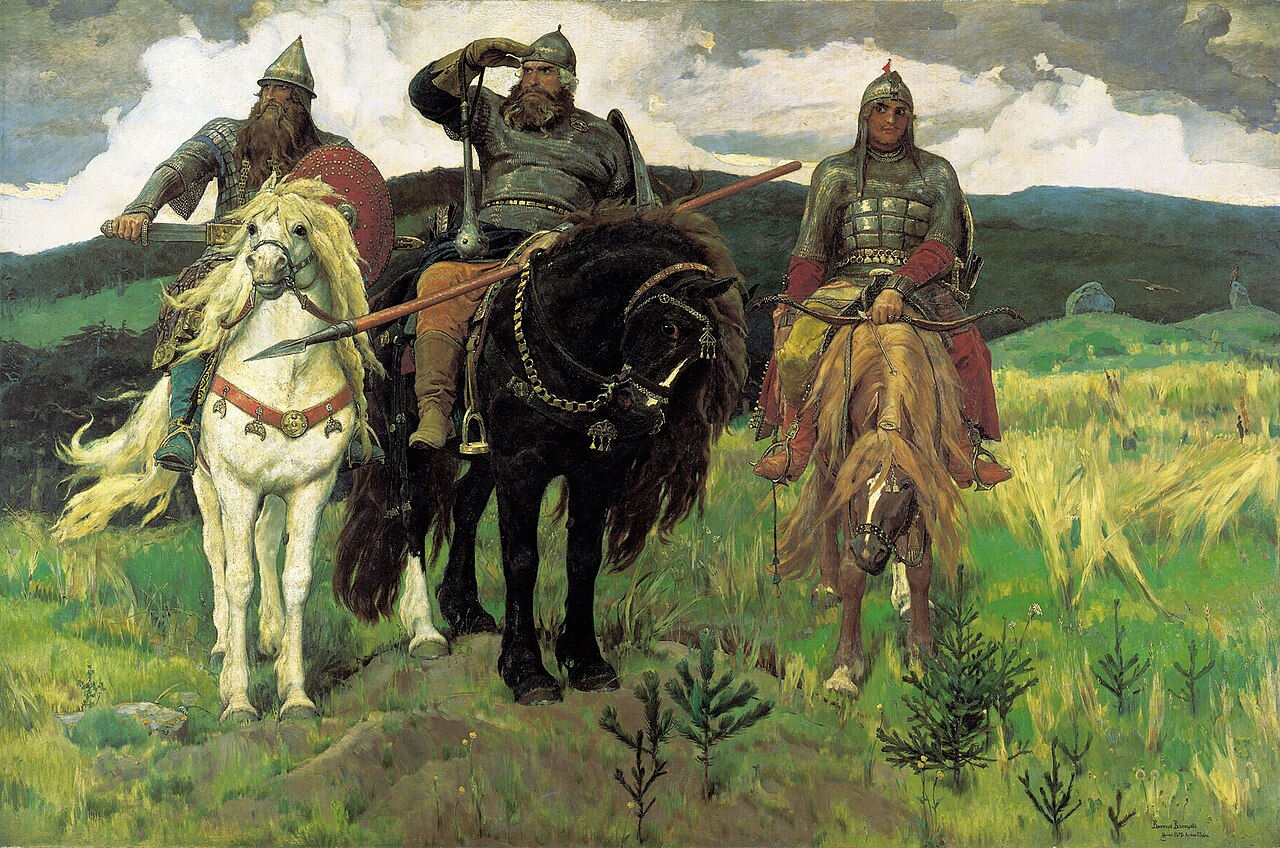
A candidate for the role of hero then appears: Ivan Levovich, a twenty-year-old resident of Saint-Petersburg, of modest means, working in his father’s carpentry business, to put it in modern terms. Ivan is a classic name for heroes of Russian fairy tales, who reliably defeat various villains, but I had never encountered the patronymic Levovich before. Perhaps the author had in mind the three famous Russian bogatyrs, Ilya Muromets, Dobrynya Nikitich and Alyosha Popovich, renowned for their exploits and immortalised in Viktor Vasnetsov’s painting of 1898, that is, shortly before the events described.
At this point, the story takes a sharp turn, leaving nothing of the fairy-tale premise intact. It turns out that Ivan Levovich embarks on this risky undertaking not out of noble motives, to save his fellow citizens from the striped menace, but for purely pragmatic reasons: “to become rich and famous throughout the empire, by overcoming the deep gulf that separated him from the splendour of high Russian society”. Had this been America, no one would be surprised, as this is the typical American dream, but in the Russian literary tradition such a motive is not customary. Though perhaps it is closer to reality than one might think.
In fact, this Ivan proves to be a thoroughly unpleasant character, calculating and selfish, yet physically resilient and lucky. He survives a confrontation with the tiger after, looking it straight in the eye, declaring: “I am not afraid, I am not afraid!” One might think he would give thanks and return home, but the gold fever does not release him even in the Siberian cold: he continues to pursue the beast, wandering through the taiga. And in the end, he fully reveals his repellent nature. Taking advantage of the trust of the Shevchenko family, who took him in, fed him and kept him warm, he commits an unspeakable act: he uses them as bait for the tiger, “calmly watching as each body is torn apart like paper”, and only then fires at the predator, not killing it, but merely wounding the animal.
I do not know why Joël Dicker chose one of the most well-known Ukrainian surnames for the innocent victims of this Russian trickster, but let me recall that the story was written in 2004, so it would hardly be appropriate to look for a political subtext here. However, a fairy tale, or even its imitation, would be a fake if evil were not punished. The tiger proves no fool: wounded and enraged, it lures Ivan, fearful of losing his trophy and continuing the pursuit, into the depths of the forest and attacks him, “tearing off skin and breaking bones”. Even in such a state, and with his entrails torn out, Ivan still manages to drive a knife into the tiger’s belly. In the end, they both die, having spent the night “looking into each other’s eyes, admiring one another and keeping each other company”.
A strange story, is it not? But the moral is clear.