In 2015, the German director Andreas Dresen and the stage designer Matthias Fischer-Dieskau, son of the celebrated baritone, created a version of Arabella at the Bavarian State Opera in Munich, placing the emphasis on Strauss’s links with the Nazi regime, which provoked heated debate. The central element of the set was an imposing staircase immediately evoking the swastika and executed in the corresponding colours red, black and white, as well as in its stark graphic design. The subtext was obvious: if you want to climb the staircase, social or otherwise, you must befriend power.
Five years later, the Canadian director Robert Carsen turned to this work; I had already seen his productions of Eugene Onegin and Rigoletto in Geneva. (Incidentally, in 2014 his Rigoletto was shown at the Bolshoi Theatre in Moscow, but met with a rather restrained response owing to the interpretation of the title character, whom the director transformed from a court jester into a circus clown, a significant lowering of status.) Arabella, however, I somehow missed at the time, and now, having come across an interview with Carsen from six years ago and seeing that he too pursued the historical line that interests me, I decided to make up for that omission. But let us begin with the plot itself.
The opera might well have remained such had the libretto not been written by Hugo von Hofmannsthal, the leading playwright of Austrian and European symbolism and Strauss’s long-standing librettist, whom the composer called his most precious friend. After their meeting in 1898, Hofmannsthal wrote the libretti for six of his operas. Sadly, Arabella became their final collaboration. A pupil of Wagner and the son of an Austrian-Jewish banking family with Lombard roots, Hofmannsthal died on 15 July 1929 from a cerebral haemorrhage, two days after the suicide of his eldest son. Almost exactly four years after this tragedy, on 1 July 1933, Arabella was premiered at the Dresden Opera, Strauss having completed the score in October 1932.
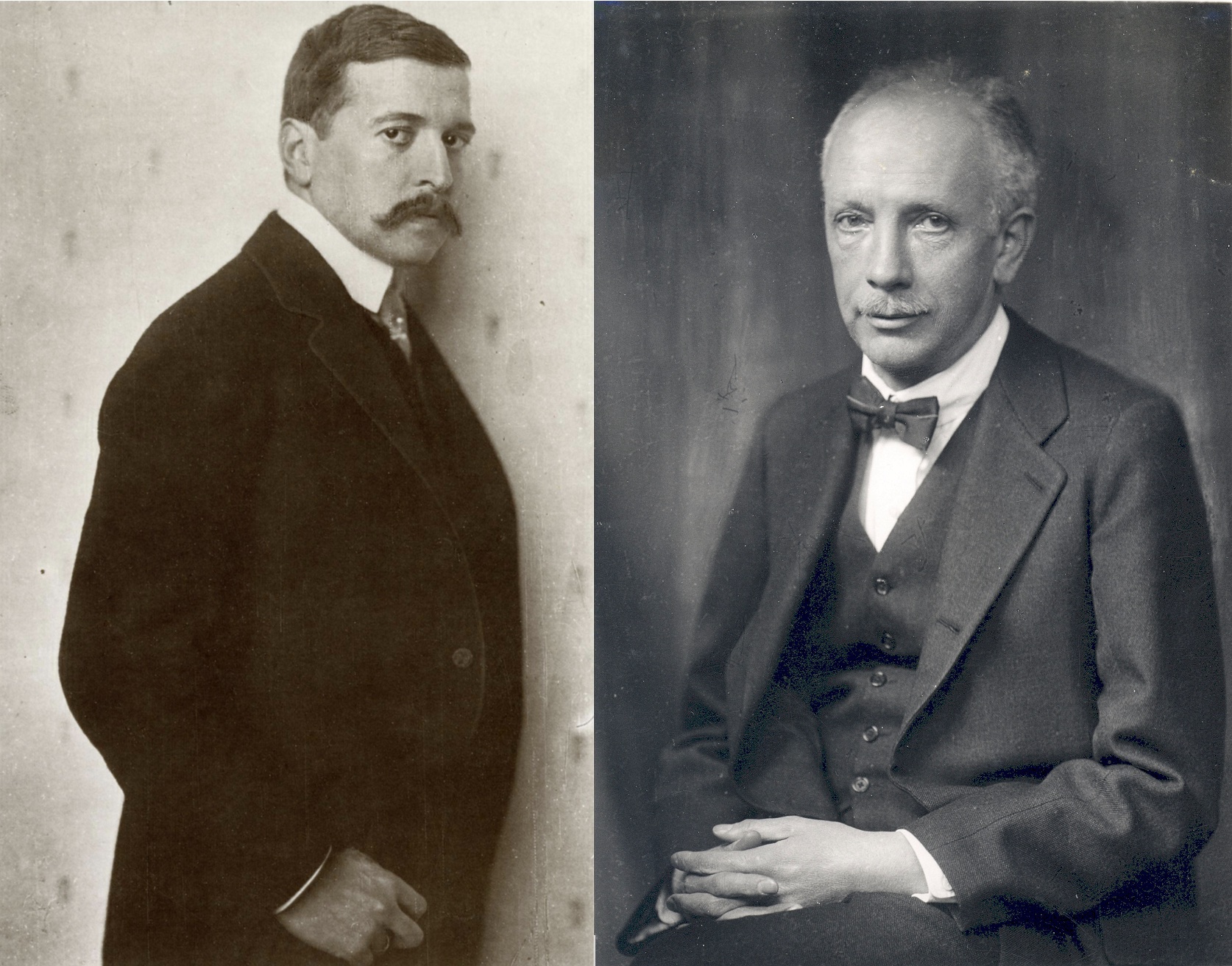
“Hofmannsthal was a perceptive artist and a man of great sensitivity, deeply aware of his time. His texts reflect the spirit of their age in a very specific way,” Robert Carsen quite rightly observed. Indeed, this “comedy of disguises”, set in Vienna in 1860, in fact turns into a social comedy, if not a tragicomedy. The theme of the divide between the impoverished nobility and the nouveaux riches, “they all crave money”, as Zdenka sings in the first act, has not lost its relevance, but even more important is the theme of the marriage of convenience at the centre of the plot. This cynical union between a man and a woman acquires a much broader meaning and raises the question of the price of material well-being, and whether one does not ultimately pay for it not merely with a union with an unloved person, but with Evil.
In this context it is difficult not to draw a parallel with Richard Strauss himself, for in the few years between Hofmannsthal’s death and the first performance of Arabella the world had changed profoundly. Six months before the premiere Adolf Hitler became Reich Chancellor of Germany, and in the same year Strauss assumed the post of President of the Reich Music Chamber, which, for example, allowed the Nobel Prize laureate in literature Hermann Hesse to regard him as a collaborator. It is worth recalling that Strauss originally dedicated his opera to the Dresden Opera’s General Music Director Fritz Busch, who was to conduct the premiere, and to the theatre’s director Alfred Reucker. Both, however, were dismissed for their solidarity with Jewish musicians, and Busch left for England. Strauss then allowed Clemens Krauss to conduct the premiere. Krauss not only took on the production of Arabella, but in 1934 became director of the Berlin State Opera, a post vacated by Erich Kleiber in protest against Nazi policy, and in 1937 was appointed intendant of the Munich National Theatre after the dismissal of Hans Knappertsbusch for the same reasons.
Those who leave and those who remain, those who are dismissed and those who take their place… A configuration all too recognisable today.
Robert Carsen sets the action in 1938, five years after the premiere, when Austria had already been annexed by Germany, as though imagining what changes Hofmannsthal might have made to the libretto had he lived a little longer. It is no accident that the libretto of Arabella is considered one of Hofmannsthal’s finest achievements, for it is anything but superficial. On the contrary, it is finely nuanced and endows its characters with sharply defined traits, placing in their mouths words that would acquire a particular resonance after his death – for instance, Mandryka’s mention of the Jew to whom he sold the forest inhabited by hermits and gypsies.
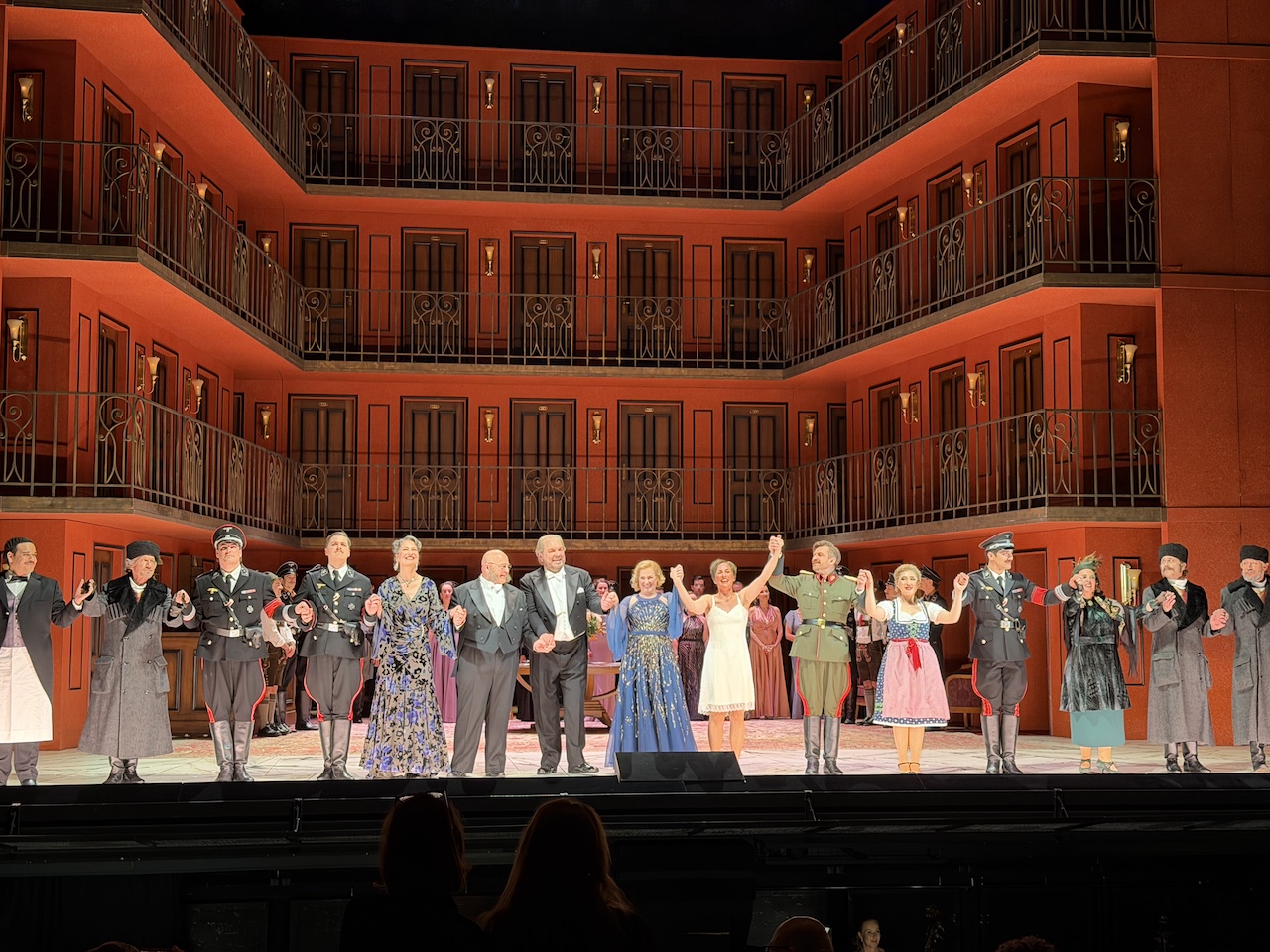
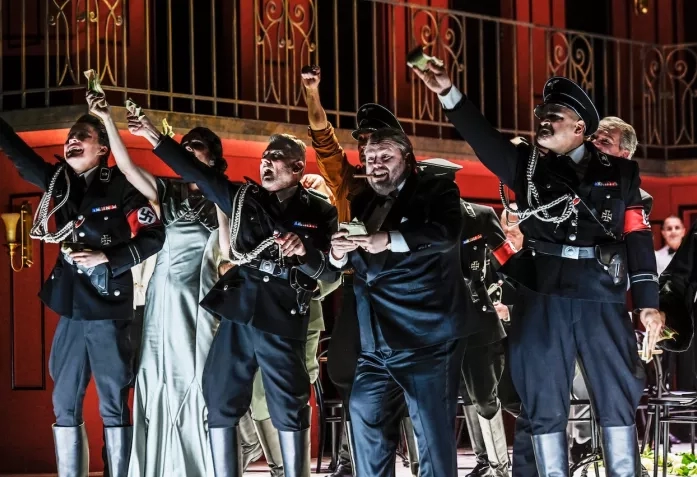
Carsen’s directorial approach is clear from the very first moments of the performance. The dominant colour of the set is red, and the three counts competing for Arabella’s favour, Elemer, Dominik and Lamoral, appear in officers’ uniforms with swastikas on their sleeves. Swastikas are present on both sides of the stage throughout the performance, the curtain opening in a deliberately evocative manner. This line might perhaps have been developed further, yet it seems to be resisted by the music itself. Strauss, whatever his real views may have been, could not but see what was happening around him, and therefore seems to have sought refuge from grim reality in the elegant Vienna of the mid-nineteenth century, with its waltzes and balls. Professional music critics often debate why Arabella is inferior to Der Rosenkavalier, yet I do not claim that authority and found much to admire in its use of folk elements, including East Slavic folklore, as well as its lyrical moments and features characteristic of the Viennese operettas I am so fond of. Even if there are moments that drag, they are not what remains in the memory.
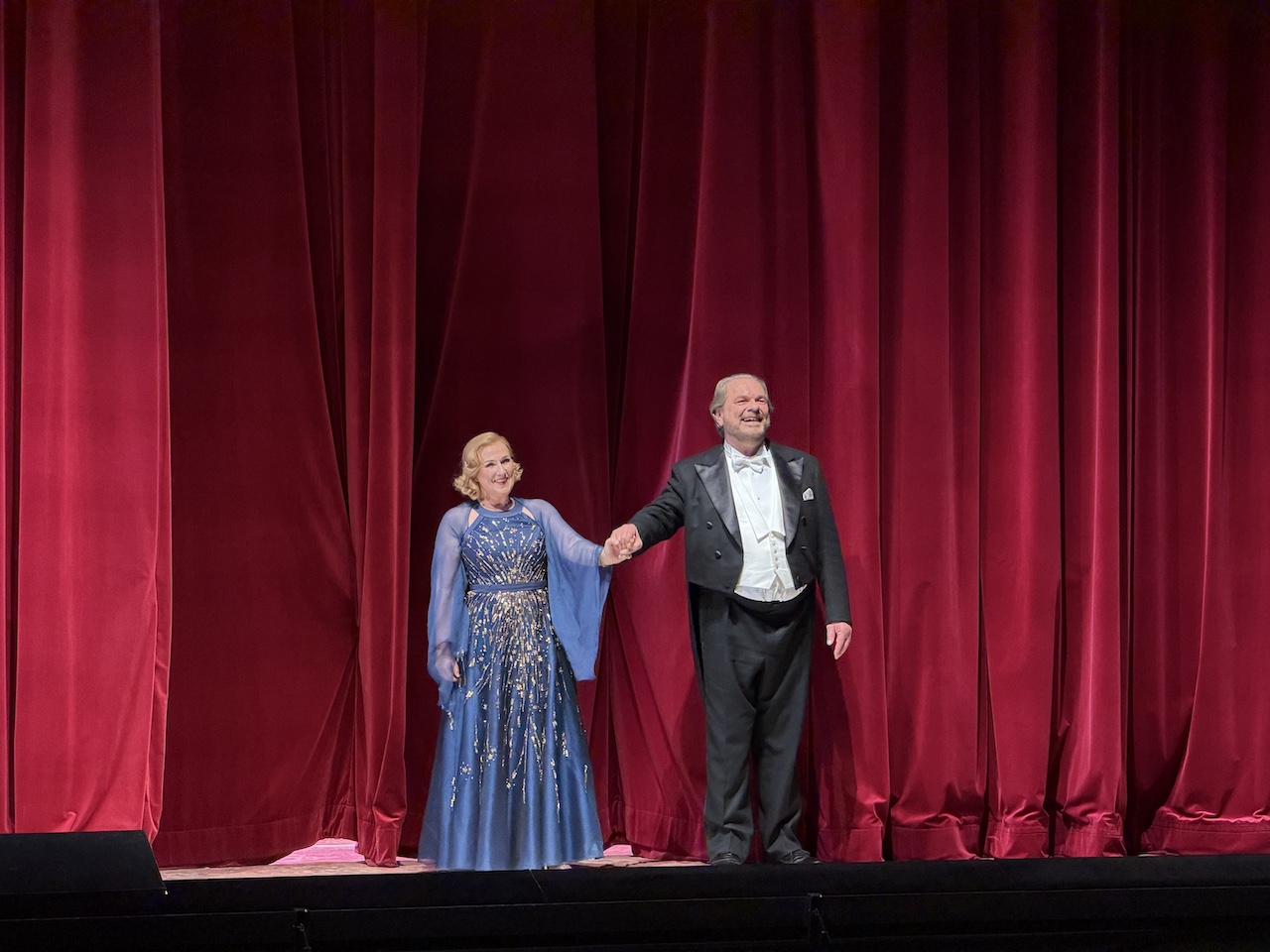
The singers more than lived up to expectations. All were excellent, but above all the German baritone Michael Volle. It is hard to imagine a more fitting Mandryka, this Eastern European strongman, a robust and handsome figure, at once sincere and brazen, and profoundly provincial despite the wealth that has come to him after his uncle’s death. The scene at the Coachmen’s Ball, when a jealous and drunken Mandryka pours out everything that, as the saying goes, a sober man keeps to himself, is a masterpiece. It is here that he utters that very rhetorical question about the price of the key to the countess’s bedroom, once again underscoring the theme of universal venality. The vocal power of Michael Volle and his equally powerful stage presence were warmly received by the audience, who accorded him a special ovation at the end of the performance.
Arabella, portrayed by the wonderful soprano Diana Damrau, proves a match for Mandryka. At first, the heroine appears a typical society beauty, if not something of a flirt, concerned only with not making a poor choice of husband – which is understandable given that her mother has already sold the family jewels, her father his duelling pistols, and he is no longer extended credit for cognac. Something must be done to save the family. Yet thanks to Diana Damrau’s artistry Arabella is transformed before our eyes, acquiring the qualities of a loving daughter and sister, sincerely rejoicing in the unexpectedly possible happiness of Zdenka, sung by the German soprano Annette Fritsch, and Matteo, the Slovak tenor Pavol Breslik, as well as those of a young woman dreaming of an ideal man. It is quite clear that she chooses the “foreigner” Mandryka not because of his wealth, of which she is initially unaware, at least not solely for that reason. Why, however, she sees in him her ideal – this bear in a dinner jacket – is a more complex question. One thing can be said: such things do happen to romantic natures – think of Beauty and the Beast. Nor is it confined to fairy tales.
So yes, Richard Strauss’s Arabella has a happy ending. But in the very final moments of Robert Carsen’s production, as the curtain begins to fall, figures bearing swastikas appear at the back of the stage, surround the embracing Zdenka and Matteo and level their pistols at them. I fear not all will notice this, yet it is precisely here that the true ending of the story lies.