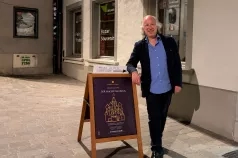
I am very fond of the Sonia Zannettacci gallery in Geneva’s Old Town. And of its owner. Both occasionally offer remarkable surprises, such as the last known photograph of Boris Pasternak taken in Europe. When I learned about the upcoming exhibition by the French artist Yvan Salomone and discussed it with Madame Zannettacci, I concluded that this time nothing I could relate to this blog. But!
The traditional vernissage was preceded by a private screening of the film 42 JOURS at my favourite Geneva cinema, Cine17. The film is the result of Yvan Salomone’s double crossing of the Atlantic, which began in Le Havre in November 2019 aboard the container ship Marfret Guyane (capacity 1,700 containers, deadweight 22,000 tonnes). The journey lasted 42 days and included 11 stops, during which the artist shared the daily life of a 22-member international crew made up of French, Lithuanian, Ukrainian and Filipino sailors.
It is hard to imagine a more unexpected setting for an artist’s residency than a container ship, a vessel designed to transport cargo in standardised units, that is, containers (TEU). Yet Yvan Salomone was not the first. The French company Marfret, founded in 1951 by Claude Vidil and operating worldwide, welcomes such collaborations. “The agreement with the shipowner was that after the journey I would produce twelve watercolours, and he would have the right to use the images for posters, a calendar and other corporate communication,” Yvan Salomone explained to me.
Twelve watercolours were painted. How? From memory, from photographs and from film stills. In some ways they reminded me of the work of Soviet painters such as Yuri Pimenov or Alexander Deineka. When I shared this observation with Yvan Salomone, he laughed and admitted that already thirty-five years ago he had been reproached for an affinity with Socialist Realism.
The film he made, just over an hour and a half long, has a hypnotic effect on the viewer. Especially after the first ten minutes, when you become accustomed to the idea that nothing is happening and, it seems, nothing will happen, and you simply sink into images of both extreme harshness and striking beauty. There is no dialogue in the film, but there is an abundance of sound, from the piano, inspired, as I later learned, by John Cage, to the dull rhythm of the engine room, the vibration of the deck beneath one’s feet, the flapping of unsecured ropes, the creaking of ropes and fittings, metallic clatter, the hiss of the ship’s wake, the rustle of rain, waves striking the hull, the whistle of wind through the lines, the hum of voices over the intercom, fragments of orders, footsteps on the metal deck, the clatter of dishes in the galley, the creaking of doors and hatches, short radio signals, and occasional horn blasts. The cries of birds. And the “emptiness” of the open ocean, the absolute silence of the night.
And then, just as I relaxed, the screen suddenly showed, in Cyrillic: Лука, Матфей, Иоанн, Марк. Luke, Matthew, John, Mark. Then, in Russian: “Пикник на обочине”. Roadside Picnic. This is how Yvan Salomone, an admirer of the novel by the Strugatsky brothers, translated into 55 languages, and of Andrei Tarkovsky’s cult film Stalker, based on this novel, chose to title an episode of his own film, devoted to the only large shared meal of the crew during the entire 42-day voyage. Oceanside Picnic. A fitting title, since after Tarkovsky’s film the term “stalker” (from the English to stalk) entered the Russian language and became firmly established. In the novel, a stalker is someone who, breaking the rules, enters the Zone and brings out various artefacts, which are then sold for a living. In Russian, thanks to Tarkovsky’s film, the word came to mean a guide capable of navigating forbidden or little-known spaces. Later, “stalkers” also came to refer to enthusiasts of industrial exploration, especially those who visit abandoned sites and ghost towns. Do you see the parallel? For me, Yvan Salomone’s film also became an unexpected journey into the industrial world of a ship crossing the ocean, into a space previously unknown to me.
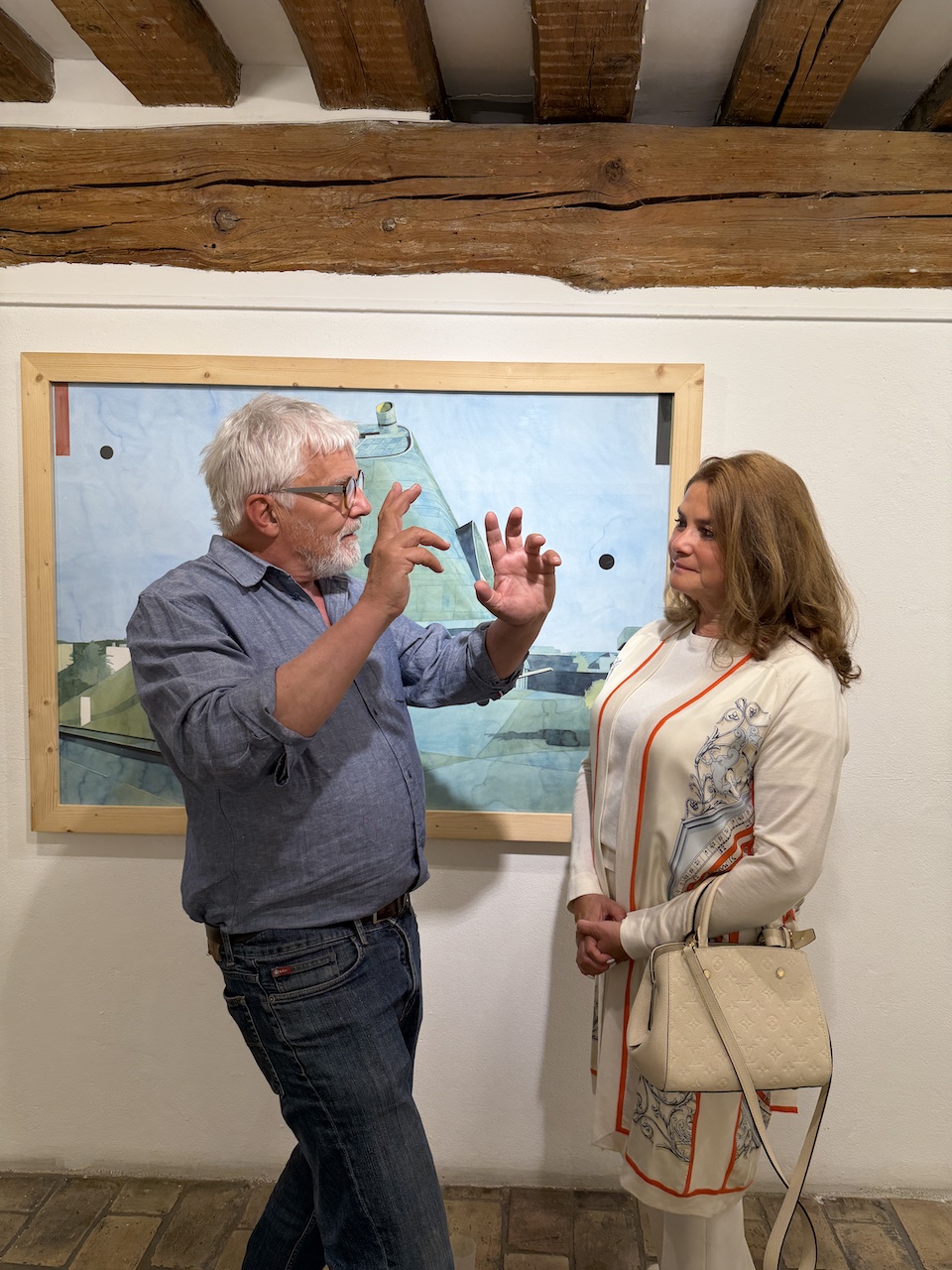
And so, this “Russian accent” ultimately gave me the opportunity to tell you about this artist, who, in addition to painting, is seriously interested in music and literature. Almost a Renaissance man. He was born in 1957 in Saint-Malo, in Brittany, and still lives there, occasionally setting off on journeys. (Reflecting on other artists who might have been such “homebodies”, I thought of Giorgio Morandi, who spent almost his entire life in the same apartment on Via Fondazza in Bologna. And of Johannes Vermeer, who never left Delft. Or of Yuri Pimenov, already mentioned, who was born and died in Moscow.) A self-taught artist with a long list of group and solo exhibitions, mainly in France but also in the Netherlands, Belgium and Italy, he is now exhibiting in Switzerland for the fourth time. His works are held in two of our museums, the MAMCO in Geneva and the Museum of Fine Arts in La Chaux-de-Fonds.
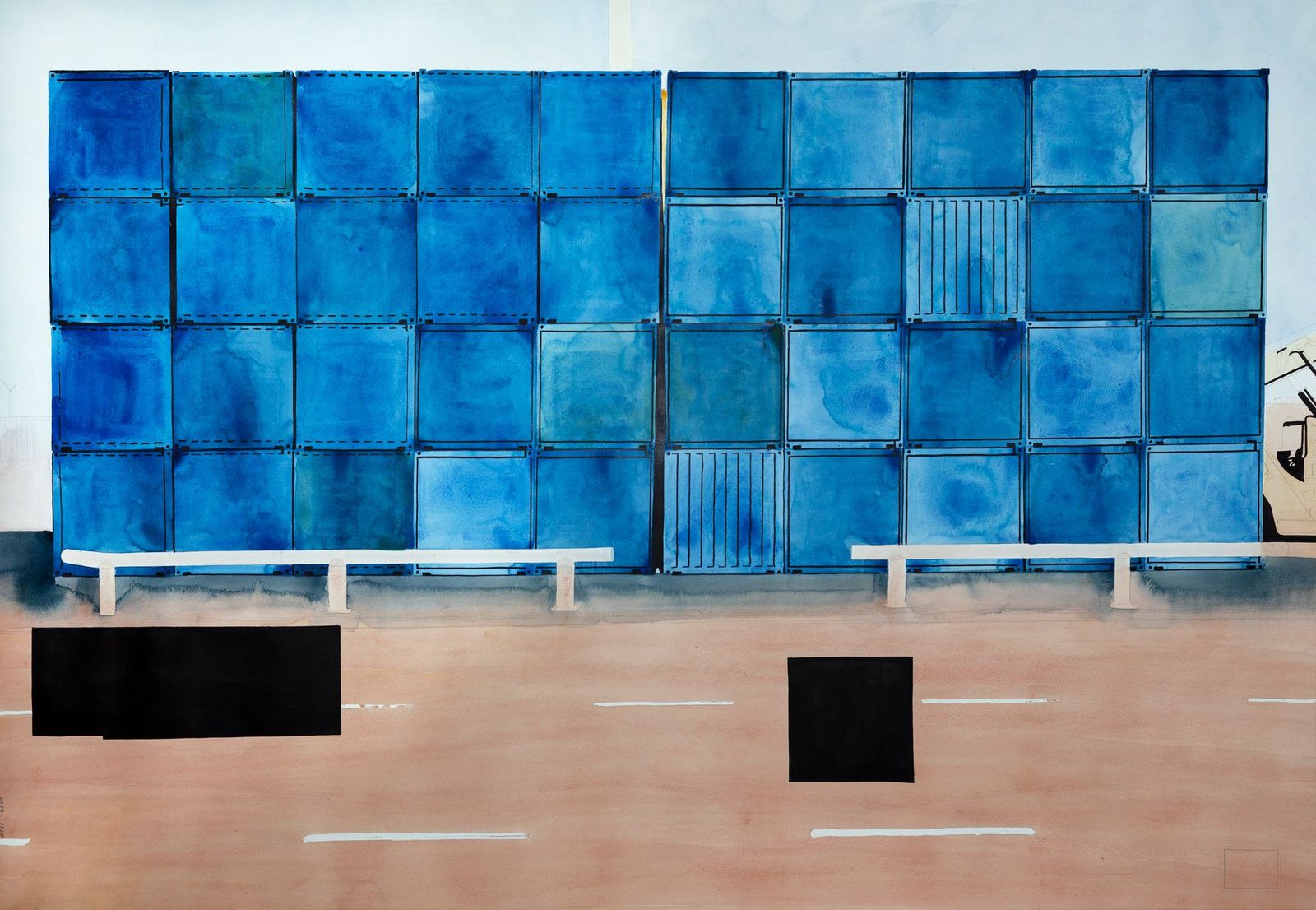
A turning point in Yvan Salomone’s artistic life came in 1991. It was then, after experimenting with different techniques, that he decided watercolour would be his sole means of expression and established a ritual from which he has not deviated since. Subjects found and photographed during his travels, whether near or far, are transferred onto sheets of paper measuring 97 × 138 cm. Work begins on Monday and is completed by the end of the week. The painting is then dated and given a title consisting of an eleven-letter word using the 26 letters of the Latin alphabet. The titles are strange, unrelated to the image, and precisely for that reason intriguing.
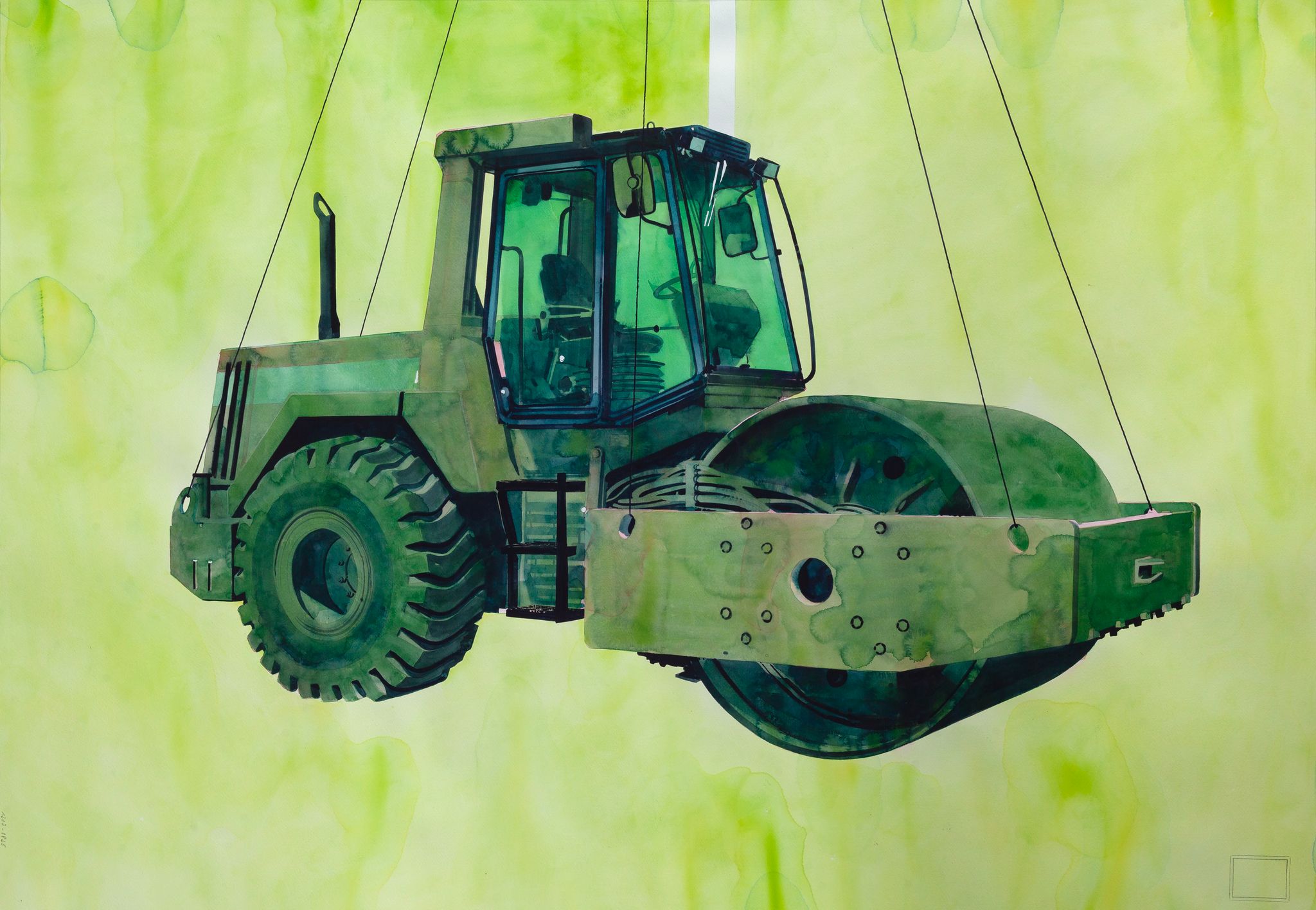
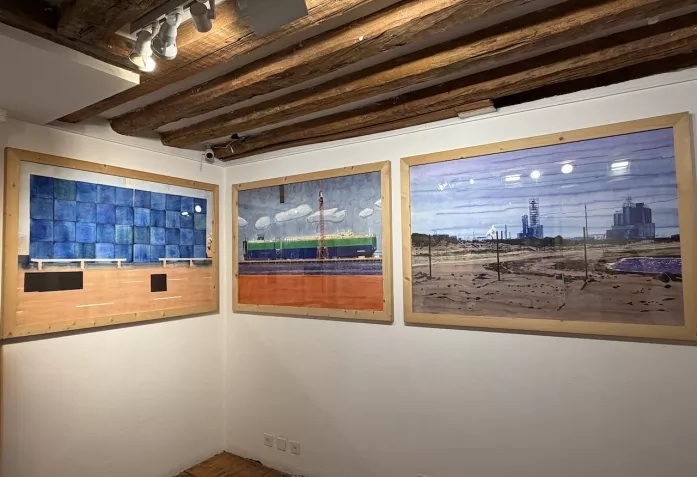
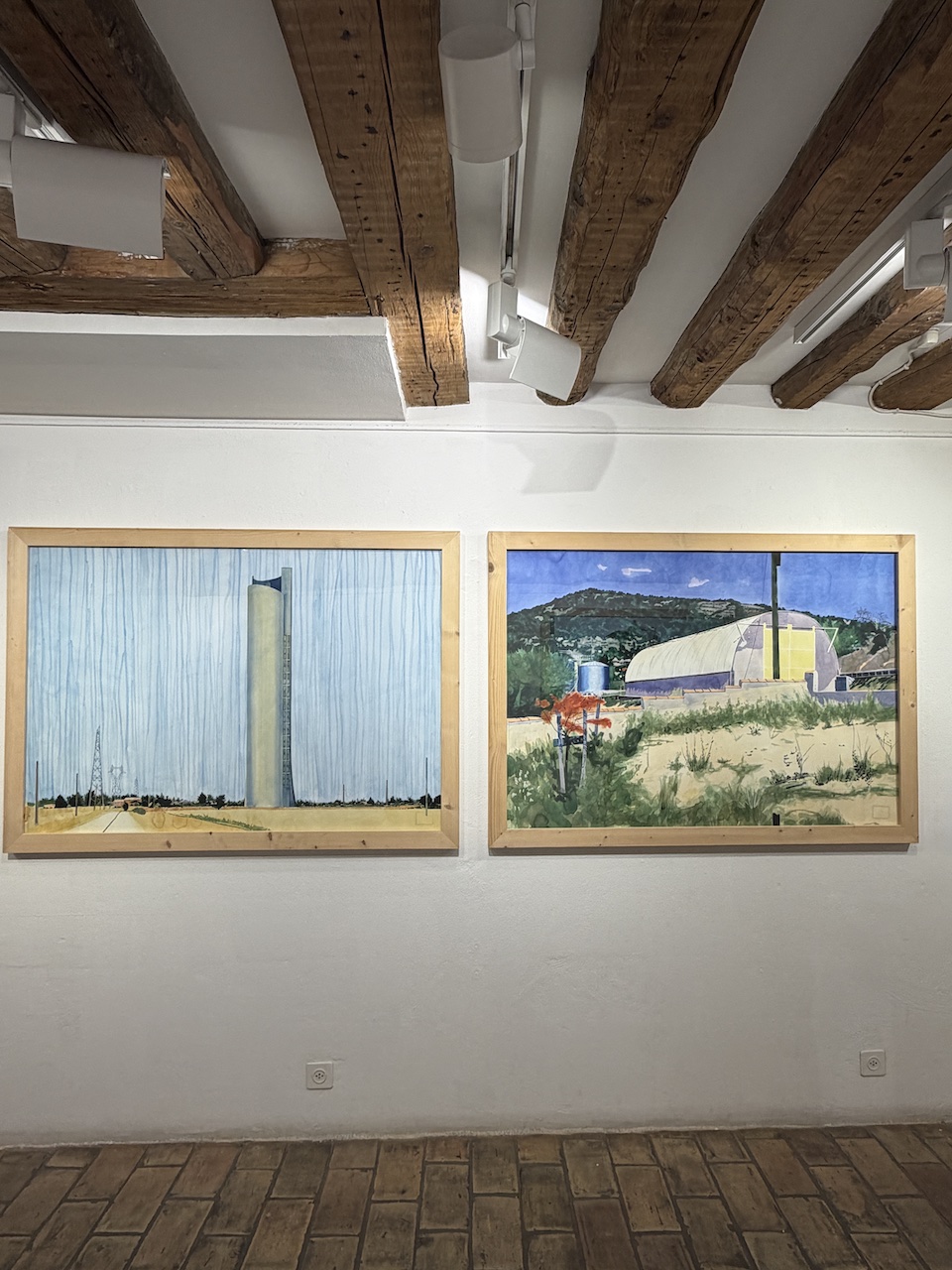
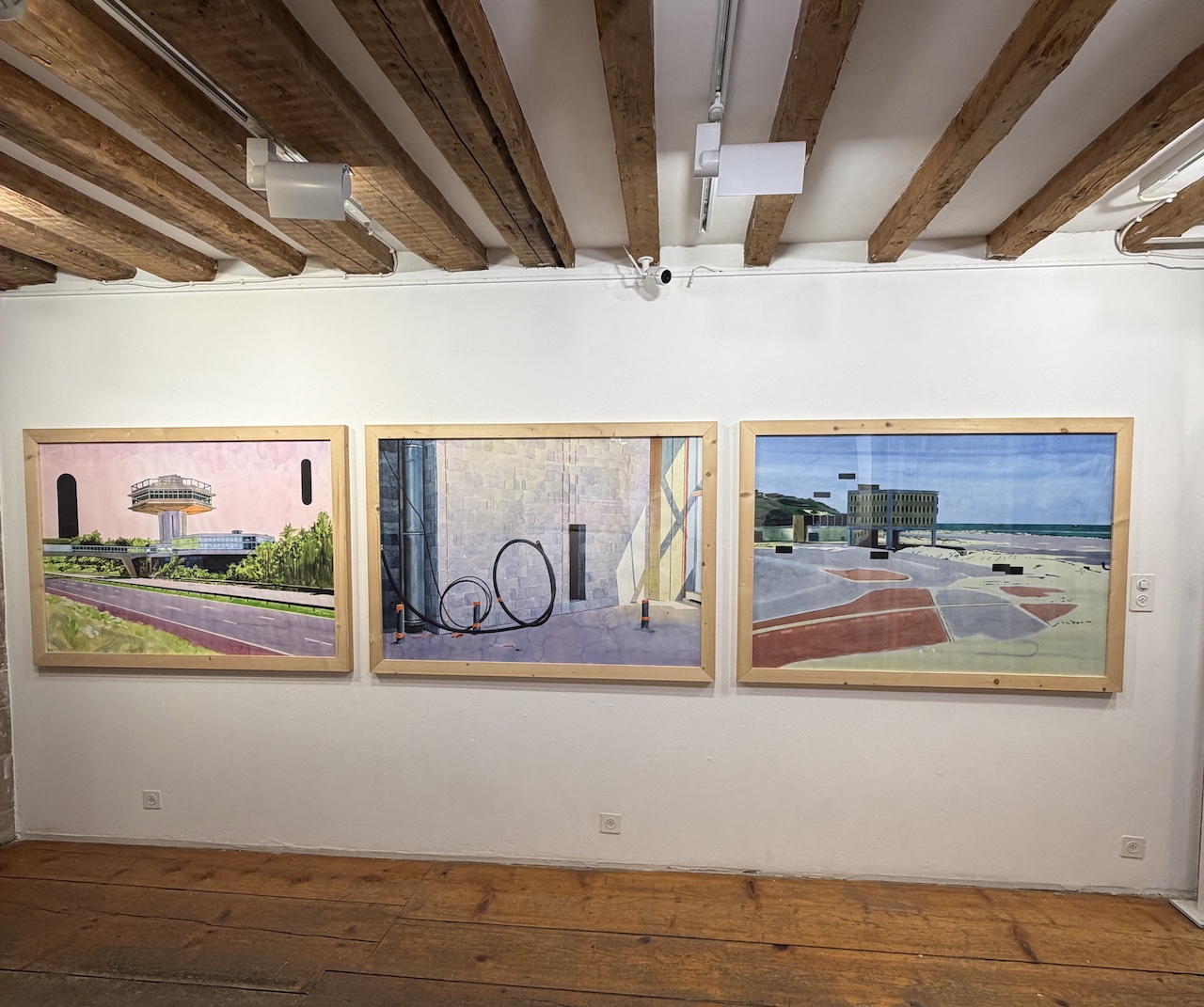
The current exhibition at the Sonia Zannettacci gallery, entitled 26¹¹, follows the same principle. Of the works produced after the container ship journey, only one is shown here. It is not immediately obvious that the squares in various shades of blue represent containers. Everything else consists of recent watercolours. At first glance, their subjects are not especially “artistic”: anonymous buildings, empty landscapes. Or even a tractor suspended by ropes. Note that this painting bears a Russian title, “Krougovorot”. In the original the word has ten letters, while in its French transcription it has eleven. Who knows where Yvan Salomone learned this word, which can denote something as concrete as the water cycle or the turning of a wheel, as well as a philosophical idea, the eternal cycle of time. Sonia Zannettacci is therefore right to say that, “contrary to a literal description, the artist reveals to us another vision, another world, through delicacy, softness, lightness, the subtlety of colours, and the vibrations he imparts to them”.
The exhibition runs until 10 July, and I highly recommend visiting it. And if you have the space, acquiring a work as well. They are timeless.



Bernard IVA May 28, 2026
Sikorsky May 28, 2026