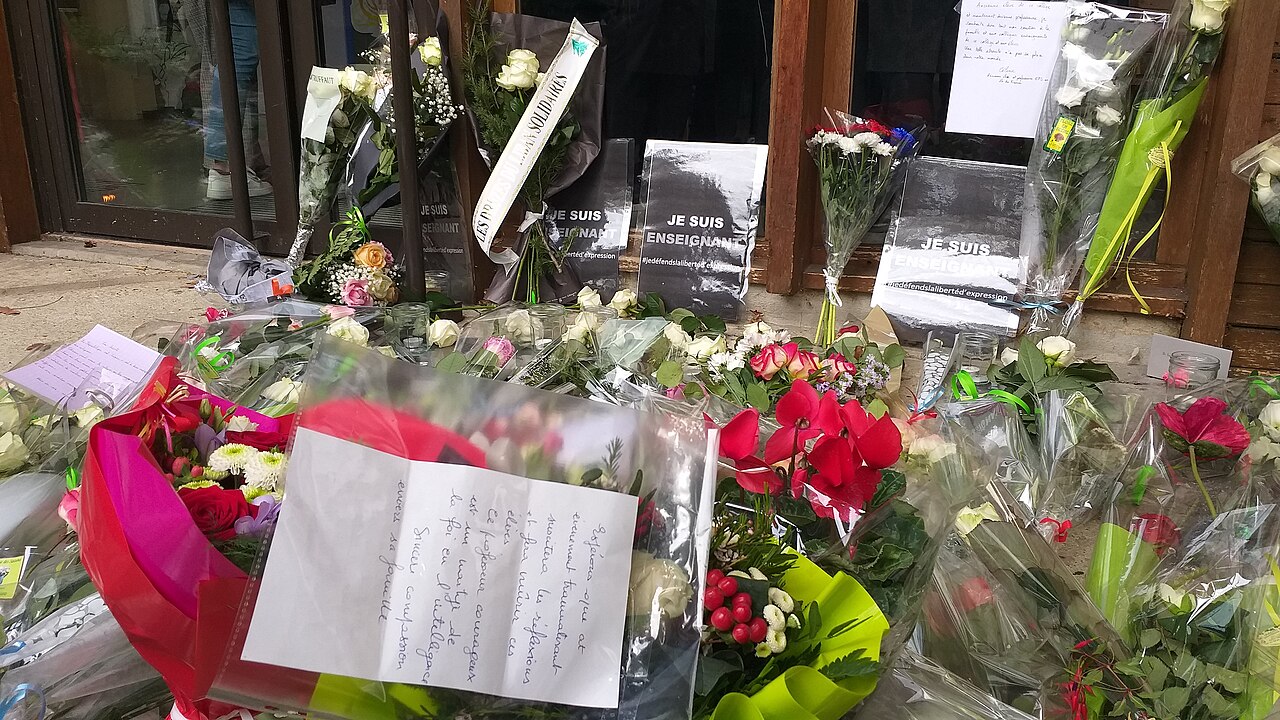
On 17 October 2020, when news of this horrific crime became public, I published a text – then on the platform of the newspaper Le Temps and only in French – which I would like to reproduce in full today, because my feelings have not changed. Here it is.
«I cannot remain silent after waking up to this news on a bleak Saturday morning, a Saturday morning in the twenty-first century. A century of unprecedented technological progress, certainly, but hardly the century of the Enlightenment. Our century is a dark one, and not only because of Covid-19.
A history teacher has been beheaded in the street, near his school outside Paris, the City of Light by definition. What was his crime? During a lesson on freedom of expression, he showed his pupils cartoons depicting the Prophet Muhammad. It takes us back almost five years, to the massacre at the offices of Charlie Hebdo in January 2015. The trial is still ongoing.
I can understand this teacher who, particularly in the context of a lesson on freedom of expression, wanted to explain to pupils who had been too young five years earlier, what was at the heart of the matter, figuratively speaking. He took precautions: he warned the class that the images might be disturbing and invited those who felt particularly uncomfortable to leave the room. In the end, it was his own heart that stopped beating, literally.
Why does this affect me so deeply? Is it because, like me, the attacker was born in Moscow? Is it because he was eighteen years old, the same age as my son? Or is it because teachers, especially those who teach the humanities, and journalists essentially do the same thing: we pass on information, ask questions and sow doubt. And all this irritates people who have no room for doubt!
I wonder how the parents who lodged a complaint against this teacher feel today. I hope they are asking themselves questions. I hope they have doubts. I also think of the child they claimed to be protecting and who must now face her classmates.
Yes, words can wound, and they must be chosen carefully. They wound, but they do not kill. Knives and bullets kill. "In the beginning was the Word, and the Word was with God, and the Word was God." Everyone knows these words, believers and non-believers alike. The gift of speech was given to us – by God, by nature, everyone is free to choose the source. We possess this magnificent gift that distinguishes us from animals. Why do we not use it to explain ourselves, to understand one another? Why do some people behave like animals? No ideology, no religion, no conviction can justify such behaviour.
A world without questions, without doubt – would it not be wonderful, and so much easier to live in? No. Because it would be a world without thought, without feeling, a world that had lost its head. A beheaded world. Is that really the beheaded world we wish to leave to our children?»
Yes, unfortunately, a “Russian accent” is not associated only with Pushkin and Rachmaninoff.
That post generated numerous reactions, which can still be read here. Although Le Temps ended its collaboration with most of its bloggers, it kept their texts online. Let me quote just one response, the very first: «Why don’t you take a look at Snapchat, TikTok or Twitter? You will find countless people rejoicing over this abominable crime! The problem is no longer freedom of expression, but the end of an entire Western era. Oil is in decline, reserves are running out... our Western civilisation is fading, while those who will succeed it are already moving their pieces across the board. The Chinese, the Indians, religious fanatics - all are preparing for their moment. And the war that will decide the winner will be fought in Europe... Each advances their own interests with their own weapons. This afternoon, I am afraid for my children and for their lack of a future.»
The case naturally generated enormous public and media attention. As always when a violent death is involved. Or, to put it more plainly, when there is a corpse.
Almost six years have passed. In that time, we learned that the tragedy began with a lie. A schoolgirl, known for her disruptive behaviour and repeated truancy, falsely accused her teacher. She had not even attended the lesson in question yet told her father an invented story claiming that the teacher had expelled Muslim pupils from the classroom.
We learned that the killer's name was Abdoullakh Anzorov and that he had been granted refugee status in France. We learned that five pupils helped him identify Samuel Paty outside the school in exchange for money: 300 euros in total. Ten times thirty pieces of silver.
Two major trials took place in Paris. The first, in December 2023, involved minors. Six teenagers stood trial: the five youngsters who had helped the killer identify Samuel Paty and the girl behind the false accusation. All six were found guilty, but received lenient sentences because of their age, between thirteen and fifteen at the time of the events. The sentences ranged from a fourteen-month suspended sentence to two years’ imprisonment, with only one teenager receiving a custodial sentence: two years, six months of which were to be served under electronic monitoring. As for the girl who set the whole affair in motion, she was found guilty of making false accusations and of defamation, and received an eighteen-month suspended sentence.
In December 2024, Paris’s special terrorism court found all eight adult defendants guilty. The court concluded that Samuel Paty’s murder was not solely the work of the terrorist himself, but also the result of an organised campaign of harassment that had gradually created a climate of hostility around the teacher. Brahim Chnina, the girl’s father, who spread false accusations against Samuel Paty on social media and effectively and effectively set the harassment campaign in motion, was sentenced to thirteen years in prison. Abdelhakim Sefrioui, an Islamist activist and preacher who actively fuelled that campaign, received a fifteen-year sentence. He had long been known to the French security services and had been listed in the so-called fichier S, a watchlist of individuals considered potential threats to state security. Two associates of the killer, who helped him obtain weapons and equipment, were sentenced to sixteen years each. The remaining defendants received sentences ranging from one to five years for spreading extremist propaganda, distributing radical material and maintaining links with the terrorist.
The killer himself never stood trial. Abdoullakh Anzorov was fatally wounded by police just minutes after carrying out the murder. The remaining defendants received sentences ranging from one to five years for spreading extremist propaganda, distributing radical material and maintaining links with the terrorist.
But the story did not end there. Four of those convicted appealed. The appeal trial opened in Paris on 26 January 2026 and continued until 2 March. Prosecutors sought harsher sentences, including terms of up to twenty years for Brahim Chnina and Abdelhakim Sefrioui. Francis Vuillemin, counsel for the defence, advanced the following argument: even if Samuel Paty had offered pupils the option of leaving the classroom before the cartoons were shown, the very act of addressing them as Muslims amounted to a breach of the principle of equality in the secular French school system.
The argument met with some success. Brahim Chnina’s sentence was reduced from thirteen to ten years, while the sentences of two associates of the killer were cut from sixteen years to six and seven years respectively. Abdelhakim Sefrioui’s fifteen-year sentence, however, was upheld. He continued to insist that he had merely been “informing the public” and bore no moral responsibility for the consequences of his campaign against the teacher.
The appeal court’s ruling was met with incomprehension and reignited heated debate in the media. Many were left with the impression that, once again, it was Samuel Paty himself who had been placed in the dock.
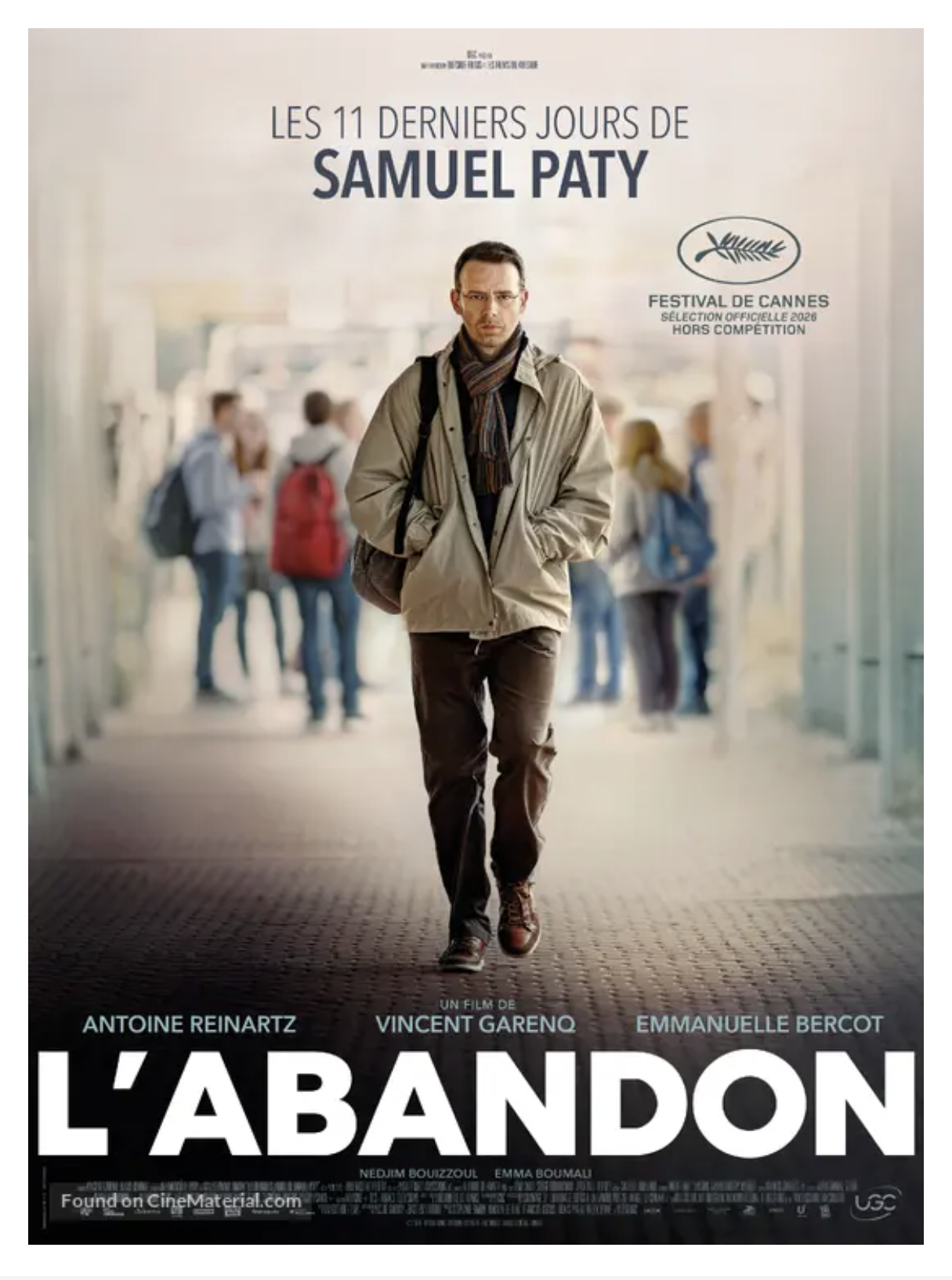
By then, Vincent Garenq’s film had already been completed, which is why the appeal proceedings do not feature in it. Presented out of competition at this year’s Cannes Film Festival, it was released on 3 June and sparked debates strikingly similar to those that had accompanied the tragedy six years earlier. Some even called for the film to be banned, arguing that it portrayed Muslims in a negative light. Many of those critics, to judge from their remarks, had scarcely taken the trouble to watch it. The film also shows Muslim parents who tried to support Samuel Paty and put a stop to the campaign against him. Anyone who understands what community pressure can mean cannot help but admire their civic courage. Sadly, their voices proved too weak.
Vincent Garenq is no newcomer to the the branch of filmmaking that comes closest to high-quality investigative journalism. He had already directed two films based on real judicial and political-financial affairs: L’Enquête (The Clearstream Affair) and Présumé coupable (the Outreau case). In this new film, where the killer appears only in the final moments, the chain of events that led Anzorov to his victim is reconstructed with restraint, free of excessive dramatisation or sensational effects: we never see the severed head of the murdered teacher.
From a schoolgirl’s lie to a social media campaign, from harassment and Islamist activism to the logistical support provided to the future killer, everything unfolds with dizzying speed over the course of just eleven days. To my mind, one of the film’s greatest strengths lies precisely in this restraint. Antoine Reinartz brings great subtlety to the role of Samuel Paty. (Swiss readers may be interested to know that he studied at La Manufacture in Lausanne.)
The central question Vincent Garenq asks is not, “Why did Anzorov kill Samuel Paty?”, but rather, “Why did no one stop him before he did?”
This is why the Samuel Paty case is often seen not solely as a terrorist attack, but also as a tragedy of collective responsibility. The teacher was not protected in time by his colleagues, some of whom were quick to distance themselves from him, nor by the school administration, nor by the institutions, nor by a society that allowed lies to spread faster than the truth.
But Samuel Paty was abandoned not only during the final eleven days of his life. To judge by the appeal proceedings six years later, and by the reactions the film provoked, some people still seem determined to find him partly responsible for his own murder.
The very title of this important film, Forsaken, points to a profound sense of both institutional and human failure. When responsibility becomes “collective”, it ends up being assumed by no one.
Samuel Paty never intended to become a hero. He wanted to teach his pupils what all good teachers of the humanities try to teach: to ask questions, to check facts, and to doubt what seems self-evident. Six years after his death, that lesson has lost none of its relevance.