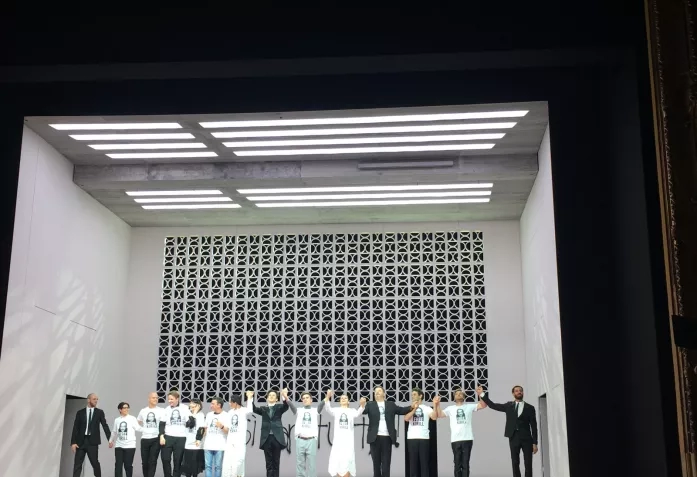
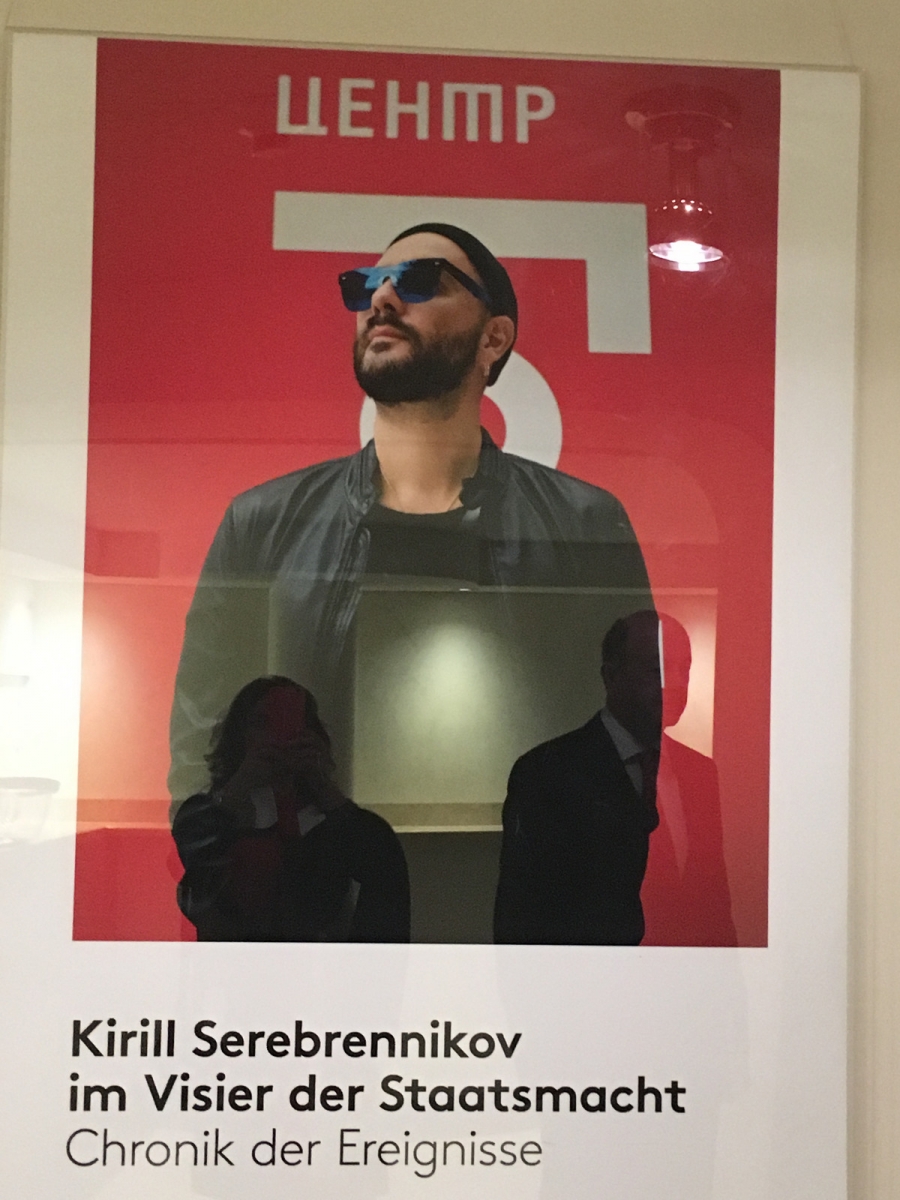
Eight years ago, as the company prepared for the premiere, Russian director Kirill Serebrennikov was under house arrest in Moscow. He had not yet been cut off from all means of communication – today, things would undoubtedly be far more complicated – and the production was therefore effectively rehearsed remotely under Serebrennikov’s direction by his longtime collaborator Evgeny Kulagin. Two words, printed in black on the white T-shirts worn by the cast during the curtain calls on 4 November 2018, instantly turned the premiere into an international political event.
Much has changed since then. Kirill Serebrennikov is free, back at work and highly active – I have already written about several of his recent projects. The cast has changed as well: the principal roles will now be sung by Elbenita Kajtazi (Fiordiligi), Siena Licht Miller (Dorabella), Yannick Debus (Guglielmo) and Bogdan Volkov (Ferrando). The production itself, however, remains unchanged, so I would like to revisit the impressions it left on me eight years ago and let you decide for yourselves whether it is worth travelling to Zurich.
***
“It is daring.” That was how a highly respected Zurich music lover and patron of the arts described the production during the interval. “Daring.” Coming from her, the word was not intended as praise. I chose to ignore the pursed lips, convinced that there is no greater compliment for a truly creative artist than an accusation of “audacity” – not in the sense of insolence, of course, but of daring to attempt something new. “We sing the glory of the brave,” proclaimed the great Soviet writer. History shows that only those who dare, who are unafraid of shocking some people and displeasing others, ultimately earn their place in the history of art.
I was particularly pleased that some readers, after reading the exclusive interview Evgeny Kulagin gave to Nasha Gazeta shortly before the premiere, made the trip to Zurich. Some were undoubtedly drawn by the highly unusual, to put it mildly, circumstances surrounding the production; others by the promise of superb music. I hope many more will follow their example, because the production is worth seeing. I also remain sincerely grateful to the Zurich Opera for taking a clear artistic and civic stand, refusing to take refuge in neutrality, and doing everything possible to ensure the production’s success.
And the success was overwhelming. The demanding Zurich public overcame its initial astonishment and soon began applauding after almost every number, reacting enthusiastically to the many comic touches before finally erupting into a genuine ovation.
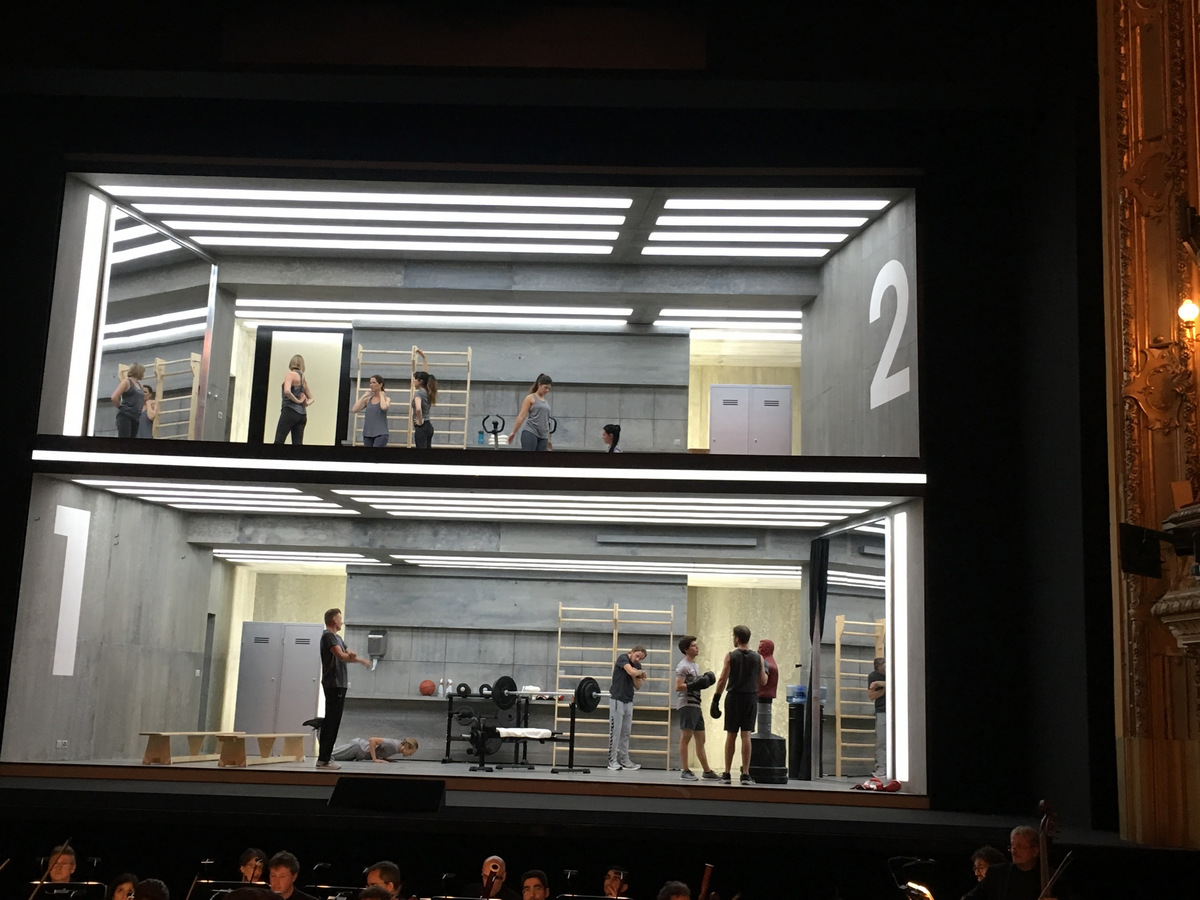
Evgeny Kulagin had not exaggerated: the cast was excellent – even the tenor did not disappoint. All of them, without exception, young and attractive, possessed not only superb voices real stage presence and physical ease. As a result, the director could ask virtually anything of them: real dramatic acting, choreographed dance sequences, even partial nudity – always aesthetically handled and never vulgar.
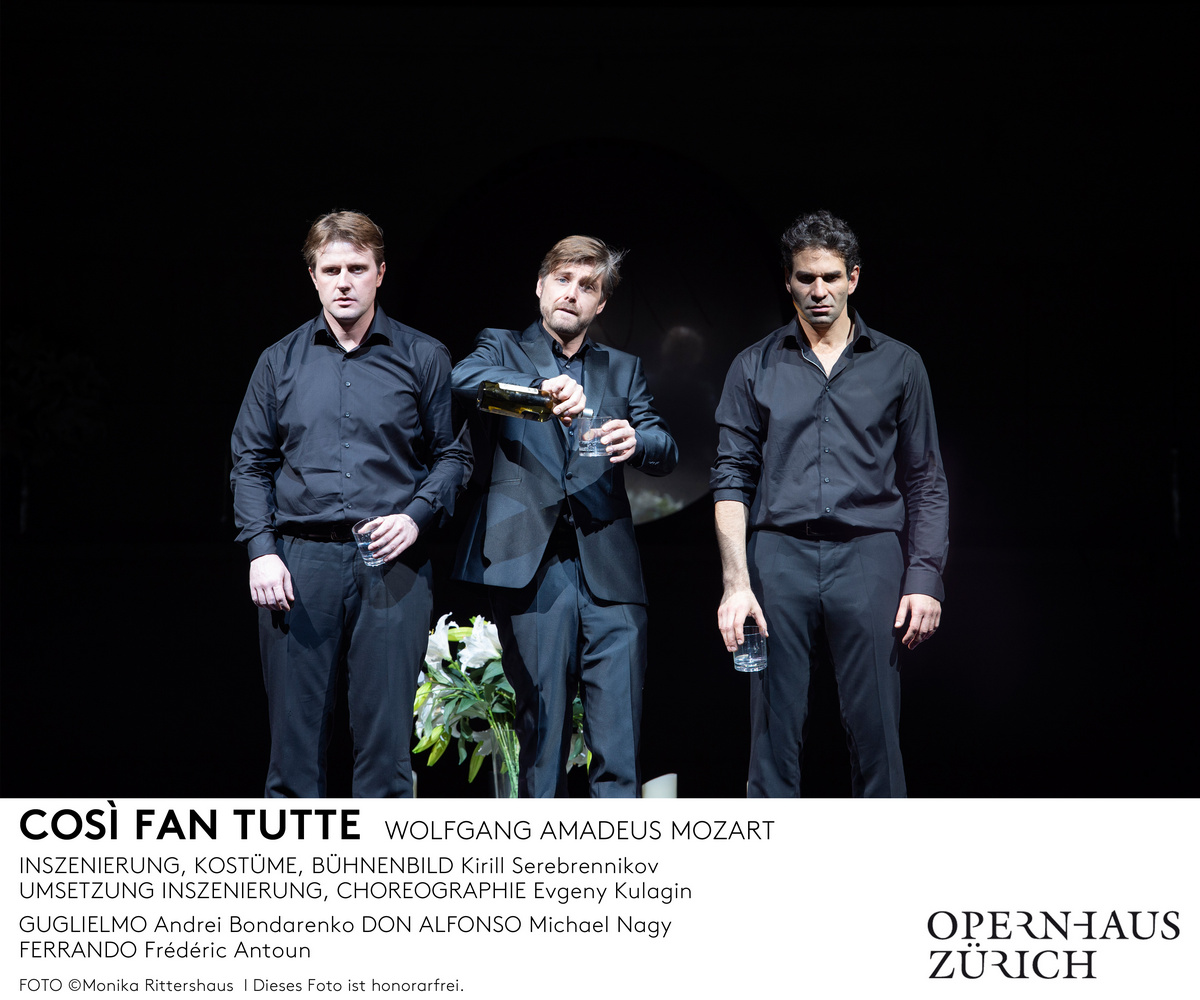
Nor had Evgeny exaggerated when he said the action had been moved into the present day: the production opens in a fitness club. In one gym, the sisters Fiordiligi (Ruzan Mantashyan) and Dorabella (Anna Goryachova) are working out; in another, Guglielmo (Andrei Bondarenko) and Ferrando (Frédéric Antoun), flushed with exercise, boast about their beloved fiancées and, provoked by their mutual friend Alfonso (Michael Nagy), calmly puffing on an electronic cigarette, end up betting one thousand francs that the women will remain faithful to them under any circumstances. Have men become any wiser since Mozart’s time? Would such a situation really be impossible today? The answer is obvious.
The fake farewell scene, in which the young men supposedly depart for military service, turned into a delightful theatrical episode. The audience burst into laughter at the sight of funeral wreaths, pseudo-zinc coffins and funeral urns – and when flames appeared as well, the whole thing positively resembled a monument to the Unknown Soldier. The suddenly “widowed” brides were sincerely grief-stricken, swore eternal fidelity, dressed in mourning and quite literally sprinkled ashes from the urns over their heads. But, as they say, never say never.
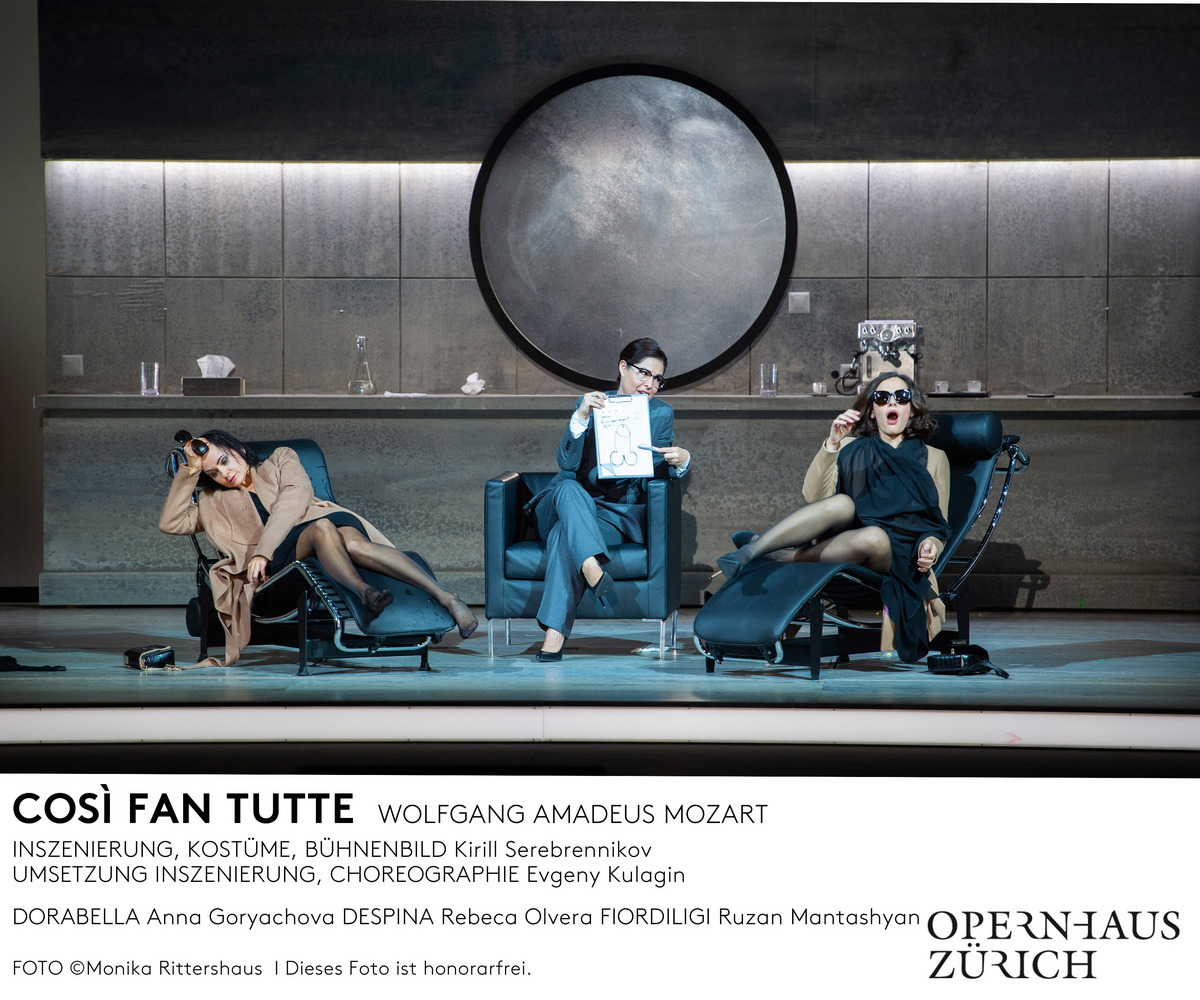
To whom did young women confide their secrets in the eighteenth century? To their maids. And today? To psychotherapists. What do the two professions have in common? A fondness for money. Despina (Rebeca Olvera), modernised here into a psychotherapist and allied with Alfonso, uses her “consultations” to persuade her patients thatyou only live once, and should not waste your years. Meanwhile, the audience watches twenty thousand francs quietly transferred into her account via Money Transfer – a rather handsome fee. Her passionate speech in favour of female emancipation and against the famous Kinder, Kirche, Küche, so familiar to Swiss audiences, accompanied by a persuasive video montage tracing the history of women’s struggles for their rights, eventually has the desired effect: as the saying goes, water wears away the stone – with all the consequences that implies.
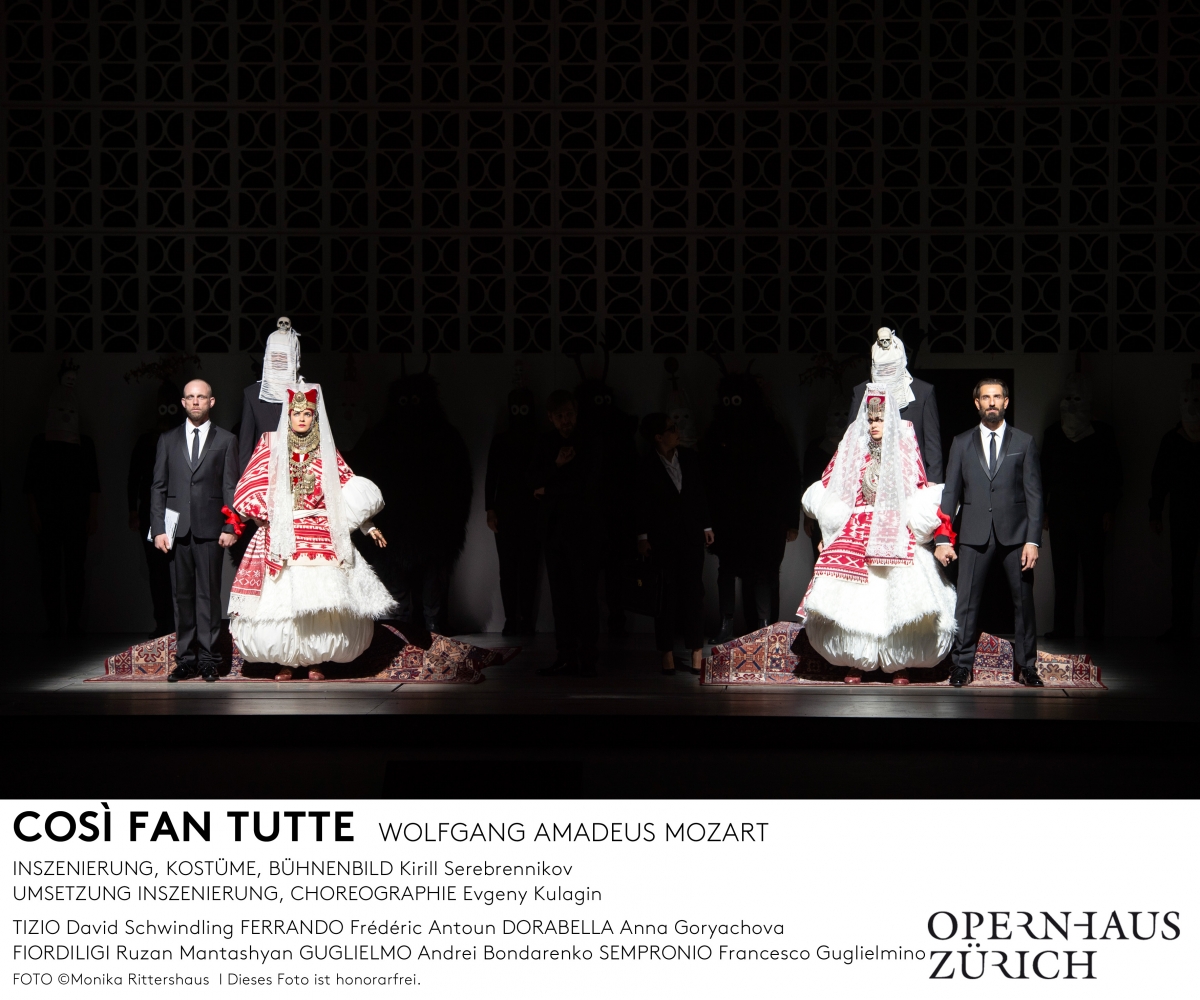
I must admit that when Evgeny Kulagin explained they had slightly altered the libretto to avoid the rather absurd situation in which the young women fail to recognise their own fiancés, I found it difficult to imagine how it would work in practice. In the end, however, the directorial idea proved entirely convincing: the story gained coherence without the music suffering in the slightest. Instead of the traditional disguises, the women are confronted with fake Arab sheikhs – extremely funny and entirely silent – rich, generous and overflowing with passion. Gold rings, enormous heart-shaped bouquets of roses, Persian carpets, hookahs… Twenty years ago, these figures might easily have been stereotypical “New Russians”, but times change, and so do stereotypes. The climactic wedding scene once again demonstrated the talent of costume designer Tatyana Dolmatovskaya, who worked with Kirill Serebrennikov, among other projects, on the films Summer and The Student.
I will not attempt to recount every successful moment in the production – there are many, though the second act does contain a few longueurs. Let me simply say that, despite considering myself an opera traditionalist, I had not enjoyed an operatic production so much in a very long time. Some may continue to purse their lips sceptically, dismiss the production as Schmutz and demand its “cleansing of filth”, but if nothing changes in opera, once this ageing generation disappears there will simply be no audience left. Change, however, must be carried out intelligently and with taste.
As for the “political farce” some claim to see in the production, I have no doubt whatsoever that, had Mozart lived today, he too would have appeared at the curtain calls in a white T-shirt bearing the words “Free Kirill”. A premiere without its director is, after all, a sad affair. And Wolfgang Amadeus, for all his genius, had a mischievous sense of humour and deeply disliked letting others call the tune.