
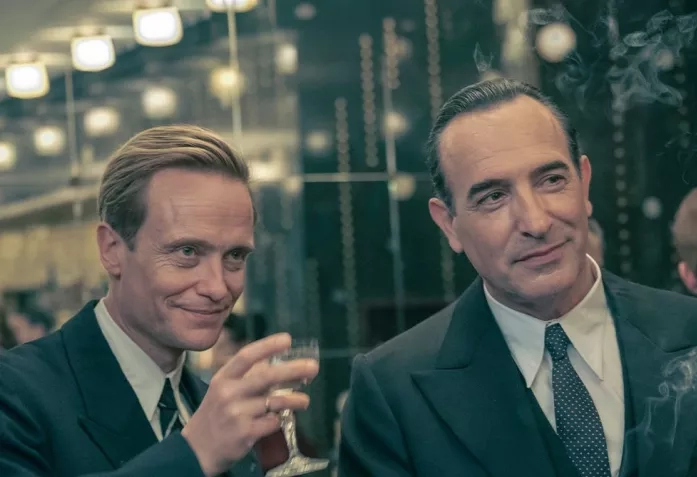
The title of the film was “suggested” to the French director Xavier Giannoli, a graduate in literature from the Sorbonne, by Victor Hugo. Les Rayons et les Ombres is the title of his collection of forty-four poems, written after 1830 and published in 1840. As is often noted, with this publication Hugo sought to bring poetry closer to people, to lead them along universal paths beyond struggles and political divisions, putting his work in the service of what he called a “civilising mission”. The “Rays” traverse a joyful universe of beauty, love, nature in full bloom and memories of happy days; the “Shadows”, by contrast, evoke sadness, death, kings and forgotten heroes. Together, they form life. The title chosen by Xavier Giannoli for his film is therefore not merely an aesthetic gesture: it points to light and shadow within a single human experience.
I first discovered this director in 2015. His film Marguerite, devoted to the American singer Florence Foster Jenkins and awarded the top prize at the 72nd Venice Film Festival, left a strong impression on me. Many of you have probably seen his other works, such as When I Was a Singer (Quand j’étais chanteur, 2006) with Gérard Depardieu, or Lost Illusions (Illusions perdues, 2021) starring Benjamin Voisin. Having already shown his ability to handle historical material, Giannoli now demonstrates a rare precision in rendering moral nuance within a complex historical drama.
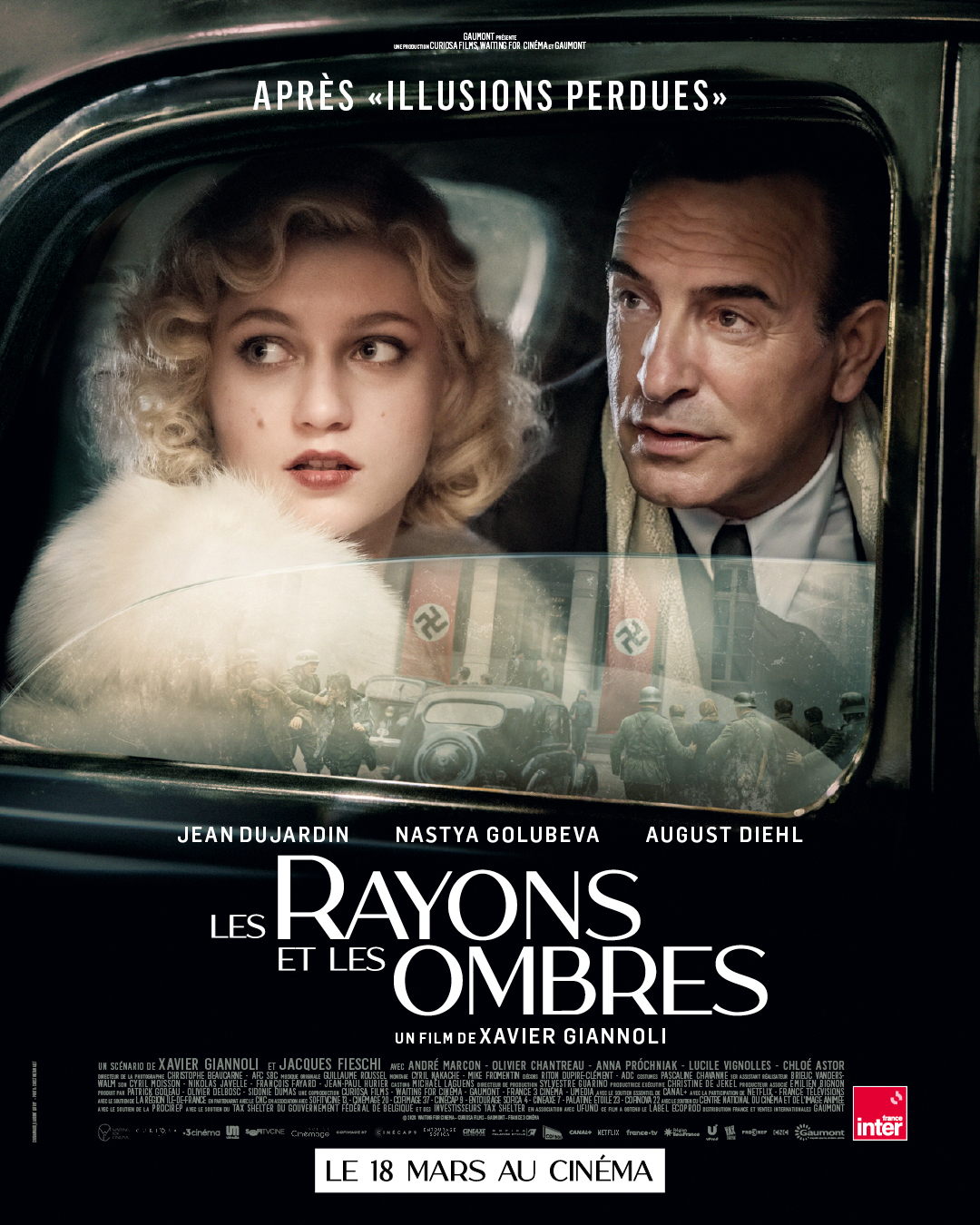
The action unfolds between Paris and Germany in the 1920s to the 1940s. At its centre are Jean Luchaire, a journalist, his daughter Corinne, an actress, and the German diplomat Otto Abetz. All three are real historical figures, though perhaps not so widely known, so a brief reminder of their inglorious biographies may be useful.
Jean Luchaire, brilliantly portrayed by Jean Dujardin, best known for his comic roles and awarded an Academy Award in 2012 for The Artist, was an outwardly charismatic and educated man, a lover of beauty in all its forms, from women to works of art. In his youth he held left-wing views and advocated rapprochement between France and Germany after the First World War as a guarantee against a new catastrophe. Even before Hitler came to power, he met Otto Abetz, a drawing teacher and ardent Francophile, a participant in the events organised by Luchaire, married to a Frenchwoman, and later to become the ambassador of Nazi Germany in Paris and one of the leading figures of the occupation administration in France. For this role, Xavier Giannoli cast the German actor August Diehl, who played the lead in Kirill Serebrennikov’s film The Disappearance of Josef Mengele, which I presented not long ago. I cannot help but feel a certain sympathy for this remarkable actor, seemingly destined to portray villains, yet it is hard to imagine anyone better suited to the role, not least because of his striking physical resemblance to Abetz!
The upheavals of the time did not destroy the friendship between Luchaire and Abetz. As early as November 1940, Luchaire founded the newspaper Les Nouveaux Temps, financed by “his friend Otto”, and in 1941 he headed the so-called Corporation of the French Press, which brought together the entire collaborationist press of the country. What a resounding slap in the face for a compromised press!
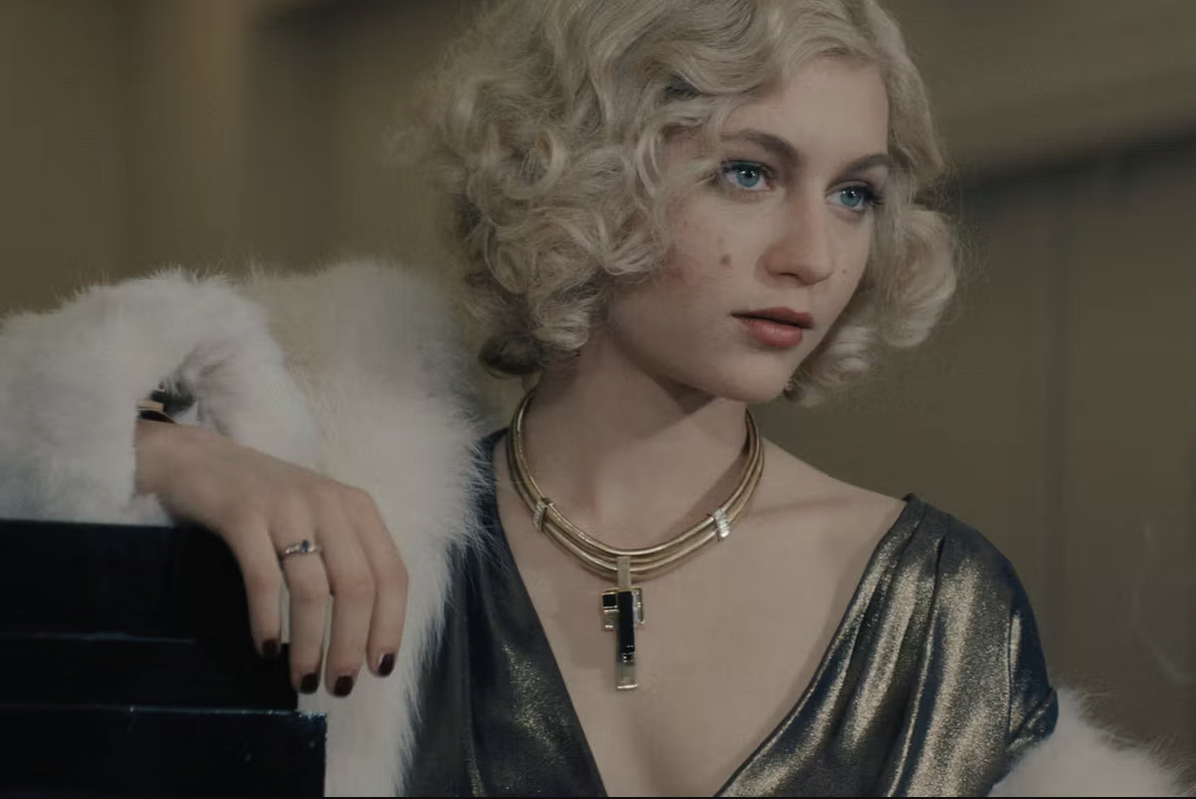
The third central figure is Luchaire’s daughter Corinne, who made a rapid career in cinema, followed her father everywhere and benefited from Abetz’s protection. In this role, a real revelation is the French actress Nastya Golubeva-Carax, born in Paris in 2004 to the Leningrad-born actress Ekaterina Golubeva and the director Leos Carax.
How did the lives of these real figures, embodied here by such talented actors, come to an end? Shortly before the liberation of Paris, Luchaire fled France with other supporters of the Vichy regime and settled in the German castle of Sigmaringen, which was taken by Allied forces on 23 April 1945. His attempts to obtain political asylum in Liechtenstein and Switzerland failed. On 24 January 1946, he was sentenced by the French Supreme Court to death, the loss of civil rights and the confiscation of his property, and he was executed by firing squad on 22 February.
Otto Abetz also failed to escape justice, despite false identity papers. In 1949 he and other representatives of the occupation administration in France were tried by a military court. Abetz was found guilty of organising measures directed against the country’s Jewish population and sentenced to twenty years’ imprisonment. Yet on 17 April 1954 he was released and was subsequently hired as a journalist by the West German newspaper Rheinisch-Westfälische Zeitung. I do not know why his sentence was reduced, but a higher judgement was ultimately passed: on 5 May 1958, Abetz died in a car accident.
Corinne Luchaire’s career was cut short by tuberculosis and long stays in sanatoria, then, after the Second World War, by a ten-year ban from her profession owing to her and her father’s collaborationist ties. She died at the age of twenty-eight, shortly after the publication, in 1949, of her memoir My Strange Life, in which she asserted her innocence. In fact, the entire film unfolds as if it were the transcription of a recording of her account on a tape recorder. It is structured in part as a recollection, allowing us to see not only the characters’ actions but also their background: the atmosphere of the time and the sense of historical necessity that so easily replaces personal choice.
The three lead performances are beyond praise, yet the casting as a whole also deserves particular mention. I should also note a “Russian accent”, albeit not by Russian actors. The director Léonide Moguy, born Leonid Mogilevsky, is portrayed by the Moldovan actor Valeriu Andriuță. This character, who gave Corinne Luchaire her first role and, for some reason, forgives her at the end of the film, is the only one who refuses to shake Otto Abetz’s hand, having seen through him from the outset. An interesting detail: in the French, Spanish, German and Italian versions of Wikipedia it is stated that this “French director of Russian origin” was born in 1898 in Saint Petersburg; in the English version, that he was born in Odessa, in a Jewish family; and in the Ukrainian version, that he was born in 1899 in Odessa, into a family of merchants, and became “one of the pioneers of Ukrainian newsreel cinema”. There is no Russian-language Wikipedia page for Léonide Moguy, which is telling in itself. Is not this “secondary episode” an illustration of our present, inviting parallels one cannot help but draw when watching Xavier Giannoli’s film?
Yes, this film is strikingly relevant today: in occupied Paris, a “feast in a time of plague” unfolds, as many of those whose opinions carried weight with the wider public, from major industrial circles and the cultural intelligentsia, not least Louis-Ferdinand Céline, portrayed by Philippe Lévy, as well as numerous women, beautiful and otherwise, make a pact with evil for personal comfort, for power and for money. Look around you, dear readers: such people have not disappeared, and they justify their cowardice and greed with the same arguments, saying they did not see, did not hear, did not understand. And not only in France, of course.
Xavier Giannoli has long been interested in the moment when private life and history intertwine and begin to speak the same language. In his earlier works mentioned above, from Marguerite to Lost Illusions, he explored the price of success, self-deception, and the ways in which social and cultural mechanisms shape personal choice. In Rays and Shadows, this interest takes on a harsher, more historically charged form: here the question is no longer one of career or recognition, but of moral responsibility.
The principal strength of the film, in my view, lies in the fact that, at a time when historical narratives are increasingly reduced to black and white, when the past is retold in terms of simple oppositions between right and wrong, Giannoli refuses simplification. He takes a risk: he portrays the “villains” not as cardboard figures, but as fully human beings, with all the contradictions that entails. Moreover, he gives them a voice. We hear their arguments, we observe how the logic of concession and the language of justification gradually displace the language of doubt, how idealism turns into compromise and then into criminal complicity. And this is precisely the film’s core: it shows not the outcome but the process, not the final fall but the gradual slide of a person beyond a line he once believed he would never cross. The viewer is immersed in that particular mixture of idealism and vanity so easily disguised as “actions dictated by circumstances”.
Yes, the film shows complexity, but it does not absolve responsibility. This is essential: there is no relativism here. On the contrary, the moral judgement of collaboration is unequivocal and leaves no room for “buts”. The prosecutor’s closing speech serves as a full stop after which all attempts at justification lose their force. Without raising his voice or resorting to rhetorical accusation, he dismantles, step by step, the system of self-justification constructed by the protagonists. Everything they have said before about duty, necessity and the “lesser evil” proves groundless.
Rays and Shadows has, unsurprisingly, provoked conflicting reactions, with many resorting to the familiar reflex of «blaming the mirror». But this means only one thing: it has struck a nerve, which is precisely the purpose of art. The film does not make things easy for the viewer, forcing him over nearly three and a half hours to experience the temptation of proximity to power, yet it does not leave him in moral uncertainty: it shows how shadows emerge and does not allow us to forget where light comes from.
I would very much like this film to win the Oscar for Best International Feature Film, though I fear the American Academy may not be ready for it. In any case, it is essential viewing. Watch it. And reflect.



Federica Brunelli April 07, 2026
Laurent Lévi-Strauss April 08, 2026
Sikorsky April 08, 2026