
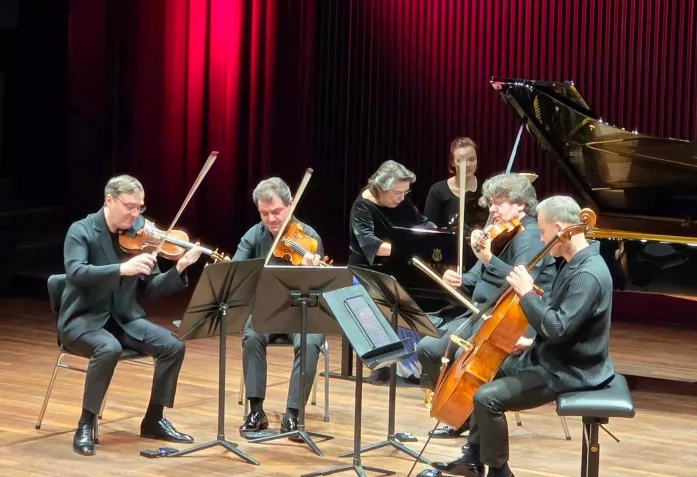
Let me briefly recall the previous episodes. Last November the world-renowned pianist Elisabeth Leonskaja, whom one French journalist once called “the last grand dame of the Soviet school” and whom his Spanish colleague dubbed the “anti-diva”, celebrated an important anniversary. This did not prevent the concert hall Muziekgebouw in the Dutch city of Eindhoven from cancelling her performance scheduled for 4 December. According to the communiqué, the decision was taken after “thorough consideration of all the circumstances”, among them the artist’s Russian origin and her participation in a concert in Moscow. (Apparently the examination was not particularly thorough: Elisabeth Leonskaja was born in Tbilisi, Georgia, she left the USSR as early as 1978 and has lived in Vienna ever since, having long ago obtained Austrian citizenship.) Shortly afterwards the pianist’s concert with the Orchestre de la Suisse Romande was also cancelled, without any public statement.
As for the Jerusalem Quartet, on 27 November last year it performed with great success at the Geneva Conservatory. Its members speak Russian perfectly well. All the while being Jewish. Shortly before that I had the opportunity to speak with the cellist Kirill Zlotnikov, who described what musicians have to face simply because they are citizens of Israel.
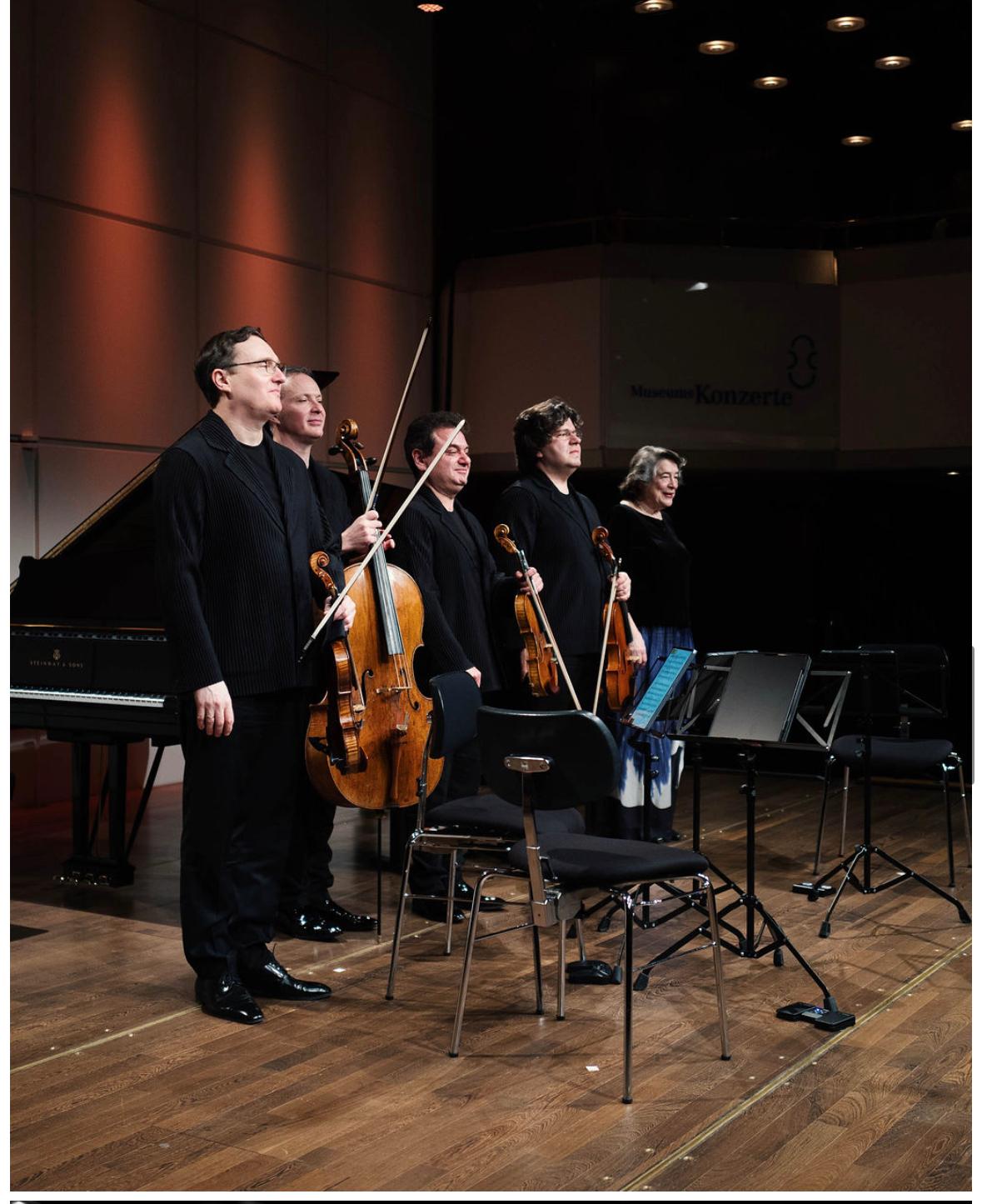
Unfortunately, what the organiser of the concert – the Music Society of La Chaux-de-Fonds – came up against in the middle of its 133rd season has very little to do with music. In fact, nothing at all. I reproduce below the statement issued by the esteemed society.
«Statement of the Music Society of La Chaux-de-Fonds concerning the concert of 22 March 2026 (Jerusalem Quartet and Elisabeth Leonskaja)
In August 2025 we were approached by the collective Action Palestine Neuchâtel, which strongly urged us to cancel the concert scheduled for 22 March 2026 on the grounds that the Jerusalem Quartet is Israeli and is allegedly supported by, or actively supports, the Israeli government.
A thorough review of the information available in the media enabled us to reject this accusation.
On 4 December last year our committee agreed to meet representatives of this collective in a spirit of constructive dialogue, which unfortunately proved illusory.
Despite threats of actions directed against this concert, namely:
- calls for the members of the public to boycott the concert;
- distribution of leaflets in markets before the concert and at other concerts;
- the organisation of a gathering in front of the Music Hall on the day of the concert,
we have decided to maintain it for the following reasons:
• Since its foundation in 1893, our Music Society (hereafter SDM) has always maintained an apolitical position.
• It is essential for us to uphold the principle of artistic freedom, according to which musicians must be able to perform without censorship, political interference or external pressure, and the public must remain free to attend high-level concerts, which is a necessary condition for democracy and cultural diversity.
• We believe that we are not entitled to require artists (in particular Israeli or Russian artists) to publicly declare their political affiliations.
• At the same time, SDM firmly refuses to invite artists who have publicly expressed support for a political regime recognised by the international community as totalitarian or genocidal.
• We consider that this clearly does not apply either to the Jerusalem Quartet or to Elisabeth Leonskaja, musicians whose artistic qualities are unanimously recognised.
• We therefore look forward to welcoming them to the Music Hall for their exceptional concert on 22 March.
• Music exists to speak of peace among all peoples (quote by the Canadian conductor Yannick Nézet-Séguin after the most recent New Year’s concert at the Musikverein in Vienna).»
This text hardly requires any comment. I will only add that Patrick Turtshi, a former mathematics teacher at the Blaise Cendrars municipal lycée and an active supporter of the boycott, warned in an interview with ARCinfo that a protest action would take place in front of the hall. He promised, however, that the members of the pro-Palestinian collective would not prevent those wishing to attend the concert from entering the hall, and that they themselves would not enter the building or disrupt the performance. It is difficult to imagine that this is happening in a city listed as a UNESCO World Heritage site, and that among the activists are teachers whose vocation, in the words of the poet Nikolaï Nekrasov, is to “sow the reasonable, the good and the eternal”. Yet this is precisely the case. (At this point I could reflect on the connection between calls to boycott Jewish musicians and the recent resolution of the congress of the Swiss Socialist Party allowing Muslim female teachers to wear the hijab at work in public institutions, but I would rather not digress from the main subject.)
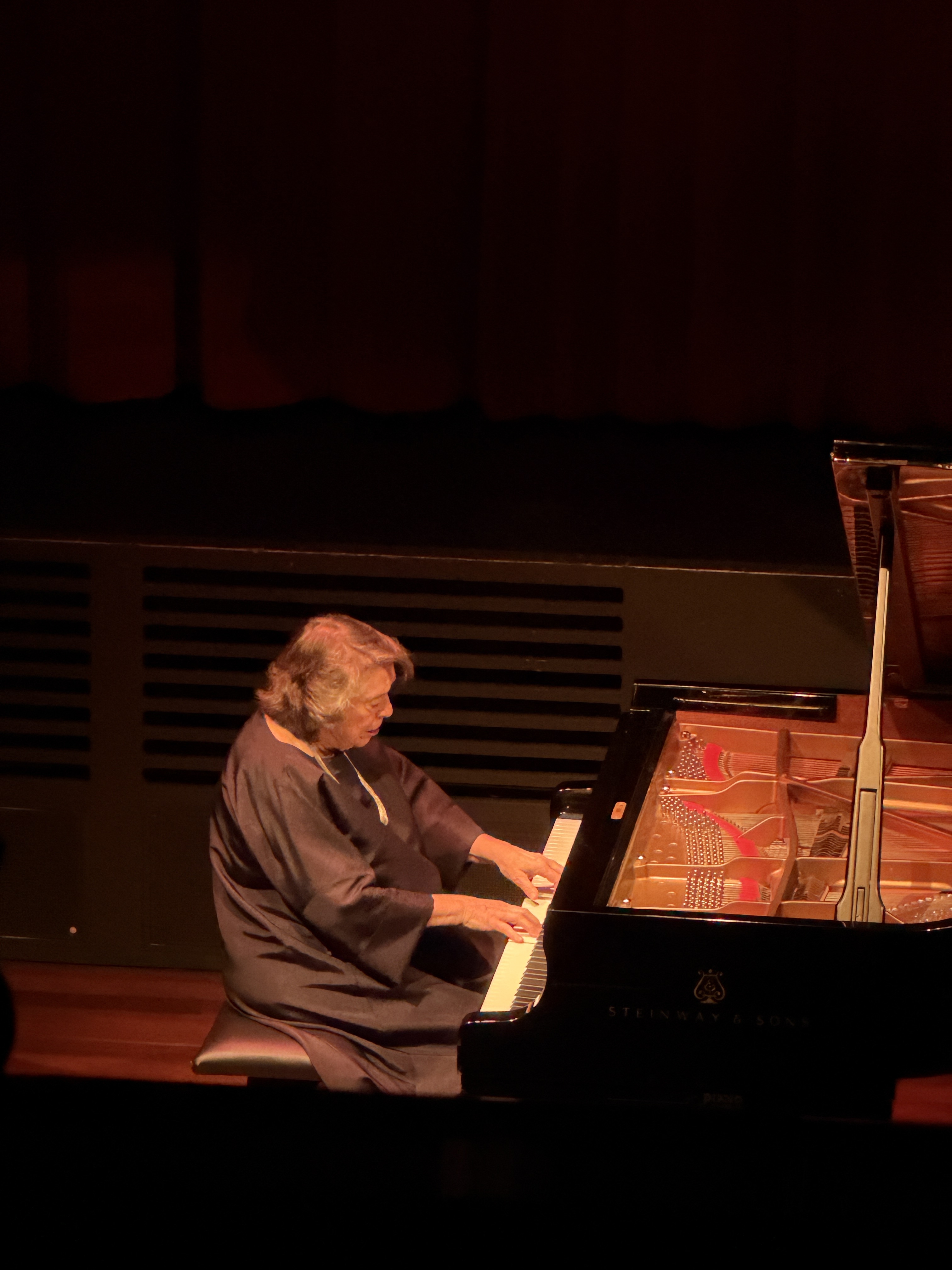
I was worried that it might not be possible to speak with Elisabeth Leonskaja – her agent told me she was tired of interviews. The last time we spoke was in Verbier in 2014, so those interested in the details of her biography and artistic evolution can read that interview; nothing has changed since then. Nor has the heroine herself changed: the same overflowing energy, the same blue eyes sparkling with intelligence and humour. I saw them again a few weeks ago after her brilliant performance in the small town of Epalinges. She then agreed to talk with me. Here is the essence of that conversation on the eve of a concert whose participants are judged solely on the basis of their nationality by self-appointed judges.
Elisaveta Ilyinichna, today being a “musician of Russian origin” and at the same time Jewish constitutes a double challenge, absurd as it may sound. How do you deal with this double identity?
I have a completely different identity. Not long ago, after my concert in Chur, there was a meeting with the audience. The first question was: “You grew up in Russia – how did you feel there as a woman?” I answered: “Wonderful.” This problem never existed in my mind, and it does not exist now either. I encountered it only after coming here and discovering feminism and divisions it imposes.
I grew up in Tbilisi. Antagonism between minorities always exists; one could give many examples. Sometimes it appears in jokes, sometimes in other ways. When I arrived at school and heard the word “kurdoshka” used to refer to another girl, I did not understand what it meant. Yes, there were Kurds in Tbilisi who swept the streets and lived in basements; my mother taught a very nice girl from a Kurdish family, but I had never heard that word at home. And that attitude to questions of nationality remained with me. Who am I? I spend most of my time with musicians and musical texts, puzzling over how best to perform them. Whether I am Jewish or Russian makes no difference to me. At the same time, the resilience acquired in the USSR has remained. Jabs in that direction do not reach my core, but the stronger ones make me think. Reflection strengthens my immunity.
The administration of the concert hall in Eindhoven explained the cancellation of your concert not only by your Russian origin, but also by the fact that free tickets to the concert in Moscow in which you participated had been offered to soldiers and members of their families. When artists goes on stage, do they know who is sitting in the hall? Did you know?
Everything that happened is complete nonsense. I think it is connected only with the fact that one of the concerts was with the orchestra Moscow Soloists of Yuri Bashmet, who appears on a “black list”. Probably when that name appears, a red light goes on in someone’s computer. Neither Bashmet nor the orchestra’s management knew anything about it, and I certainly did not. The Eindhoven text is purely legal, apparently written to calm some dragon or other.
What actually happened? Towards the end of the year the Russian Ministry of Culture together with the “Defenders of the Fatherland” foundation decided to organise an action that included an opera performance, a ballet, a drama production and a classical concert. No one asked anyone’s consent. This information did not appear on posters or in programmes; it was only on the internet, next to information about discounts for pensioners and so on. The Ukrainian embassy translated this into English and sent it to Eindhoven together with the poster, saying that I was playing for soldiers. At that moment I was already in Moscow when my agent called me. I arrived at rehearsal and told others about it. The orchestra director opened his eyes wide: “What soldiers?!” Perhaps the philharmonic administration should have asked us, but perhaps it was not obliged to do so, since the matter concerned the sale of tickets, which has nothing to do with the artists. The director of the orchestra made a scandal, but it was too late. I saw no soldiers in the hall, but for journalists the mere mention of them and of a pianist playing for them was enough – they need something to report. The concert in Moscow was dedicated to the memory of Oleg Kagan, my former husband; it was his birthday.
Are you angry with those who cancelled your concerts?
Not at all. They cannot act otherwise. They risk either their positions or their subsidies, and they need to continue working, which is difficult in such complicated times, especially in small aggressive countries. I was rather surprised that my concert with the Jerusalem Quartet in Groningen, also in the Netherlands, took place. And I was deeply touched by the way it was organised. We were brought by car from Germany to the rehearsal at the Philharmonie and were calmly invited to discuss what would happen if pro-Palestinian activists rushed onto the stage. It was decided not to interrupt the concert. In the end there was a shouting group outside and silence in the hall. The organisers had foreseen everything and thought everything through.
If you are not angry, would you agree one day to return to the venues that cancelled your concerts?
Of course. Let me tell you a very touching story. In February this year I was supposed to give a concert at the piano festival at Flagey, a wonderful concert hall in Brussels, in a historic building. Earlier, in December – that is already after the Eindhoven affair – I played in Cologne with the chamber orchestra of the Amsterdam Concertgebouw. When afterwards I was running to catch my train, a man was waiting for me. He introduced himself as Ledure, said he was from Brussels and that he had been very moved by the text of my statement, and said: “Welcome to Brussels.” It was Gilles Ledure, the director of Flagey. It was Sunday. In order to tell me that, he travelled two and a half hours by train in one direction, and the same distance back.
So there is no logic. One may regret that this is so, but to take offence – no, it is not worth it.
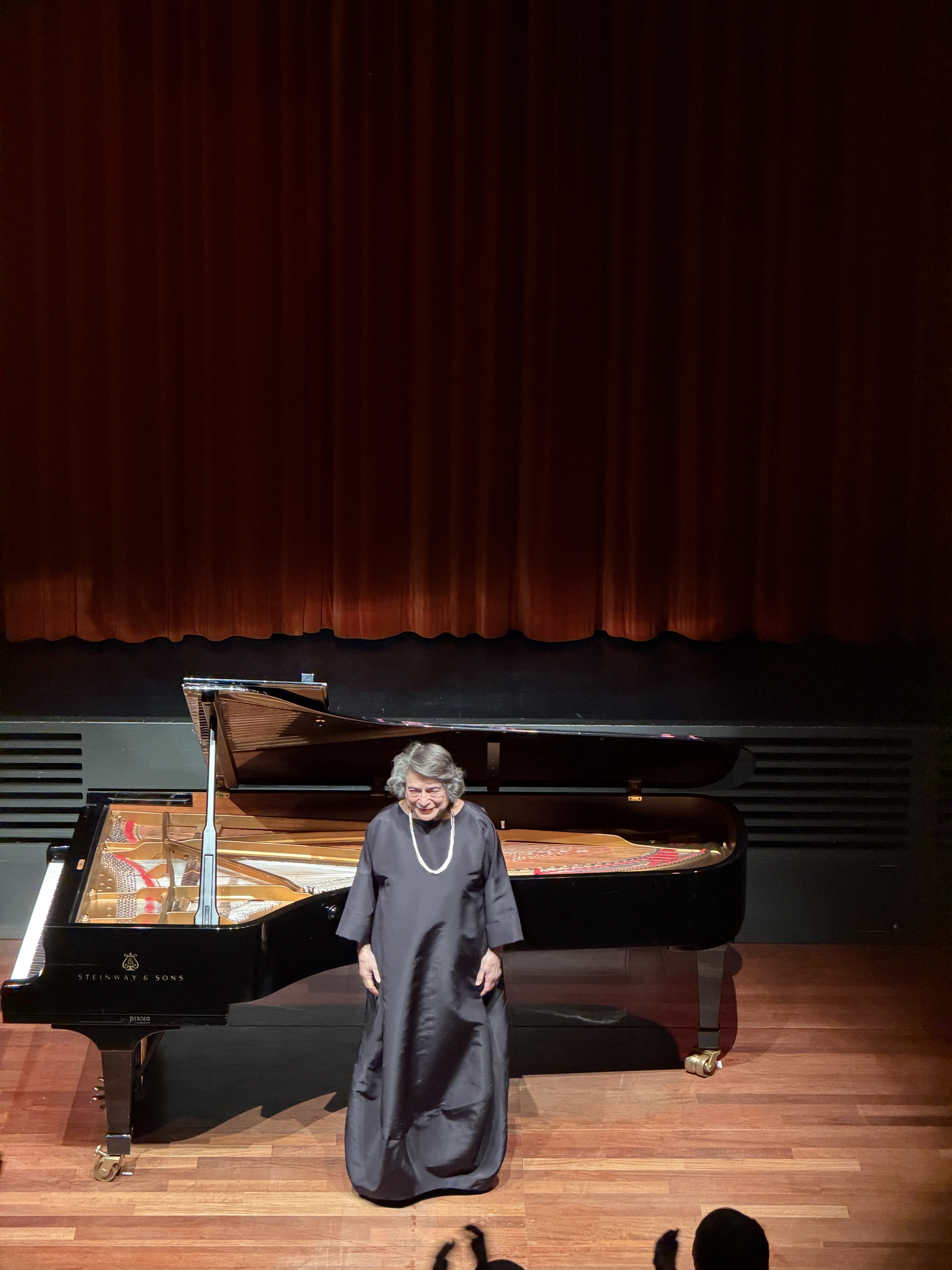
You mentioned small countries, among which Switzerland also belongs. I know that many here do not understand why, for example, your concert in Geneva was cancelled, while other musicians who not just occasionally go to Russia but live there permanently continue to perform here, no problem. How can the public make sense of this?
I think it depends only on what falls into the field of vision and what does not. I see no system in it. We are musicians, and what happens around us because of the political situation cannot be our spiritual nourishment; we feed on something else. We can only take note of it. Our nourishment is the world of beauty, and our task is to perceive this beauty and pass it on to those who need it. Painters do this with their paintings, musicians with their playing, actors with their transformations. To rummage through everything else is not worth it – it distracts from what is essential.
Let us speak about something more pleasant. Have you already performed in the hall of the Music Society of La Chaux-de-Fonds where we will have the pleasure of hearing you on Sunday?
Yes, several times. Moreover, in 1984 I recorded there, with the late Heinrich Schiff, Rachmaninov’s cello sonata for Philips. It is an absolutely phenomenal hall with perfect acoustics; it is no coincidence that Philips records there. And what a marvel Dvořák’s Second Quintet is, which we will perform! It is such a rich work. In my opinion, for the string players it is even more enjoyable, if one may say so, than Brahms’s quintet. Dvořák’s music is so alive, so timeless and eternal, so earthly and at the same time heavenly.
P.S. I will certainly go to the concert in La Chaux-de-Fonds dedicated to the 80th anniversary of Elisabeth Leonskaja and the 30th anniversary of the Jerusalem Quartet, and I hope to meet my readers there. The remaining tickets can be purchased here.




Bernard IVA March 17, 2026
Sikorsky March 17, 2026
Yves Strub March 17, 2026
Sikorsky March 17, 2026
Laurent Lévi-Strauss March 17, 2026
Sikorsky March 17, 2026
Claudio Poloni March 17, 2026
Sikorsky March 17, 2026
Лазарь Фрейдгейм March 18, 2026
Sikorsky March 18, 2026
Renée March 18, 2026
Sikorsky March 18, 2026
Federica Brunelli March 19, 2026
Sikorsky March 19, 2026
Philippe Lüscher March 19, 2026
Sikorsky March 19, 2026
Philippe Lüscher March 19, 2026
Alexandra, le couteau suisse March 20, 2026
Sikorsky March 20, 2026