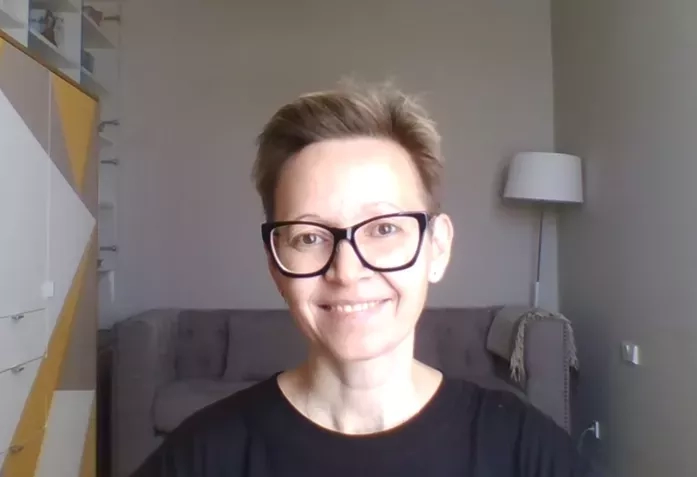
Today, A Train to Samarkand, a novel by the acclaimed Russian writer Guzel Yakhina, arrives in bookshops in Switzerland and France. Published by Noir sur Blanc, it has been translated into French by Maud Mabillard. Shortly before its release, we spoke to the author via Skype.
Guzel, perhaps you should now be described not simply as a celebrated writer, but as a notoriously controversial one, given the stormy reaction provoked by each of your new books, not to mention the television series based on Zuleikha Opens Her Eyes. How do you respond to all this? Do you read the reviews?
I do not think there is much point now in dwelling on anything that happened before February 2022. I must admit that, to me, it feels not quite like a previous life, but like a life that has become very distant.
More broadly, however, it is certainly true that works of fiction taking a critical view of the Soviet past often found themselves at the centre of public attention in Russia. I saw this as a sign that society wanted a dialogue about that past. But it was also, of course, an indication of the growing divisions within society. That is what seems important to discuss, far more important than me or any particular incidents involving my books.
Over the past decade, attitudes towards the Soviet past acquired increasing political significance. Looking back from 2023, I have come to the conclusion that this was inevitable, because after the collapse of the Soviet Union certain political steps were never taken to establish a definitive position on that past.
There was an enormous public debate. The 1990s are often called a decade of discussion, and with good reason. There were civic initiatives, and the subject was explored from many different angles in culture. Yet the most important thing never happened: no political judgement was made.
In my view, that was an enormous mistake, and we are now reaping the consequences. I am convinced that what has been happening since February 2022 is, among other things, the result of our failure to come to terms with our Soviet past.
Between the 1990s, when that past was viewed very critically, and the 2010s, when it began to be presented in rosy colours, the tension within society gradually intensified. Certain works of art became occasions for arguments about the past. My novels were among them. They raised questions about how we should deal with the crimes of the Soviet regime, whether they should be considered crimes and, indeed, whether they had taken place at all.
That is precisely why I began our conversation with a question that surprised you slightly. It seems obvious to me that the refusal of a large part of the Russian population to face the truth and acknowledge the mistakes of the past goes a long way towards explaining the position they have taken today. Your novels added fuel to a fiercely burning debate that has still not died down.
A writer inevitably lags behind real events, except in those rare instances when a writer anticipates them, and the publisher of a translation lags further behind still. A Train to Samarkand was published on 9 March 2021. Would you have taken up this subject a year later, or would its importance have been eclipsed by other events?
For several months after February 2022, I felt that the themes I wrote about had lost their relevance. Later, however, I began to feel the opposite, as all forms of enquiry into totalitarianism, both scholarly and artistic, were becoming increasingly relevant.
As time passes, it becomes ever more important to speak about the Soviet past, where, as we have already discussed, the roots of what happened in February last year are to be found. It seems to me that writing about the Soviet past today is not merely permissible but necessary.
For me, such writing is a way of examining the present. Today we live in a country whose foundations were laid a hundred years ago, if not legally, then in essence. That essence lies in the relationship between the individual and the state: the all-powerful state and the tiny, defenceless human being.
All three of my novels are about this: how a person survives and preserves their humanity in inhuman conditions.
In the latest, A Train to Samarkand, I use the example of its protagonist, Deyev, to ask whether it is possible to remain human while serving as an instrument of a totalitarian system. What should one do when one’s civic duty comes into conflict with one’s duty as a human being?
These questions seem to me more relevant now than they were five years ago, let alone ten.
On the whole, I agree with you. But how can we explain the fact that, despite the vast amount that has been written, recounted and discovered about the Soviet period, most of Russia’s population supports the present aggression and is prepared to take part in it? How can we explain this apparently ineradicable servile mentality, despite everything that has been experienced and learned?
Several questions have merged into one here, so I shall try to separate them.
As for the phrase ‘servile mentality’, I would rather not comment on it. I do not accept such formulations.
There is no doubt that the totalitarian regime inflicted profound trauma on society, on individuals and on entire generations. These traumas are so serious that they are extremely difficult for people who grew up outside that experience to understand.
Unfortunately, trauma is inherited and passed down by word of mouth. That is true in my own case as well. What is transmitted from one generation to the next are survival mechanisms based on silence, the avoidance of certain subjects and, in some respects, doublethink.
You cannot simply cut these things out of your consciousness with a pair of scissors in a single day. Unfortunately, several decades have not proved sufficient either. A long process of healing is required, along with an enormous effort to articulate and discuss what happened.
That is precisely why I insist that we must continue to speak about the Soviet past. As long as it is either rejected outright or appropriated and endowed with mythical qualities, it cannot become part of a historical memory that has genuinely been worked through.
Returning to your question, I once rather naively believed that the generation born in the 1970s would prove to be a watershed generation. We received the memories of events directly from our grandparents, we experienced the Soviet Union ourselves and know it at first hand, while our children were born in a democratic Russia.
I thought the Soviet trauma would end with us, with our generation. Unfortunately, it has not. The Soviet past, which appeared to have been buried, has now caught up with both us and our children.
Our children are experiencing all these practices today: silence, avoidance and endless adaptation to an abnormal reality. These are extremely complex mechanisms, and unfortunately they cannot be explained simply by attaching a label to them.
Russians do indeed possess an extraordinary capacity to adapt to the worst possible changes. But this ability can be viewed in two ways: it can be judged negatively, or it can be understood as a desire to preserve a normal life.
People try to maintain the illusion of the normal life they long for. That is how I explain it to myself: adaptation is a survival mechanism. Those who do not possess it are the first to perish. I do not feel I have the right to pass judgement on that mechanism.
But does constant adaptation to an abnormal life, and the creation of an illusion of normality, not eventually result in abnormality being accepted quite sincerely as normal?
Absolutely. The norm shifts, and it does so very quickly.
I can observe this because I spend a great deal of time in Russia. I first became aware of the phenomenon while working on A Train to Samarkand, and it astonished me.
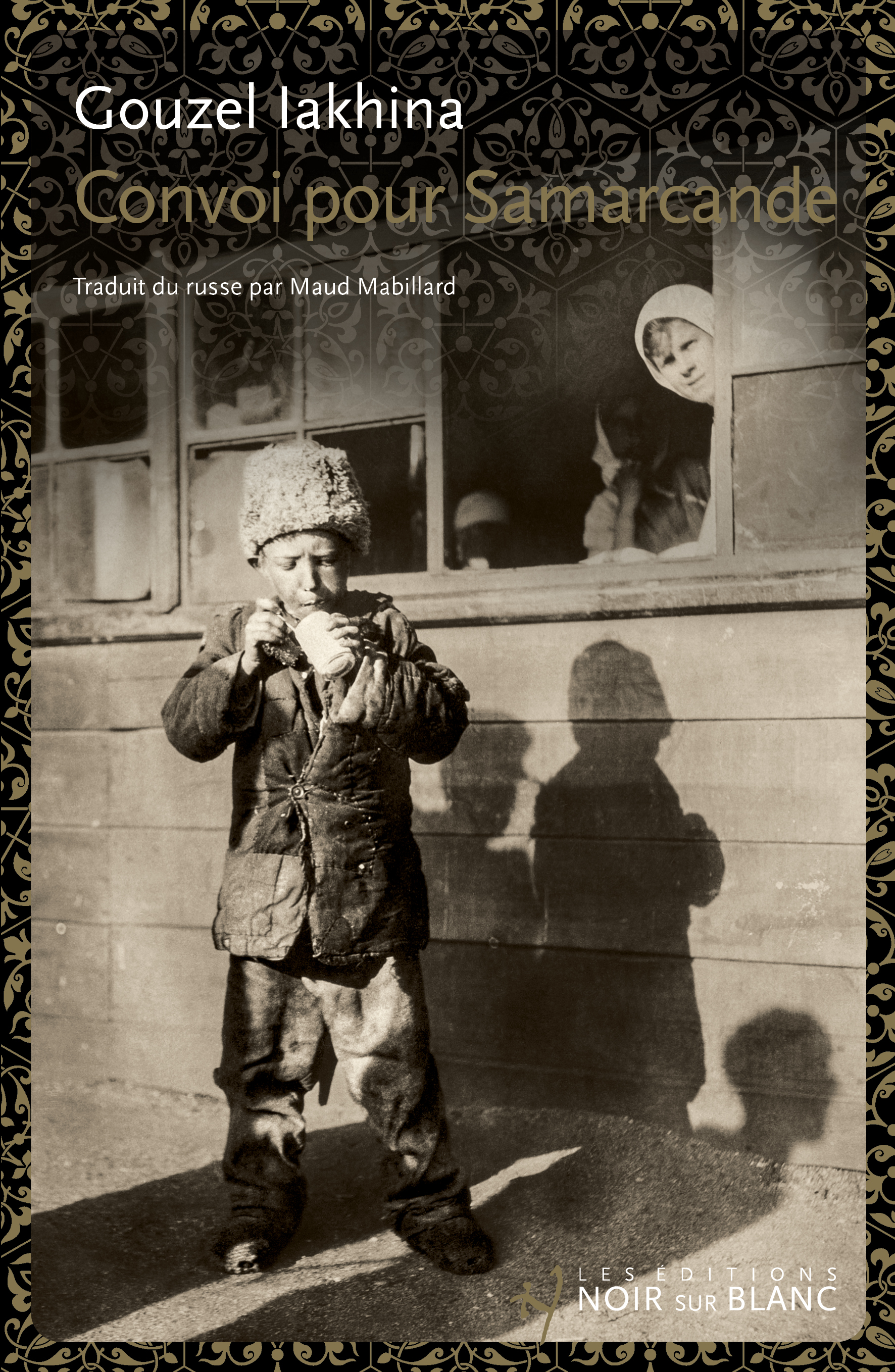
In documents and newspapers from a hundred years ago, I read about things that seem utterly savage to us today but were then regarded as normal. Families, for example, placed their children in orphanages simply because they could not feed them. Or they left them at the entrance to a building, or put them aboard a train travelling towards a region where food was more plentiful.
This was considered normal. It was not seen as the heartless abandonment of a child, but as an attempt to give that child at least some chance of survival. That was how far the ‘norm’ had shifted.
Another example is the large-scale migration of entire sections of the population, including in search of food, which was also regarded as normal at the time. People wandered from place to place. This was referred to as a ‘nomadic condition’. That was the exact phrase used in newspapers, and no one found it surprising.
The newspapers of the period also wrote extensively about the enormous number of homeless children, around one and a half million of them, and the appalling conditions in orphanages. That, too, was normal. The list could go on.
A strange shift in the norm can also be observed in Russia today. When you remain inside the country all the time, you do not perceive it as sharply as you do when you leave.
Because I travel a great deal and repeatedly return to Russia, the contrast is obvious to me. What I notice above all is the profound militarisation of society and the intrusion of military themes into every sphere of life.
There is also growing anti-Western sentiment and the negative portrayal of everything associated with the West and Western culture.
At the same time, there has been an abrupt turn towards the East, visible not only in the news and in cultural life but in everyday life as well. Large numbers of Chinese cars now drive through Moscow, and garages that once specialised in European vehicles are gradually becoming specialists in Chinese ones.
The presence of Asian and African countries has increased sharply, while that of Western countries has diminished.
The choice between East and West is one of Russia’s eternal questions...
Yes. These swings are not surprising in themselves. They are simply particularly abrupt at present and therefore seem extraordinary.
At the beginning of our conversation, you used the word ‘watershed’. For many Russians, that watershed came on 24 February 2022. Many decided to leave, whereas you did not, although your position on the war is perfectly clear. Why?
I have people close to me whom I would not wish to leave.
I also believe it is very important not to deepen the rupture: to travel abroad while that remains possible, but to return. I would like to keep my home in Moscow. I would like to continue living here, and until there is a direct threat to my life or my freedom, I shall remain in Russia.
This is my country. I fully understand the desire of many people to distance themselves and erect a barrier between themselves and the horror that is taking place. But it is clear to any reflective person that, even if you separate yourself physically, you cannot separate yourself mentally. Your homeland lives within you.
Geographical distance may help some people, but to me it seems more like an illusion of separation.
Zuleikha Opens Her Eyes, My Children and A Train to Samarkand: can these books be described as a trilogy? Have you exhausted the subject of the 1920s and 1930s, or do you intend to explore it further?
I do not myself call the three novels a trilogy, although that interpretation is possible.
What unites them is their focus on the ‘little man’ and his condition during the early Soviet period.
There is a fourth text on which I am now working, with great difficulty, I must admit. For many months there was no room in my head or my heart for creative work. All the available space was occupied by the news and by thoughts about the future of the world.
This fourth text also concerns the Soviet period, although it approaches it in a rather different way. So the subject is by no means closed for me. It seems bottomless.
Was this the text you worked on during your recent stay at the Jan Michalski Foundation?
Yes, and I am very grateful to Vera Michalski for inviting me to stay at the writers’ residence in Montricher.
It was an idyllic, peaceful month away from everything, and it allowed me to return to a text with which I had been ‘on bad terms’ for thirteen months.
Unlike your first two novels, which centred on particular ethnic groups, the Tatars and the Volga Germans respectively, the central character in A Train to Samarkand is hunger itself. Why was it hunger that compelled you to write the book?
You have put that very precisely, and I am grateful that you understood the text so accurately. That is indeed the case.
I wanted to describe the collective experience of living through famine, because exactly a hundred years ago it was a truly mass phenomenon in our country.
It was an enormous subject, one that touched, I am not afraid to say, every family.
In the 1920s, unlike in the 1930s, the subject had not yet been silenced. The young Soviet state was extremely weak and fighting for survival. The Civil War was still under way, and it was in no position to conceal its own crimes.
The famine was widely reported at the time, and a vast body of documents and even film footage has survived. Soviet Russia was still an open country. It appealed to the West for assistance, and many Western journalists were present in Russia. Information also survived thanks to their work.
This material was not hidden. I found it in the archives while searching for information about homeless children. All the material I used in the novel came from open sources.
When I began researching the famine, I found the subject almost psychologically unbearable, and there was a serious risk that I would make it unbearable for the reader as well.
I faced a paradoxical task: to describe the subject honestly enough, while not plunging the reader into depression and still giving them a chance to reach the end.
I knew from my own experience how unbearable it was to read material connected with famine. A healthy mind recoils from it.
My novel is built around that contradiction: it tells the story of a tragedy in an entertaining form.
In the end, I came to define A Train to Samarkand as an adventure story about mass starvation, a journey novel spanning six weeks, during which five hundred children travel from the famine-stricken Volga region to well-fed Samarkand.
Not everyone was satisfied with this approach. Despite several scenes that make the blood run cold, some of your critics, including fellow writers, accuse you of sentimentality and of smoothing over reality. In your book, everyone is ‘good’, from the main characters to passing Chekists or bandits whose hearts are touched by the young homeless children. What would you say to that?
Is Zagreika, for example, not excessive, licking Deyev’s feet like a puppy? Or Deyev’s almost biblical wanderings through the desert in search of ‘manna from heaven’?
The degree of horror in the novel was one of my principal concerns.
I tried to balance the weight of the subject through various literary techniques: the adventure genre, a cinematic approach to the scenes, a love story, indeed several love stories, and the mythological elements that you have quite rightly mentioned.
Once the book appeared, however, I realised that the perception of horror is entirely individual. The wide range of responses I received made that very clear.
Some people wrote: ‘It is impossible to read, it is so frightening. I began several times but could not get through it.’
Others wrote: ‘A tremendous adventure! I devoured it in two days. Perhaps it is only a little too much like a fairy tale.’
It is impossible to calculate the precise dose of horror, as though measuring medicine, nor is it worth trying.
I believe that an attentive reader will perceive both layers: the serious, tragic one, concerning the deaths of one hundred of the five hundred children and the way the Chekists rob some people in order to feed others, and the adventure story.
In a sense, this is an expression of respect for the reader on my part. The reader does not need everything to be spelt out and explained.

How can kindness and ruthlessness coexist within a single person, even if we are not speaking of genius and villainy? Let us take the protagonist, Deyev, who took part in suppressing a ‘women’s revolt’, although he did not shoot at pregnant women, and who then moves heaven and earth to save other people’s children.
Deyev is a symbolic character through whom I attempted to answer the question that matters most to me: why has the Soviet phenomenon proved so enduring?
It seems to me that one reason we still cannot form a judgement of the Soviet past is that it contained so many people like Deyev.
Two sides coexist within him. One grows out of the other and cannot be separated from it.
On the one hand, he is undoubtedly a hero. The novel is constructed so that during the first hundred pages the reader, I hope, falls in love with him while witnessing the many feats he performs entirely selflessly.
But as the novel develops, it becomes clear that Deyev is not so pure after all, that there is blood on his hands, and a great deal of it.
He killed first during the Civil War and later while serving in the ‘food army’, confiscating food from prosperous peasants. It is therefore possible that the children he is now saving were orphaned through his own actions.
He is both a murderer and a rescuer.
It is precisely the blood on his hands that drives him to do good and to atone for his guilt.
He copes with all the practical tasks involved in saving the children, but not with the psychological burden. He cannot answer the question of who he is.
People like Deyev were not, by nature, inclined to murder, but the state forced them to kill. The same individuals could become genuine heroes during the Great Patriotic War and guards in the Gulag.
How are we to regard such people? How are we ultimately to judge them? How are we to separate black from white?
That is the central question, and it also offers a partial explanation for the endurance of Soviet power.
Unfortunately, that unanswered question has carried over into the present day. Apparently perfectly normal people, who may never have had the opportunity to perform heroic deeds, are prepared, once they receive their call-up papers, to go and kill Ukrainians.
Do you believe that pangs of conscience are inevitable? Is that why Deyev confesses to Bug, the medical orderly, because he needs to justify himself both to himself and to others?
I cannot answer for everyone who finds themselves in such a situation. I can answer only for my character.
He does suffer from pangs of conscience, although he is unable to articulate what is tormenting him or to separate black from white.
But he is capable of understanding that something is wrong, and it weighs on him.
All your books are remarkable for their extraordinary detail. I was deeply moved, for instance, by the character of Senya, the boy pursued by lice. Have you ever actually seen a louse?
Yes, more than once.
Since you have mentioned Senya, I cannot resist telling you about him.
He is based on a real child, as are almost all the children described in greatest detail in the novel. I simply ‘grew’ these characters from tiny shoots.
In Senya’s case, I read about a boy who lived in Penza. He was bedridden by starvation and had frostbitten his legs so badly that insect bites became extremely painful.
As a result, he suffered bouts of delirium and genuinely feared that enormous lice were chasing him.
I found your attention to the colourful language of homeless children particularly interesting, although, unfortunately, some of their expressions can now be read in leading Russian newspapers or heard from the mouth of a member of parliament.
At the same time, you note the starving children’s urge to rhyme, if not to write poetry, then at least to compose chastushki. Does this mean that material existence does not always determine consciousness, and that a longing for beauty lives in everyone?
For a long time, I was afraid to begin writing about the children because I understood the danger of slipping into endless pity for them.
I did not want to exploit the subject of miserable, starving and sick orphans, children left bedridden by hunger. It seemed to me an impermissible device.
But when I began immersing myself specifically in the subject of homeless children in the 1920s, I realised that my fears were unfounded.
This was not a story about weakness or pity. These were extraordinarily tenacious, energetic and adaptable little creatures, ready to fight tooth and nail for their right to live.
I took some of their expressions from newspaper articles of the period, where I also noticed their inclination towards verse.
Some of the rhymes are authentic and some I invented. Maud Mabillard translated all of them brilliantly.
I did not invent these children’s longing for beauty. I observed it.
I cannot help recalling one disappointment I experienced.
At the Lenin Library, I came across a small book entitled Homeless Children Tell Their Own Stories. I was delighted and prepared to discover something new and truthful.
Unfortunately, when the volume arrived from a distant archive, I found carefully sanitised, heavily censored accounts of how terrible life had been on the streets and how wonderful it had become in the orphanage. There were no revelations.
There are also truths about these children that I thought it right not to recount in graphic detail, but merely to suggest.
This applies in particular to child cannibalism, which also existed.
In general, these children were adults in children’s bodies. They knew far more about life than many grown-ups.
In the novel, I wanted to preserve their childhood. Otherwise, however, the book contains a great deal of truth drawn from documentary sources.
At the very end of the book, you provide a list of all the names and nicknames of the train’s passengers. It reminded me in some way of the list in Vasily Grossman’s essay ‘Ukraine Without Jews’ of those whose bodies lay piled in layers in the ravine at Babyn Yar. Have you read it? Is there a connection, or is it merely a coincidence?
A coincidence. I have not read the essay, but now I certainly shall.
‘How desperately one longs for kindness!’ exclaims Bug, the elderly medical orderly. All the little children who reach Samarkand call themselves Iskanders, after the dead son of Fatima, their carer on the train, whose lullabies were heard throughout the entire convoy.
Your book is like a fairy tale in the sense that goodness and love triumph over evil. Do you believe that this is possible in real life as well?
You have understood it perfectly. For me, this is the central idea of the novel.
I want to believe that it is not only a book about the horrors of that period, the shifting of the norm or the psychological suffering of people at the time, but also about humanity as a condition for the survival of any society.
The train carrying the children crosses half the Soviet Union and encounters an enormous number of adults along the way.
They include gangs of every kind and nationality: Chekists, Ural Cossacks, Kazakh Basmachi, various railway inspectors...
At some point, every one of them decides to help the train.
Had even one of them made a different choice, the train would simply never have reached Samarkand.
The children become the measure of the adults’ humanity, although under different circumstances many of those adults would have killed one another.
The novel is about the fact that kindness exists in every heart, even the hardest one, and that this kindness can be awakened and become a means of salvation.