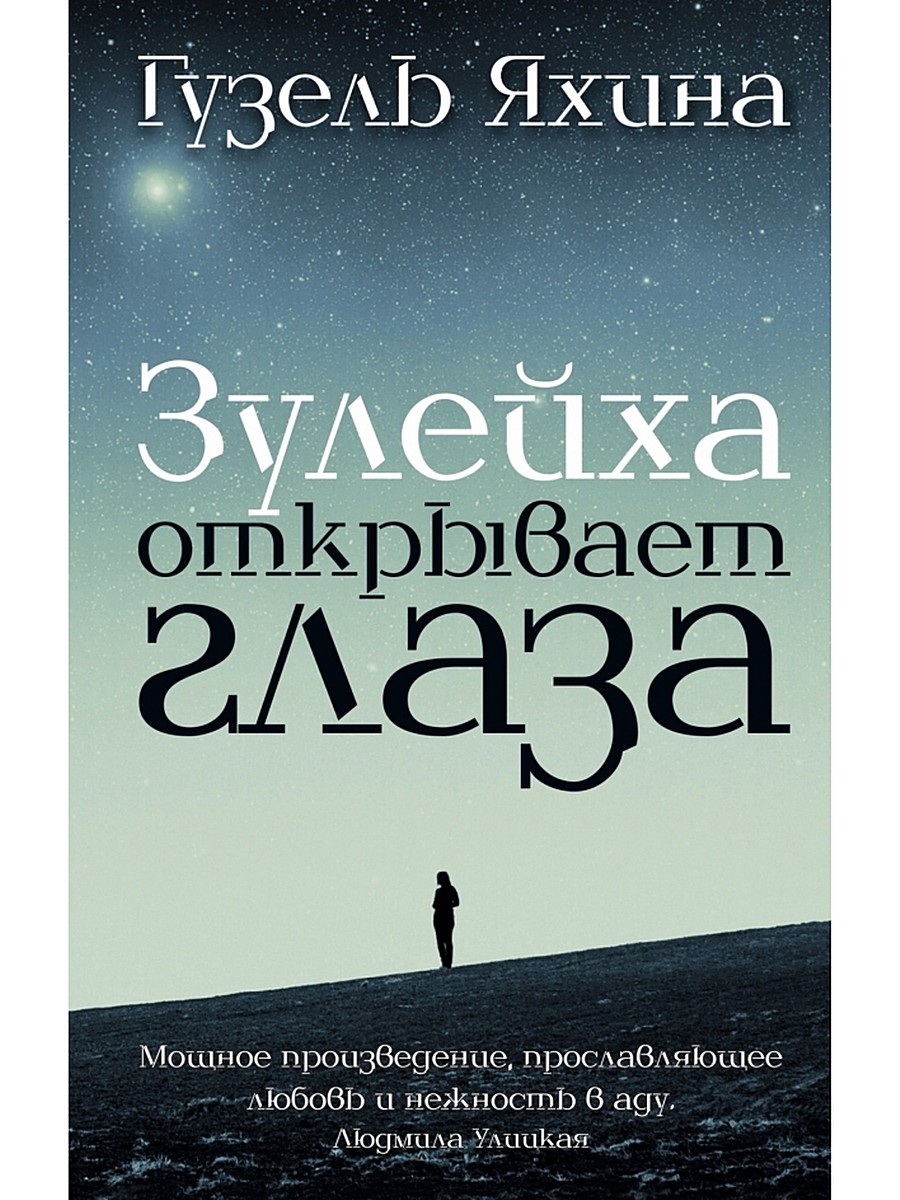
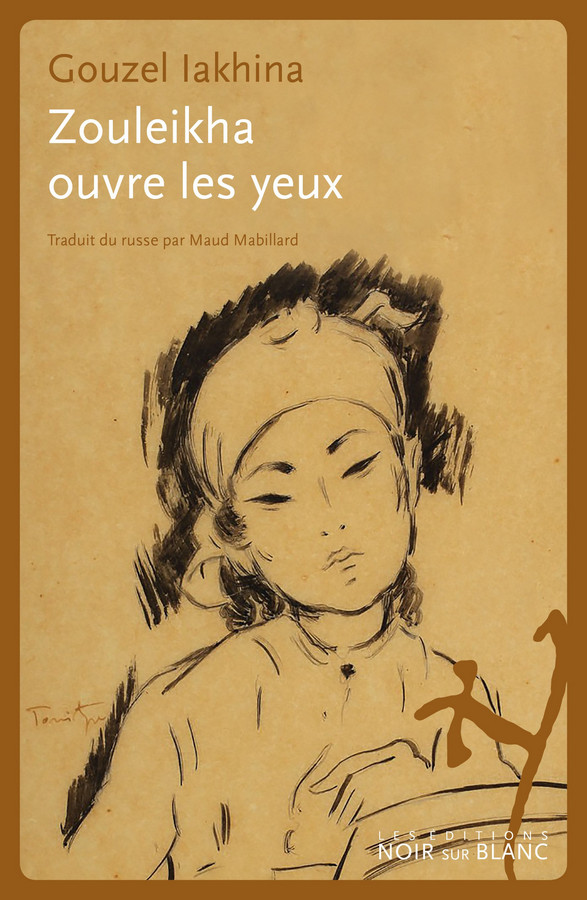
Last August, the Lausanne-based publishing house Noir sur Blanc brought out the French translation of Zuleikha Opens Her Eyes, winner of Russia’s Big Book Award.
In my view, Guzel Yakhina’s debut novel has been one of the most remarkable events in Russian literary life in recent years. And not merely because of the official recognition it has received. What matters most is that I do not know a single person who has remained indifferent to it.
In her wonderful foreword to your book, Lyudmila Ulitskaya draws particular attention to your ‘bicultural identity’. How did you come to know the world you describe in the first part of the novel so intimately? Did you grow up in a traditional Tatar family, from which you also inherited your beautiful name, one that sounds exotic in Moscow?
Guzel Yakhina: My name is exotic only in Moscow. In Tatarstan, it is as ordinary as Olga or Natalia. And mine was a perfectly ordinary Soviet family: my mother was a doctor and my father an engineer.
But I was fortunate to have grandparents from very different backgrounds. On my father’s side, they were Tatars from Kazan, city dwellers who had preserved certain bourgeois customs. On my mother’s side, they were rural Tatars. They moved to Kazan in the 1960s in search of a better life, yet even in their city home they retained the traditional way of life of the countryside.
It is their house, where I spent a great deal of time as a child, that appears in the first part of the novel as Zuleikha’s home: the walls, windows, staircases, entrance hall, courtyard, cowshed, storerooms full of household utensils, the salted goose and apple pastila in the attic...
Traditions were observed in my grandparents’ house, and observed quite strictly. We did not always understand their meaning. Why were you not allowed to step on the threshold? Why could you not take bread with your left hand? Why should a loaf never be placed crust-side down?
It was only much later, as an adult, after reading a great deal, that I realised these were remnants of a pagan culture that had survived in the lives of my grandparents, their parents and their more distant ancestors.
So the descriptions and details in the first, distinctly national part of the novel are, as they say, drawn from life. Of course, in reconstructing my memories, I heightened the colours considerably and shifted certain emphases.
I am very glad that I was born and grew up in Kazan, a city where two cultures, Tatar and Russian, coexist peacefully and harmoniously. Admittedly, it took almost five hundred years of living side by side to achieve that balance.
I grew up drawing nourishment from two sources, from two cultures. Later, German culture also entered my life: my original training was as a teacher of German.
You could draw on your own memories for the first part, but certainly not for the second. How did you work on it? How did you gather your material?
My first source was my grandmother’s stories. In 1930, when she was only seven, she was sent into exile in Siberia as the child of a kulak family, and she remained there for sixteen years. It was those stories that inspired me to write the book.
Zuleikha Opens Her Eyes is not a biographical novel, however, and its heroine is certainly not my grandmother. I was more interested in telling the story not of a child who grows up and is formed in Siberia, but of an adult woman who believes her life is over and then unexpectedly receives a second life: a chance to transform her fate and herself completely.
A woman who, at the age of thirty, leaves her native village for the first time, is forced to speak another language and even to take up a weapon and become a hunter. A woman who travels not only geographically, from her village to Siberia, but inwardly as well, from the archaic world of the past into the modern world...
My grandmother’s memories were the original impetus for the novel. To be honest, I had no real choice about what to write. I knew that I would write about dekulakisation and the exile of kulak families.
Another source was academic research and doctoral dissertations. Here I would first like to mention, with profound gratitude, a scholar whose work I drew on extensively: Viktor Nikolayevich Zemskov, a professor at the Institute of Russian History of the Russian Academy of Sciences, who devoted the last thirty years of his life to the study of special settlers. Sadly, he died recently.
I spent a great deal of time on the website of Memorial, which brings together the recollections of people from very different backgrounds who lived through the Gulag. It was a vast, difficult and extremely important body of reading.
Academic studies can provide fascinating figures, facts and historical conclusions, but not life itself, with its smells and sensations. Memoirs are precisely the opposite: in them, you can feel the breath of life.
I also visited several museums. At Moscow’s Rizhsky railway station, for example, there is a railway museum where you can look inside a converted goods wagon of exactly the kind in which my characters were transported to Siberia. You can see the darkened walls, the wooden bunks, the small barred windows and the stove in the centre.
And you can try to imagine what people must have felt when they were transported for weeks in such a cattle wagon...
Another important source was films from the 1930s about collectivisation. Above all, I would mention Alexander Dovzhenko’s Earth and Sergei Eisenstein’s Bezhin Meadow, which was banned and later lost, then reconstructed by Naum Kleiman from surviving fragments of film, photographs and Alexander Rzheshevsky’s screenplay.
It was what was known as an ‘emotional screenplay’, in which Rzheshevsky not only described the images but also tried to convey as precisely as possible the emotions of those living on the screen. The text is both brilliant and terrifying in its absolute faith in the rightness of what was taking place.
The one thing I deliberately avoided while preparing the novel was reading works of fiction about the Gulag. I forbade myself from rereading Shalamov, Solzhenitsyn or Ginzburg. I did not want to fall under their influence.
Young people have been criticised in every age, and they are criticised today, among other things, for their indifference to both the past and the future and for being preoccupied with immediate material concerns. Yet you are still a young woman, and you have turned to an exceptionally painful subject from the past. How long did you spend writing the novel, and what motivated you?
I wrote it over almost three years, and my motivation was primarily personal. I wanted to understand my relationship with my grandmother and what exactly had shaped her character, which was very strong and severe.
Once I had begun working on the subject, I realised that I had to approach it seriously. It was very important for me to do this for the sake of my grandmother’s memory, for my parents and my daughter, and also to fill the gaps in my own knowledge.
I had failed to remember some of my grandmother’s stories. There were things I had not thought to ask her about or record, and now I regret that very deeply.
Many reviewers have remarked on a certain severity in your style and on the cinematic way in which the text is structured, almost like a screenplay. The latter can perhaps be explained by the fact that you are a professional screenwriter. But what about the former?
I simply wrote as I felt and as I knew how. I am not a professional writer able to select a style from a rich palette of possibilities.
The one thing I understood clearly was that the novel, which begins firmly rooted in a particular national culture, had at some point to change and grow into something supranational and international.
I also wanted the novel, on the one hand, to be historical, attentive to every detail and faithful to historical truth. On the other hand, I wanted it to transcend history: not merely to recount the hardships of kulak exile, but also to address universal human questions beyond the historical context.
For example, what matters more to a woman: her love for a man or her love for her child? What does it mean to love your enemy, the man who murdered your husband? How do you carry for years the burden of guilt towards your dead husband because of the feelings you have developed?
Your book is moving because it contains no black-and-white characters. Even in the terrifying Upyrikha, Zuleikha’s mother-in-law, you reveal her capacity for love: her love for her son, which sometimes assumes grotesque forms but remains love nonetheless.
And the description of that group of unfortunate people cast by fate onto the banks of the Angara, all so different and unlikely ever to have met under other circumstances, goes straight to the heart. Contrary to the pessimism now in fashion, your book restores one’s faith in humanity and in the idea that even in the most terrible circumstances, the best qualities in people can still emerge.
It was important for me to preserve in the novel the lighter notes from my grandmother’s stories. Oral accounts sometimes contain much more light than written memoirs.
My grandmother spoke about Pit-Gorodok, the labour settlement in Siberia where she spent sixteen years of her life, and described not only terrible things but also warm moments: gathering cloudberries in the taiga, travelling down the Angara on rafts...
It also emerged that Pit-Gorodok itself, which had long been considered dead, is still alive in a sense. After the collapse of the Soviet Union, it was no longer needed, and its last inhabitants left.
After the novel was published, however, former residents, now scattered across different cities, wrote to me. They told me that once a year they gather together and travel to Pit to tend the graves.
This year marks the centenary of the October Revolution. There is still no single assessment of that event in Russia. Do you personally have one?
Some Eastern statesman, Mao Zedong, I think, was once asked about the French Revolution and replied that too little time had passed to assess it. I think his words apply to the Russian Revolution as well.
So you feel no resentment towards the Soviet authorities for what happened to your grandparents?
There is no point in resenting the past. Not one of them felt such resentment themselves. What is more, one of my grandfathers, on my father’s side, remained a committed communist until the end of his life.
My grandmother, whose fate inspired me to write the novel, even recalled her years in exile with a slight sense of nostalgia. Above all, it was nostalgia for the strong and unbreakable friendships they had formed.
Until her death, she remained in contact with the people who had lived with her in Pit-Gorodok. They were closer to her than some of her relatives.
There is a clear tendency in contemporary Russian society to whitewash Stalin. Does that not frighten you?
The succession of traumas our country has endured is so long and so painful that they cannot be worked through quickly. Over the past hundred years, practically every generation in Russia has experienced its own trauma.
And each trauma was layered upon the one before it, without any public discussion, without being worked through or properly understood.
Yes, during perestroika and in the 1990s, such a discussion did take place. At a certain point, it seemed to us that we had answered all the questions, that we had finished with the past and could now turn towards the future.
We now see that this is not the case. Wounds that have neither been worked through nor healed are opening again, and the conversation about the past is beginning once more. Let that conversation continue for as long as necessary.
Look at the list of winners of the 2016 Big Book Award. First prize went to Leonid Yuzefovich for The Winter Road, a book about the Civil War in Yakutia. Second prize went to Eugene Vodolazkin for The Aviator, a contemporary story that begins and ends on the Solovki Islands. Third prize went to Lyudmila Ulitskaya for Jacob’s Ladder, a novel based on the life and letters of her grandfather, who spent thirty years in the camps.
That is what concerns writers. And it concerns readers too: all these books have appeared in large print runs.
So you do not believe it is time to draw a line under the matter?
A line does, of course, have to be drawn eventually, but there is no need to rush or to accelerate the process artificially.
Zuleikha Opens Her Eyes is your first novel, and it was immediately so successful: prizes, translations into more than twenty languages... Does that encourage you, or does it make you complacent?
Neither. Success brings responsibility, and it also raises expectations enormously.
I am now working on my second book. I do not yet know when I will finish it, or whether I will be able to make it as good as the first. I hope so.
Of course, I am extremely grateful for the success of Zuleikha. The prizes and translations have helped the book find more readers, and that is what matters most.
What was the reaction to the book in Tatarstan?
Very varied and highly emotional. Some felt that the novel denigrated Tatar women and Tatar mothers, and that I had treated national and religious themes inappropriately. Others, on the contrary, regarded the book as a hymn to Tatar women.
I am grateful for all the responses and reviews, even the most negative ones, because the lively discussion surrounding the novel ultimately stimulated readers’ interest.
It was important to me that the novel’s first translation should be into Tatar. It was produced by the republic’s most distinguished publishing house, the Tatar Book Publishing House, and very quickly: exactly one year after the Russian edition appeared, the Tatar version was already on the shelves.
That brings us to the translations of your book. You were able to follow the German translation, which appeared in February this year, but what about the others? The book contains so many words that even Russian-speaking readers may not understand. Do you simply have to trust the translators and publishers?
First of all, I am immensely happy about every translation. If, after reading Zuleikha’s story, a reader somewhere in China or America understands Russian history a little better, or develops even a slight interest in Tatar culture, I will be delighted.
I do not work alone. I work with a professional literary agency that oversees the entire process. I communicate with the translators and answer all their questions.
Yes, I trust the publishing houses, because I believe I am working with highly professional people. We all share the same aim: to make the book as accessible as possible to the reader.
As for the Turkic words, which I use fairly frequently in the first part of the novel, each publisher makes its own decision about whether to retain them, in order to convey the atmosphere and national character more vividly, or to remove them.
In Finland, for example, they decided to retain all the Tatar words in the text, without italics and without a glossary at the end of the book in which readers could check their meaning. They believed the text would remain comprehensible as it was.
The British publishers, by contrast, decided, with my agreement, to translate all the Tatar words in order to avoid making the text unnecessarily complicated and putting readers off from the very first pages.
In the German translation, some of the Tatar words were retained and set in italics.
Almost all the ‘Sharikovs’ in your book are punished to varying degrees: Denisov, Grunya and perhaps, later, Gorelov. Do you believe that crime inevitably brings punishment?
Guzel Yakhina: (She pauses to think.) You are right. In most cases, I do, of course, punish them...
Which greatly pleases the reader who longs for justice!
Guzel Yakhina: ...but notice that I do this only with minor characters, not the main ones.
In describing the fates of the major characters, I still tried to remain faithful to historical truth. Exercising my authorial privilege, I allowed all thirty settlers who survived the first winter in the taiga and founded the labour settlement to remain alive.
Perhaps this is not entirely realistic, but by that stage of the novel I had other aims. My task was not so much to preserve strict verisimilitude as to give this story of survival the qualities of a legend.
In general, I was much kinder to my characters than life would have been.
Perhaps that really is the author’s greatest privilege...