Bookshelf

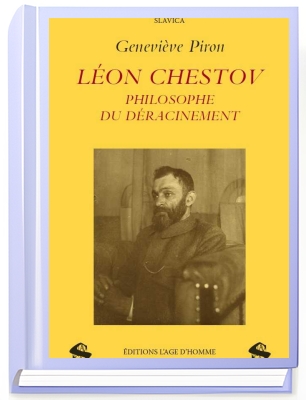
Geneviève Piron : «Léon Chestov, philosophe du déracinement», Editions l’Age d’Homme, 2010, 460 pp., 55 Frs

Cette étude d’une chercheuse de l’Université de Genève est publié avec le soutien de la Fondation Neva.

Léon Chestov (1866-1938) est une grande figure de la pensée existentielle. Derrière les présupposées rationnels, il dénonce une position métaphysique fondée sur la résignation. Pour lui, la véritable philosophie est révolte : elle naît de la conscience tragique. Opposant le malheur du «penseur privé» Job aux idées générales de Hegel, Chestov explore les pensées les plus incandescentes, les plus paradoxales, dissimulées derrière les systèmes des philosophes dans l’histoire. Ses «pérégrinations à travers les âmes» le conduisent à faire éclater la synthèse entre pensée grecque et judéo-chrétienne en retrouvant un pouvoir   caché dans les paroles bibliques. Au-delà des «évidences», il désigne une «seconde dimension de la pensée», liée à une liberté absolue, fondée en Dieu, pour qui «rien n’est impossible».

L’ouvrage de Geneviève Piron explore la genèse de cette pensée tragique, ancrée dans le XXe siècle et plus que jamais actuelle. Pour la première fois, on y voit réconciliées les deux «périodes» de l’œuvre du philosophe russe: son rattachement à «l’Age d’argent» dans la Russie du début du XXe siècle, et sa période de maturité, dans la France de l’entre-deux-guerres. Etudiant des matériaux d’archives inédites, l’auteur nous présente un nouveau visage du philosophe cultivant le mystère; et éclaire ses démarches de penseur, d’exégète et d’écrivain.

Cette étude, incontournable pour la connaissance de l’œuvre de Léon Chestov, intéressera aussi les amateurs de critique génétique, de culture russe, de philosophie.

Chez le même éditeur, de Léon Chestov :

Les commencements et les fins
Spéculation et révélation
Les grandes veilles

 

About the author

Nadia Sikorsky

Nadia Sikorsky grew up in Moscow where she obtained a master's degree in journalism and a doctorate in history from Moscow State University. After 13 years at UNESCO, in Paris and then in Geneva, and having served as director of communications at Green Cross International founded by Mikhail Gorbachev, she developed NashaGazeta.ch, the first online Russian-language daily newspaper, launched in 2007.

In 2022, she found herself among those who, according to Le Temps editorial board, "significantly contributed to the success of French-speaking Switzerland," thus appearing among opinion makers and economic, political, scientific and cultural leaders: the Forum of 100.

After 18 years leading NashaGazeta.ch, Nadia Sikorsky decided to return to her roots and focus on what truly fascinates her: culture in all its diversity. This decision took the form of this trilingual cultural blog (Russian, English, French) born in the heart of Europe – in Switzerland, her adopted country, the country distinguished by its multiculturalism and multilingualism.

Nadia Sikorsky does not present herself as a "Russian voice," but as the voice of a European of Russian origin (more than 35 years in Europe, 25 years spent in Switzerland) with the benefit of more than 30 years of professional experience in the cultural world at the international level. She positions herself as a cultural mediator between Russian and European traditions; the title of the blog, "The Russian Accent," captures this essence – the accent being not a linguistic barrier, not a political position but a distinctive cultural imprint in the European context.

Events
Most read

The decision of the Music Society of La Chaux-de-Fonds not to cancel the concert by Elisabeth Leonskaja and The Jerusalem Quartet, scheduled for 22 March, has turned what would have been an ordinary cultural event into a victory of reason and professionalism. I will explain why and present an exclusive interview with the outstanding pianist.

Let me clarify at the outset: this is not about a specific musical composition, but about an ensemble formed just over a year ago which, after a successful debut in Zurich, is now preparing to demonstrate its artistry in Geneva.

The personal relics of the last King of Italy, preserved within the family until today, will be presented to the public in Geneva for the first time. This month, Piguet Hôtel des Ventes will offer at auction a unique collection of orders of chivalry and decorations that belonged to Umberto II (1904-1983). They will be exhibited in the Maison’s salons from 12 to 15 March, before being offered to collectors during the auction week beginning on 16 March.