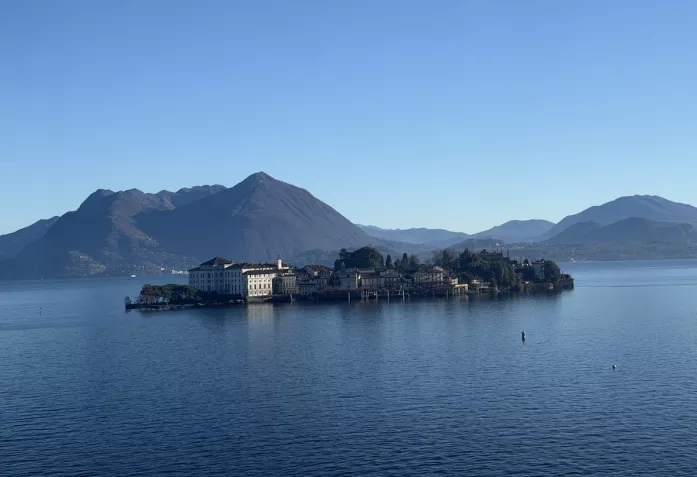
Poetry is not meant to be consumed in bulk and one piece after another, tossing rhymes down like shots of vodka. It is meant to be savoured slowly, like a good wine. So I too, having downloaded the collection onto my iPad and taken it with me on a train journey, intended to read a couple of poems, then admire the landscapes and listen to music, then — another couple… The plan failed: once I began reading, I could no longer tear myself away, growing inebriated with every page, and of all the beauty outside the window I noticed only one thing — an island in the middle of Lake Maggiore. An island of extraordinary beauty, especially against the backdrop of the blue sky and the slightly darker yet equally serene water. At once, that solitary, beautiful island merged in my mind with Lermontov’s sail and pine, both solitary too.
It happened last December, and right then I decided to tell you about this collective creation, this collective cry of the soul, yet I chose to wait for February, when, for more than a century now, one is supposed, in Pasternak’s words, ‘to take ink and weep’, and for the past four years — to speak of the war. How could Boris Leonidovich have known that the tragedy would occur in this very month, and that poets of other generations would once again ‘write of February, sobbing’?! And yes, generations, in the plural: not all the authors indicated their dates of birth in the biographical notes, yet from the available information it appears that the oldest was born in 1938 and the youngest in 1989. This difference in age is not felt in the poems in the slightest: the reader hears the powerful voice of like-minded people, and the lace they have woven protects him, the reader, from dehumanisation more reliably than any coat of mail.
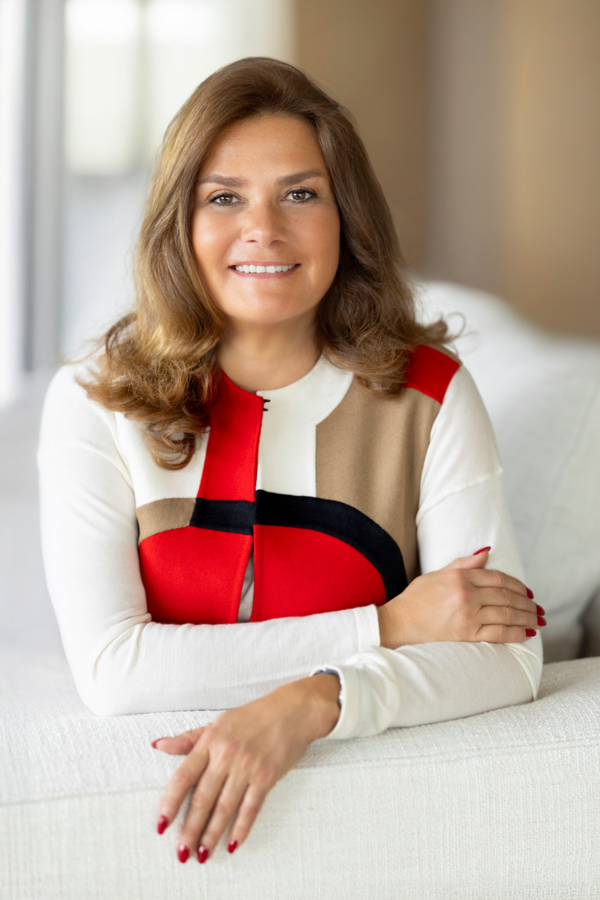
While waiting for February, I reread the collection several times, finding it impossible to select the most important poems — each of them is too valuable. I also managed to obtain the email address of Tatiana Bonch-Osmolovskaya, the compiler of the collection and one of its authors and translators. Tatiana Bonch-Osmolovskaya is a prose writer, poet, philologist, teacher, literary scholar, and researcher of literature. A graduate of Moscow Institute of Physics and Technology (MIPT) and the French University College, she is the author of around twenty books of prose, critical essays and poetry, as well as publications in English. Tatiana has organised literary and cultural events, including the Australian Festivals of Russian Traditional and Experimental Poetry and the seminars ‘Mathematics and Art’. She currently lives and works in Sydney. Overcoming the time difference, we found a way to exchange.
Tatiana, literature in general and poetry in particular have long held a special role in a closed Russian society, especially in ‘fateful moments’, to quote Tyutchev. The Great Patriotic War gave rise to an enormous body of verse, and many of the poems written then, especially those set to music, truly became part of the popular consciousness. Few expected such an outburst from the present war — a different era, a different rhythm of life, different sources of information. Yet your collection testifies that Russian poetry is alive. How did the project come into being? How did you bring together authors scattered across the world, whose union you felt was necessary?
Russian poetry — independent, free, personal, thinking, feeling — is, of course, alive. The poems included in this collection were written because they could not but be written, and published because they had to be published. It was not difficult to come together: the existence of poetry is not determined by geography; we all know one another, wherever we may be, wherever we are physically. We were united by mutual friendship and respect, and by an inability to remain silent in a time of shared misfortune. Our project became an opportunity for poets to give voice to their feelings at this moment, and for readers to hear them.
Do you think that the role of poetry today differs from that of the twentieth century?
When you speak of poetry, do you mean Russian-language poetry? Even if we limit ourselves to Russian-language poetry, it is a very complex question for a short answer. The twentieth century was very long. Poetry was diverse. Here I shall omit at least an hour-long account of poetic movements and move to a conclusion.
Compared with the twentieth century, contemporary poetry is a more private affair. The poet no longer declaims from a tribune, no longer fills stadiums — even poetry slams do not fill stadiums. The state is not particularly interested in poetry. A poem may be read at the inauguration of an American president, yet everyone understands that people have not gathered there for that.
Poetry books are no longer published in print runs of hundreds of thousands as they were in Soviet times, when literature was a weapon of ideological struggle and served the proletarian state. Alongside this, of course, there existed independent underground literature, as well as authors beyond the Soviet Union, samizdat and tamizdat.
All this has changed several times. Today’s Russian state, evidently, does not equate the pen with the bayonet — and I consider this wonderful. Thus poets with independent voices today exist more or less safely without the attention of the state. Not always, of course. The monster of the state machine still seizes those who write: Alexander Byvshev, Artem Kamardin, Yegor Shtovba, Glikery Ulunov, Yevgenia Berkovich, Svetlana Petriychuk.
Even more often, a person is declared a ‘foreign agent’, and the laws currently adopted in Russia deprive such people not only of the possibility to teach or publish but of any means of earning a living.
As a result, many authors have left Russia. Yet today, as always, poets cannot help but write poems. ‘For the drawer’, for a small circle, online, through a private publisher, by switching to another language, by turning to landscape lyricism, to zaum, to complex metaphysics — the poet writes. Through the word he comes to know himself and the world. When the world collapses, he records this rupture. Incidentally, he does it by means of a wide variety of poetic techniques — in this too contemporary Russian-language poetry differs from that of the Soviet era: diversity, individual sounds and colours. Of course, the poet writes for a reader, publishes from time to time, shows his poems. In literary journals, collections and anthologies one hears not a coordinated chorus but a diversity of individual poetic voices. Our collection is an example of this.
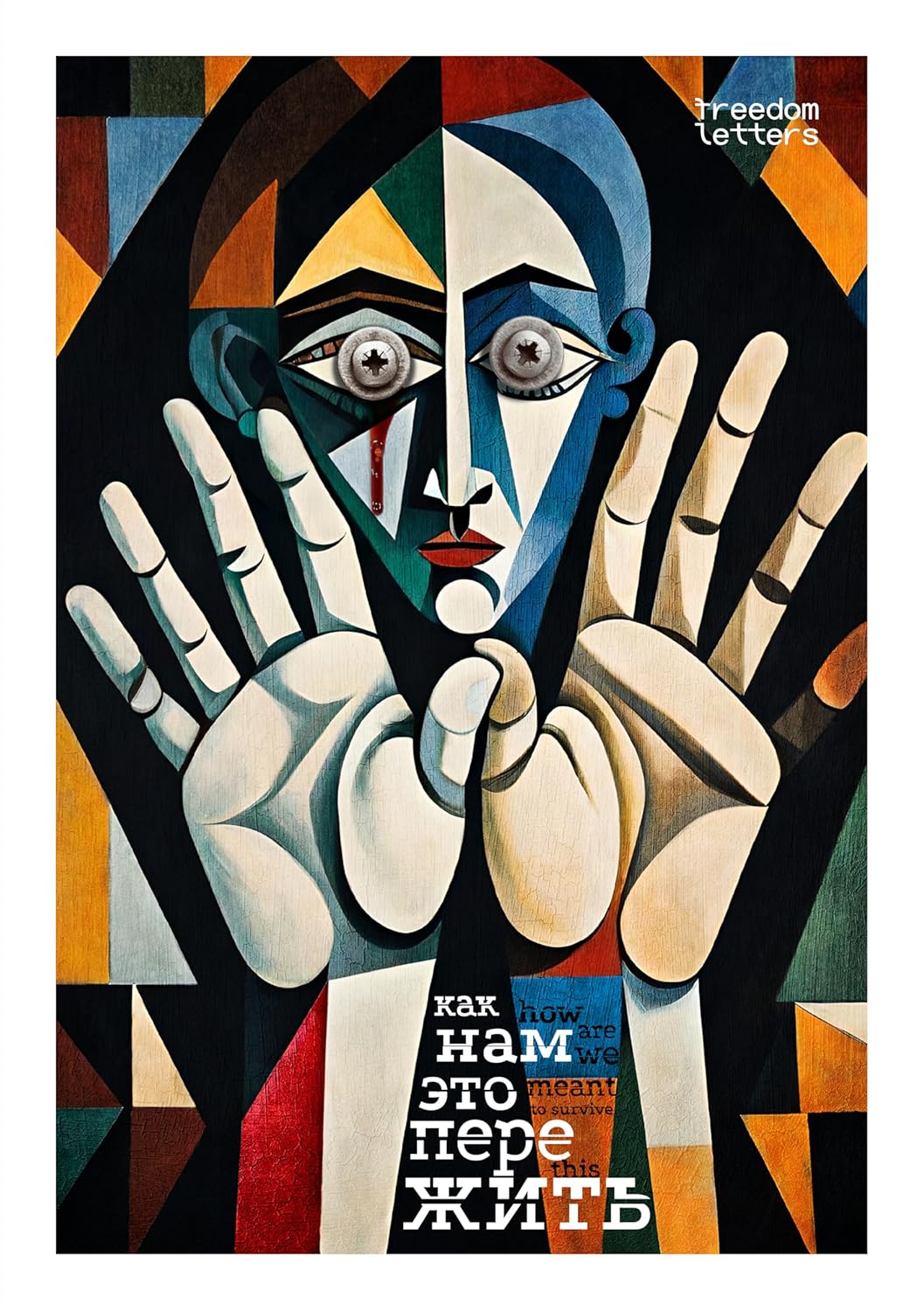
How difficult was it to find a publisher? How did negotiations with Freedom Letters proceed, and how should one understand the indication of its location — Petrograd?
Before Freedom Letters we approached a couple of other publishers, with whom cooperation ultimately did not work out. With Freedom Letters, everything fell into place immediately. It is a unique publishing house issuing honest contemporary literature. A unique publisher, Georgy Urushadze, unique staff and volunteers. In less than three years of existence, the press has released more than six hundred remarkable books, in print and often simultaneously in electronic form. They are printed in a dozen countries worldwide and are also distributed as print-on-demand editions. Have a look at their website — you can browse the titles there and purchase them.
The reference to Petrograd is probably a joke. For different books the Freedom Letters publishing house names various places on the geographical and even historical map. In today’s world a book is prepared for print using a computer, and members of the publishing team may be located anywhere on the globe.
If I am not mistaken, for some time after publication the collection was sold in Russia on the Ozon platform. What was that — did censorship overlook it?
Our book has no censorship restrictions. It does not even need to be wrapped in cellophane. For the Russian readers we indicated the author designated a foreign agent; all legal requirements were fulfilled. There were no questions about the collection.
The current war is often described as ‘fratricidal’ and compared to a civil war. One of the very first poems in the collection, by Alla Bossart, speaks of this: ‘We should be rooting for our team’. But who is ‘our team’ today, especially given the spread of inverted concepts? ‘Ours’ is no longer simply a possessive pronoun but also the name of a movement that might have been called patriotic if the very notion of patriotism had not been distorted. The word ‘ours’ today draws together very different people. Even a political scientist finds it difficult to make sense of this — what, then, is a poet to do?
In my view, Alla Bossart writes with complete clarity:
“We should be rooting for our team but
no-one explained just what our team was
and since that happened wins and losses
began to look about the same
when on our team one player murdered
a guy who was a total rival
and after that he shot his pet dog
and after that he raped his wife
and kicked her with his foul shitkicker
and kicked the toys around the carpet
and knocked out cold the crying baby
applying gunstock to his head…”
Here, I think, I may use the pronoun ‘we’. We are against violence, against murder; our poems exist outside the language of hatred. We write about what it means to remain human in human and inhuman conditions.
Not only political concepts have been turned upside down, but everything, even what was familiar and beloved since childhood. This is reflected with piercing accuracy in the poems included in the collection. I am thinking, for instance, of Marina Boroditskaya’s distinctive paraphrase of Samuil Marshak’s translation This is the House That Jack Built, known to every Soviet child. Her poem begins with the words ‘This is the house destroyed by “Grads” ’, self-propelled 122 mm multiple rocket launchers. It is far closer to Lars von Trier’s film of the same name – about a serial killer – than to a children’s rhyme. What do you think about this? Do you define this phenomenon in any way?
I must confess that I have not seen Lars von Trier’s film and cannot compare them. As for Marina Boroditskaya, she herself is a translator and the author of many poems for children; for her, translating nursery rhymes is second nature. Here Marina speaks in her own language, the language of children’s fairy tales, and the impression that arises is indeed frightening — a terrifying contrast between what is familiar, kind, domestic and homely on the one hand, and the nightmare into which life has turned on the other. Yet fairy-tale language can also tell frightening stories; here I would rather recall Guillermo del Toro. Fairy tales are a universal, recognidable language of children and of adults who were once children and who told stories to their own children. A fairy tale is one of the models for describing the world, including a nightmarish world. A fairy tale teaches: in the forest there is a wolf, beyond the river — bandits, in the mountains — a dragon. A fairy tale warns. But a fairy tale, as a rule, ends well. And Marina Boroditskaya concludes her poem, remaining within the fairy-tale paradigm, with a reminder of the ending of another story — about the Golden Cockerel. It is a way of inviting the child, and the child within the adult, to recognize the fairy tale, and then there is a chance that everything will turn out well, that fate, time, the cockerel will intervene and the nightmare will end. Once again, if we recall films — as in Life Is Beautiful by Roberto Benigni.
In the poems of this collection there are many references to Russian classics placed in a new dramatic context. Some are direct, such as ‘If only we could live within the family circle’ by Tamara Bukovskaya, others more subtle. I noted for myself Pushkin, Lermontov, Turgenev, Dostoevsky, Gogol, Bulgakov, Pasternak, Nabokov… What is this — a form of nostalgia, which is keenly felt among many authors?
In contemporary poetry the inclusion of lines by other authors within one’s own text is a common phenomenon, even to the point of constructing a cento entirely from lines of poets of the past. And not only from poems: from song lyrics, phrases from films, familiar quotations, even Soviet slogans and clichés — a kind of ready-made poetry. This approach was introduced into Russian poetry by the Moscow Conceptualists, and contemporary poets develop and employ it in many ways. Not only banal references but complex concepts, quotations and reminiscences of philosophers, theologians, linguists — anyone at all — may appear. A wide range of aims is possible here, from appropriation to deconstruction. For instance, Natalia Sivokhina builds her entire poem ‘Well, last night was a blast — telling you, it was bitchin’ on idioms revolving around the ‘head’. In the lines by Alla Bossart quoted above there is, of course, an allusion to a line by Boris Pasternak. Or when Alexander Skidan writes ‘arendt said this is a prophetic text, sholem said this is a prophetic text adorno said this is a prophetic text…’, he addresses a reader who has read all these authors and those mentioned thereafter. There are indeed a great many such lines in the collection. I see here not nostalgia but the same fixation on a state of shock: what we relied upon, the structure of culture, has collapsed; the world as we knew it has come to an end. Yet this phenomenon can hardly be reduced to a single interpretation: different poems explore different motifs and allow for different readings.
Several poems are written in the form of prayers. How is one to reconcile faith, Christian values and the role played today by the Russian Orthodox Church?
You know, when I reread the collection some time after publication, with fresh eyes, I noticed how many prayers it contains, or appeals to God, to the Mother of God, or even motifs of God’s abandonment. With your permission, I shall quote a few lines. Larisa Miller, one of the luminous lyrical poets — incidentally, her poems were translated by the distinguished British theologian Rowan Williams — addresses God directly: ‘Creator, we need an answer from you…’ The same sense of a rupture in the universe, of a discord with an eternal design.
Marina Boroditskaya writes: ‘it says ДЕТИ – on the road, on the roof, on the whole round of earth, in very large letters. CHILDREN, Lord. Children’. Seemingly calm words, yet they are read as a cry, a howl: an inscription in enormous white letters on the asphalt, visible from above, from an aeroplane, from a satellite, from the heavens. Did they not see the inscription from the planes? Did they not wish to see it? Did the Lord see it?
And then Tamara Bukovskaya begins with a traditional prayer: ‘O Lord, thou still art in heaven’ and ends with the bitter words: ‘or either you haven’t been and are not at all.’
In the same vein, there comes Alina Vitukhnovskaya with ‘Our New God ex nihilo…’, and, ironically, Igor Irteniev: ‘But I am sad for the people, So much so that I can stand it no longer - The ground beneath them is shaking, But the Lord protects us, The people’s lot in life never ending, No matter what you do to them’, and Natalia Sivokhina ‘“Who’s playing the white?” God’s fingers tremble, But the world is a chessboard. The pieces assemble.’, Tatiana Shcherbina ‘An icon, the Virgin with Child, a puff of grass, quick and light, wipe off your soul with a towel — that settles might vs. right…’, and words of faith by Lyubov Summ: ‘but yesterday Christ had risen, but today he’s truly risen, today and forever and…’, as well as my own poem ‘My prayers are for you…’. Such varied appeals — religious, lyrical, ironic, ecumenical, agnostic…
Incidentally, not only Christianity appears here: Dmitry Vedenyapin writes of Jewish righteous men in an unknown (Nabokovian?) country: ‘ten tsadiks from Zemble, perhaps, not Zemble – God grant them good health! — they pray from the right to the left So that we shouldn’t be able to completely destroy mother Earth…’.
What does all this suggest? That in an era of existential fracture, as in a diving aeroplane, there are no atheists? It seems to me worth paying attention to the lines by Veronika Dolina: ‘I will put a steadfast candle up And teach my kids to shine.’. Lighting a candle is a sacred act, not only in Christian but also in Buddhist and Hindu temples. It is performed by a human being — a gesture of service to light, of burning for others, for good, for harmony, for illuminating a dark world, for helping people and, if there is enough light, for salvation.
How did the idea of creating a bilingual edition arise? Are there plans for translations into other languages?
From the very beginning the collection was conceived as bilingual: Russian originals, English translations. Here I would like to speak about the translators — an absolutely unique team came together. Imagine: nearly one hundred and fifty poems, twenty-six authors, each with a unique voice, all needing to be translated, and rather quickly.
The translators, like the authors, worked from different countries and continents. For some English is a native language; some have long worked professionally as translators; some are amateurs — and all are tireless workers. My deepest gratitude and respect to the translators!
There are no plans for translations into other languages for now. My translation contacts are in the English-speaking world. But should an offer come from a publisher or translators working from another language, we would of course be delighted.
Do you think some explanatory notes would be useful, and not only for foreigners? I doubt that many Russians, especially those of younger generations, would recognise in ‘Mark Naumych’ in Dmitry Vedenyapin’s poem Mark Bernes and the cult song ‘I Love You, Life’ by Eduard Kolmanovsky with lyrics by Konstantin Vanshenkin.
Perhaps, when we provided only a small number of notes to the translations for a foreign audience, we had in mind a reader of poetry more or less familiar with our local cultural context. For an academic edition, should one be realised, or for public readings outside Russia or within Russia (the latter, unfortunately, is very unlikely), it may be necessary to prepare more detailed commentary on the texts.
Despite the life-affirming declaration ‘Russian Poetry Has Not Lost its Speech Power’, many poems in the collection echo the theme of hopelessness, born above all of one’s own powerlessness. This is expressed most precisely in Tatiana Voltskaya’s poem about an old woman on the ruins of Bakhmut, ending with the words: ‘She shakes — I see what she is feeling, But I can't stop it all the same’. What can poetry do?
Poets write poems. That is precisely what we have done: written poems and shown them. It is a joy when a word meets its reader.
As for powerlessness and hopelessness, this is indeed one of the recurring motifs of the poems in the collection — which is hardly surprising. The poet sees everything more clearly — including the darkness.
And yet he believes in light. He acts little by little. For a difficult task begins with an easy one, a great achievement with a small step, because the difficult is created from the easy, the great from the small. As in the lines by Veronika Dolina already cited. As in Larisa Miller: ‘But victory comes, not with gnashing teeth, it comes with sounds that will caress our ears.’. In Natalia Sivokhina: ‘Can this really be fear? No, and there is no fear. <…> My Grey Neck duck, the River Styx is freezing over, my child’. Credo quia absurdum. I believe because it is absurd. Here I would like to quote in full one poem by Natalia Klyucharyova, translated by Dmitri Manin:
* * *
Pick chestnuts, for it’s pointless.
Feed homeless cats, for it’s pointless.
Give change to the bum outside the supermarket, for it’s pointless.
Separate your trash, for it’s pointless.
Write poems, for it’s pointless.
Sign petitions, for it’s pointless.
Take long walks, for it’s pointless.
Sign up for courses, for it’s pointless.
Make plans, for it’s pointless.
Love, for it’s pointless.
Live, for it’s all there is.
Even the annotation to your collection turned out to be unusual — suffice it to recall the phrase ‘compressed time of catastrophes’. Poets have always been prophets, though most often in their various homelands they were not heeded. But can one speak of some shared prophecy or foreseeing that you and your colleagues arrived at?
There is no shared prophecy. We did not consult one another, did not coordinate our texts, did not sit at a common table holding hands and gazing into a mirror. We are not Pythias. I can speak only for myself. I did not foresee the annexation of Crimea, nor Russia’s unleashing of the war, nor that this war would be so exhausting and long. It has already lasted longer than the Great Patriotic War! And I have little hope that it will end soon. If one looks ahead, there is darkness. The further one looks, in time and in space, the darker it becomes. And yet there is the here and now, and each and every one of us who is alive today. That, if you like, is my foresight.
These metaphors — the Golden Age and the Silver Age of Russian poetry — belong to the era of Romanticism and post-Romanticism, when, slightly exaggerating, the poet presented himself as a messenger of eternity, able to perceive harmonics unknown to ordinary people, as the possessor of an ideal voice and perfect mastery inaccessible to the masses. Since then the role of the poet has changed significantly. Already in modernism and the avant-garde, not to mention postmodernism and other movements, the poet today occupies a different position.
In the history of Russian poetry there were proposals to define an era through metal — the Bronze Age, as an attempt at self-naming in the mid-to-late twentieth century. There is both the nobility of metal and the shadow of the classics, weight and density. Not a golden standard but a private and difficult endeavour: the poetry of independent authors. Such a self-definition existed, but in relation to a past epoch.
Metallic associations can be extended in any direction — a Copper Age, meaning trumpets, that is, loud, military, patriotic poetry, glory and emptiness; or an Iron Age — working poetry, simple, durable, unadorned; a Uranium Age — dangerous, toxic, effective; a Paper Age — abundant, fragile, graphomaniac; a Glass Age — transparent, displayed to all, networked poetry, visible to everyone, as in Orwell’s world; a Wooden Age — ecological, New Age poetry; a Plastic or Microchip Age — various AI techniques. Yet few are eager to define themselves by such, unlike gold and silver, non-elitist materials! Thus poetry has ceased to be elitist. One might, of course, identify as a poet of a Platinum or Diamond Age — that too is an option. Who’s to stop you?
You see, material associations no longer work. Because if one were to choose a single epithet for contemporary poetry, it would be this: diverse. There are continuators of the Acmeist line; there were and are Moscow Conceptualism and Metarealism; there are and were modernist, postmodernist, post-conceptual authors, ‘naïve’, intellectual, academic; there was and is experimental poetry; one may speak of contemporary poetry. There has been no single name for the era since the 1990s, and in my view, none is likely to appear.
P.S. Dear readers! I encourage you to purchase the poetry collection and support this wonderful project. You can do so easily here.




Federica Brunelli February 26, 2026