Bookshelf

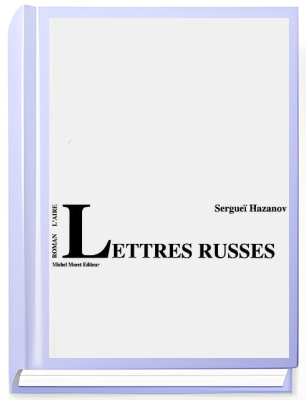
Sergueï Hazanov "Lettres russes. Roman épistolaire". Editions de l'Aire, 1997.

Livre publié avec l'aide du Service des Affaires culturelles de l'Etat de Vaud.

A propos de ce roman épistolaire, l'auteur confie: "Je garde encore la nostalgie de ma couverture d'enfant, que ma grande-mère avait improvisée de chiffons. Elle avait assemblé pendant de nombreuses années des morceaux d'uniforme, de pyjama, de brocart et même de soutane. Le soir, au lit, je choisissais dans cette couvertire un nouveau morceau, l'examinais et en rêvais jusqu'à m'endormir...

Mon livre aussi est un patchwork, une satire des réalités de la Russie et de la Suisse, qui renverse bien les clichés des médias et crée les siens.

Si la fatalité vous pousse vers ces Lettres russes, sachez qu'elles

- ne tandent pas à une histoire continue et à suspense;

- n'aspirent ni à la profondeur de pensée, ni à l'élévation de style, ni au déferlement des passions.

Vous n'êtes pas dissuadés?

Alors bonne lecture."

Né en 1951 à Moscou, Sergueï Hazanov vis en Suisse depuis 1990. Il est l'auteur, en russe, de quatre livres, romans et pièces de théâtre )en collaboration avec D. Koline).Il a également publié de nombreux vers et nouvelles dans les principales revues littéraires russes, en Suisse dans le Passe-Muraille et aux Etats-Unis dans la revue Time and We. De langue maternelle russe, Sergueï Hazanov àcrit aujourd'hui sa prose en français. 

About the author

Nadia Sikorsky

Nadia Sikorsky grew up in Moscow where she obtained a master's degree in journalism and a doctorate in history from Moscow State University. After 13 years at UNESCO, in Paris and then in Geneva, and having served as director of communications at Green Cross International founded by Mikhail Gorbachev, she developed NashaGazeta.ch, the first online Russian-language daily newspaper, launched in 2007.

In 2022, she found herself among those who, according to Le Temps editorial board, "significantly contributed to the success of French-speaking Switzerland," thus appearing among opinion makers and economic, political, scientific and cultural leaders: the Forum of 100.

After 18 years leading NashaGazeta.ch, Nadia Sikorsky decided to return to her roots and focus on what truly fascinates her: culture in all its diversity. This decision took the form of this trilingual cultural blog (Russian, English, French) born in the heart of Europe – in Switzerland, her adopted country, the country distinguished by its multiculturalism and multilingualism.

Nadia Sikorsky does not present herself as a "Russian voice," but as the voice of a European of Russian origin (more than 35 years in Europe, 25 years spent in Switzerland) with the benefit of more than 30 years of professional experience in the cultural world at the international level. She positions herself as a cultural mediator between Russian and European traditions; the title of the blog, "The Russian Accent," captures this essence – the accent being not a linguistic barrier, not a political position but a distinctive cultural imprint in the European context.

Events
Most read

A Russian accent in an Art Brut collection? I certainly did not expect to encounter one at the exhibition Écrits d’Art Brut at the Fondation Jan Michalski. It all began with a sheet of paper dated December 1938, covered with Russian, French and English words, which which evoked a vague sense of someone's tragedy, encoded in chaotic lines and symbols.

On 17 June, people in the Italian capital will be reading Dostoevsky’s «White Nights». That is the premise of La tempesta silenziosa (The Silent Storm), an initiative conceived by the writer Alessandro Baricco and organised by Rome’s Department of Culture as part of the city’s Day of Remembrance programme.