Bookshelf

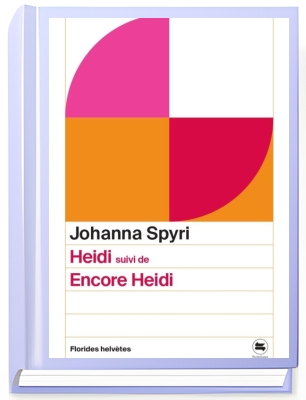
Johanna Spyri: Heidi, suivi de Encore Heidi. Editions Floride helvètes. 28 juin 2024, 324 pages, CHF 18.

Johanna Spyri naît en en 1827 dans le canton de Zurich. Après quelques années d’études, elle épouse l’avocat et journaliste Johann Bernhard Spyri dont elle a un enfant, Bernhard Diethelm, en 1855. Lectrice passionnée, proche des milieux culturel et intellectuel zurichois, elle publie dès 1871 des histoires pour enfants. Après la mort de son époux et de son fils en 1884, elle se consacre pleinement à la littérature, laissant dernière elle, à son propre décès en 1901, plus de trente ouvrages.

Petite orpheline, Heidi est confiée à la garde d’un grand-père bourru, là-haut sur l’alpage. Elle se lie d’amitié avec Peter, le petit chevrier, et sa grand-mère, mais doit brusquement partir à la ville, en Allemagne, pour y rejoindre sa tante et tenir compagnie à une petite fille paralysée, Clara. L’amitié qui naîtra entre elles ne suffira pas à guérir Heidi de la nostalgie: ne supportant pas la vie citadine, elle tombe malade. Elle est autorisée à retourner chez son grand-père, mais Clara se voit ainsi enlever sa seule amie, et son état de santé décline à son tour. Que faire ? La réponse se trouve sur l’alpe…

Les histoires de Heidi, Peter et Clara ont été publiées en deux parties : la première en 1880, (Heidis Lehr-und Wanderjahre), la seconde en 1881 (Heidi kann brauchen, was es gelernt hat). Traduits la première fois en français par Camille Vidart, enseignante et féministe militante, ces deux tomes ont été publiés en 1882 aux éditions Georg, à Bâle. Réunis en un seul volume dans la présente édition, ils sont accompagnés d’une préface inédite d’Alain Bagnoud, écrivain.

Et pour mieux comprendre, au-delà de ces textes, comment Heidi est devenu un mythe, plongez dans l'enquête de Jean-Michel Wissmer, Enquête sur un mythe suisse qui a conquis le monde.

A lire plus

About the author

Nadia Sikorsky

Nadia Sikorsky grew up in Moscow where she obtained a master's degree in journalism and a doctorate in history from Moscow State University. After 13 years at UNESCO, in Paris and then in Geneva, and having served as director of communications at Green Cross International founded by Mikhail Gorbachev, she developed NashaGazeta.ch, the first online Russian-language daily newspaper, launched in 2007.

In 2022, she found herself among those who, according to Le Temps editorial board, "significantly contributed to the success of French-speaking Switzerland," thus appearing among opinion makers and economic, political, scientific and cultural leaders: the Forum of 100.

After 18 years leading NashaGazeta.ch, Nadia Sikorsky decided to return to her roots and focus on what truly fascinates her: culture in all its diversity. This decision took the form of this trilingual cultural blog (Russian, English, French) born in the heart of Europe – in Switzerland, her adopted country, the country distinguished by its multiculturalism and multilingualism.

Nadia Sikorsky does not present herself as a "Russian voice," but as the voice of a European of Russian origin (more than 35 years in Europe, 25 years spent in Switzerland) with the benefit of more than 30 years of professional experience in the cultural world at the international level. She positions herself as a cultural mediator between Russian and European traditions; the title of the blog, "The Russian Accent," captures this essence – the accent being not a linguistic barrier, not a political position but a distinctive cultural imprint in the European context.

Events