My long-time readers need no introduction to Sasha Filipenko — the Belarusian dissident writer, winner of numerous literary awards, who has been living in Switzerland in recent years. Those who read Russian know a little more about him; those who read French, a little less. But everyone understands that his favorite literary color is black. He writes about the darkest aspects of the reality he knows — Belarusian (Former Son) or Russian (The Cremulator) — regardless of whether the story is set in the 1930s or in the present day. Some may accuse him of overdramatization, but that is a matter of personal perception.
The novel Return to Ostrog, which I will discuss today, was originally published in 2019 in Znamya, one of Russia’s leading literary journals, celebrating its 95th anniversary this year. On the eve of the French edition’s release, I reread the magazine version and, already on the first page, found myself making notes. It seemed to me that some explanations might be useful for my multilingual readership beyond the outcome announced in a brief prologue — the suicide of the protagonist, the author’s namesake. Evidently, the translator Marina Skalova felt the same need and wrote a preface for the French edition. I will allow myself to add a few remarks and, in some cases, to disagree.
The novel is set in the city of Ostrog at a historically recognizable, if not precisely dated, moment: the era of Gorbachev’s perestroika and glasnost has faded into memory, and Crimea is already “ours.” As far as I know, there is no city called Ostrog in contemporary Russia, but such a town exists in Ukraine, recalling the time when it was part of the Russian Empire, where ostrogs appeared as early as the late 11th–early 12th centuries. An ostrog was a fortified settlement, permanent or temporary, surrounded by a palisade of sharpened wooden logs four to six meters high. The word’s etymology is linked to the verb strogat’ (“to plane, to shave wood”), a verb devoid of any political or emotional coloring.
However, in the 18th–19th centuries — much closer to our time — ostrog also meant a prison housed in a wooden structure. The expression “to send someone to an ostrog” came to mean “to imprison someone,” and, more broadly, to exile, isolate, condemn to hard labor, or banish to remote, inaccessible places.
With this in mind, the novel’s title takes on a very different meaning. Return to Ostrog becomes the return of an entire country to the proverbial broken trough from Pushkin’s “The Tale of the Fisherman and the Little Fish”, after a brief period of euphoria — so brief that it sometimes seems it never existed at all, as if no one ever left the ostrog in the first place. The image of an all-encompassing prison is reinforced on that same first page by a parrot in a cage, its bright colors standing out against the drabness of the local police officer’s office. The bird’s owner (it was a gift from his daughter) refuses to let it out of the cage for didactic reasons: “The bird must remember that the cage is its home.” Need I comment?
The novel is divided into parts of varying length, defined not as chapters but as “songs” — twenty-four in all. Marina Skalova explains to the French reader that this is a reference to Homer’s Odyssey. That may well have been the author’s intention, but my own immediate association was with Dante: his Divine Comedy is also composed of cantos, and the provincial Russian town of Ostrog described by Filipenko is a true hell on earth, where “every neighbor is both a cellmate and a guard.” The fact that the novel is written in the present tense is somewhat surprising, yet it intensifies the sense of permanence of this state of affairs.
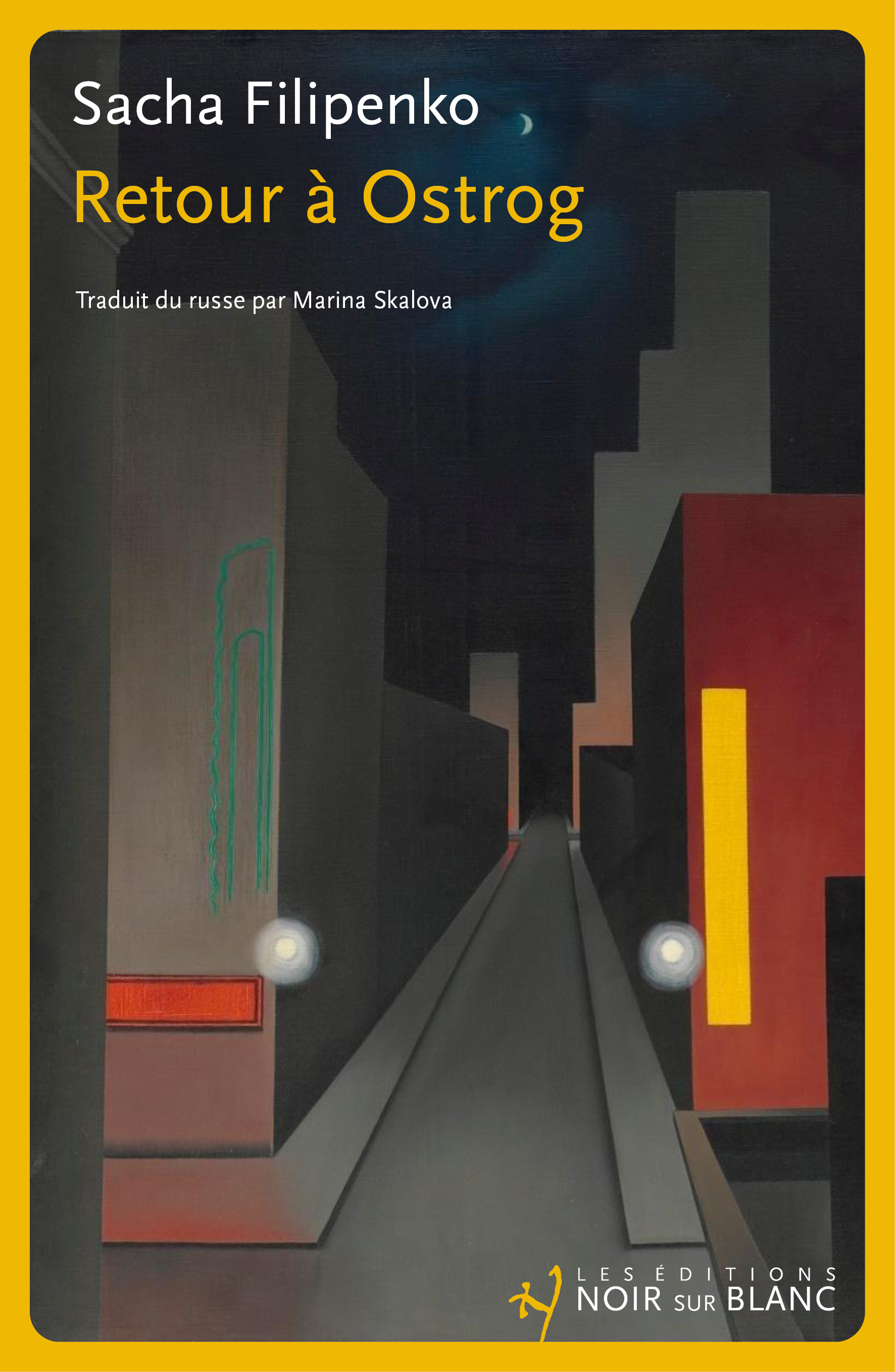
Into this hell arrives — returns! — a Moscow investigator, Chechen war veteran Alexander Kozlov. He comes to investigate a series of suicides among the inmates of the local orphanage, another form of prison. On the very day of his arrival, a fourth teenager takes her own life. Kozlov’s task is straightforward: to find a scapegoat — someone who can be charged with “driving to suicide” under Article 110 of the Russian Criminal Code. Marina Skalova treats the investigator’s surname as a “telling” one — Kozlov comes from kozel, “goat,” a word that in Russian can be used as an insult — in a Gogolian vein. I am not so sure. It is a common surname, and Kozlov is far from being a “goat” in any moral sense. To the point that it even raises doubts about the character’s plausibility. Although abandoned by his wife, he remains faithful to her and resists even the charms of a Moscow journalist named Agata — a truly “speaking” name for a detective novel — who comes to his hotel room uninvited. (Through her, Filipenko takes aim at the entire journalistic profession: the self-assured Agata asks Siri why children commit suicide and, when working on a story, thinks only about how many likes it will get.) Even Kozlov’s tragic ending ultimately casts him as a positive character — or at least as a doubting one.
A different case is the surname of Ostrog’s former mayor, Kichman — the man Kozlov had originally come to Ostrog to put behind bars. This name was adopted by Arkadi, who had served seven years in prison and, after his release, built a successful cotton-swab business, rose to become a mid-level oligarch, and was elected mayor. In prison slang, kicha (or kich) means “prison.” There is also a Jewish-coded undertone — no one in his right mind would choose such a pseudonym, even as a joke.
From the same category are the names of the Siamese twins Vera (Faith) and Lyubov (Love) — note the absence of Nadezhda (Hope)! — “the one and only real tourist attraction of Ostrog.” The subtext is clear even to readers far removed from Russian politics: after Crimea’s annexation, the conjoined sisters “can’t find common ground anymore. One is now for Russia, the other for the khokhols. They bark at each other every day. Lyuba walks around with a scratched face, and Vera with a split lip. We all thought they’d make up — after all, they’re one body — but the other day Lyuba filed a petition: she wants to separate from her sister.”
This is how the local investigator Mikhail describes the situation. For Russian-speaking readers, his lexical choices — the word “accession” rather than “annexation,” and the slur “khokhol” — speak volumes about his political views; others can rely on the translator’s notes.
And how could one fail to mention the priest named Casemate, who reflects on Alexei Tolstoy and Mussorgsky — a name easily decipherable by French readers as well — or the town’s main entertainment venue, the karaoke bar called “Bastille”?
On the other side of this bleak reality stands Petya Pavlov, a former orphan who never fit into foster families because of his excessive righteousness. He is — to put it mildly — eccentric, at least in the eyes of Ostrog’s residents. A Swiss reader, however, might find nothing eccentric in the fact that Petya is polite to others and demands polite treatment in return (“There is nothing more insulting to a Russian than being addressed politely”), or that he crosses the street only at designated crossings, even if it means walking an extra kilometer.
Living in a former prison barracks, Petya is a distant literary relative of Pushkin’s Yurodivy (the holy fool): he is a young Tolstoyan, incapable of harming even a fly, a blessed soul who strives to do good and sincerely forgives his enemies. He belongs to that category of people who hold solitary pickets — lone warriors in the endless Russian fields. In Ostrog, he protests against the construction of Kichman’s second factory out of concern for local birds (“The factory means death for the woodpecker”) and works as a “free taxi” in his spare time.
An ideal scapegoat. Especially since it is he — а prophet of sorts — who speaks out against Kichman’s plan to take Ostrog’s orphans to Greece, warning that nothing good will come of it. But who listens to prophets in their own land? The children were taken abroad, shown another life, the sun and the sea. What could be wrong with that? They were happy. Yes — but then they were brought back. Into the cage. And the promised second trip never took place: the generous sponsor ended up behind bars. A ray of sunshine flashed, then faded away. All the doors slammed shut.
… I will not reveal the outcome of the investigation — the author would never forgive me. I will only note that the slight caricature quality of the characters is balanced by the inclusion of real Russian federal statistics on the number of orphans and the suicide rate among them — statistics more terrifying than any fiction. The children of the Ostrog orphanage die in different ways: one hangs himself in the forest, another throws himself under a train, a third cuts her veins at a landfill, a fourth jumps from a window. Even the Siamese twins find their own way out.
Return to Ostrog is a frightening variation on the theme of loneliness and despair among people deprived of hope. No ray of light — of the kind introduced into Russian literary discourse by Nikolai Dobrolyubov in A Ray of Light in a Realm of Darkness — reaches the provincial Russian world depicted by Sasha Filipenko. And from there, it is a short step to the noose, the train tracks — or any other exit at all.