Bookshelf

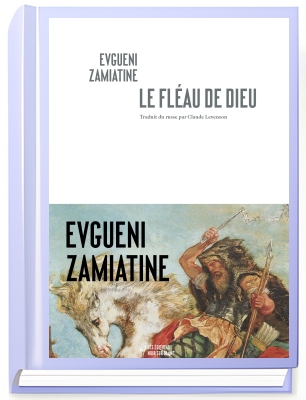
Evgueni Zamiatine : Le Fléau de Dieu, Éditions Noir sur Blanc, Mise en vente 4 février 2021, 112 pages, 12 Euros / 15 CHF

Traduit du russe par Claude Levenson. Collection La bibliothèque de Dimitri Première édition : 1975. Traduction revue et corrigée

Le Fléau de Dieu est un roman sur la jeunesse d’Attila. Otage de l’empereur romain Flavius Honorius, ce Barbare, ce garçon à l’état de nature, sauvage et indomptable, observe l’empire corrompu et forge son caractère en opposition à cette société mourante. Le récit adopte le point de vue de deux personnages : d’un côté Attila, qui regarde la civilisation décadente de l’Empire ; de l’autre l’historien byzantin Priscus Panita, qui observe ce même pourrissement. Tout le roman est tissé de métaphores : la terre hurle « comme une femme qui sent déjà son ventre enflé prêt à projeter dans le monde des êtres nouveaux », Attila a des cheveux « comme des cornes » qui balaieront l’ancien monde. Ce récit constitue un véritable manifeste du mouvement scythe qui considère la révolution russe de 1917 comme un élan messianique, une union spirituelle néochrétienne, socialiste et révolutionnaire opposée à la pensée bourgeoise et au nouveau pouvoir soviétique.

Evgueni Zamiatine est un écrivain russe né en 1887. Bolchevik de conviction, il participe à l’insurrection de 1905. Après un exil en Angleterre, il revient en Russie en 1917 puis quitte le Parti, déçu de la révolution. Critiquant le pouvoir et la littérature prolétarienne, il demande à Staline l’autorisation de quitter la Russie. Il s’installe à Paris en 1932 où il décède en 1937. Son roman Nous, d’abord publié en anglais et interdit en Russie, a directement inspiré 1984 de George Orwell. Nousa eu une telle influence littéraire et sociale qu’il a presque occulté le reste de l’œuvre prophétique de Zamiatine.

About the author

Nadia Sikorsky

Nadia Sikorsky grew up in Moscow where she obtained a master's degree in journalism and a doctorate in history from Moscow State University. After 13 years at UNESCO, in Paris and then in Geneva, and having served as director of communications at Green Cross International founded by Mikhail Gorbachev, she developed NashaGazeta.ch, the first online Russian-language daily newspaper, launched in 2007.

In 2022, she found herself among those who, according to Le Temps editorial board, "significantly contributed to the success of French-speaking Switzerland," thus appearing among opinion makers and economic, political, scientific and cultural leaders: the Forum of 100.

After 18 years leading NashaGazeta.ch, Nadia Sikorsky decided to return to her roots and focus on what truly fascinates her: culture in all its diversity. This decision took the form of this trilingual cultural blog (Russian, English, French) born in the heart of Europe – in Switzerland, her adopted country, the country distinguished by its multiculturalism and multilingualism.

Nadia Sikorsky does not present herself as a "Russian voice," but as the voice of a European of Russian origin (more than 35 years in Europe, 25 years spent in Switzerland) with the benefit of more than 30 years of professional experience in the cultural world at the international level. She positions herself as a cultural mediator between Russian and European traditions; the title of the blog, "The Russian Accent," captures this essence – the accent being not a linguistic barrier, not a political position but a distinctive cultural imprint in the European context.

Events