Ce roman (1908), considéré par Gorki comme son œuvre « la plus mûre », salué à sa sortie par un immense concert d’applaudissements – et de sarcasmes (Lénine condamnera sans appel son « mysticisme ») – traduit en français dès 1909, sera exclu des Œuvres complètes de l’écrivain par la censure marxiste… et condamné, par le fait, à près d’un siècle d’oubli.
Matveï – qui lui ressemble comme un frère -, faut ses classes sur la route avec les vagabonds, pratique tous les métiers, et finit par trouver la Voie – celle d’un christianisme social parfaitement hérétique – au fil de rencontre hautes en couleur. La sainte Russie est vaste, et vaste aussi ce roman qui contient la terre immense. Cette générosité-là, seuls les Russes de la grande espèce savent la pratiquer. Et peu importe, dès lors, qu’on adhère ou non aux idées de l’écrivain, aussi sympathiques qu’irréalistes. Il nous suffit d’aller avec lui sur les chemins perdus semés d’embûches et de merveilles. Marx se perdra en cours de route, et Jésus lui-même… mais nous nous y retrouverons.
Né en 1868 dans l’Empire russe, maxime Gorki est considéré comme un des fondateurs du réalisme socialiste en littérature et politiquement engagé auprès des révolutionnaires bolcheviques. Après avoir exercé quelques temps le métier de journaliste, il devient très rapidement un écrivain célèbre. Plusieurs fois exilé pour des raisons politiques et médicales, il revient définitivement à Moscou en 1932 où il meurt quatre ans plus tard.
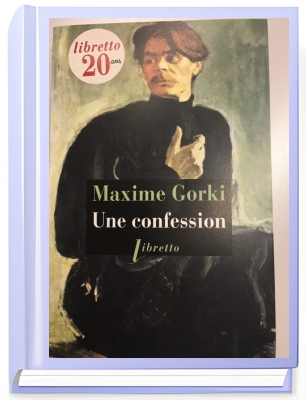
Maxim Gorki. Une Confession. Editions Libretto, 2018
About the author

Nadia Sikorsky grew up in Moscow where she obtained a master's degree in journalism and a doctorate in history from Moscow State University. After 13 years at UNESCO, in Paris and then in Geneva, and having served as director of communications at Green Cross International founded by Mikhail Gorbachev, she developed NashaGazeta.ch, the first online Russian-language daily newspaper, launched in 2007.
In 2022, she found herself among those who, according to Le Temps editorial board, "significantly contributed to the success of French-speaking Switzerland," thus appearing among opinion makers and economic, political, scientific and cultural leaders: the Forum of 100.
After 18 years leading NashaGazeta.ch, Nadia Sikorsky decided to return to her roots and focus on what truly fascinates her: culture in all its diversity. This decision took the form of this trilingual cultural blog (Russian, English, French) born in the heart of Europe – in Switzerland, her adopted country, the country distinguished by its multiculturalism and multilingualism.
Nadia Sikorsky does not present herself as a "Russian voice," but as the voice of a European of Russian origin with the benefit of more than 30 years of professional experience in the cultural world. She positions herself as a cultural mediator between Russian and European traditions; the title of the blog, "The Russian Accent," captures this essence – the accent being not a linguistic barrier, not a political position but a distinctive cultural imprint in the European context.