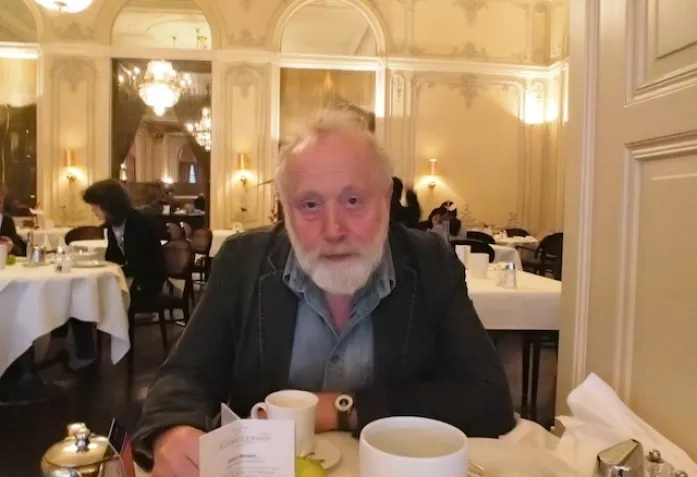
One of the guests at the “Zaubersee” music festival, recently held in Lucerne, was, somewhat unexpectedly, the outstanding Russian animator whose Tale of Tales was признана the greatest animated film of all time. His work was the focus of a special programme, “An Evening with Norstein”. I had the rare opportunity to speak with the Master in a relatively calm setting.
When I was a student, I worked part-time as an interpreter at the Soyuzmultfilm studio, where I was able to see the backstage side of this magical world of animated films, the world full of painstaking, meticulous labour for the delight of children. (Although the films of Yuri Norstein, who long ago should have been awarded the title of hero of that very labour, are addressed no less to parents and grandparents, so much deep, subtle philosophy, everyday wisdom, humanity and simplicity they contain.) Thus, even in those distant years, and we are speaking of the late 1980s, I once had the opportunity to visit Yuri Borisovich and his wife and colleague Francheska Yarbusova at home. Already then, practically all the usable space was covered with sheets bearing sketches for The Overcoat. Since then, we have not met, but the feeling of having touched “something out of this world” has remained.
Over the years he has not changed at all: the same resemblance to the Hedgehog, the same directness of gaze, the same youthful maximalism. We met over breakfast, between a late night and an early morning flight to Moscow.
Since we met at a music festival, let us begin with music. What is your relationship with it?
Yuri Norstein: My relationship with music was built on hatred: my brother, who is two years older than me, began playing the violin at the age of five. And when a person is sawing away next to you for half the day, it cannot but irritate a boy of three or four. If we speak seriously, however, music had and still has enormous importance in my life. But one must also correlate it with THAT life, when in our home the only musical device was a gramophone, but there were several first-class records.
For example?
The aria of Boris performed by Fyodor Chaliapin, the Varangian Guest performed by Mark Reizen. I was particularly fond of the recording of Kachalov reading Lermontov. I still remember the profound impression made on me by the words: “And you will not wash away with all your black blood the poet’s righteous blood.” It had a very strong effect, because children perceive everything literally, and even then I knew that blood is red.
How was the programme “Norstein Night” created? Had you been acquainted before with the pianist Alexander Melnikov? Under what “sauce” did the organisers of the “Magic Lake” manage to lure you to Lucerne?
Alexander and I were only superficially acquainted, and I am very grateful to him for the idea of bringing the evening “Music and Animation” to this wonderful festival in beautiful Lucerne. And the “sauce” was the desire to tell the public about the marvellous composer Mikhail Meerovich, with whom I had the opportunity to work a great deal. The process was difficult, but in the end his music always fitted flawlessly into the film, dissolved into its fabric, precisely occupied the space allotted to it. Meerovich’s work is, unfortunately, undeservedly little known, and I regret that, due to lack of time, little of his “serious”, non-animated music was performed. He had written three ballets based on Mayakovsky, which were never staged. Everyone knew he was talented, but his career was immediately very unfortunate.
Music is wonderful. But let us return to your main work. You have been working on The Overcoat for more than 30 years, since 1981. Is there light at the end of the tunnel, or is completing the project simply not part of your plans?
To be honest, I have spoken about this so much already that I do not want to repeat myself, since this question was asked of me twenty years ago as well. And no one looked around, as if they did not see the difficult conditions in which we had to work. Of course, some people helped us. Rolan Bykov helped with premises. Andrei Ilyich Kazmin, who for a time headed Sberbank, helped a great deal. In particular, he gave 180,000 dollars, an enormous sum for us, for the publication of my three-volume edition. I remember how worried I was then that the book would “not sell”, and I would be ashamed before the taxpayers. Now we are preparing a second edition, already with our own money.
But to return to your question: of course, completing the film is part of my plans, but I cannot and do not want to name specific deadlines or promise anything. We simply work. I have to overcome this mountain in order to begin descending from it.
Is the financial problem still present even now?
It has become a little easier now, but at one time it was very bad, there was no money, we had to earn abroad and invest everything earned into renting premises, paying taxes, and other technical expenses. I spent a huge amount of money on this. In fact, it is pointless…
Why?!
Because there is nothing better than state funding. This system proved itself. We know what kind of cinema we had. And now everyone points to the West. But the West had its own life, it developed in its own way. There, for example, there was no free education, whereas we had it, there was free healthcare, all sorts of free children’s clubs, art schools, pioneer houses. Now all this has been destroyed. Everything has become paid, and even then you have to fight your way through. And as for quality, there is nothing to say.
Do you feel nostalgia?
I do not feel nostalgia. I feel a cold hatred for what is happening now. It is not about nostalgia, but about the need to act according to the rules of decency. They include this, and this, and this. But they do not include, and cannot include, the desire to overtake those ahead by pushing them, devouring them, absorbing them, killing them. That is our system today.
And what does the power do, apart from speaking eloquently from the rostrum about its good intentions? And apart from intentions?..
And yet you still live in Moscow, although surely there was no shortage of offers to move and work in the West?
That is true. But in all those offers there was always an unspoken element that stopped me. It is one thing when you arrive as a guest “from there” and everyone fusses over you, and quite another when you are already “there” and the people who facilitated this move expect something in return from you, including commercial return. Tarkovsky’s example is indicative: despite the fact that he left already a very famous director, he had to run around Europe in search of money. It is not so simple, and they are not very willing to spend on such films. Some people think that art yields commercial returns directly: you invest here and receive there. That is not how it works.
How did you end up at Soyuzmultfilm after a furniture factory, where you worked in your youth?
Out of idleness, after I had failed to be accepted anywhere four times: twice I failed to get into the 1905 Art School, and once each into Stroganov Art Institute and VGIK. Now no one believes it, everyone laughs, but that is exactly how it was. There were nuances I do not want to talk about. But the fact remains, even though 37 years have passed. So I completed two-year animation courses, after which, in 1961, I came to the studio.
What do you think about the state of Russian animation today? Do you follow the work of your colleagues, both in Russia and abroad?
Of course, I follow it, as I regularly attend various Russian festivals. It is always a pleasure to watch good films. There are now many talented animators in Russia, off the top of my head I will name Konstantin Bronzit, Alexander Petrov, Mikhail Aldashin, Ivan Maximov. I feel great sympathy for my younger colleagues — although some of my former students are already grandfathers — because they have found themselves in a situation where they are constantly forced to struggle for survival, to earn money. At their age, all my energy went into creativity, although earnings were tiny and I was constantly in debt. But I had films!
The American Film Academy recognised your film Tale of Tales as the best film of all time back in 1984, still during the USSR. How did you react to this news? What was the reaction of the Soviet authorities?
For me it was, of course, a staggering piece of news, and the USSR reacted with silence. I was not even told about it, I learned of it by chance: someone called from the Union of Filmmakers and said a dispatch had arrived. I saw the text only several days later, and I received the award itself only a year later. I did not make anything of it, but at first I was glad, of course, I began to tell friends and acquaintances. I called the then director of the studio, and in response I heard: “No one has reported this to me.” Well, to hell with it!
It had a negative effect on my situation, as our bosses do not like other authorities. But why be surprised if a film by the great Fyodor Khitruk, nominated for an Oscar, was blocked by our own people?! But the names of those officials have long sunk into oblivion, while Khitruk remains Khitruk.
By the way, in 2002 Tale of Tales was again named the best film, and a year later Hedgehog in the Fog.
On your studio’s website there is a humorous description of your working day. And if seriously?
Seriously speaking, you need SUCH a paragraph of obscenities, and everything else afterwards.
For some reason I am sure that you get up early…
Yes, I do get up early, that is true. But I do not manage to have such a harmonious day as I once did. Then I knew that I was going to work. I would get up, have breakfast, kiss Francheska and go. I would always arrive about an hour before the start of the working day, when it was still quiet, clean, the cleaner was still moving a rag across the floor… I would go into the pavilion, close the doors, and work for about two hours. The cameraman, Alexander Zhukovsky, knew about this, greeted me through the door and sometimes even hung a lock on it, you know, like a sign in hotels, “Do not disturb”. And then I would go out, meet colleagues… There was order in this. What gives a person health? Routine!
And when you are constantly getting calls, quarrelling with someone, then clutching your head, it is very difficult to concentrate.
Your image has little in common with business, with money. Yet last year there was information that the financial corporation Otkritie had acquired the rights to use the images of all the characters from the book Hedgehog in the Fog from you and your wife. Copyright for the images came into force on 1 September 2012 and is valid for one year. Did you monitor how the Hedgehog, the Horse and the Owl were used?
Very much so! The contract stipulated that all variants of the use of the characters’ images had to be presented to us before implementation. Naturally, any transformation of the images is strictly prohibited — the rights to the image of the Hedgehog were sold not as a character torn out of context, but together with the surrounding space, as in the book. I must say that our partners made a mistake only once, I was very angry then. I threatened to terminate the contract. There were no more conflicts. When I categorically rejected their proposed version of gift coins, we ourselves made a layout, and everything worked out.
But in general, in Russia an entire corporation parasitises on the Hedgehog, printing him on anything.
And what can you do?
I can do nothing! If it were another country, I would say to it: “Country, I am your representative, please protect me.” But in our country, if I start a legal case, I will perish in it.
Norshtein and politics seem incompatible concepts, like ice and flame. And suddenly — your speech at a concert dedicated to the 75th anniversary of Vysotsky. Presenting the award to Elena Kamburova, you suddenly spoke about Magnitsky, saying: “Magnitsky died of Putin’s heart failure, of the prison chief’s heart failure…” Your words were then drowned in cries of “Bravo” and applause from the audience. What suddenly made you speak out? And did anything happen to you for this, to put it in childish terms? What are your relations with the authorities now?
I will start from the end: after my recent meeting with our Minister of Culture, I do not think he will invite me again. As for my “outburst” at the ceremony, I spoke out because when Putin was informed of Magnitsky’s death, he said not “we will investigate the situation and find those responsible”, but “we will give a symmetrical response”. The tragedy of Magnitsky became a bargaining chip in his political game.
And the detonator was the words I heard at the ceremony from Dr Roshal that the country lacks 120,000 doctors. So I began to think: in such a situation, ENORMOUS amounts of money is spent on the Olympics solely for prestige, in order to throw dust in people’s eyes and to give those close to power the opportunity to enrich themselves even more. Somehow this became intertwined with Magnitsky, and it all happened spontaneously.
Nothing happened to me for this, I am too old to be afraid of anyone, and they know it.
What is your recipe for success?
In addition to talent and great labour, one must fill oneself with content, one must read books, listen to music. As the late violinist Oleg Kagan said: “Do you think one plays with one’s fingers?” One plays with his heart.