
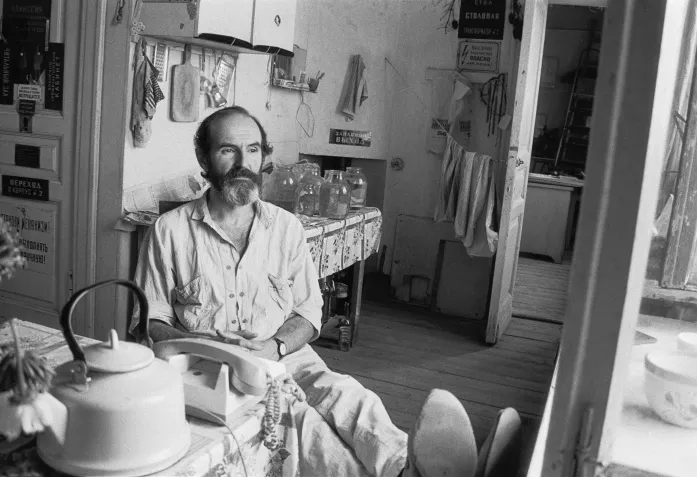
Erik Vladimirovich Bulatov, one of the innovators of painting in general and of Soviet art in particular in the second half of the twentieth century, passed away on 9 November 2025 in Paris’s 18th arrondissement, at the age of 92. Despite this impressive figure, he remains in the memory of all who knew him as young in spirit and an eternal nonconformist. His works have found their place in major public and private collections in Russia, Europe, and the United States. There are not many of them, around three hundred.
The beginning of his life was typical of his generation. His father, Vladimir Borisovich Bulatov, a member of the Bolshevik Party since 1918, was killed at the front of the Second World war on 7 July 1944. His mother, Raisa Pavlovna Schwartz, originally from Białystok, emigrated illegally to the USSR at the age of fifteen and soon, almost miraculously, found work as a stenographer, even though upon her arrival she did not know Russian, speaking only Yiddish and Polish. Before the war, the family lived in Moscow, where she worked as a stenographer at the People’s Commissariat for Communications of the USSR (and after the war, at the Moscow Bar Association), and also typed samizdat texts. She outlived his father by forty years. I remember how struck I was by Bulatov’s succinct description of his parents’ relationship: “My mother was opposed to the party’s general line, opposed to any authority, a mindset typical of the Russian intelligentsia. She should have been opposed to my father as well; their views were in many ways diametrically opposed, yet they loved each other deeply.” How many families today are facing such an inner divide!
It so happened that Erik Bulatov owed a great deal to Switzerland. It was here, in Zurich, that his first solo exhibition took place, at a time when he no longer dared to dream of it. For many years he collaborated with, and was a close friend of, the Skopia gallery in Geneva, whose owner, Pierre-Henri Jaccaud, has organised this tribute exhibition to the Great Artist, which will run until 28 February. All the works on display were sold long ago and are now in private collections, so seeing them is a unique opportunity, one that I sincerely encourage you not to miss.
It was in this very gallery that I had the good fortune to meet Erik Vladimirovich in 2016 and to conduct an interview which, in my view, has lost none of its relevance even today. Here it is.




rachel babecoff January 24, 2026
Sikorsky January 24, 2026