There is no need to introduce Dominique de Rivaz, the Swiss film director who has long divided her life between Bern and Berlin and has long studied Russia. I have already written about her trips to the settlement of Shoina, on the shore of the White Sea, and to Kaliningrad, closer to Berlin. Both lavish photo albums, prepared in collaboration with the Belarusian photographer Dmitry Lelchuk, were published by the Lausanne-based Éditions Noir sur Blanc. And it so happened that Dominique de Rivaz’s new project, which she herself has defined as a “cinematic essay”, will also have its premiere in the capital of the canton of Vaud, home to the Swiss Cinémathèque, the national film archive and one of the ten largest in the world.
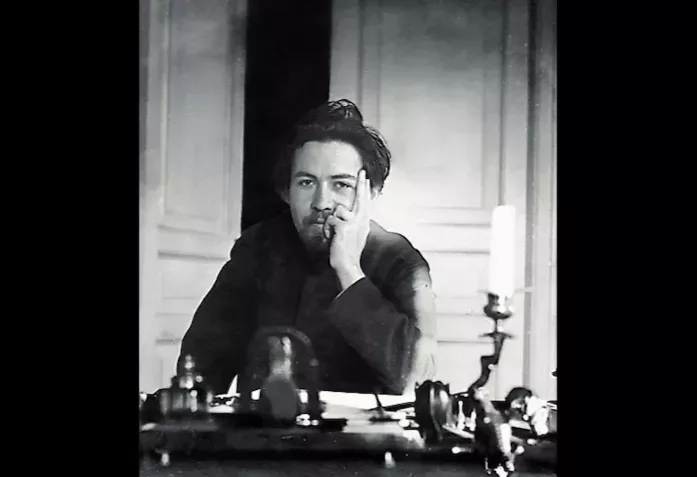
Of all the works by Dominique de Rivaz that I know, A Selfie with Anton Chekhov is the most romantic. More than that, it is a one-hour declaration of love to the great Russian author. As the filmmaker informs us in the opening minutes of the film, she also appears as narrator and “guide to Chekhov’s places”, she fell in love with Anton Pavlovich from a photograph – at first sight. In that photograph, the 24-year-old Chekhov, not yet famous – “1.86 metres tall”, as Dominique de Rivaz notes – is indeed irresistible. He is captured at the peak of his short stories. In the inquisitive, ironic gaze of Chekhov’s eyes directed at her, Dominique de Rivaz saw a “silent yet obvious invitation” which she could not refuse. And yet, in the beginning there was the word.
“Ich sterbe…” These two words disrupted my cinematic plans. The last, dying words of Anton Chekhov. Two words spoken not in Russian, his native language, but in German, a language he scarcely mastered. He was 44 years old.”
This is how Dominique de Rivaz begins her narrative, favouring a romantic explanation for Chekhov’s choice of language over a more pragmatic one: in the final minutes of his life, spent in the German town of Badenweiler, he was attended by his doctor – the German Dr Schwörer, who certified his death and informed the writer’s wife, Olga Knipper-Chekhova. Be that as it may, Dominique de Rivaz followed in Chekhov’s footsteps on his final journey, building the polyphonic structure of her essay in accordance with the structure of his plays: “numerous voices echo, respond to one another or fall silent, leaving space for silence”.
One might get the impression that the film, which will not leave admirers of Russian literature indifferent, is more about Chekhov’s death than about his life. Unless one knows that the first signs of tuberculosis, this “AIDS of the nineteenth century”, appeared when he was only 24. The disease that, as Dominique de Rivaz reminds us, “took the lives of Chopin, Schubert, Kafka and the three Brontë sisters” was then incurable – something Chekhov the doctor knew perfectly well – and thus the twenty years that followed were spent in an ironic anticipation of the inevitable end and, at the same time, in a full enjoyment of life right up to the very last moment.
Chekhov’s words “Ich sterbe”, “I am dying”, also attracted the famous French writer Nathalie Sarraute: in Dominique de Rivaz’s film we hear her voice, preserved in the “Voice Library”, reading an essay dedicated to Chekhov. (Incidentally, do our readers know that Nathalie Sarraute – born Natalia Chernyak – was born on 18 July 1900 in Ivanovo-Voznesensk, not far from Moscow, into an assimilated Jewish family?)
A special place in the film is occupied by excerpts from Chekhov’s letters, whose addressees Dominique de Rivaz chose not to name. Some are obvious – his sister Masha, to whom Anton Pavlovich gives instructions shortly before his death on how to clean a water closet, or Dr Schwörer. But who are the others? I must admit that I did not immediately guess. However, I did not hesitate to consult the final volumes of the Collected Works and found the answers. “Adolf Fyodorovich” is Adolf Fyodorovich Marks, who came to Russia in 1859 from Stettin and founded the “Partnership of Publishing and Printing A. F. Marks” and the first mass illustrated weekly magazine in Russia “for family reading” – Niva. “Isaac Naumovich” is the Yalta doctor I. N. Altshuller, who treated Chekhov and corresponded with him until the last days of the writer’s life, while “Grigory Ivanovich” is none other than Chekhov’s fellow student at Moscow University, the neurologist Professor Rossolimo.
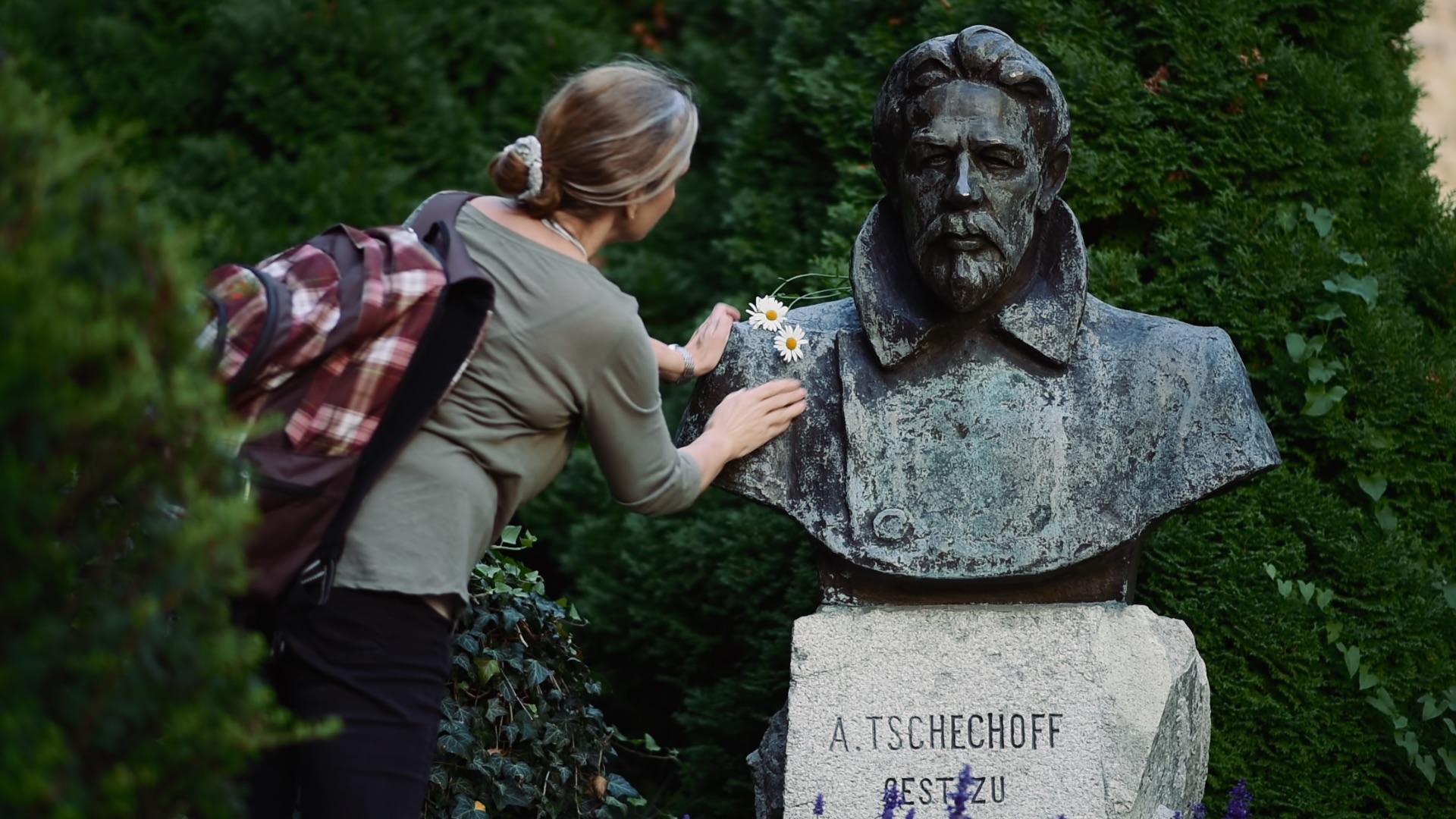
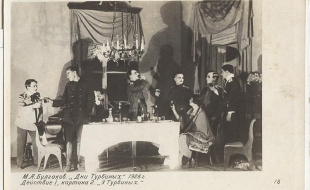
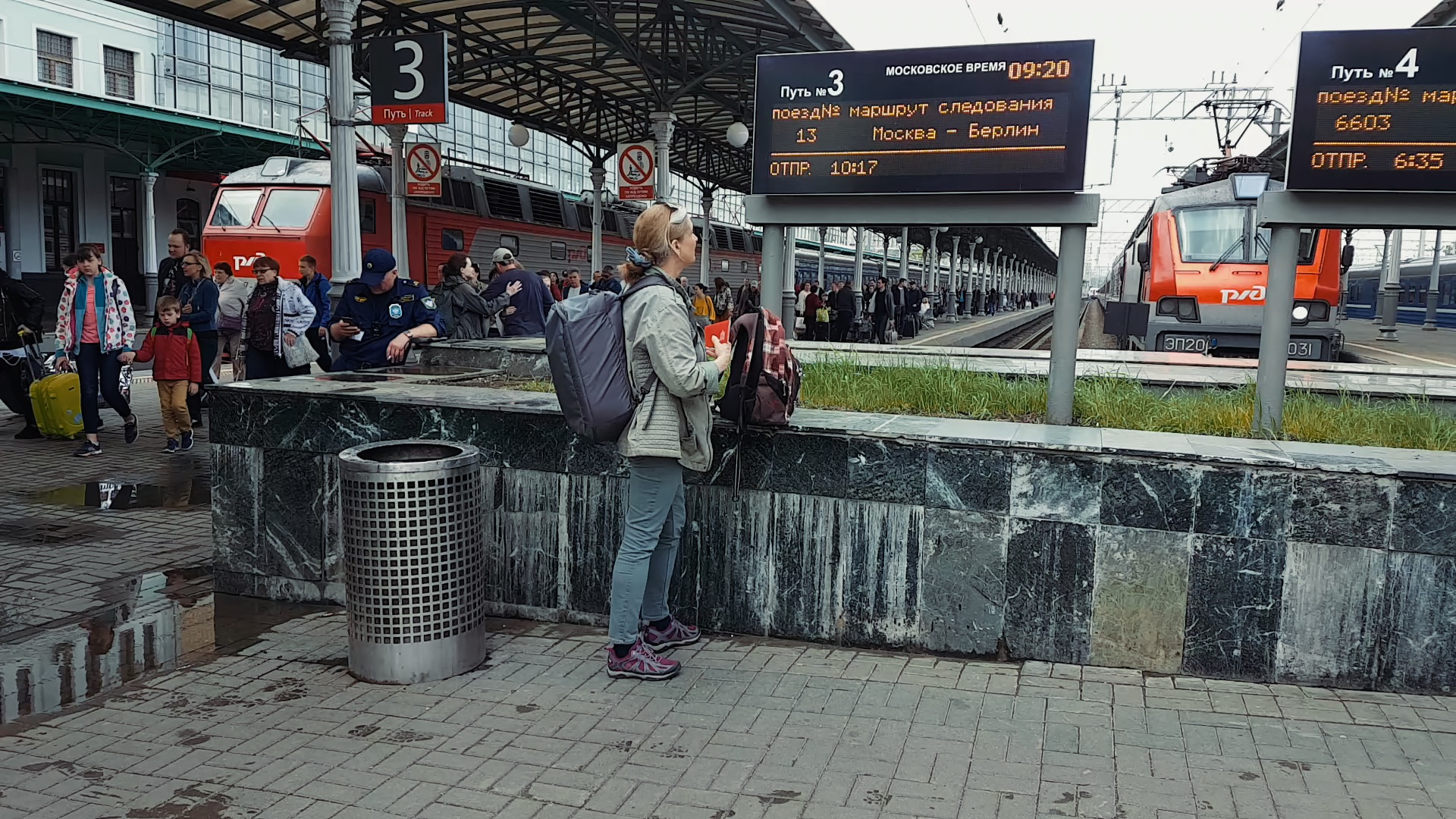
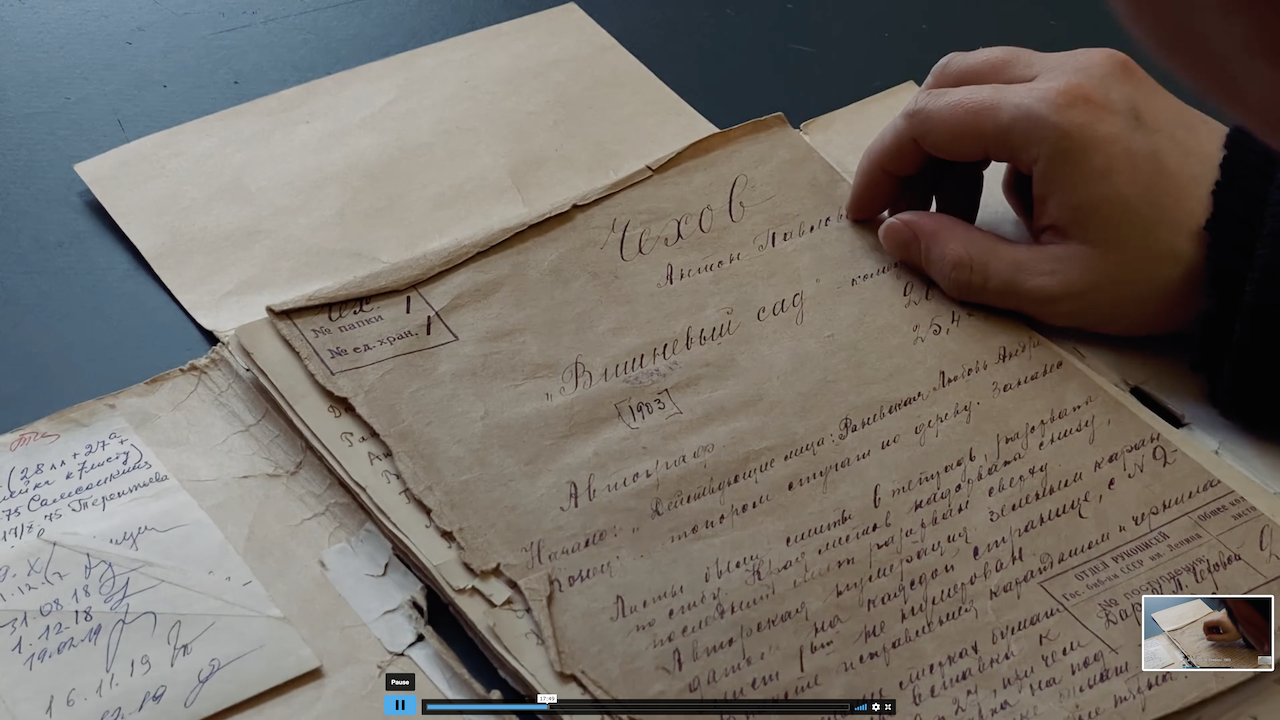
Together with the film’s author, we examine old posters in the archive of the Moscow Art Theatre, where in 1898 the Moscow premiere of The Seagull took place with enormous success. We watch excerpts from several contemporary productions of Chekhov’s plays, including the work by Timofey Kulyabin that impressed me so much, who, as Dominique de Rivaz rightly notes, “amplified the voices of the Three Sisters by making them silent”. We listen to Chekhov’s Swan Song performed by the Swiss actor Robert Bouvier — we have also written about this production. We take photographs with Chinese tourists at Chekhov’s grave at the Novodevichy Cemetery in Moscow and join a selfie taken by three young Russian women. We travel on the Moscow–Berlin train departing from Leningradsky, formerly Nikolayevsky, station, to the accompaniment of “Misty Morning”. We walk through the streets of Badenweiler, looking at memorial plaques…
And, of course, with particular attention, in light of today’s events, we listen to the familiar words of Petya Trofimov from The Cherry Orchard, Chekhov’s last play: “We have fallen behind by at least two hundred years; we have as yet nothing at all, no definite attitude to the past; we only philosophise, complain of melancholy or drink vodka. It is so clear that to begin to live in the present, we must first atone for our past and put an end to it; and we can atone for it only through suffering, only through extraordinary, unremitting labour.”
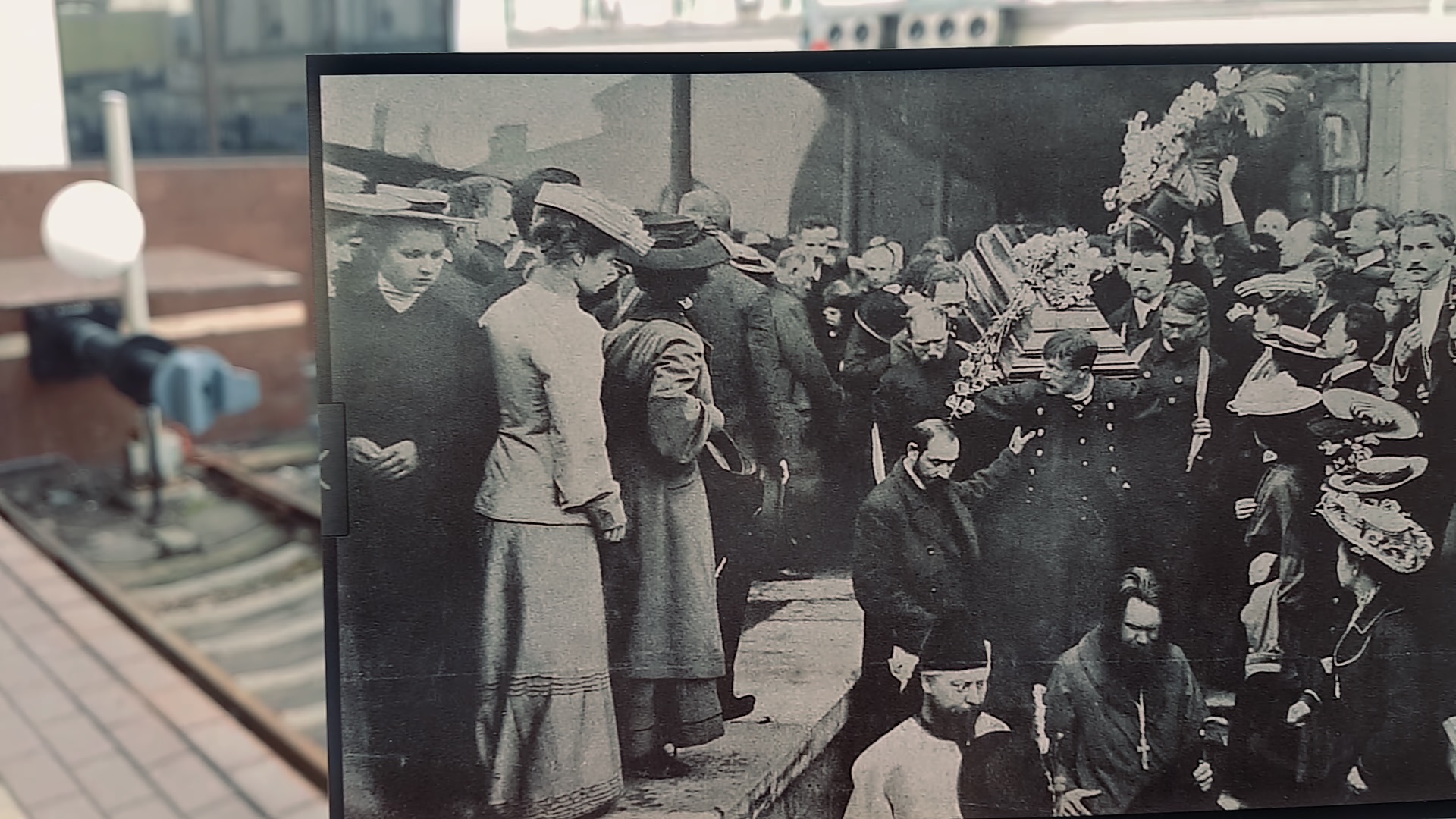
… A pedantic German from a funeral bureau issued a bill listing everything down to the silk cushion placed under Chekhov’s head – for 12 marks. As you know, Anton Pavlovich was returned to his homeland in a railway carriage marked “For the transport of fresh oysters” — a detail worthy of one of his plays. “My heart contracts, and I am ready to howl, to roar, to fight out of indignation, out of anger. For him it is all the same, he might as well be transported in a basket for dirty laundry, but for us, for Russian society, I cannot forgive the carriage ‘for oysters’. In that carriage there is precisely that vulgarity of Russian life, that lack of culture, which so outraged the deceased,” Maxim Gorky commented on this fact. At the Nikolayevsky station, the coffin with Chekhov’s body arrived at the same time as the coffin of some general, so the military band was not playing for him.
“To read Chekhov is to understand today’s Russia. To film Chekhov is to say thank you to him,” Dominique de Rivaz concludes.
Allow me to add that to watch her film is also to reflect once again, deeply, on what troubles all of us today.