Our regular readers know perfectly well the position Nasha Gazeta took on February 24, speaking out unconditionally against the war in Ukraine, but also against hatred, and in favor of dialogue. Seven months have passed, and our position has not changed by a single iota. Throughout this long and difficult period, in keeping with our editorial policy, we have reported on all Swiss developments connected with the war: political decisions, economic measures, individual lives brought to Switzerland by force of circumstances, as well as charitable and cultural initiatives, often organized jointly by Russians, Ukrainians, and Swiss. This visible and essential part of our editorial work reaches you every day, and we are grateful to all those who do not spare kind words (or emojis) in our direction.
But there is also another kind of work, one that remains outside the screens of your computers and mobile phones. It consists of countless contacts, conversations, negotiations, and attempts to help some find housing, others employment, or simply to offer advice. It was precisely from this invisible part of our activity that the idea of the concert we are now warmly inviting you to was born.
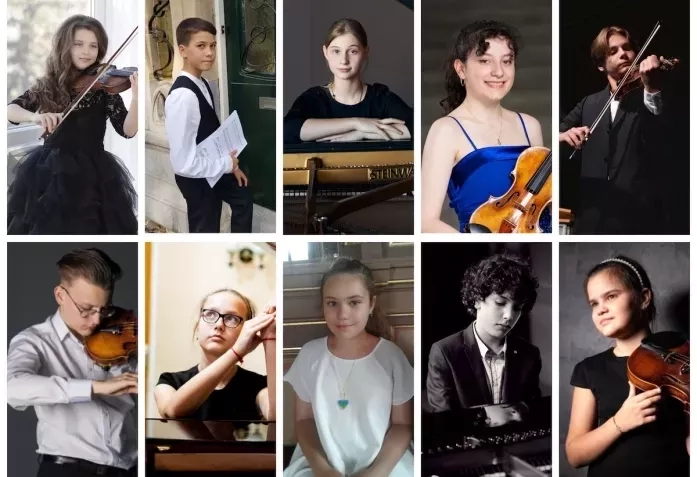
You already know the beginning of this story if you read our article about Nastia Bodareva, a young violinist from Odessa whose family was taken in by residents of the canton of Vaud. After Nastia, thanks to the violinist Alexandra Conunova, was able to resume the music lessons she had missed so deeply, other compelling “musical stories” began to reach our editorial office.
We learned that since May of this year, Sergei Milstein, a professor at the Geneva Conservatory who was born in Moscow, has been teaching ten-year-old Aya Vytiaganets, who previously had no opportunity to study the piano seriously. We learned that in the class of another Muscovite, Viktoria Shereshevskaya, there was a young boy from Kyiv, Dariy Krasilich. We learned that the Ukrainian violinist Oleg Kaskiv, director of the ensemble of soloists at the International Yehudi Menuhin Music Academy, and the Argentine pianist Nelson Goerner took sisters Margarita and Elisaveta Pochebut into their classes. And we learned that in Nelson Goerner’s class there was also a young Russian girl, Katia Boniouchkina, who was unable to complete her studies at the Central Music School in Moscow, just a few months short of graduation.
Why Ukrainian children have found themselves in Switzerland needs no explanation. But why Katia, we can already hear the reasonable question. Here is the answer. Her mother decided to leave Moscow after Katia’s twenty-year-old sister Nina was arrested for an anti-war post published on the VKontakte social network. At the time, the case ended with a fine, but another such incident would have risked criminal prosecution.
After listening to all these stories, it became clear that something had to be done. And what else can one do with musicians, if not organize a concert? “I am ready to accompany all the violinists!” declared Rusudan Alavidze-Goerner, and the matter was settled.
For us, the meaning of this gesture was obvious, both in form and in substance, and required no explanation. Yet to our surprise, a Swiss woman who received an invitation to the concert through the Association for the Promotion of Russian Culture in Switzerland, created at the initiative of Nasha Gazeta, expressed her bewilderment. “The origin of the musicians is unclear to me,” she wrote. “They are mostly Ukrainian, why is that? Of course, I have nothing against Ukrainians, but the Association is meant to promote Russian culture. Why not invite Russians?”
What can one say? An answer was nevertheless required, and we gave it, reminding her that Russian culture is respected throughout the world for its humanist traditions and its capacity for compassion. In our view, the upcoming concert fully corresponds to the goals of the Association.
We therefore invite you to a concert performed by children, but one that is by no means childish, which we have titled Music. Simply Music. There will be no politics here, only music: a language that needs no translation and is understood by all, a language that makes possible the dialogue so vital to us. While certain “grown-up gentlemen” are busy playing their “game of war,” children will be playing Russian, Ukrainian, French, German, American, and Italian music, masterpieces that together form a single whole: world musical culture.
Nasha Gazeta invites its engaged readers to attend a concert organized by young musicians and for their sake.
The editorial team of Nasha Gazeta expresses its sincere gratitude to all the teachers, all the children and their parents, as well as to Pablo Bodino-Acker (France), Sarah Isabel Ispas (Australia), Theodor Kaskiv (Switzerland), and Bogdan Luts (Ukraine), who supported this idea and made the tragedy of their friends their own.