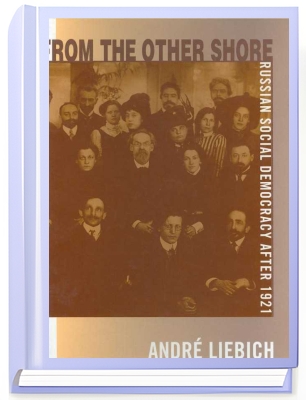
This book is an inquiry into the possibilities of politics in exile. Russian Mensheviks, driven out of Soviet Russia and their party stripped of legal existence, functioned abroad in the West--in Berlin, Paris, and New York--for an entire generation. For several years they also continued to operate underground in Soviet Russia. Bereft of the usual advantages of political actors, the Mensheviks succeeded in impressing their views upon social democratic parties and Western thinking about the Soviet Union.
The Soviet experience through the eyes of its first socialist victims is recreated here for the first time from the vast storehouse of archival materials and eyewitness interviews. The exiled Mensheviks were the best informed and most perceptive observers of the Soviet scene through the 1920s and 1930s. From today's perspective the Mensheviks' analyses and reflections strikingly illuminate the causes of the failure of the Soviet experiment.
This book also probes the fate of Marxism and democratic socialism as it tracks the activities and writings of a remarkable group of men and women - including Raphael Abramovitch, Fedor and Lidia Dan, David Dallin, Boris Nicolaevsky, Solomon Schwarz, and Vladimir Woytinsky - entangled in the most momentous events of this century. Their contribution to politics and ideas in the age of totalitarianism merits scrutiny, and their story deserves to be told.
“While the Bolsheviks have long had books—even libraries—devoted to them, the Mensheviks have had to wait until now for a first-rate account of their work and fate. André Liebich…has finally done justice to a group which history had dealt with unjustly.”—T heodore Draper, The New York Review of Books
“[An] important new book… From the Other Shore raises the question of what would have happened if the Mensheviks had prevailed in 1917. Would they have gone the route of the Bolsheviks, laying the groundwork for the repressive totalitarianism to follow? Or would they have found another path committing themselves to a radical transformation of Russian society while at the same time…respecting the political liberties of their opponents?… Although Liebich identifies closely with Martov’s group, he avoids the temptation of reading back into its history an early and absolute division from the Bolsheviks… Liebich asks us to see the Mensheviks as something more than political losers. They stand, he writes, ‘at the very heart of the crisis of Marxism.’ Our judgment of them as political actors and thinkers—as a possible alternative leadership for a revolutionary Russia—can help determine whether Marxism has any legitimate claim as a serious and honorable political tradition or deserves nothing better than its current consignment to the dustbin of history.”— Maurice Isserman, The New York Times Book Review
“This book is a tremendous piece of scholarship, charting the evolution of the Russian Menshevik leaders during 40 years of exile and their influence within the wider social-democratic parties, especially in Germany and Austria…for uncovering the extent of their influence and the significance of their analyses, Professor Liebich deserves our gratitude.”— Paul Hampton, Workers’ Liberty
Nasha Gazeta’s interview with Professor André Liebich can be read here.