v\:* {behavior:url(#default#VML);} o\:* {behavior:url(#default#VML);} w\:* {behavior:url(#default#VML);} .shape {behavior:url(#default#VML);}
/* Style Definitions */
table.MsoNormalTable
{mso-style-name:"Tableau Normal";
mso-tstyle-rowband-size:0;
mso-tstyle-colband-size:0;
mso-style-noshow:yes;
mso-style-priority:99;
mso-style-qformat:yes;
mso-style-parent:"";
mso-padding-alt:0cm 5.4pt 0cm 5.4pt;
mso-para-margin:0cm;
mso-para-margin-bottom:.0001pt;
mso-pagination:widow-orphan;
font-size:10.0pt;
font-family:"Times New Roman","serif";}
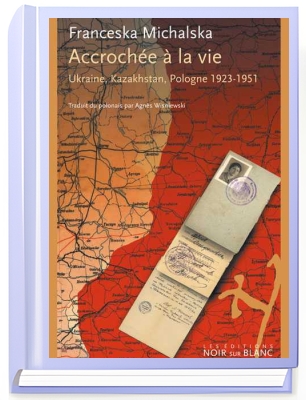
Franceska Michalska naît en 1923 dans une famille polonaise de Volhynie, région frontière des confins polonais alors sous obédience soviétique. L’univers paisible de la société campagnarde traditionnelle de son enfance où Polonais, juifs et Ukrainiens cohabitent paisiblement depuis des lustres ne tarde pas à se fissurer. Les autorités politiques décident de mettre au pas la région. Par chance, sa famille survit à la grande famine des années 1932-33, provoquée par les autorités politiques pour affaiblir les paysans opposés à la collectivisation de l’agriculture. Puis en juin 1936 vient la déportation. Après un mois d’un voyage très éprouvant, ils se retrouvent dans la steppe désertique du nord du Kazakhstan avec l’ordre de construire rapidement leurs habitations, l’hiver n’étant pas loin et les températures glaciales. Des habitations sommaires sont édifiées avec les rares moyens locaux, un semblant de vie en société s’organise malgré l’isolement, les privations et les maladies, et la solidarité subsiste.
C’est en 1941, en pleine guerre, que l’auteur décide d’entreprendre des études de médecine en principe interdites aux déportés. À l’issue d’un véritable parcours du combattant et d’un marathon bureaucratique inouï qui l’entraîne d’Alma-Ata, par Kharkov et Czernowitz jusqu’à Wrocław, elle arrive à ses fins. D’abord infirmière, puis sage-femme, elle a raison des obstacles grâce à sa pugnacité et sa capacité à survivre aux pires difficultés. Se nourrissant au mieux de pain séché mélangé à de l’eau, souffrant du froid et de la peur, elle survit grâce à des rencontres inattendues avec des êtres humains bienveillants. Toutes ces épreuves n’entament pas sa foi en l’homme.
Ce bref récit autobiographique d’une grande simplicité, rédigé avec une économie de mots certaine, sans aucun effet de style, parvient à nous toucher par sa sincérité et son authenticité. Il s’en tient purement aux faits, sans porter le moindre jugement.
Ce témoignage éclaire un pan peu connu de l’Histoire du XXe siècle et se situe dans la lignée de Soljenitsyne. Au delà des horreurs qu’il relate, c’est aussi et surtout une formidable leçon de volonté et de courage que nous donne l’auteur. Elle a réussi à forcer son destin, à changer la donne, à échapper aux contraintes d’un système coercitif redoutable programmé pour anéantir toute velléité de résistance individuelle. Accrochée à la vie envers et contre tout, elle nous apporte finalement un message d’espoir.
Franceska Michalska, pédiatre réputé, aujourd’hui à la retraite, vit en Pologne.