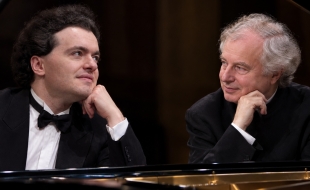
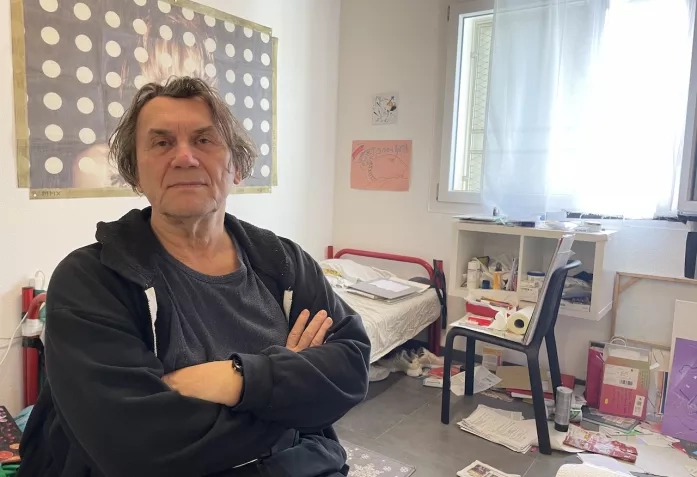
It was Professor Jean-Philippe Jaccard who first told me about him. Then the artist Babi Badalov. I later read an article in Le Temps, contacted the man himself, and went to the Vaud Migrant Reception Centre (EVAM) in Ecublens, near Lausanne. The Russian artist, filmmaker, actor, and author Konstantin Vitalievich Mitenev, sixty-seven years old, known to everyone simply as Kostia, has been living there since 17 October 2022.
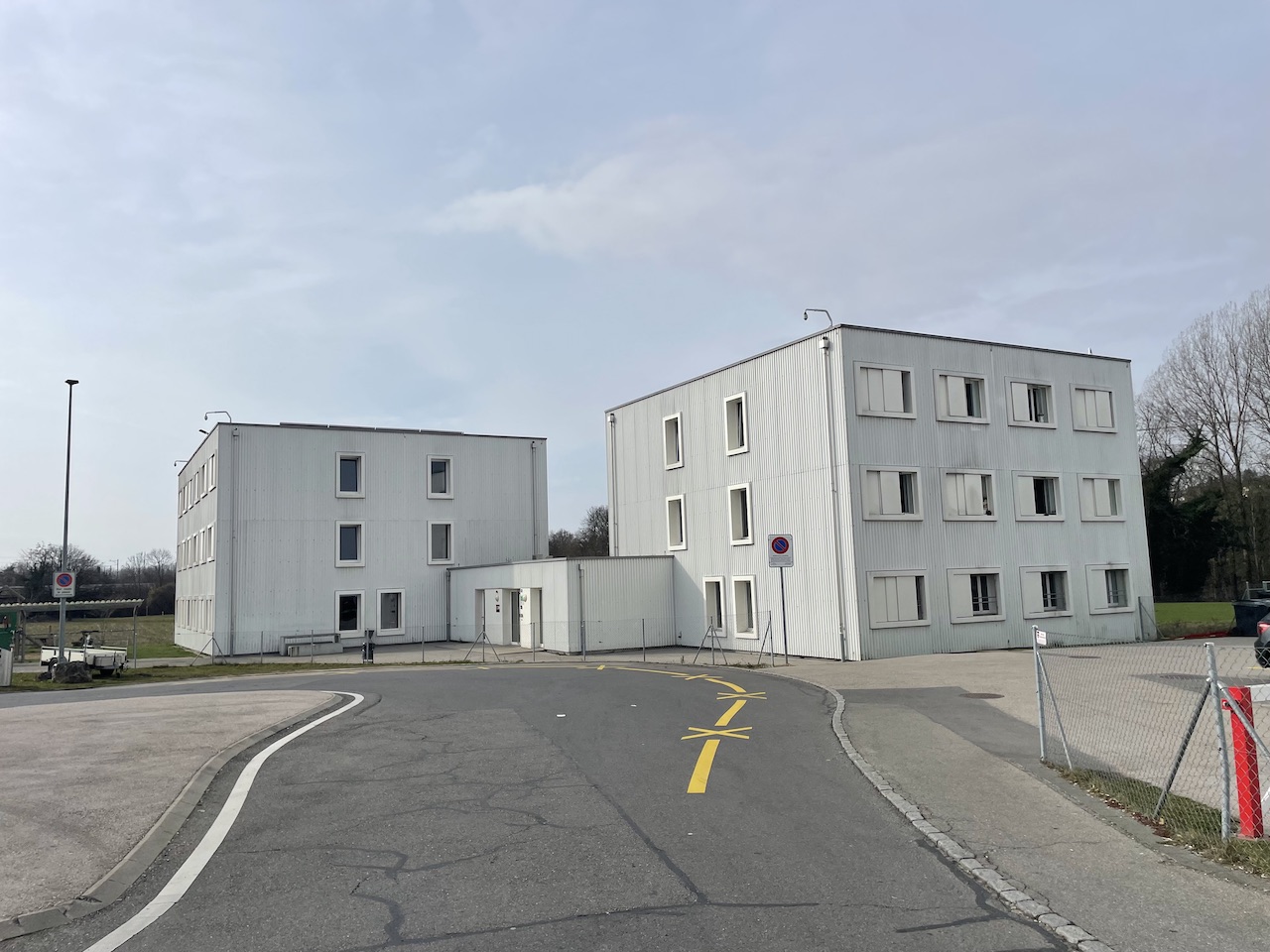
The building, entirely clad in white panels, blends perfectly into the industrial area. Surrounded by large supermarkets and companies, mainly in the automotive sector, it gives no hint of its function. Just another residence, like many others. Only when approaching the entrance does one notice a pink sign reading: EVAM – Établissement vaudois d’accueil des migrants. To the left of the entrance sits a security guard, to whom one must show an identity document. “Konstantin is calm, there are no problems with him. If everyone were like that, I wouldn’t even be needed,” he says kindly as he hands my ID back to me.
Konstantin leads me to the room where he lives alone (“I’m lucky!”) and shares a bathroom with a couple of refugees from Odessa. He has divided his space (some 24–25 m2, by the look of it) into several sections: “studio, gallery, bedroom, kitchen, and dining room,” as he describes his temporary belongings with a broad smile. “Everything is very well organised. There’s an Aldi one minute away on foot, where you can buy everything you need. The allowance I receive is enough for me, because I only spend it on food. Public transport is free, but only to Lausanne, not to Geneva. Medical care is also free. The only real difficulty is buying art supplies: the specialist shops are far away, but in principle you can get there. Once a week, a kiosk opens where you can obtain second-hand clothing free of charge. Shoes are a problem for me, because not all of them are suitable for my prosthesis. Sometimes I go to Morges. My student card (I’m taking a French course) gives me discounts for museums. So all in all, it’s fine.”
We decide to start by having a coffee and then talk seriously, and so we sit down in the kitchen-dining area. While waiting for the “art deco” coffee machine to rumble, I allow myself a brief introduction of my host.
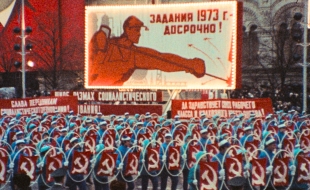
Konstantin Mitenev was born in what was then Leningrad, graduated from the Polytechnic Institute in 1979, joined a group of underground poets, then underground artists, and took part in the parallel cinema movement. In 1988, he studied at the Lenfilm film school under the renowned director Alexander Sokurov and appeared in an episode of Sokurov’s film Save and Protect. He began working on his own film, Tight Lips, which was interrupted by studio management for ideological and aesthetic reasons. Among the notable events organised by Konstantin Mitenev were the outdoor performance New Sky and the Moon On It on St Isaac’s Square in 1991, the year Leningrad became Saint Petersburg again, and, in 1998, the Bonfire of the Vanities marking the 500th anniversary of Savonarola’s execution. In the early 2000s, he began teaching at various art institutions in Saint Petersburg. In 2003, he gave a series of lectures entitled Media Art Movement at Free University-2, at the Pushkinskaya-10 art centre, and a year later at Saint Petersburg State University, as part of the arts and humanities programme. In 2007, he opened his studio “Gold TV” and turned to street art. In 2020, Konstantin Mitenev took part in the exhibition The History of Multimedia Art in Russia, 1980–2000 at the Sergei Kuryokhin Contemporary Art Centre in Saint Petersburg and at the Ekaterina Cultural Foundation in Moscow.
It would take time to list everything Konstantin Mitenev has done in his life, and the longer the list grows, the more insistent the question becomes: how could such a talented and respected person end up in a migrant centre? Meanwhile, the coffee is ready and we can begin our conversation.
Konstantin, when we arranged our meeting with you a week ago, we could hardly have imagined it would take place the day after Alexei Navalny’s death. What does his death mean to you?
It means that a button has been pressed. I believe repression in Russia will only intensify. I am calling on all my friends who have stayed there to leave the country immediately, because they are in grave danger, as demonstrated by Alexei Navalny’s death. It is clear that the ogre, who until now has masked himself with grimaces and so-called “dialogues”, including his last interview, cynically nauseating, given to that ridiculous American journalist, will not stop there. The Russian authorities have described Alexei’s death as “sudden death syndrome”. That means murder, because there is no illness corresponding to such a “diagnosis”.
Did you know Alexei Navalny?
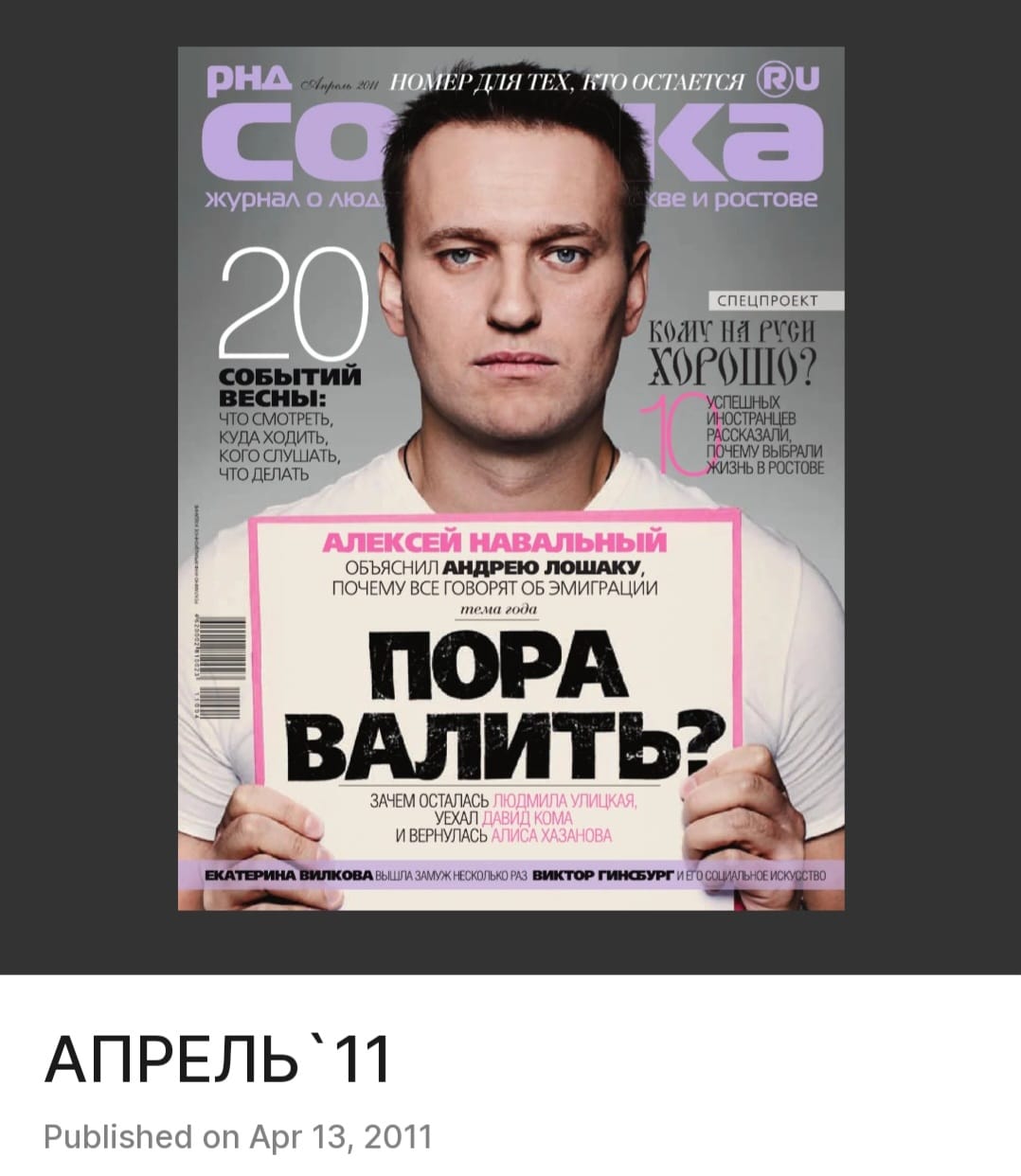
Not personally. But when I looked through my archives, I remembered how I first learned of his existence. In 2011, when he had just emerged, the Saint Petersburg magazine Sobaka.ru came out with Navalny’s portrait on the cover, accompanied by an article about him and an interview with me. The issue was devoted to Russians abroad, and I spoke there about my urban art project in Lisbon. That is where our paths crossed. You will agree that the question on the cover, “Is it time to leave?”, has only grown more relevant over time, and that the answer has become ever clearer. Since then, I have followed Navalny’s actions.
Konstantin, the directions of your work have changed several times, but I fear they may be incomprehensible to most readers. Could you explain, for example, your transition from necro-realism to meta-symbolism, and what these two terms mean?
That is a good question, because it is also a question for myself. The fact is that I am a “New Artist”. The group “The New Artists” appeared in Saint Petersburg in the 1980s. Its leader was Timur Novikov, with Oleg Kotelnikov and Ivan Sotnikov among his associates. At the same time, the necro-realist movement emerged, represented by Evgeny Yufit. Necro-realism is an inverted calque of socialist realism, literally meaning “photography of the dead”; the name was suggested by Oleg Kotelnikov. Today, I see it as a kind of creative punk movement, a new wave in Russia. Despite its light-hearted atmosphere, its participants always thought about the concept of the “new man” they were striving to realise. I joined this movement in 1986, staging actions at the “Krasny Oktyabr” (Red October) cultural centre, while embarking on filmmaking and immersing myself in the underground context. The notion of the “new man” pushed me to become a “new artist”. I remained it until 1991, when Leningrad was renamed Saint Petersburg. That was when I felt that everything was changing, including art and myself. On that basis, I moved towards new media.
You have always belonged, if I may say so, to alternative culture, which in the 1980s, while not attracting ageing members of the Politburo, was nevertheless “tolerated” by them. Did you ever encounter Vladimir Putin when he was working in Leningrad, your shared hometown? And what changed for you after he came to power in Moscow?
I suspect I once saw him very close up. It happened on St Isaac’s Square in Saint Petersburg, on the night of 6 November 1991. We were preparing a major action to mark the city’s renaming. At the Mariinsky Palace, opposite which we had set up a giant screen to project our film, an important meeting was taking place: Mayor Anatoly Sobchak was receiving the President of South Africa, Pieter Botha, known as “The Big Crocodile”. As we were stretching our canvases, a man came out of the palace, identified me as the organiser, approached me and asked, “What are you doing here?” I replied that the birth of a new Russian cinema was imminent. He said, “Very good. Make sure there’s no fighting.” And he left. I remember his faded fish-like eyes, his gaunt silhouette. Ten years later, I turned on the television and saw the new president. And I thought: “I’ve seen him somewhere before…”
Do you consider yourself a political figure?
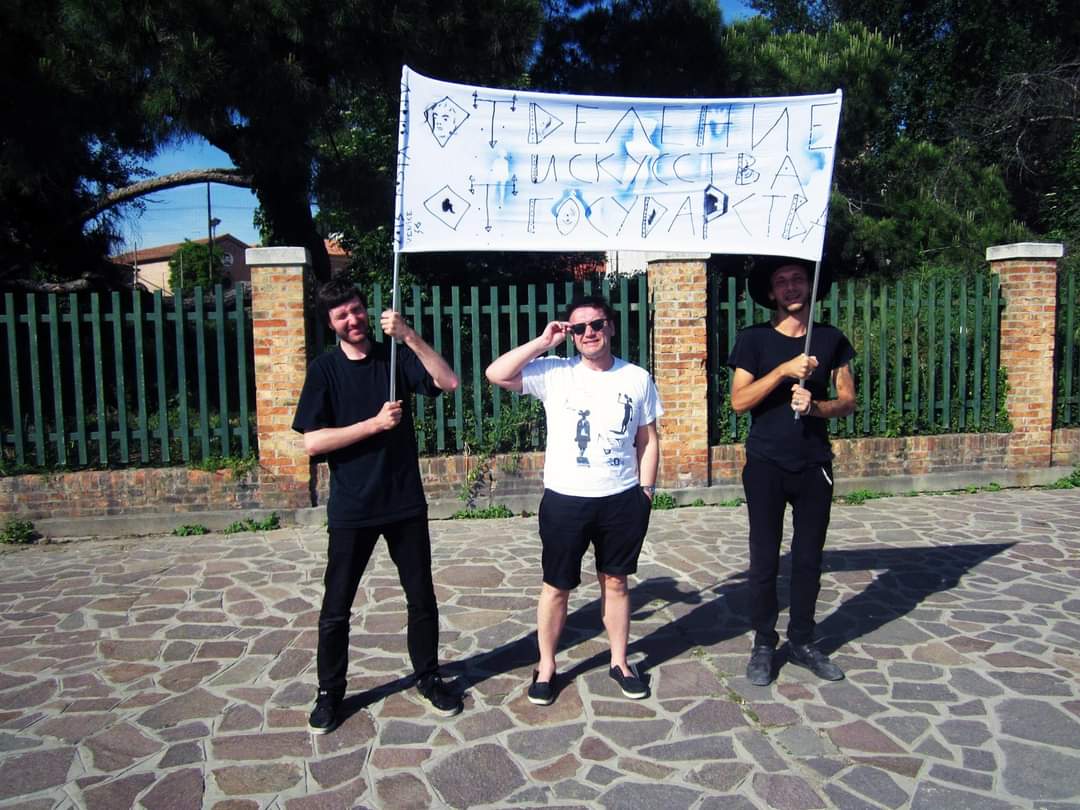
Now I do, since in 2015 I organised the action Separation of Art and State in Venice, aimed at the then Russian Minister of Culture, Vladimir Medinsky. Previously, I was concerned only with aesthetic questions, but after the start of the war I took a clear stand of categorical rejection.
From what I see, Switzerland is not the primary destination for Russian artists, who are more often drawn to America, Berlin, Paris… Yet you, already in the late 1990s, when you organised A Great Clone Party, the first online sound stream between Saint Petersburg and nine cities worldwide, included two Swiss cities: Geneva and Lausanne. Why?
That was not entirely my choice. At the time, all the cities were virtual. The internet was still in its infancy, both technically and ideologically. We were advocating a free and open internet as a new artistic space. An immense virtual platform emerged, where people communicated, presented their work, organised exhibitions and symposiums. That allowed me to say that after “new media” came “next media”. New media were artworks created using the language of the computer, but visible only on the internet. What I proposed was using the internet to transport our offline artworks anywhere in physical space. When it became possible to transmit sound over the internet, I discussed the idea with Geert Lovink, founder and director of the Institute of Network Cultures in Amsterdam, who at the time was working on pirate radio. He put me in touch with people in Paris, who then involved other French-speaking cities in the project.
In 2019, you took part in Art Basel Miami Beach, a “branch” of Art Basel. Another Swiss connection…
That was thanks to the Zurich-based gallery ArtBox.Projects, a gallery with serious international ambitions that organises group exhibitions in powerful art venues. Unfortunately, I have never exhibited in Basel itself, which remains a dream.
At the outset, the coronavirus pandemic was not taken very seriously in Russia. Allow me to raise a painful subject for you: the virus made you disabled. Would you be willing to talk about it?
Yes, especially since it is one of the reasons I am here in Switzerland. On 1 June 2021, while in my studio in Saint Petersburg, I felt unwell and called an ambulance. The doctor suggested it was COVID, but I refused to go to hospital, since I was alone, isolated, and I thought that it would pass. Two days later, I began to feel unbearable pain in one leg, pain resembling a spasm that would not subside. I called an ambulance again. They immediately diagnosed COVID and sent me to a clinic that in reality resembled more a “warehouse” for coronavirus patients. Treatment there was minimal, cockroaches were running everywhere, and three people died in my room. The procedure was as follows: you were tested, given a few pills, waited for a negative result, and then discharged. It turned out that alongside COVID, I had suffered a thrombosis that caused pain so intense it made me scream. I underwent surgery, but incompletely: the pain disappeared, but my foot began to swell. I was discharged when gangrene had already set in. The discharge certificate stated that I was in perfect health. Immediately afterwards, part of my foot was amputated in a specialised clinic. I stayed there for a month, after which I had to do my own dressings. That was the state in which I entered the year 2022.
The beginning of 2022 was doubly tragic for you: on 20 February, your mother died of COVID, and on the 24th, the war in Ukraine began. For someone with a worldview as unconventional as yours, these two events must somehow have merged…
Yes, it was a moment of staggering epiphany. When I managed to see my mother, she did not recognise me; a week later, she was gone. I realised then that I was alone in the universe and that I had to either drink tea or hang myself. That was my state of mind. Gathering my last strength, I realised I still had a chance to save myself by clinging to the invitation from the Zurich gallery I mentioned, which proposed that I exhibit in Venice. I also understood that in my situation it was necessary not only to send my works there but to go myself. I obtained a Finnish visa, but by the time I tried to leave Russia, its border was already closed. I therefore travelled via Istanbul and arrived in Venice on 12 May 2022. My leg was hurting terribly, I wore bandages and waited for it to pass. On 14 May, at the opening of the exhibition held in a gallery on the other side of the Arsenale Bridge, the main venue of the Venice Biennale, I spoke publicly. I stood there with my painting and repeated: “Make art, not war.” Everyone took photos of me.
What happened next?
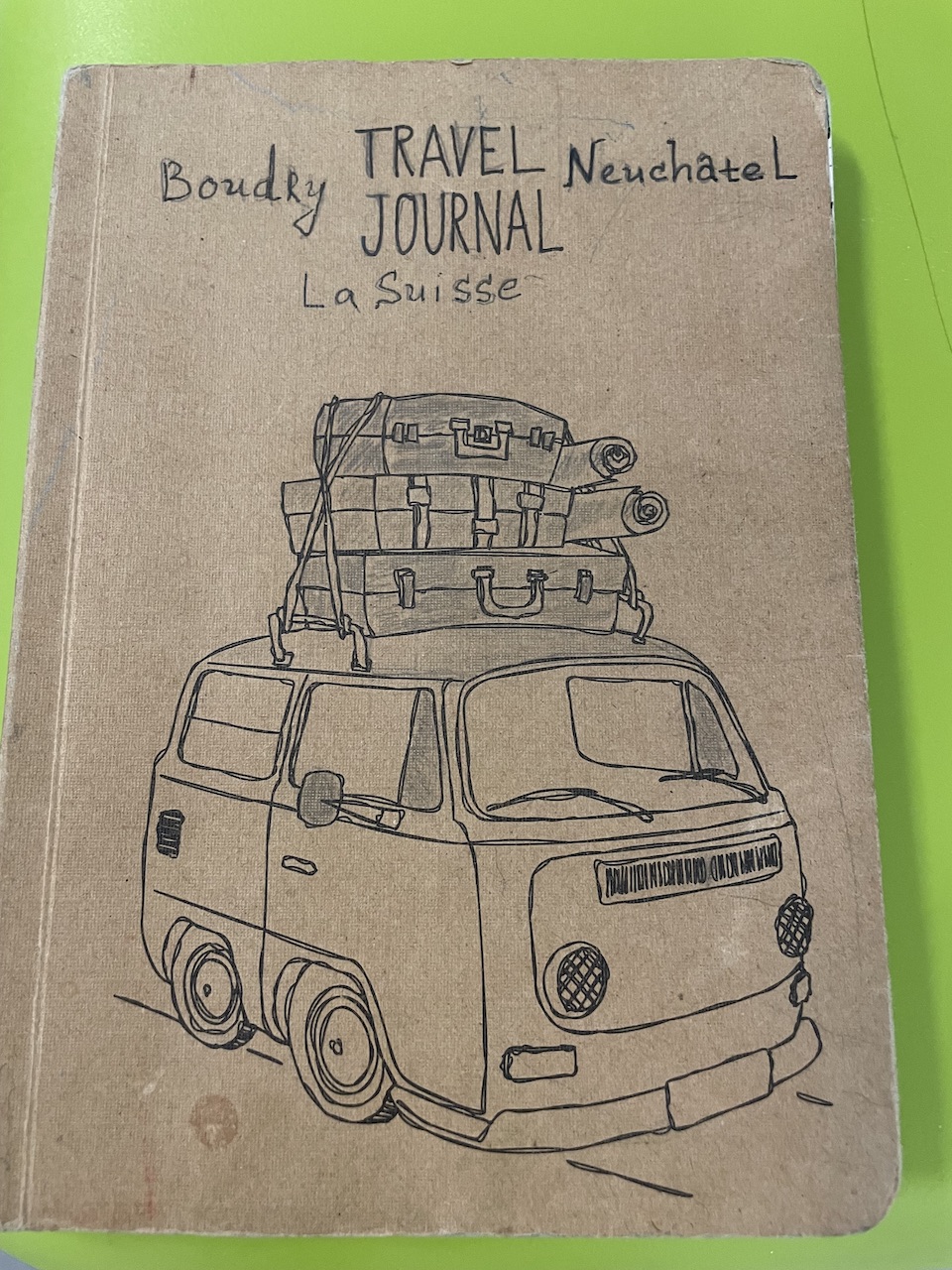
Jean-Philippe put me in touch with the organisers of an anti-war exhibition in Geneva. I gave them my material. However, the day before the exhibition, I began to have such severe pain in my leg that I could no longer move. I had to undergo another operation, which I could not pay for because my insurance had expired three days earlier, without my knowing it. The doctor who operated on me was very humane. He explained that I had gangrene already when I left the Saint Petersburg clinic, where nothing had been said to me, and that I needed another operation. After that, I decided to apply for asylum in order to save my life. I therefore went to the Federal Migration Centre in Boudry. I was first placed in a room for fifteen people, where I lived and made drawings in a notebook. One drawing a day.
The migration service then refused you asylum. Once. Twice. For what reasons? What were you told?
The first refusal was based on the fact that I had a Finnish visa; they therefore wanted to send me to Finland. But while I was in hospital, the deadline for the Finns to accept me expired. Hearing daily statements from Finland that they would expel any Russian on their territory, I categorically refused that option, explaining the situation to the Swiss authorities. They told me that such a thing could not happen. I appealed, and four days later (!) I received a second refusal, along the lines of: “We will have to expel you.” With no indication of a destination. Since then, I have been living here, receiving everything I need, and waiting for my expulsion. They cannot give me a studio, but they have promised me a computer. As you understand, it is very important for me to have constant and benevolent medical follow-up. Here, I feel that I am not alone and that I can trust the local healthcare system.
Do you think the migration service understands what awaits you in Russia?
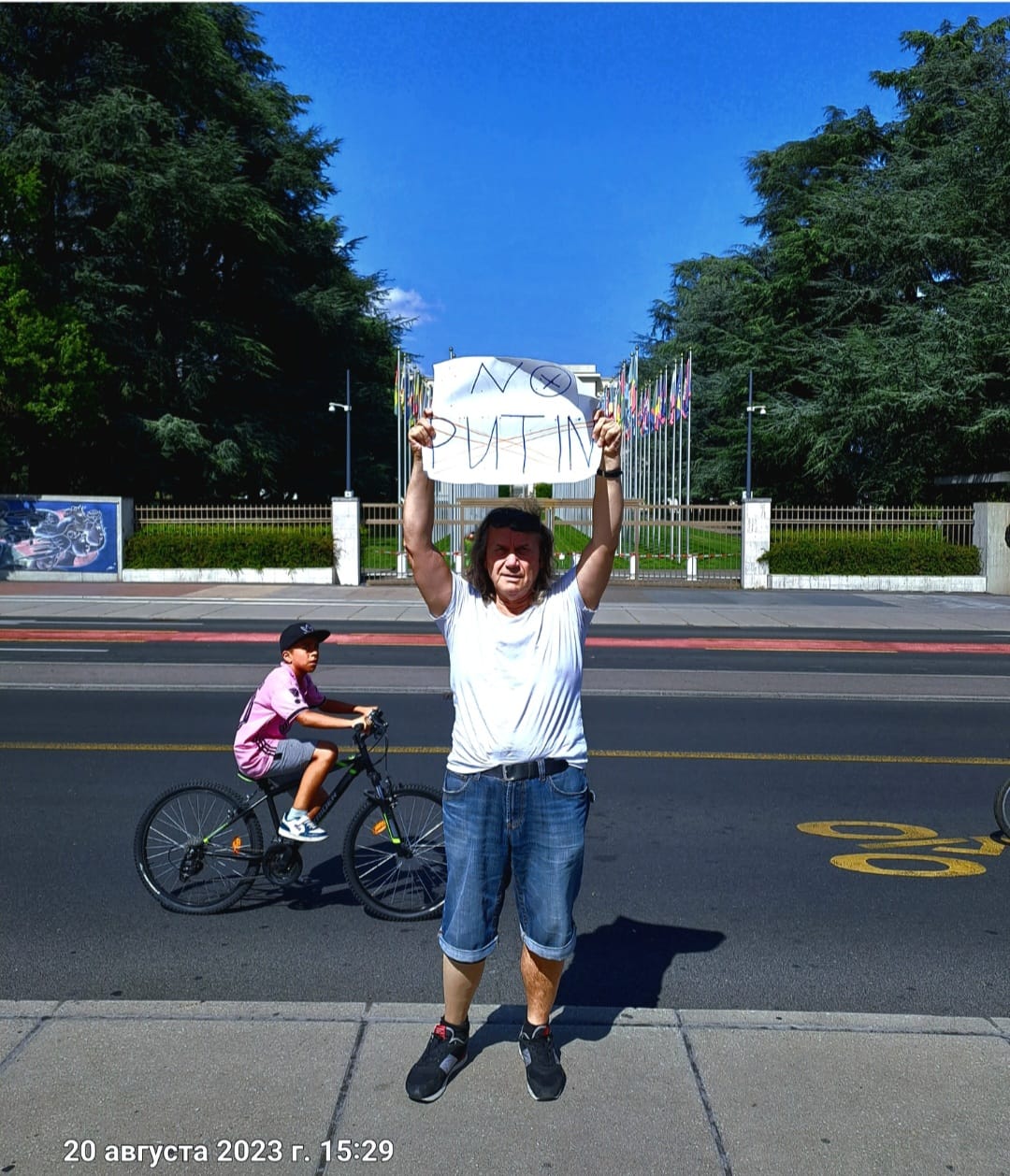
That is the question a woman asked me during my last visit to Boudry. I explained to her that after all my anti-war and anti-Putin statements, they would throw me in prison and label me a “foreign agent” on the pretext that I was returning from abroad. It is perfectly logical!
In an interview with Le Temps, you said that artists were powerless in Russia and that you could therefore only be useful abroad. How do you see that usefulness?
My usefulness lies in my active political and civic position, which I express through my art, without fearing anything. If I manage to obtain refugee status in Switzerland, I intend to work actively, participate in local cultural life, and I dream of one day seeing my works exhibited at Plateforme 10 in Lausanne.
P.S. Several organisations are currently advocating on behalf of Konstantin Mitenev. One can only hope that the Federal Administrative Court will listen to them and reconsider his case in order to grant him political refugee status.