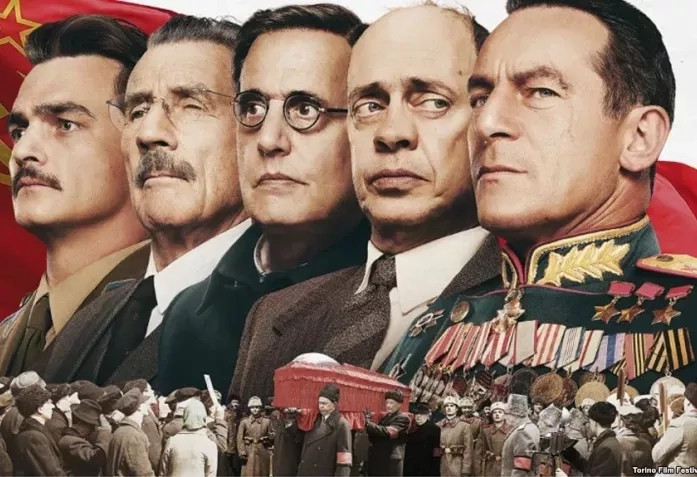
Last Wednesday, Armando Iannucci’s film, already notorious after being banned in Russia, was released in Switzerland. Naturally, I went to see it.
Forbidden fruit is always tempting. Everywhere and at all times. Human nature does not change. What is remarkable is that Russian cultural officials keep making the same mistake, apparently failing to realise that in an age when information is instantly accessible almost everywhere, their hysterical cries of “YOU MUSTN’T!” look just as ridiculous as the characters in the film itself. And just as powerless. The Death of Stalin premiered in Moscow on 25 January 2018 at the Pioner cinema although its distribution licence, granted by the Ministry of Culture only days earlier, had already been revoked. There were just four screenings, but those who really wanted to see the film managed to do so.
As usual, Culture Minister Vladimir Medinsky did not act on his own initiative, but in response to “public concern”, notably from members of the artistic intelligentsia. After a special screening organised by the Ministry of Culture on 22 January 2018, an open letter appeared in the press urging the minister to suspend the film’s licence. Among the signatories, I was unsurprised to find Nikita Mikhalkov, Vladimir Bortko, Sergei Miroshnichenko, Alexander Galibin, and Era Zhukova, daughter of Georgy Zhukov. The accusations were by now entirely predictable: “disrespect towards the national anthem”, “terrible acting”, “false and careless sets”, “a slander against our nation’s history”, an attempt to “humiliate the dignity of the Russian (Soviet) people”, “a slap in the face”… and so on. Naturally, the ban was presented as an attempt to shield the public from such “filth”, as though the public could not think for itself.
According to a February 2018 poll conducted by VTsIOM, the state-run polling agency, 30% of Russians supported the Ministry of Culture’s decision to ban The Death of Stalin, while 35% opposed it. At the same time, 58% said they wanted to see the film. I hope they eventually had the opportunity to do so and form their own opinion instead of relying on somebody else’s. Because whatever its flaws, the film possesses one undeniable quality: it forces viewers to think. About the past and the present.
Having read virtually every review of The Death of Stalin available online, I entirely agree with film critic Valery Kichin of Rossiyskaya Gazeta, who described the film as a “crude, but unfortunately fair tragic farce” and wrote that the film’s grotesque exaggeration feels so disturbing precisely because it is rooted in reality, leaving the viewer with the same sense of shock and helplessness one experiences before paintings by Francisco Goya and Hieronymus Bosch. Nikolai Gogol would have put it more succinctly: “Don’t blame the mirror…”
But let us look more closely.
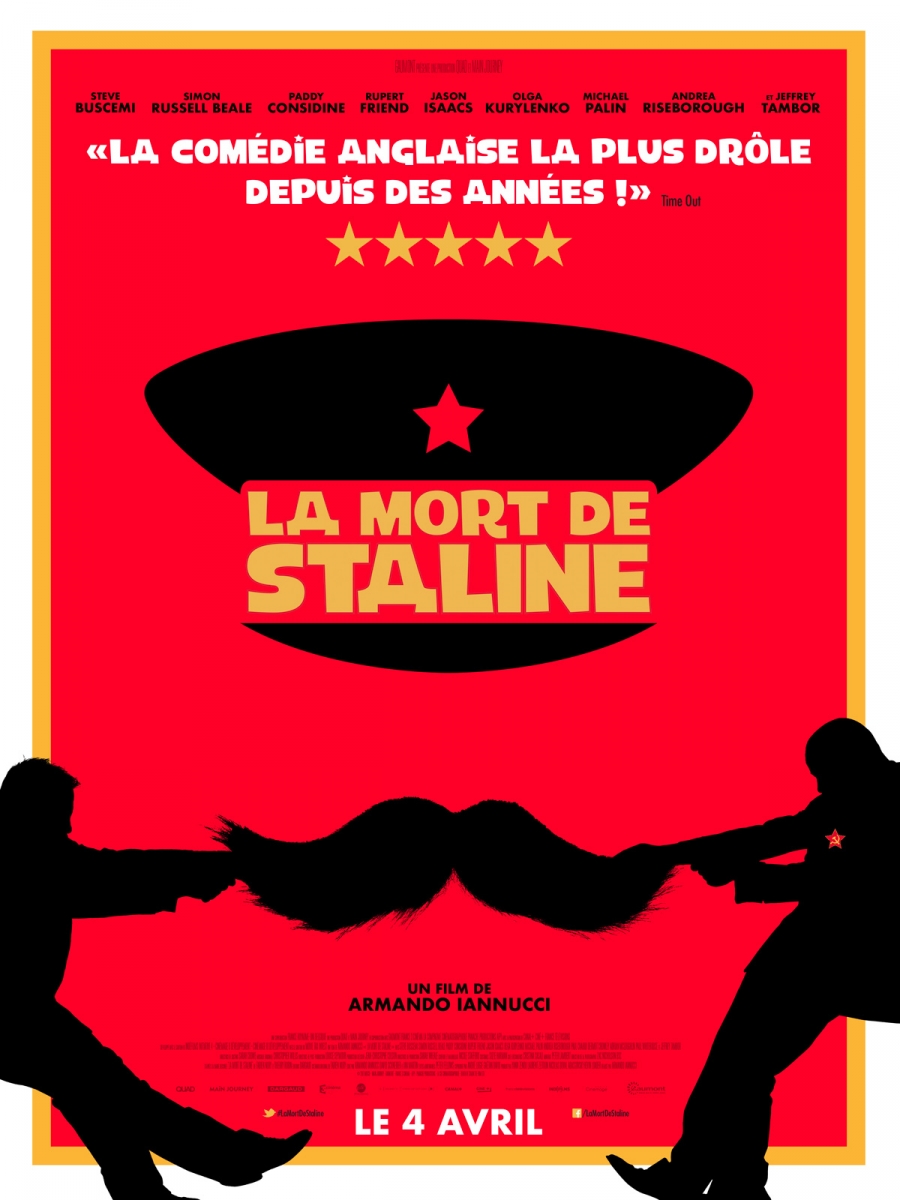
Before the film reached Swiss cinemas, I watched the trailer. Several times. The Soviet anthem alternated with the polonaise from Eugene Onegin. The trailer described the film as a ‘comedy of terror’. The film’s premise was clear enough: ‘an entire nation living in fear of one man’. And then came the main hook: “so absurd it’s hilariously funny”. Everything pointed to broad, heavy-handed comedy. The characters immediately struck me as puppet-like, which is hardly surprising given that the film is based on the 2010 graphic novel by Fabien Nury and Thierry Robin. Yet the filmmakers clearly made an effort to ground the story in historical reality: before shooting began, they travelled to Moscow, visited the Kremlin and Stalin’s dacha, spoke with historians and Muscovites who remembered the 1950s, and watched Burnt by the Sun (1994) by Nikita Mikhalkov and Khrustalyov, My Car! (1998) by Aleksei German.
Can one really laugh at death, when the film is ostensibly about Stalin’s final hours in March 1953? Probably not at death itself. But in the film, death merely sets in motion the events that followed, and only those who never experienced such things themselves, or saw their loved ones endure them, can laugh comfortably at what comes next.
I agree with the genre definition, which is hardly new in Russian culture. As one Swiss acquaintance of mine once remarked, “A Russian comedy is when not everybody dies.” In this film, not everybody dies. What I do not agree with is the claim that what we see is absurd. That is precisely what makes it terrifying: none of it feels absurd at all.
I grew up in Moscow’s musical world, among what was then the genuine cultural elite, not the diluted version of the term we use today. Which is why I know for a fact that frantic calls to the recording booth of the Great Hall of the Moscow Conservatory demanding a recording of a concert that had just ended – and had not even been recorded – or dragging outstanding musicians out of bed in the middle of the night to entertain the “Father of Nations”: all this really happened.
Like many despots, Stalin had a weakness for classical music. Yet I doubt many people in the Geneva audience realised that the elegant young pianist who agrees, for money, to perform Mozart’s Piano Concerto No. 23 a second time and slips an accusatory note into the hastily pressed record - a note which Stalin reads just before bursting into laughter, collapsing dead, and wetting himself - was a real person. Maria Yudina. Stalin genuinely admired Maria Yudina’s playing. Yet even Stalin’s admiration did not save her from dismissal first from the Leningrad Conservatory and later from the Gnessin Institute, from being banned from recording, and from countless other humiliations. Absurd, you say? Not at all. The story of the rushed recording appears in the memoirs of Dmitri Shostakovich, and he is certainly a witness one can trust. As so often happens, reality proved more horrifying than fiction, which is precisely why the film kept giving me chills: it felt too plausible. The audience around me seemed to feel it too. The laughter heard at the beginning quickly faded away.
What can one say about this little clique of “top state leaders” who, after Stalin’s death, begin behaving like frightened adolescents? They are revolting, collectively and individually. Are the portraits exaggerated? Certainly. Is there grotesque caricature? Of course. Is the physical resemblance less than convincing? Absolutely. But is the essence distorted? Was Beria not a sadistic sexual predator? Was Molotov not a coward who renounced his own wife after her arrest on charges of “Jewish nationalism”, while remaining a loyal servant of Stalin’s will? And was Khrushchev not an ignorant buffoon? How many execution orders bear the signatures of these inhuman men, not to mention the fifteen hundred people killed during Stalin’s funeral, victims solely of the authorities’ incompetence and negligence?
The frantic scramble that begins the moment “the king is dead”, the complete inability of the “successors” to make rational decisions, their greed, their willingness to stop at nothing in the struggle for power - is any of this untrue?
What truly frightens me is that even today, after the enormous work carried out by the Memorial organisation and its allies to restore historical truth, after the publication of thousands of documents leaving no doubt about the scale and depth of the evil committed in our country, there are still people trying to justify it, whitewash it, embellish it, apply historical Photoshop.
Allow me one final hypothesis. The Death of Stalin, terrifying beneath its comic surface, was banned in Russia not only for the officially stated reasons, although I readily admit that the film would undoubtedly have rubbed the hardline patriots the wrong way. Perhaps the deeper reason lies elsewhere: the problem of political succession in Russia remains unresolved to this day, and everything Mikhail Khodorkovsky told Nasha Gazeta in a 2014 interview - an interview whose publication cost me two important sponsors - remains true. And perhaps someone is very anxious to prevent people from thinking about it.