
I am always delighted when readers not only respond to my articles but also give me new ideas for future ones. This time, without a tip from my Italian friend, I might never have learned that such an interesting event with a distinctly Russian accent was being planned in Rome. “My public readings always pursue the same goal: to provide answers that generate new questions. That is how the chain of learning is sustained.” This is how Alessandro Baricco describes his series of Readings, which has already been held with great success in many Italian cities, where not individuals, couples, or groups of friends, but thousands of complete strangers gather at the same time to read.
(As a reminder, Alessandro Baricco is one of Italy’s best-known contemporary writers, essayists, and public intellectuals. His novels Silk (Seta), Ocean Sea (Oceano mare), Novecento, and many others have been translated into dozens of languages, including Russian. Beyond his literary work, he is known as a cultural communicator, the founder of the Scuola Holden creative writing school in Turin, and the creator of large-scale public projects devoted to literature, music, philosophy, and the history of art.)
The next link in that chain will be La tempesta silenziosa – The Silent Storm. Rome’s Department of Culture has prepared ten thousand free copies of Fyodor Dostoevsky’s White Nights for distribution so that, on 17 June at 8:47 p.m., people can gather to read together at Domitian’s Stadium on the Palatine Hill, the Ara Pacis (the Altar of Augustan Peace), Villa Torlonia, the Rome Opera House, and Piazza del Campidoglio.
It is symbolic that Baricco’s new Readings are devoted to Dostoevsky. You may recall that after the outbreak of the war in Ukraine, Italy became the scene of one of the most prominent controversies surrounding the attempted “cancellation” of Russian culture. In the spring of 2022, Milan’s Bicocca University tried to cancel a lecture course on Dostoevsky, deeming it inappropriate in the context of war. The decision provoked a major scandal in Italy and beyond, and the university ultimately reversed its decision and reinstated the course.
Equally revealing was the attitude of the journalist who interviewed Alessandro Baricco for the Italian newspaper La Repubblica. (The interview was later reprinted by the French newspaper Le Figaro.) Although the project revolves around a Russian literary classic, the war in Ukraine, now in its fifth year, was not mentioned at all in the interview. Instead, the journalist repeatedly tried to persuade the writer to acknowledge that his initiative was political, even protest-oriented, something he consistently refused to do. Baricco insisted that this was not a political gesture but an attempt to draw attention, in a world dominated by displays of hard power and spectacular actions, to the “soft power” of culture, to a lost sense of elegance, and to a world of “gentle people” united by shared values.
At one point, the journalist put the question bluntly: “Are you saying that this world of values, which continues to exist despite Trump and Netanyahu, should claim its own space?” A revealing shift of emphasis. Yet Baricco refused to follow her lead. Gracefully sidestepping a direct answer, he returned the conversation to the realm of culture and ideas, reminding readers that White Nights is “a book about a dreamer, a man in love who blurs the boundaries between imagination and reality. A book that explains, from its very first pages, who we are. We are those who dream while looking at the facades of houses, shy people who feel the hearts of others, solitary souls connected to everything around them.”
I had quite different questions in mind and would very much have liked to speak with Alessandro Baricco myself, but he was on tour and thus unavailable. I hope our conversation has merely been postponed. In the meantime, I shall follow his example: rather than being drawn into polemics, I would like to return to the book he has chosen and offer my own thoughts on that choice.
According to the organisers, the event is expected to last about ninety minutes, which may surprise readers familiar only with Dostoevsky’s major novels, each of them running to well over five hundred pages. Yet White Nights, first published in 1848, although it bears the subtitle A Sentimental Novel, is, by Dostoevsky’s standards, scarcely more than a novella: it is only 53 pages long, making an hour-and-a-half reading entirely realistic. I must admit that, rereading White Nights for the first time since my student years, I saw both the book and its protagonist in a new light, as so often happens with literary classics.
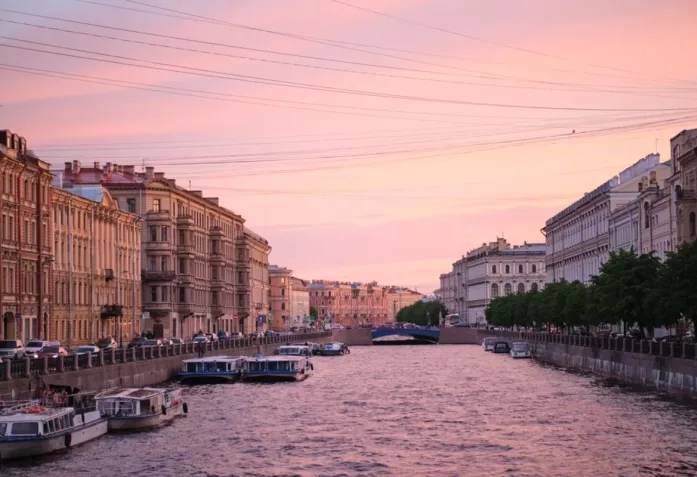
Need I remind my readers that the White Nights are one of the most remarkable natural phenomena of the northern summer? In St Petersburg, where Dostoevsky lived, the sun barely dips below the horizon in June, and darkness never truly falls. The city is bathed in a silvery twilight in which familiar outlines blur and reality itself begins to resemble a dream. It is hardly surprising that Dostoevsky chose this season for the story of his dreamer, a man living between imagination and reality, and that he divided his tale not into chapters, or even days, but into nights – the perfect time for dreaming, whether asleep or awake.
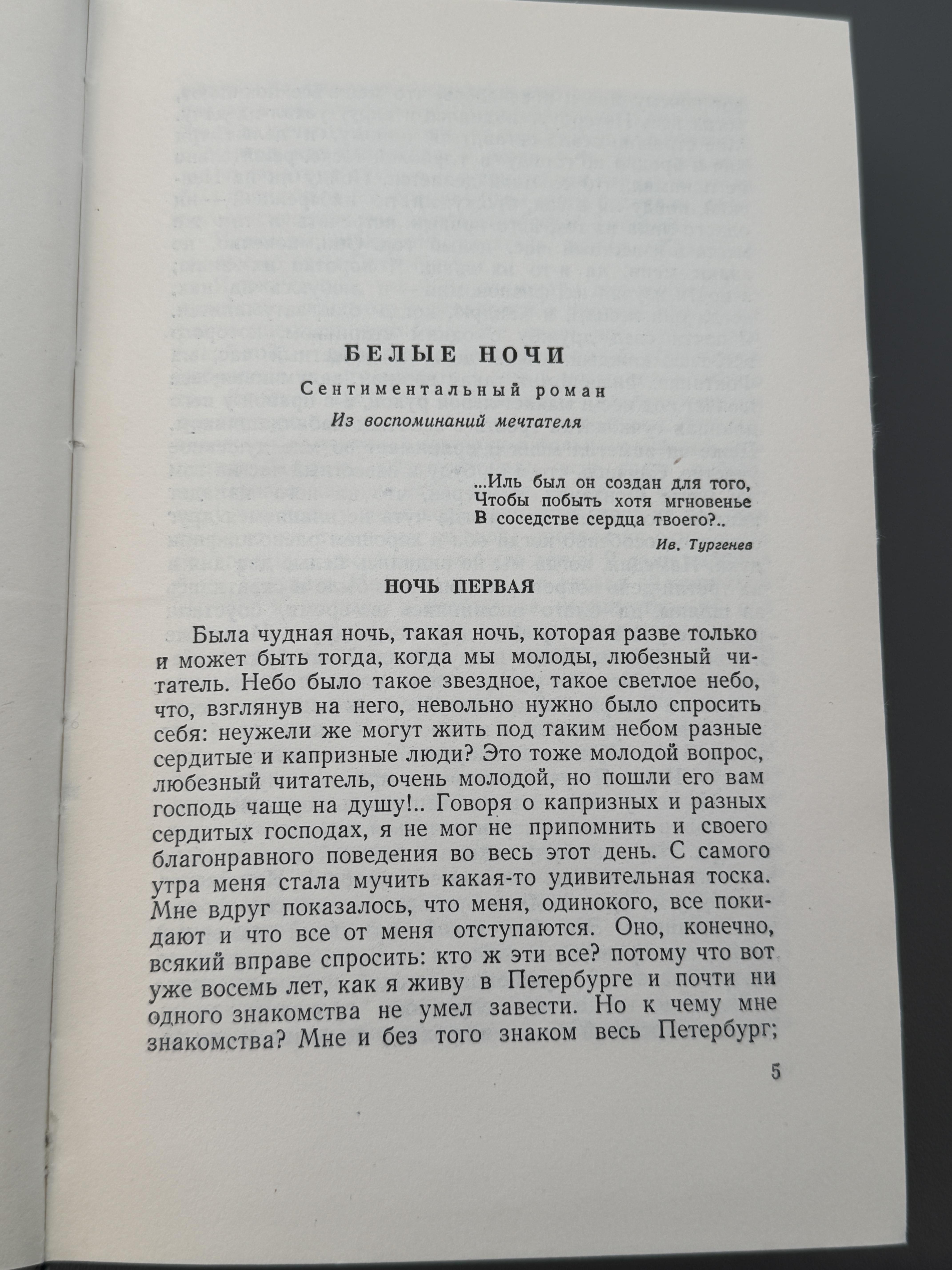
“It was a wonderful night... The sky was so starry, so bright, that looking at it one could not help asking: can angry and capricious people really live under such a sky?” The answer, unfortunately, is yes. Dostoevsky’s hero is tormented by “a strange melancholy”, at times bordering on unhealthy suspiciousness: “Suddenly it seemed to me that everyone was abandoning me, that everyone was turning away from me.” Yet the reason is entirely mundane: the residents of St Petersburg have simply left for their dachas. After all, it is summer.
In the commentary to White Nights published in the second volume of the famous ten-volume grey-covered edition of Dostoevsky’s collected works in 1956, the Soviet literary scholar Liya Rosenblum described the protagonist as follows: “The hero of White Nights is a poor St Petersburg intellectual, a man of high spiritual culture. He is dear to the writer precisely because he feels alien and ill-suited to a world of petty, philistine concerns. The dreamer himself aptly describes his life as ‘a mixture of something purely fantastic, ardently ideal, and at the same time... dull, prosaic and ordinary, not to say incredibly vulgar.’ Dreaming is a peculiar form of protest against vulgarity, though a passive and weak one.”
Passive and weak though it may be, it remains a form of protest. And does this definition of dreaming as “a peculiar form of protest against vulgarity” not echo what Alessandro Baricco seems to be talking about today: reading and using one’s imagination as a way of resisting a world of banality and everyday noise?
Books play a special role in White Nights, which, in my view, may be another reason why Baricco chose this particular work. After all, it is with books that the story of Nastenka and her lodger begins. He lends her novels by Walter Scott and Pushkin, and reading becomes the first step towards bringing them together. “So we began reading Walter Scott,” Nastenka recalls, “and within a month we had read almost half of it. Then he kept sending more books, and Pushkin too, until at last I could not live without books and stopped dreaming of marrying a Chinese prince.”
And she ends up marrying not a “Chinese prince” but a man who built a relationship with her through books and opera (Italian readers will no doubt appreciate the appearance of The Barber of Seville in Dostoevsky’s novella). Reading together gives them something to experience and discuss together. In Dostoevsky’s world, a book is not merely an object and not merely a text. It is a means of overcoming loneliness, a way of establishing a human connection.
It is no coincidence that Pushkin is among the authors whose books the lodger gives to Nastenka. Dostoevsky’s admiration for Eugene Onegin is well known. In his famous Pushkin Speech of 1880, he described the novel in verse as a work of national significance and saw in it far more than a love story between Tatyana and Onegin. In Tatyana herself - who, as you may recall, was “terribly dreamy” - he saw a figure of profound moral integrity.
Despite the absence of any direct reference to Eugene Onegin, in the second of the four nights of White Nights Dostoevsky seems to turn Pushkin’s plot into a psychological experiment. Here too there is a young woman who is the first to confess her love, a letter, the agonising wait for a reply, and even passages that come close to prose paraphrases of Pushkin’s verse. Yet the roles have been rearranged. If in Eugene Onegin Tatyana writes to the man she loves and sends the letter through her nurse, in Dostoevsky’s novella another man helps deliver the letter, while being in love with the heroine himself. A complex triangle emerges in which the dreamer simultaneously plays the roles of friend, intermediary and unhappy rival.
But perceptions of literary characters change with their readers, and today the Soviet interpretation of Dostoevsky’s “dreamer” no longer seems the only possible one. I tried to imagine how a young Italian woman encountering him for the first time might respond to the protagonist of White Nights. In my view, she might well see him not as a rebel but as a lonely, immature man who prefers a world of fantasies to life as it is and to genuine relationships. He has no friends, no family, and we know almost nothing about his professional life or his activities beyond his fantasies. He does not build relationships with women but prefers to fall in love from a distance, with idealised images of them. Instead of learning how to connect with real people, he retreats into endless internal monologues and constructs imaginary scenarios for his own life.
In the eyes of a contemporary woman, his behaviour may seem not merely odd but unsettling. What kind of man becomes emotionally attached to a complete stranger almost instantly, idealises her after only a few meetings, and effectively places responsibility for his happiness on her shoulders? His love arises not from truly knowing another person but from his own need to be loved. For him, Nastenka is less a real young woman than a rescue from loneliness. For today's heroines, immaturity is hardly an attractive trait, nor is his fear of the real world, where one must act rather than dream. I suspect that these shortcomings would outweigh, in the eyes of many female readers, the sensitivity, kindness and delicacy that may now appear merely as signs of weakness. It is entirely possible that today's reader would side with Nastenka, who chooses not the dreamer but the man who came, made a choice, and took responsibility for his love. Yes, the ending of White Nights is a bitter one: after four nights comes morning, and with it reality.
It seems to me that Dostoevsky himself recognised this ambiguity. He clearly sympathises with his hero, yet at the same time portrays him as someone living what he calls “not a real life”. It is no accident that at the beginning of the novella the dreamer admits that his actual life is so poor in events that he is forced to replace it with fantasies. In this sense, White Nights can be read not only as a a celebration of dreams but also as a rather stern warning about the dangers of a life lived in fantasy, cut off from reality.
Viewed through the eyes of a modern psychologist, the hero of White Nights seems surprisingly close to some of the problems of our own time. A lonely young man who lives largely in a world of his own fantasies, becomes emotionally attached to people he barely knows, and prefers imagined relationships to real ones – this no longer seems an exclusively literary portrait. Researchers increasingly speak of an epidemic of loneliness among young people, paradoxically unfolding at a time when opportunities for connection have never been greater. Social media allow us to stay in constant contact, but they do not always help us feel genuinely connected to other people.
That is why Alessandro Baricco’s choice of White Nights strikes me as such an inspired one. On the one hand, his initiative invites us to reclaim the right to dream and to cultivate an inner life in an age that prizes efficiency, speed, strength and spectacle above all else. On the other hand, his proposal to gather and read a single book together becomes not merely a literary gesture but an almost therapeutic one: a reminder that personal stories and big History need not be experienced alone but can be shared with others. not be experienced alone but can be shared with others.
It is a wonderful initiative, in my view, and participation is free – all you have to do is register at latempestasilenziosa.it. And if you cannot take part, then at least reread White Nights: June is exactly the right time for it.
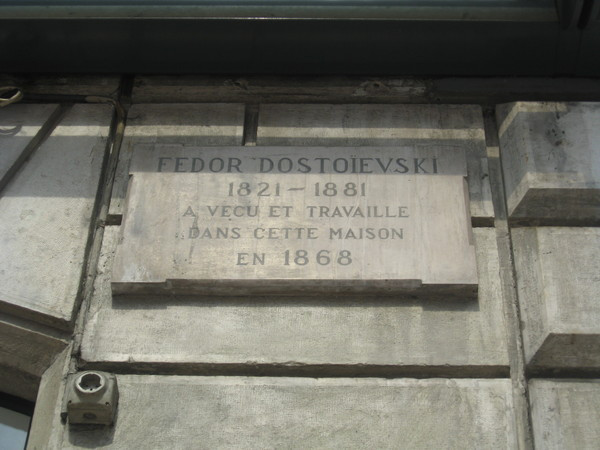
P.S. Fyodor Dostoevsky lived in Geneva from late 1867 until the spring of 1868 with his young wife, Anna Grigorievna. A commemorative plaque on a building on Rue du Mont-Blanc marks his stay. It was here that he began writing one of his greatest novels, The Idiot. It is also in Geneva, at the Cimetière des Rois, that his daughter Sofia is buried. The loss of the child, who lived for only three months, left such a painful mark on him that he came to dislike Geneva. But enough time has passed for us to forgive him.







Claudio Poloni June 12, 2026
Sikorsky June 12, 2026
Laurent Lévi-Strauss June 13, 2026
Sikorsky June 13, 2026
Federica Brunelli June 13, 2026
Sikorsky June 13, 2026