Giles Milton is a British writer specialising in narrative history, particularly the history of the Second World War. His books have sold more than a million copies in Britain and have been translated into twenty-five languages, though apparently not into Russian. French-speaking readers, however, have already discovered twelve of his books thanks to Éditions Noir sur Blanc, some of them successful enough to be reissued.
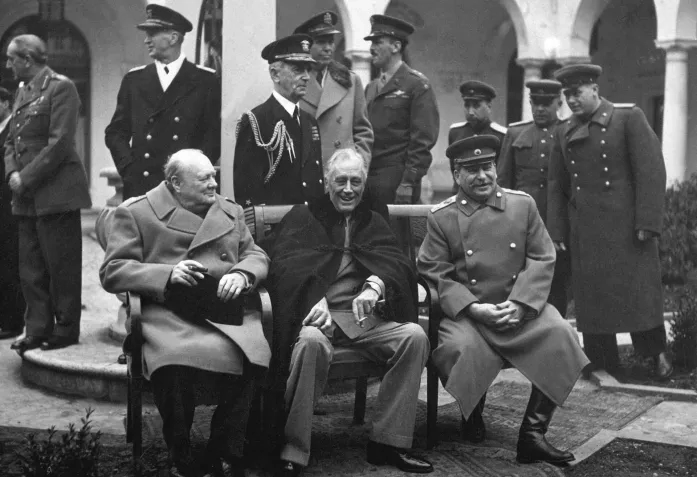
Originally published in 2024, The Stalin Affair: The Impossible Alliance That Won the War examines the extraordinarily fragile and paradoxical alliance between Joseph Stalin, Winston Churchill and Franklin D. Roosevelt during the Second World War. Milton writes not so much a grand military history, preserved in collective memory in photographs of the Big Three at Tehran and Yalta, as a story of personalities, mutual distrust and attraction, diplomatic intrigue and psychological games surrounding the alliance between the United States, Great Britain and the USSR. It was an alliance born of necessity: opening a second front was essential to defeating the common enemy and served everyone’s interests. One of the book’s greatest strengths lies in its use of private diaries, letters and little-known testimonies, particularly those connected with the American diplomat Averell Harriman and his daughter Kathleen (“Kathy”). The substantial bibliography at the end of the volume inspires respect for the author’s work and confidence in his conclusions.
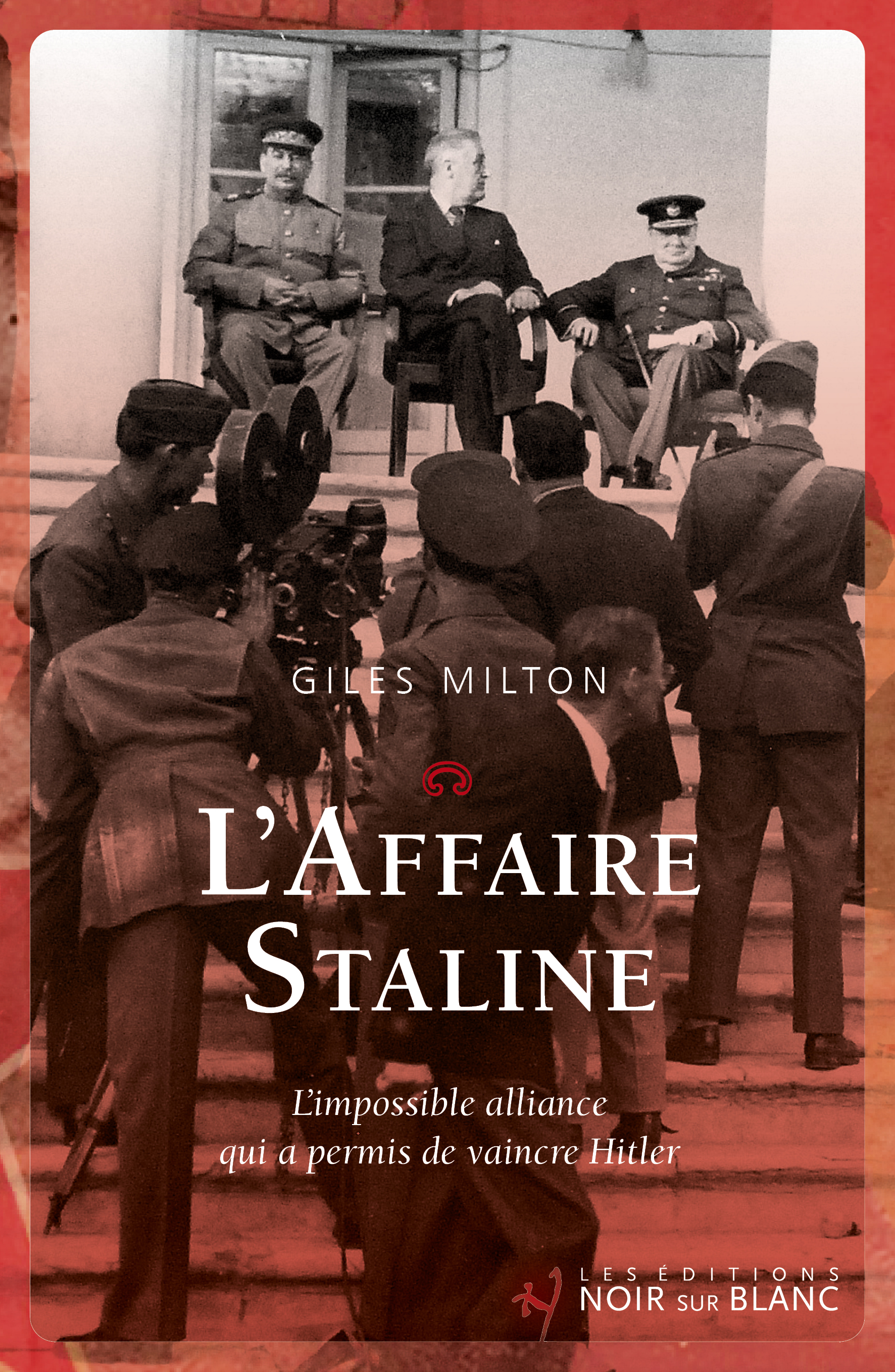
Accustomed to thinking – and writing – in several languages, I cannot help pausing over the title of the book. There is something interesting here: the original English title, The Stalin Affair, like the French L’Affaire Staline, is is open to several interpretations. It may suggest an affair, a story, an episode, a scandal or even a diplomatic incident. This ambiguity, this mixture of wordly drama and political intrigue, corresponds perfectly to the style of the book, in which war appears as a combination of diplomacy, psychological theatre and personal relationships.
The Russian version of the title, however – Delo Stalina – would immediately produce a rather different effect. It would begin to function almost like a legal formula: the case of so-and-so, the case of an accused man, of a suspect. For Russian readers, this inevitably evokes associations such as the Dreyfus affair, the Beilis affair, the Doctors’ affair and so forth. The very word delo immediately introduces a judicial and political register and sounds accusatory even if formally it means only a “story” or a “matter”. In this sense, the Russian title would be harsher than the English original, leading readers to expect a moral verdict on Stalin, a figure about whom no genuine consensus exists in Russia to this day.
But Giles Milton is British, and his book is subtler than that. Rather than delivering a political indictment, it explores the mechanisms of seduction, political naïveté and forced alliance with dictatorship. This is precisely why the title works so well: it promises both a judicial “case” and a diplomatic case study at the same time.
Milton’s style belongs firmly to the Anglo-American tradition of narrative history: highly cinematic, with a strong emphasis on scenes, personalities and dramatic tension. He knows how to turn historical non-fiction into something very close to a political thriller. This is both his strength and his limitation. Academic historians sometimes reproach him for romanticising documentary material, yet the book remains genuinely gripping, and ordinary readers are unlikely to complain.
This book will hardly offer major revelations to specialists in Soviet history: most of the events described are already well known. Yet this is precisely where its interest lies: in its successful synthesis of familiar facts, its vivid portraits and its demonstration of just how profoundly Western leaders misjudged their temporary ally. The book constantly moves between history, political myth and moral ambiguity, situating it precisely where many contemporary debates about the memory of war and European historical culture now unfold.
Whenever we read a historical book or watch a historical film, we instinctively compare the past with the present. Giles Milton’s book almost deliberately invites such a reading, especially since the mechanisms of personal diplomacy, political illusion, media spectacle and simple human vanity have by no means disappeared.
Reading this book today, it is difficult to escape a sense of déjà vu.
Roosevelt, convinced that he could “charm” Stalin and establish an almost personal relationship with him, seems strikingly modern. His confidence in his own ability to negotiate directly with a dictator, bypassing institutional mechanisms of caution and distrust, often sounds like an echo of today’s rhetoric of “personal understanding” with Vladimir Putin on the part of President Trump, right down to the conspicuously theatrical protocol of their recent meeting in Alaska, complete with a red carpet. And this despite the fact that the Russian president, like the Soviet Generalissimo whose rehabilitation he actively promotes, considered “free speech” to be “the great weakness of democracy”. It is a remarkably powerful quotation in today’s climate of endless discussions about the “weakness” of open societies, the “inefficiency” of democracy and the supposed advantages of authoritarian regimes in times of crisis and information warfare.
Another parallel is equally striking: the most important diplomatic missions were then, as now, often entrusted not to professional diplomats but to people belonging to the president’s inner circle. President Trump entrusts crucial negotiations to businessman Steve Witkoff; in Milton’s book, one of the central figures is the American millionaire and diplomat Averell Harriman. His name is probably more familiar to the older Russian generation than to contemporary Western readers, although Columbia University’s Harriman Institute bears his name.
It is therefore worth recalling that this American industrial millionaire, a second-generation embodiment of the American dream, took part in the London Lend-Lease negotiations in March 1941 on behalf of the US president, served as Roosevelt’s special representative in Great Britain and the USSR between 1941 and 1943 and coordinated Allied cooperation under the programme, before becoming US ambassador to the Soviet Union from 1943 to 1946, meeting Stalin frequently. Yet it is precisely here that the historical parallel begins to break down: unlike many contemporary intermediaries, Harriman quickly lost his illusions about the Soviet leader and became perhaps the most perceptive observer of the entire story.
“Stalin wanted weak neighbors, because weak neighbors could be dominated”, he realised shortly after the Yalta Conference that redrew the map of Europe. “We must recognize that our objectives and the Kremlin’s objectives are irreconcilable. < > The Kremlin wants to promote Communist dictatorships, controlled from Moscow, whereas we want – as far as possible – to see a world of governments responsive to the will of the people.” Or again: “Wherever and whenever we show signs of weakening, we may expect to be pounced upon. We must therefore not only be strong – we must look strong.”
These reflections survive thanks to the diaries of Robert (“Bob”) Meiklejohn, Harriman’s assistant during his “Soviet years”. Such testimonies undermine the widespread myth of “naïve ignorance”: the problem, alas, often lies not in the lack of information, but in the absence of political willingness to draw conclusions from it.
It is striking to see how violently the American press turned against Harriman at the time, reducing the matter to the claim that he feared the USSR simply because he was a millionaire. Soviet diplomat Oleg Troyanovsky later recalled Stalin remarking in 1947 that “this man bears his share of responsibility for the deterioration of our relations after Roosevelt’s death”.
And Churchill, so intelligent, so experienced a politician – what about him?
“A man of massive outstanding personality, suited to the sombre and stormy times in which his life has been cast. A man of inexhaustible courage and will-power and a man direct and even blunt in speech”, he said to the British parliamentarians after meeting Stalin for the first time. “No mention of the criminal purges, the millions of murders, the Gulag prison camps. Churchill portrayed Stalin in a wholly positive light and confessed to having found him likeable and impressively frank”, Milton underlined.
Milton emphasises here not so much Churchill’s “betrayal” as the mechanism of self-persuasion among democratic leaders during wartime. Gradually they begin describing the dictator in terms of strength of character, efficiency and historical grandeur, as though such qualities could eclipse the price at which they were achieved. Particularly revealing here is the notion of frankness. Authoritarian leaders often strike people as “frank” precisely because they do not conceal their brutality, and for part of the Western elite such bluntness paradoxically begins to seem more authentic than the complex language of democratic politics.
Milton’s book is particularly fascinating in the way it focuses not only on politicians themselves but also on the infrastructure of power: interpreters, advisers, journalists and accompanying officials, whose judgements often differed from those of the principal actors. The interpreters become almost invisible co-authors of history. This is only fair, since the atmosphere of negotiations and the perception of what was said often depended on their professionalism, their intonation and on whether translations were deliberately softened or sharpened – something that sounds unexpectedly relevant today in the age of machine translation. One cannot help regretting that the Soviet interpreter Vladimir Pavlov, who attended all these historic meetings, left no memoirs, unlike his American and British counterparts.
The role of the press also appears strikingly modern. Milton portrays journalists willing to sacrifice complexity for sensational headlines and political spectacle, more interested in producing scoops than in understanding events, with little regard for the consequences. One exaggerated article about Churchill’s supposed love of caviar nearly discredited a crucial mission to Moscow in September 1941 in the eyes of public opinion. Some journalists deliberately ignored the obvious, seduced by the carefully staged Soviet theatre: Stalin perfectly understood the power of symbols, which could prove as effective as diplomatic memoranda.
One of the book’s most unexpected figures is Harriman’s beloved daughter Kathleen, who accompanies her adored “Popsie” everywhere. Young, brilliant, highly educated and fluent in Russian, she becomes a genuine star of Moscow’s diplomatic world. She is admired, closely watched and repeatedly drawn into political games.
Because the book relies so heavily on diaries, it is filled with intensely personal observations from a wide range of figures, which is precisely what makes it so compelling. Yet I did not expect it to strike such a deeply personal chord in me. My heart suddenly tightened on page 119, where Milton begins describing the evacuation of the diplomatic corps from Moscow to Kuibyshev, today’s Samara, on 15 October 1941. It so happens that the previous day, on 14 October, a train had departed from the very same Kazan Station carrying my grandmother, grandfather and nine-year-old uncle to Kuibyshev: the Bolshoi Theatre was being evacuated. Artists and their families were permitted to take one suitcase each; diplomats, as I now learned from the book, were allowed two. The former covered the 1,013 kilometres in four days, the latter in five, yet both groups were housed on arrival in educational buildings emptied of furniture, under Spartan conditions.
“Kuibyshev’s only other attraction was the Bolshoi ballet, whose dancers had been transferred to the city from Moscow. But even Swan Lake lost its magic after the umpteenth performance”, noted the British ambassador in his diary. It is entirely possible that Sir Archibald Clark Kerr heard my grandfather perform in The Barber of Seville or William Tell, yet the two men could never have met: Soviet citizens were forbidden to have contact with foreigners.
I could say much more about this book, but I do not wish to deprive readers of the pleasure of making their own discoveries. So let me end with one final quotation. Averell Harriman left Moscow in January 1946 with profoundly contradictory feelings towards the Soviet leader.
“It is hard for me to reconcile the courtesy and consideration that he showed me personally, with the ghastly cruelty of his wholesale liquidations,” he wrote. “Others, who did not know him personally, see only the tyrant in Stalin. I saw the other side as well – his high intelligence, that fantastic grasp of detail, his shrewdness and the surprising human sensitivity that he was capable of showing, at least in the war years.
“I found him better informed than Roosevelt, more realistic than Churchill, in some ways the most effective of the war leaders. At the same time, he was, of course, a murderous tyrant. I must confess that for me, Stalin remains the most inscrutable and contradictory character I have ever known – and leave the final judgment to history.”
History rarely repeats itself literally. Yet certain political mechanisms, as Milton’s book demonstrates, prove astonishingly resilient.