
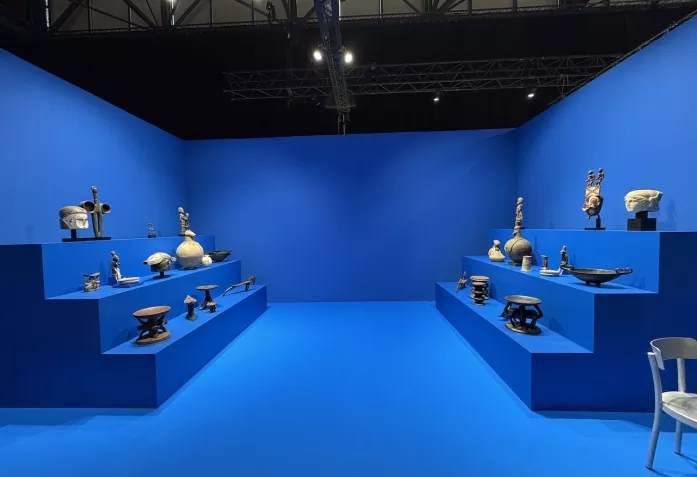
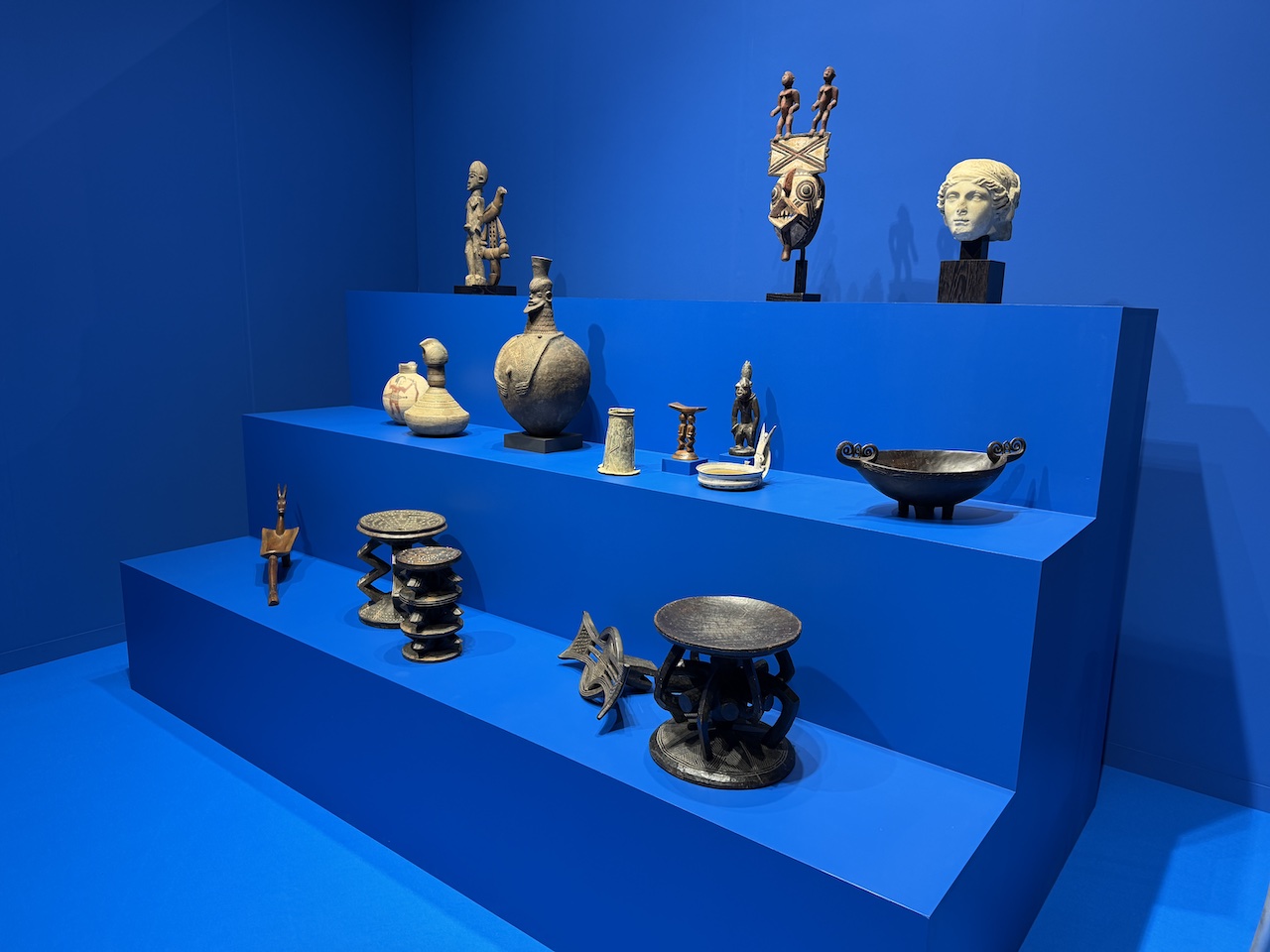
Monochrome blue. Stadium-like tiers. And thirty-five unique objects facing one another. Simple and elegant. All of this is contained within a space of 30 square metres at the heart of Palexpo, to which these objects have been transferred for a few days from their usual home on rue Calvin, in Geneva’s Old Town.
Last October, I told my readers, who at the time were still exclusively Russian-speaking, about the exhibition Pleasing the Spirits at the Barbier-Mueller Museum, renowned worldwide for holding the largest private collection of works belonging to what is commonly referred to as so-called primitive art. The exhibition is devoted to the many representations of spirits or other imaginary, or perhaps not imaginary, beings that have long been present in numerous cultures, as well as to the traditions through which people have sought to appease them in a wide variety of ways.
Among the Slavic peoples, for example, there exist the domovoï, household spirits and mythological guardians of the home, believed to ensure the well-being of the family, fertility, and the health of both people and animals. For centuries it was believed, and some still believe it today, that without a domovoï a household would be plagued by misfortune. For this reason, when moving house, on the final night or just before leaving the old dwelling, the domovoï was invited to follow its inhabitants to the new home. The ritual varied from one country, or even one village, to another. In the old house, a gate or a trapdoor leading to the cellar was opened, and lapti, peasant shoes woven from plant fibres, were placed in front of it while the domovoï was called. The family’s belongings were then carried to the new house, dragging the lapti with the help of a cord, where, so it was said, the domovoï rode. The first slice of bread cut at a meal in the new home was buried in the right-hand corner beneath the house, and the domovoï was once again called to settle there. In other cases, the master of the house, bowing towards the east where the sun rises, invited the domovoï to the housewarming with a freshly baked loaf, leaving it on the stove ledge. If, by morning, the loaf showed signs of having been bitten, it meant the domovoï had come. When a new house was built, a coin was placed in the cellar, or sometimes four coins, one at each corner of the log structure, for the domovoï. When the first loaf was baked in the new oven, the heel was cut off, salted, and thrown beneath the oven, again for the domovoï. All of these varied customs followed two unbreakable rules: the demands of the domovoï had to be met, and its anger had to be soothed with offerings. To my knowledge, no one has ever seen a domovoï face to face. In my part of the world, it is most often depicted as a shaggy old man or grandfather in a fur coat, with a beard, though sometimes as a small gnome.
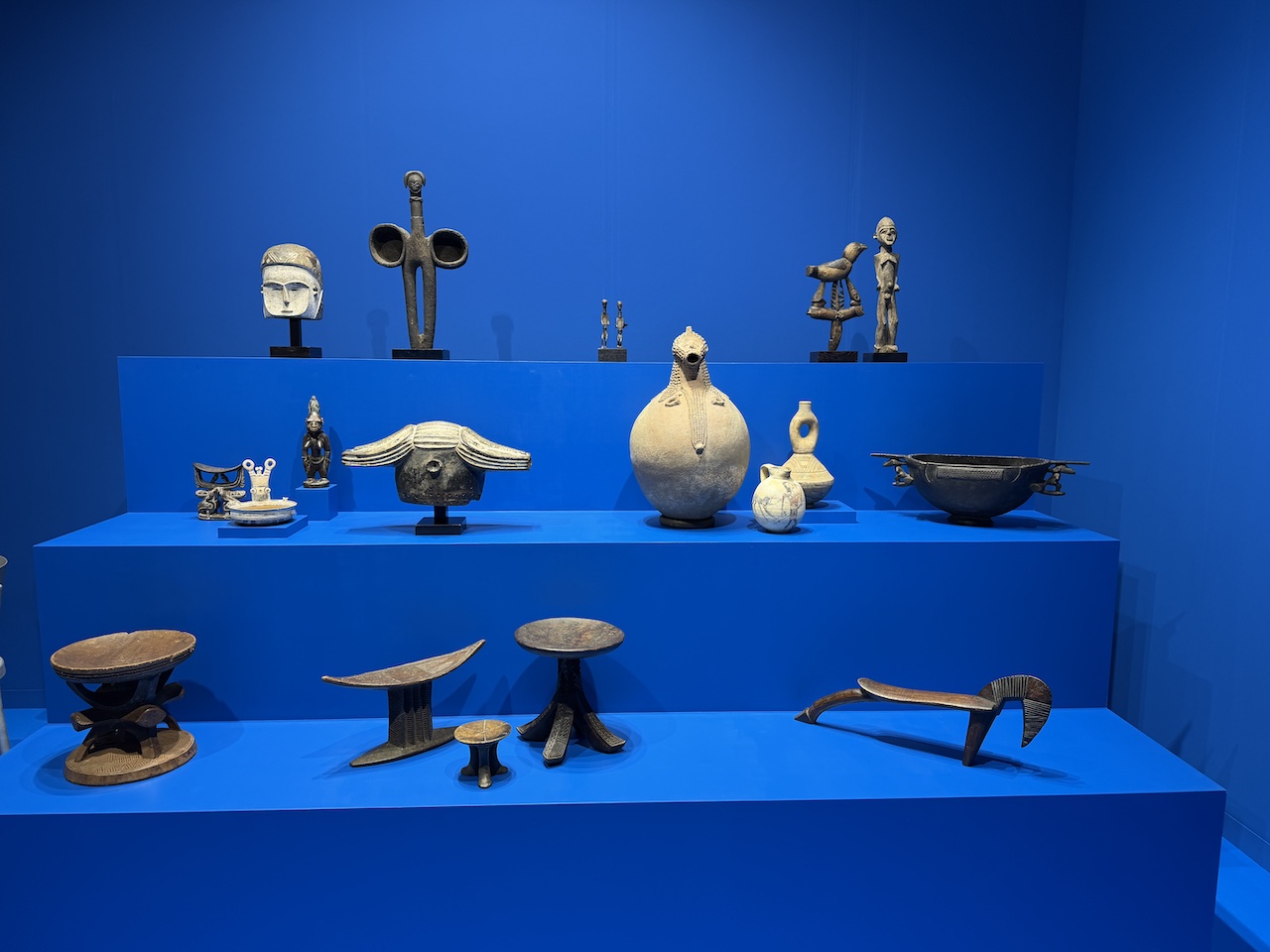
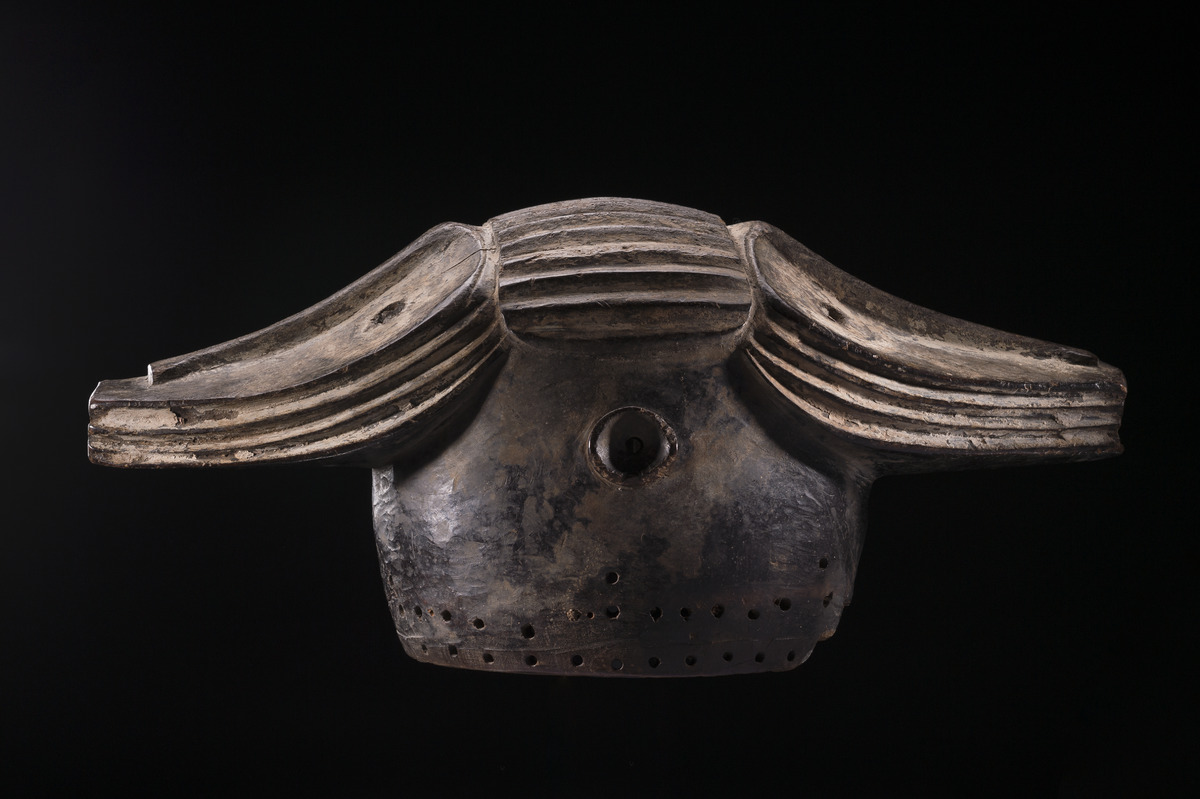
The imagination of other peoples is no less rich. In how many forms, for instance, do African spirits appear! Without fur coats, of course, the climate seeing to that. But how can one fail to believe in the supernatural power of a Nigerian Janus helmet mask, or of a pair of figurines made of wrought iron and brass wire, created by an unknown master in the Congo at the turn of the nineteenth and twentieth centuries? I would like to draw particular attention to the oldest objects from the Barbier-Mueller Museum collection presented at Art Genève this year: a pair of bichrome oinochoai, the correct term for ancient Greek wine jugs, produced in Cyprus between 670 and 600 BCE.
The exhibition at the Barbier-Mueller Museum itself was curated by the French artist Paul Mahéké, who conceived a space permeated with esoteric, spiritual, and at times mystical references. The scenography of the part of the exhibition transferred to the more dynamic and international setting of Art Genève was entrusted, for its part, to the Geneva-based architect Youri Kravtchenko, who speaks without Russian accent and who succeeded in preserving what matters most: the duality of our world and the multiplicity of our mirrored reflections within it. “The son of a father of Polish origin, a composer of film music, and of a mother who was a Russian dissident and professional translator, he was immersed in an intellectual environment from an early age,” wrote the newspaper Le Temps several years ago of this graduate of the École polytechnique fédérale de Lausanne, who founded his own architectural studio, YKRA, in 2012 and has been teaching since 2018 at Geneva’s University of Art and Design (HEAD). Youri Kravtchenko is best known to lovers of elegant restaurants: in Geneva, Bottle Brothers, La Bologne, L’Osteria Zaza, the Café de la Plage of the Grand Théâtre, the Brasserie Europe in the Plaza cinema complex, and many others, are all his work. One of his most recent restaurant projects is the sausage bar BRAD, owned by a member of the younger generation of the Barbier-Mueller family. Everything becomes clearer now, does it not?
“I had heard about Youri Kravtchenko for a long time, and we had even crossed paths several times within the same circles, but we truly got to know each other about six months ago, in fact at BRAD,” confirmed my guess Séverine Fromaigeat, Director of the Barbier-Mueller Museum. “I invited Youri to the museum, and he was very taken with the collection. In the meantime, Art Genève approached us with the idea of participating in the contemporary art fair, which I mentioned to Youri. And so, step by step, the idea of a collaboration emerged, the main aim of which was to present our stand at the fair as an extension of the museum, where the exhibition Pleasing the Spirits is on view until 31 May this year.”
Moving from restaurant design to the scenography of a museum collection, particularly one as unusual as this, requires a certain degree of boldness. The museum’s team is pleased with the result, and I too feel that it has been a success. You will be able to form your own opinion by visiting the Barbier-Mueller Museum stand, number A1, at Art Genève from 29 January to 1 February inclusive. Do not miss it.





Federica Brunelli January 29, 2026
Sikorsky January 29, 2026