On the Pro Natura website, the choice is explained in detail. It is based not so much on the fact that the European hedgehog (Erinaceus europaeus) has inhabited Swiss territory for around 20,000 years and ranks among the country’s most beloved wild animals, as on the fact that suitable habitats for it are becoming increasingly scarce. For millennia, it found everything it needed to live on agricultural land. Over the past century, however, its natural habitat has changed dramatically: hedgerows, piles of leaves and branches have disappeared, streams have been channelled into pipes, and agriculture has become increasingly intensive. The hedgehog has found a substitute for its natural environment in the gardens and parks of villages and cities. At birth, hedgehogs’ spines are soft and embedded in the skin. After about six weeks, they already have to manage on their own, without their mother, and their main task is to eat, eat, and eat again.
“Faced with danger, the hedgehog curls up into a ball, hoping that its coat of spines will protect it. This strategy, effective against the fox, is of little help when fallen leaves that could have served as a winter refuge are cleared away, when at night it ends up under the wheels of a car with fatal consequences, or when the prey it depends on disappears,” I read further on the Pro Natura website. And I immediately recalled how, in 2022, Nicolas Bideau, then head of Présence Suisse and now the public face of the Swiss Federal Department of Foreign Affairs, speaking at the Forum 100 organised by Le Temps, compared Switzerland to a hedgehog, calling it “useful and harmless” and reminding everyone of the theory put forward by the English philosopher of Russian-Jewish origin Sir Isaiah Berlin in his famous essay The Hedgehog and the Fox. (In fact, Mr Bideau did not mention Isaiah Berlin, that’s my hint to you.) According to Berlin, hedgehogs simplify the world by reducing it to a single organising idea, principle or concept that unites everything and guides their actions. For Switzerland, according to Nicolas Bideau, such an organising idea is stability, around which everything revolves.
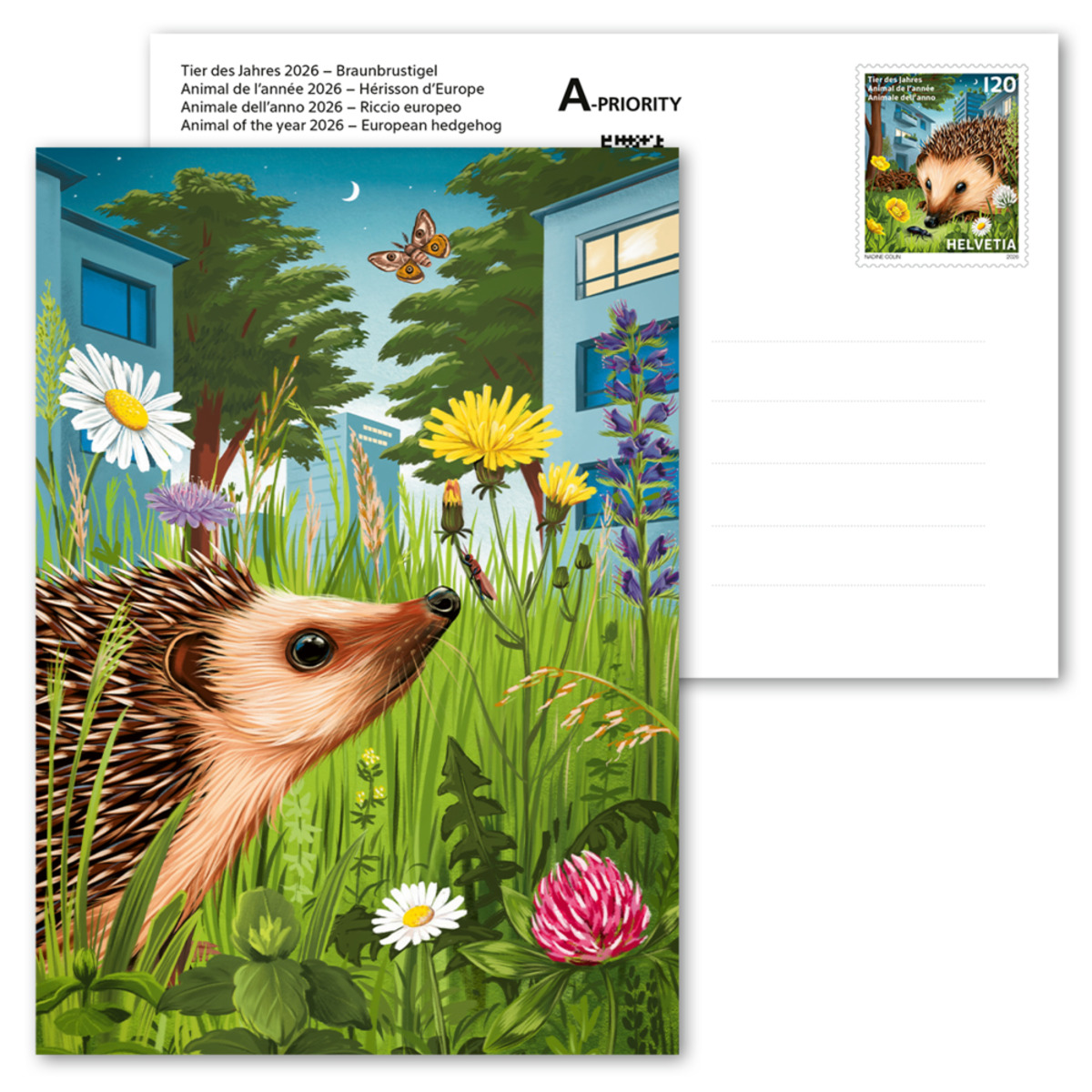
To mark the hedgehog’s selection as Animal of the Year, the Swiss mint Swissmint issued a commemorative coin featuring a charming little face, while Swiss Post released matching stamps, envelopes and postcards. Many will no doubt buy them as souvenirs.
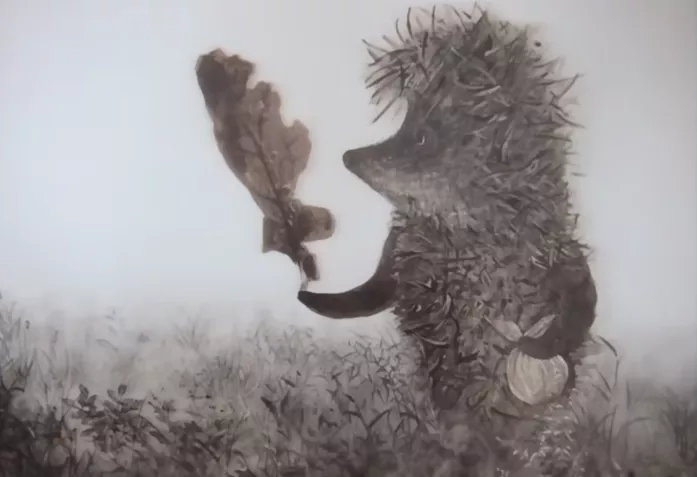
When I was a child, a hedgehog named Yasha lived at our dacha. But not everyone had dachas with hedgehogs, whereas there was no one in the USSR of my generation or younger who did not know the nameless Hedgehog, the main character of the animated film Hedgehog in the Fog, based on the fairy-tale novella of the same name by Sergei Kozlov and created by the great Soviet animator Yuri Norstein, who will turn 85 this year.
But today I would like to tell you about Yuri Norstein’s Hedgehog – several monuments have been erected to him, including one in Kyiv. I do not know whether it still exists. The film Hedgehog in the Fog was made in 1975 and has since received more than 35 different awards, and in 2003 it was named the greatest animated film of all time following a poll of 140 film critics and animators at the Laputa festival in Tokyo. What is its secret? This question has been addressed not only by numerous film scholars and cultural theorists, but also by psychologists working with children. I will not retell their theses, but will simply share my own impressions, which have not faded over the past fifty years.

The film Hedgehog in the Fog is short, just ten minutes, and its plot is simple. The Hedgehog sets off to visit his friend the Bear Cub, to drink tea with raspberry jam and count the stars. Accompanied by the magnificent music of the composer Mikhail Meerovich, he carries a jar of jam wrapped in a white cloth. White, like the fog that envelops everything. The road to the Bear Cub’s house is well known to the Hedgehog, yet how many fears the little traveller must overcome, for whom an ordinary grassy field appears as a forest with impenetrable thickets. A Snail may cross his path and suddenly turn into an Elephant, an Owl may hoot behind him and peer with him into a well, or out of the fog there may suddenly emerge a huge white Horse, or a Bat may swoop down and frighten him so much that the Hedgehog loses his bundle. Fortunately, a Dog will find it and return it, otherwise what would he and the Bear Cub drink their tea with?
Through the fog, the Hedgehog hears the voice of the Bear Cub, worried about where his friend has disappeared. Hurrying towards that voice, the hero falls into a river, but before he can philosophically say to himself, “I am completely soaked. I will soon drown,” someone living in the river comes to his rescue and brings him to the shore. Of course, everything ends well, it is a cartoon. The reassured viewer, of any age, breathes a sigh of relief, seeing that the Hedgehog has safely reached the Bear Cub, who has already prepared the samovar, gathered juniper twigs and drawn the wicker chairs closer. But here is the thing: the friends simply sit and look at the stars, they do not drink tea, and the jar of jam remains in the bundle. What could this mean?
Researchers have identified all sorts of prototypes in the Hedgehog created by Yuri Norstein’s wife, the artist Francheska Yakubova, from Andrei Rublev’s icon Christ Pantocrator to the fairy-tale illustrations of Yuri Vasnetsov. Yuri Borisovich himself has often spoken of his love for Paul Klee and wrote in his book Snow on the Grass that Klee’s “Clown” “served as the measure that kept the film Hedgehog in the Fog within aesthetic boundaries, helped us, together with the artist Francheska Yakubova, not to lose our way and not to slip into sentimentality.” As for me, the shots in which the Hedgehog lights his way with a blade of grass carrying a glow-worm remind me of the final scenes of Andrei Tarkovsky’s film Nostalghia. Do you remember the scene when the hero carries his candle across a pool of water?
Of course, this cartoon, like everything truly great, only seems simple. It is well known that when, at a meeting of the artistic council of Soyuzmultfilm, where Hedgehog… was being discussed, Norstein was asked why he had chosen such an “unpretentious” tale for the screen, he quoted the opening lines of The Divine Comedy, which, thanks to the brilliant translation by Mikhail Lozinsky, every reasonably educated Russian speaker knows: “Midway upon the journey of our life / I found myself within a forest dark.” That, it turns out, is the philosophical depth of the film. And are we not all today a little like Hedgehogs, making our way through the fog of a complex and often frightening life? And is it not important for each of us to have a friend with whom one can simply sit and count the stars, even without tea, and feel protected in the increasingly unstable habitat we have been given?
I invite you all to watch this wonderful animated film, which I love very much, and in which everything is clear even without translation. And if the narrator’s voice sounds familiar to you, do not be surprised — it is Alexei Batalov, who played the leading male role in The Cranes Are Flying, the only Soviet feature film to have received the top prize at the Cannes Film Festival, in 1958. An amusing detail: at the festival, the film’s title was translated as Quand passent les cigognes (literally “When the storks pass”), since a literal translation of the words “crane” (grue, which in slang can also mean “prostitute”) and “to fly” (voler, which is also a homonym meaning “to steal”) would have produced the unintended meaning “prostitutes steal”. But I will tell you more about this when the crane becomes Animal of the Year in Switzerland.