
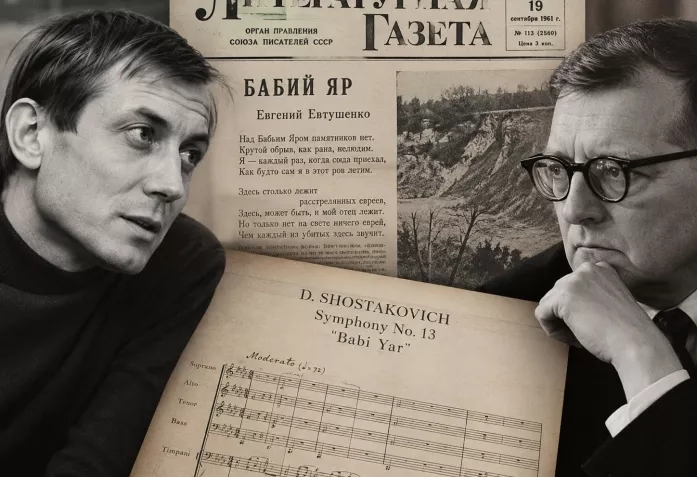
“My first academic year as a professor had barely begun when an event occurred that brought literature and music together: on 19 September 1961, Yevgeny Yevtushenko’s poem Babi Yar was published in Literaturnaya Gazeta.
Since 1960, the newspaper had been headed by its twenty-sixth editor-in-chief, a man with the less-than-euphonious surname Kosolapov, derived from the Russian word for ‘club-footed’. During the war, he had served as a Communist Party organiser, a propaganda instructor and an agitator, and afterwards became head of the periodicals and literature department of the Main Political Directorate. His time at Literaturnaya Gazeta was brief: he was reprimanded for publishing Babi Yar, and a little over a year later was dismissed for this and other ‘mistakes’ committed during his tenure.
Could an experienced Party man have been unaware of the danger? Of course not. Yet he went ahead all the same. So much for ‘Valerka Clubfoot’, as Valery Alexeyevich was called behind his back. Yevtushenko appreciated what he had done and later dedicated a poem to the former editor, leaving no room for any suggestion that the publication had somehow been a ‘misunderstanding’. Here it is:
And Kosolapov smiled at me.
There was a glint
of peasant cunning in him,
and that is the very best remedy
for fear
in a country so cowed:
‘Yes,
the state won’t ever
get bored with you...
Just wait.
I’ll telephone my wife.’
‘Why your wife?’ –
I asked instinctively,
timidly anticipating a ‘YES’.
‘Because I’m going to be dismissed.’
‘What for?’ –
‘For my beautiful eyes.’
That was how Kosolapov immortalised himself in Russian literature. Clearly, this was not what he had expected, and I do not know what made him take the risk of publishing the poem, although I suspect it was once again a case of ‘split personality’, an affliction from which many people suffered in those days.
What, then, was so seditious about a poem devoted to the victims of a mass shooting in which, over two days in September 1941, the Nazis, assisted by collaborators, murdered 33,771 Jews near Kyiv? Nothing, of course, unless the very word ‘Jew’ was considered seditious: until then, it had rarely appeared in Soviet literature in a positive or respectful context. (Grossman’s novel Life and Fate had already been written by then, but it was completely banned, so no one had read it.) Nothing, unless one knew that this tragedy, like others of its kind, had been carefully suppressed in the USSR. Even today, perfectly respectable music reference works describing the genesis of Shostakovich’s symphony of the same name can still speak of ‘several hundred’ victims. Nothing, unless one regarded the antisemitic policies still being pursued at the time as criminal, policies that placed the USSR alongside every other regime that had persecuted Jews.
I have no wish to play the proverbial Chaim, humming Caruso second-hand, and retell the poem in my own words, so I shall quote it in full, especially as it is not particularly long.
BABI YAR
Translated by George Reavey
No monument stands over Babii Yar.
A drop sheer as a crude gravestone.
I am afraid.
Today I am as old in years
as all the Jewish people.
I see myself now
a Jew.
Here I plod through ancient Egypt.
Here I perish, crucified, on the cross,
and to this day I bear the scars of nails.
I see myself as
Dreyfus.
The Philistine is both informer and judge.
I am behind bars.
I am surrounded.
Hounded, spat at, slandered.
Squealing,
dainty ladies in flounced Brussels lace
stick their parasols into my face.
I see myself then
a young boy in Bialystok.
Blood runs, spilling over the floors.
The bar-room rabble rousers
give off a stench of Vodka and onion.
A boot kicks me aside, helpless.
In vain I plead with these pogrom bullies.
While they jeer and shout,
“Beat the Yids. Save Russia!”
some grain-marketeer beats up my mother.
O my Russian people!
I know
you are
by nature international.
But those with unclean hands
have often taken in vain your purest name.
I know the goodness of my land.
How vile these anti-Semites- without a qualm
They proudly call themselves
“The Union of the Russian People!”
I see myself as
Anne Frank,
limpid as a branch in spring.
And I love.
And have no need of empty phrases.
My need
is that we look into each other.
How little we can see
or smell!
We are denied the leaves,
we are denied the sky!
Yet we can do so much-
tenderly
embrace in a dark room.
They’re coming here?
Be not afraid.
It is the muffled sound
of spring itself-
spring is coming here.
Come then to me.
Quick, give your lips.
Are they breaking down the door?
No, it is the ice breaking...
The wild grass rustles over Babii Yar.
The trees look ominous
like judges.
Here all things scream in silence,
and, baring my head,
Slowly I feel myself
turning gray.
And I myself-
one massive, soundless scream
above the thousand thousand buried here-
I am
each old man
here shot down.
I am every child
here shot down.
Nothing within me
will ever forget.
Let the “Internationale”
thunder
when the last anti-Semite on earth
is buried forever.
In my blood there is no Jewish blood.
In their callous rage all anti-Semites
must hate me now
as if I were a Jew.
And for that reason
I am a true Russian!
It is powerfully written but, you will agree, carefully so. At first glance, all the guilty parties are foreigners: the ancient Egyptians and Romans, the French, the Germans. And where Russians do appear, they belong to the pre-revolutionary past. But the Soviet leaders were not idiots, and when it came to ‘reading between the lines’ they had few equals. Here, however, there was no need even to read between the lines. It was there in black and white: ‘O my Russian people! I know you are by nature international.’ The sedition lay in ‘by nature’: that seemingly innocent qualification implied precisely a doubt about the internationalism of the Russian people.
I admit that I did not work this out for myself. On 19 September itself, the very day the poem appeared, Western radio stations – the so-called ‘enemy voices’ – analysed Yevtushenko’s text in minute detail, and everyone who had access to their broadcasts listened to this unexpected lesson in literature mixed with history. Abroad, the tragedy of Babi Yar, whose twentieth anniversary the poem marked, was known in all its horrific detail.
The twenty-nine-year-old Yevtushenko became instantly famous. His poem was translated into many languages and, it was said, it was thanks to it that he was soon nominated for the Nobel Prize. He did not win it. At home, meanwhile, he was duly subjected to a campaign of abuse, accused not only of ideological errors and falsifying history, but of having no talent. Ah, envy, envy, that gravest of human maladies! Anyone who doubts it should read Yury Olesha.
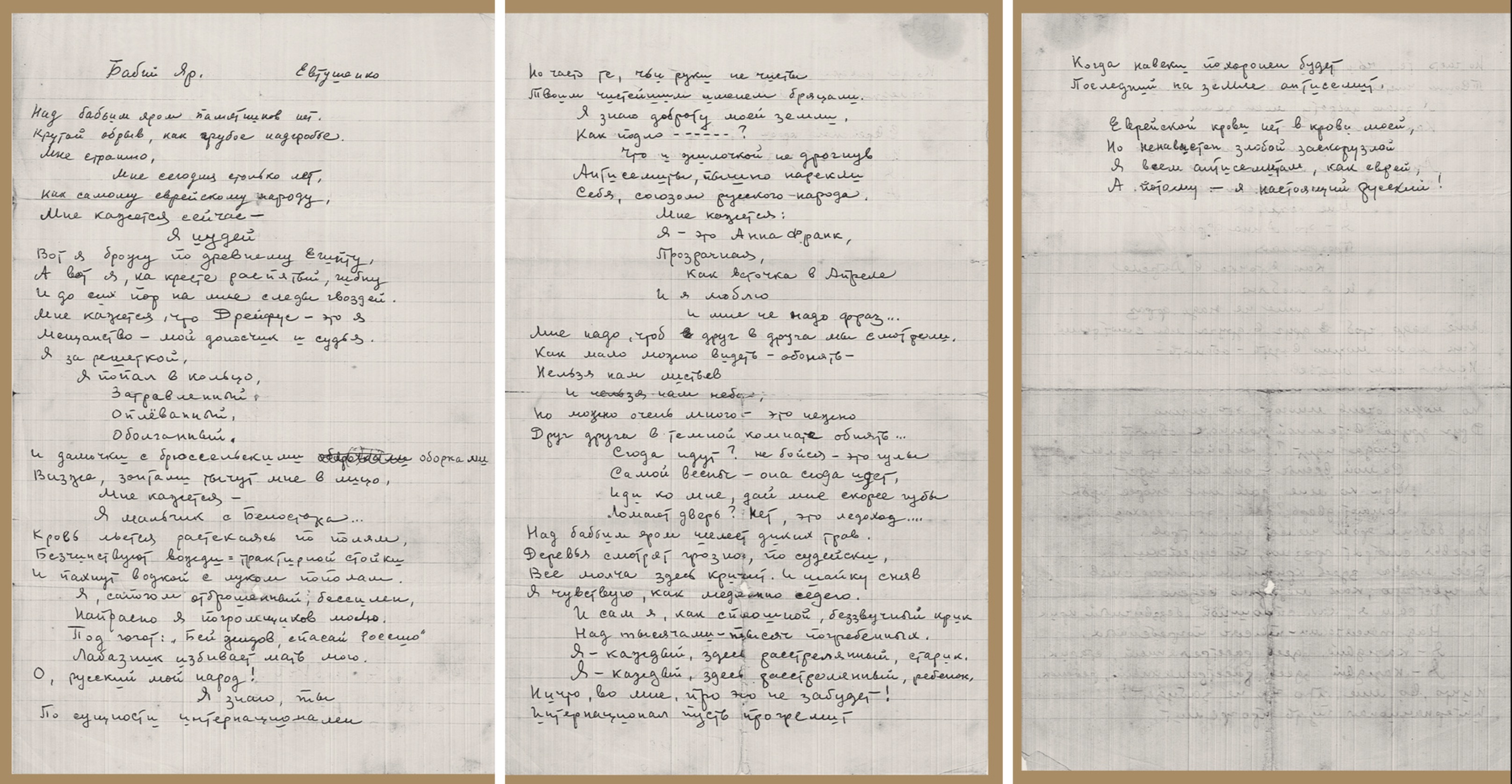
Why would a successful writer with not a drop of Jewish blood in him take on such a dangerous subject? I do not know. Perhaps it was his revenge on Stalin for the arrest in 1938, on charges of ‘counter-revolutionary agitation’, of his maternal grandfather, the mathematician Rudolf Gangnus, whose surname the future poet bore at birth? I shall not speculate.
What we do know for certain is that Shostakovich was given a copy of the poem Babi Yar by his close friend Isaac Davidovich Glikman, a professor at the Leningrad Conservatory who had once enrolled in the philology faculty of Leningrad University on Vsevolod Meyerhold’s advice and, in the 1940s, headed the literary department of the Maly Opera Theatre, where, among other things, he worked with Samuil Samosud on War and Peace. We even know where this happened: the two friends were having lunch at the Hotel Europe.
Shostakovich liked the poem and immediately decided to write a vocal-symphonic work based on it, assigning the vocal part from the outset to a bass. And that, initially, was what it was.
Musicologists have long since examined this story from every angle and established its chronology in minute detail, so it is common knowledge that by 23 March 1962 Shostakovich had completed the preliminary sketch, by 27 March the piano score, and by 21 April the full orchestral score. By then, however, he had met Yevtushenko in person and read more of his poems. He liked both the poet and the poetry very much.
We know that by the end of June Shostakovich was already telling friends about a symphony in five movements. But on 8 July he received five new poems from Yevtushenko, which inspired him to continue and gave him the idea of introducing the theme of conscience, which, as he put it, was in need of rehabilitation. The rehabilitation of conscience – just think about that! One word: genius!
The final page of the symphony’s score was dated 20 July, and the result was Symphony No. 13 in B-flat minor, Op. 113. Before I had even heard it, merely from the titles of its movements – Babi Yar, Humour, In the Store, Fears and A Career – I sensed a resemblance to the cycle From Jewish Folk Poetry: here too tragedy stood beside comedy, laughter beside tears. These contrasts of meaning were underlined in the music by the orchestral parts assigned to flutes, clarinets, bells, xylophone and harp, set, so to speak, against the tuba, timpani, double basses and great bells.
I do not know whether the backstage manoeuvring that unfolded around this symphony will ever become widely known. The reason was that, having denounced Stalin’s cult of personality, Nikita Sergeyevich Khrushchev remained, in his views on art, a sincere and fervent Stalinist, albeit an even more ignorant and coarse one.
Word quickly seeped beyond the Kremlin’s thick walls that, at yet another meeting on ideological matters, Khrushchev had complained that Shostakovich had raised the ‘Jewish question’ when there was no need for it. The work was not banned, but some musicians decided to play safe, thereby putting the premiere itself in jeopardy. Among them, I am sorry to say, I must name Mravinsky.
Yevgeny Alexandrovich, who had traditionally conducted the premieres of most of Shostakovich’s works, was preparing for a foreign tour at the time but had promised to get the preparations under way: have the orchestral parts copied, prepare the choral material and so on. It soon emerged, however, that he had done none of this and had not included the new symphony in the Leningrad Philharmonic’s plans.
It seems to me that what disappointed his many admirers most was not the refusal itself, but the manner of it: he had not dared tell Shostakovich the truth. There was even talk of concealed antisemitism. The fact that, during the worst years of the campaign against the ‘cosmopolitans’, he had refused to dismiss Jews from his orchestra was now explained purely by his pragmatic understanding that without them there would simply have been no one left to play in it. I do not presume to judge. But he behaved badly towards Shostakovich. That much is a fact.
The problems did not end there. Of all the possible basses, Dmitri Dmitrievich chose Boris Gmyrya, who had a wide-ranging voice and a mellow timbre. Shostakovich made a special trip to Kyiv to see hi– the mountain really did go to Mohammed.
Knowing Dmitri Dmitrievich’s reasoning when he selected singers for From Jewish Folk Poetry, I will allow myself to suggest that his choice of Gmyrya was based on more than the singer’s vocal qualities, which the composer had praised more than once. Shostakovich could not have been unaware that during the occupation of Ukraine Gmyrya had remained in Kyiv, where he continued to sing at the opera house. The attitude of the Soviet authorities towards anyone who had lived under occupation is well known: a certain ‘whiff’ lingered around them for the rest of their lives, and sometimes even after death.
It seems to me that Shostakovich wanted precisely such a man to sing about Babi Yar. But his plan was not to be. Gmyrya sent the composer a letter saying that the Ukrainian leadership was categorically opposed and that he therefore ‘naturally’ could not take part in the performance of the symphony. I can imagine Shostakovich’s reaction to that ‘naturally’! As for Gmyrya, God is his judge, and in any case I do not know all the circumstances. Yet only the other day I was astonished to learn that he has been included in a list of the most distinguished figures in the entire history of Ukraine. Did the compilers of that list know about this episode involving Shostakovich?
Meanwhile, the premiere was looking increasingly precarious. But there is no such thing as a hopeless situation, especially when those involved are prepared to make certain compromises. Shostakovich and Yevtushenko were prepared to make some, understanding that otherwise no one would ever hear the work. But there were limits to how far they would go.
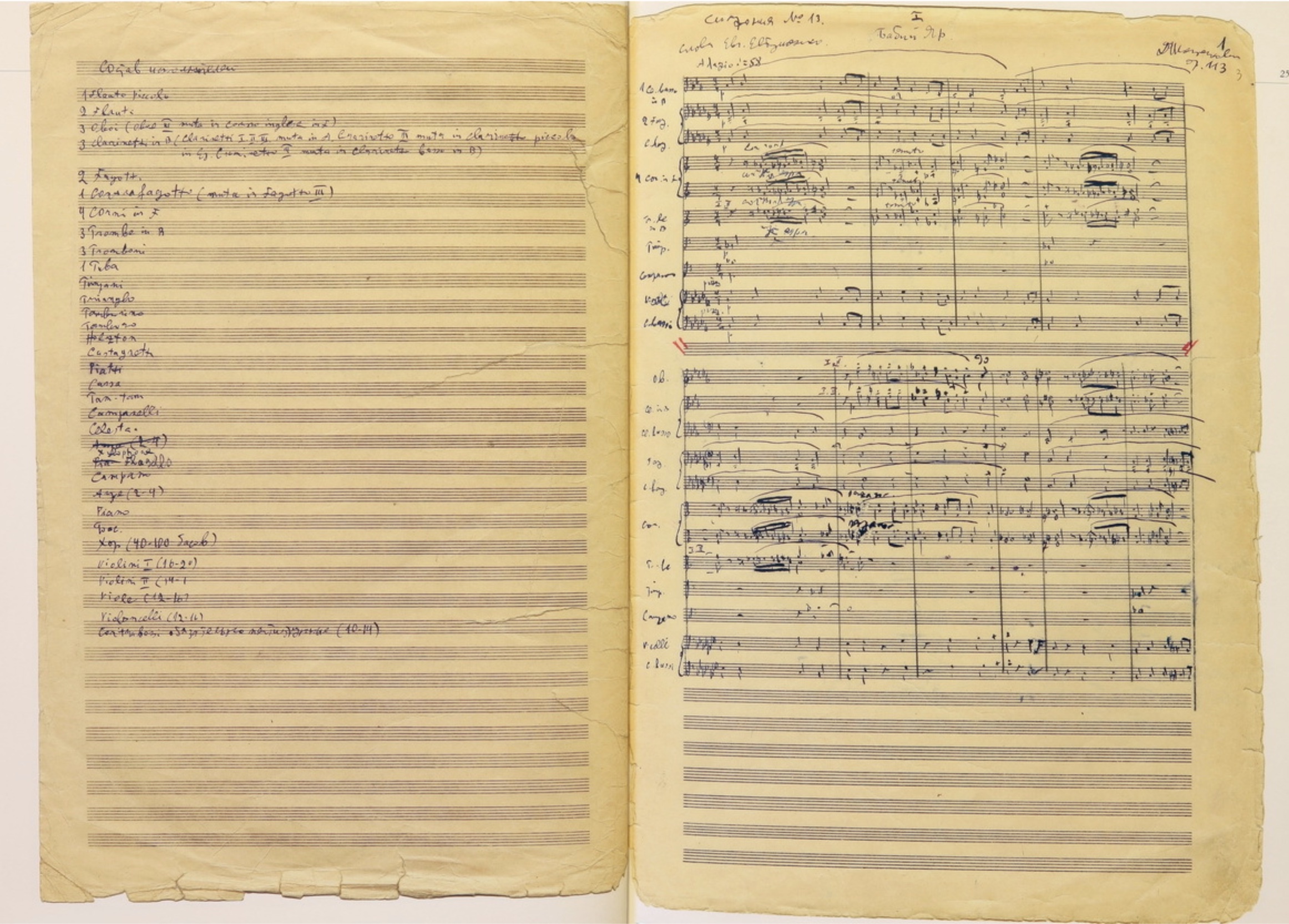
It was decided to move the premiere from Leningrad to Moscow, and Kirill Petrovich Kondrashin agreed to conduct it without a moment’s hesitation. Many people were amazed by his courage at the time and called it recklessness. To me, however, his decision seemed entirely logical: not long before the events I am describing, on 30 December 1961, he had conducted the Moscow Philharmonic Orchestra in Shostakovich’s Fourth Symphony, which had been sitting ‘in the drawer’ since 1936! And he had done so despite being strongly advised, as a Party member, not to.
The Thirteenth Symphony, meanwhile, had not actually been banned. All that was needed was a way to lull the ‘watchers’ into complacency.
‘My father was a self-taught violinist and played in the orchestra of the Moscow State Jewish Theatre (GOSET) under Lev Pulver. He would never have forgiven me if I had refused. And my mother can hardly wait to hear the new symphony,’ Kirill Petrovich himself explained, half in jest and half in earnest.
The premiere was scheduled for 18 December. But difficulties continued to arise. Alexander Vedernikov, invited in place of Gmyrya and by then already singing at the Bolshoi Theatre, also withdrew from the project, without giving any reason. And yet he had studied at the Moscow Conservatory with the wonderful Roza Yakovlevna Alpert-Khasina, who had quite literally saved him when he lost his voice in his third year!
You will agree that it is difficult today to imagine any soloist turning down an invitation from Shostakovich himself! Finding himself without a singer once again, Dmitri Dmitrievich chose Viktor Nechipailo, another Ukrainian bass with the Bolshoi company. In light of the previous months’ experience, it was decided to prepare an understudy just in case. I do not know on whose recommendation Vitaly Gromadsky was chosen. He had graduated from the Conservatory in 1960 and brought distinction to the Soviet school of music at the Schumann Competition in Berlin, where he won first prize, after which he was immediately engaged by the Moscow Philharmonic.
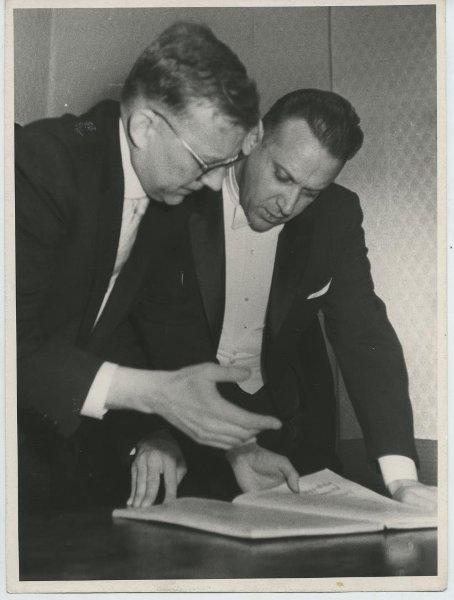
Responsibility for the chorus was entrusted to Alexander Alexandrovich Yurlov, an outstanding professional whose name the choral ensemble now bears, so there was nothing to worry about on that score. Orchestral rehearsals began. All manner of rumours spread through Moscow, stirring the curiosity even of people with little interest in music. Everyone was eagerly awaiting the premiere.
When I ran into Kirill Petrovich, I naturally asked how things were going. He shrugged.
– Not too badly, I suppose. Both soloists have learnt their parts, and Dmitri Dmitrievich has approved them. Nechipailo is singing at the rehearsals for now, but Gromadsky hasn’t missed a single one. He comes and listens attentively. He’s had a hard time of it, of course: the music is difficult and he’s young, but I work with him a great deal, secretly hoping we won’t need him. He’s a good man, a former sailor, a brave lad. Though he doesn’t understand what the problem is.
– What do you mean?
– Well, he doesn’t understand what all the fuss is about. We’re only telling the truth, he says, and there’s no antisemitism in the USSR. An innocent soul!
Kirill Petrovich gave a laugh, and we went our separate ways.
But on 18 December, the day of the premiere, I ran into him on Gorky Street, and he was plainly in no mood for laughter.
– Can you imagine, Solomon Markovich, my instinct didn’t let me down after all! – he announced without preamble. – Our Nechipailo hasn’t turned up!
I could not help smiling at the fact that, even in such an agitated state, Kondrashin had managed to paraphrase a line from the duel scene in Evgeny Onegin.
– What do you mean, hasn’t turned up?
– Exactly that. The dress rehearsal was set for ten in the morning. I was just about to leave home when the telephone rings and he tells me he is ill and cannot sing. Can you imagine? And he didn’t come to the rehearsal either, the ‘imaginary invalid’. I don’t believe in his illness for a second. Either he lost his nerve or somebody frightened him off.
At this point Kirill Petrovich swore violently.
– But worse still, Gromadsky didn’t come either! He attended every rehearsal, and now, of all days, he wasn’t there. So picture the scene: Shostakovich and I are there, the chorus and orchestra are there, the bigwigs are in the audience, some in uniform, some not. And we’re waiting for Gromadsky. He lives in the back of beyond and doesn’t even have a telephone. But never mind, they found him and brought him in. I said, ‘Vitaly, why didn’t you come earlier?’ And he answers like a schoolboy: ‘I’m sorry, Kirill Petrovich! I thought I wouldn’t be singing in the evening anyway, so I decided to get some sleep.’ Isn’t that kindergarten stuff, Solomon Markovich?
I could only spread my hands, imagining what they must all have been through.
– But what naval training does for a man! – he went on. – ‘I won’t let you down,’ he says. We start rehearsing. He makes mistakes, gets confused, Shostakovich is on edge, fidgeting, and then I’m called to the telephone. Who do you think it is?
– Khrushchev?
– No, one rank lower: the Minister of Culture. And in all seriousness he suggests that I perform the symphony that evening without the first movement, meaning without Babi Yar! I wanted to tell him where to go, but thought better of it and calmly explained that the programme had already been announced and that making such a change at the last minute would only heighten the excitement. He grumbled a bit, but didn’t argue. I don’t even know how all this is going to end tonight. I’m off to grab something to eat and then back to the Conservatory. Will you be there this evening?
– Of course! I’ll be rooting for you. I’m sure it will be a triumph.
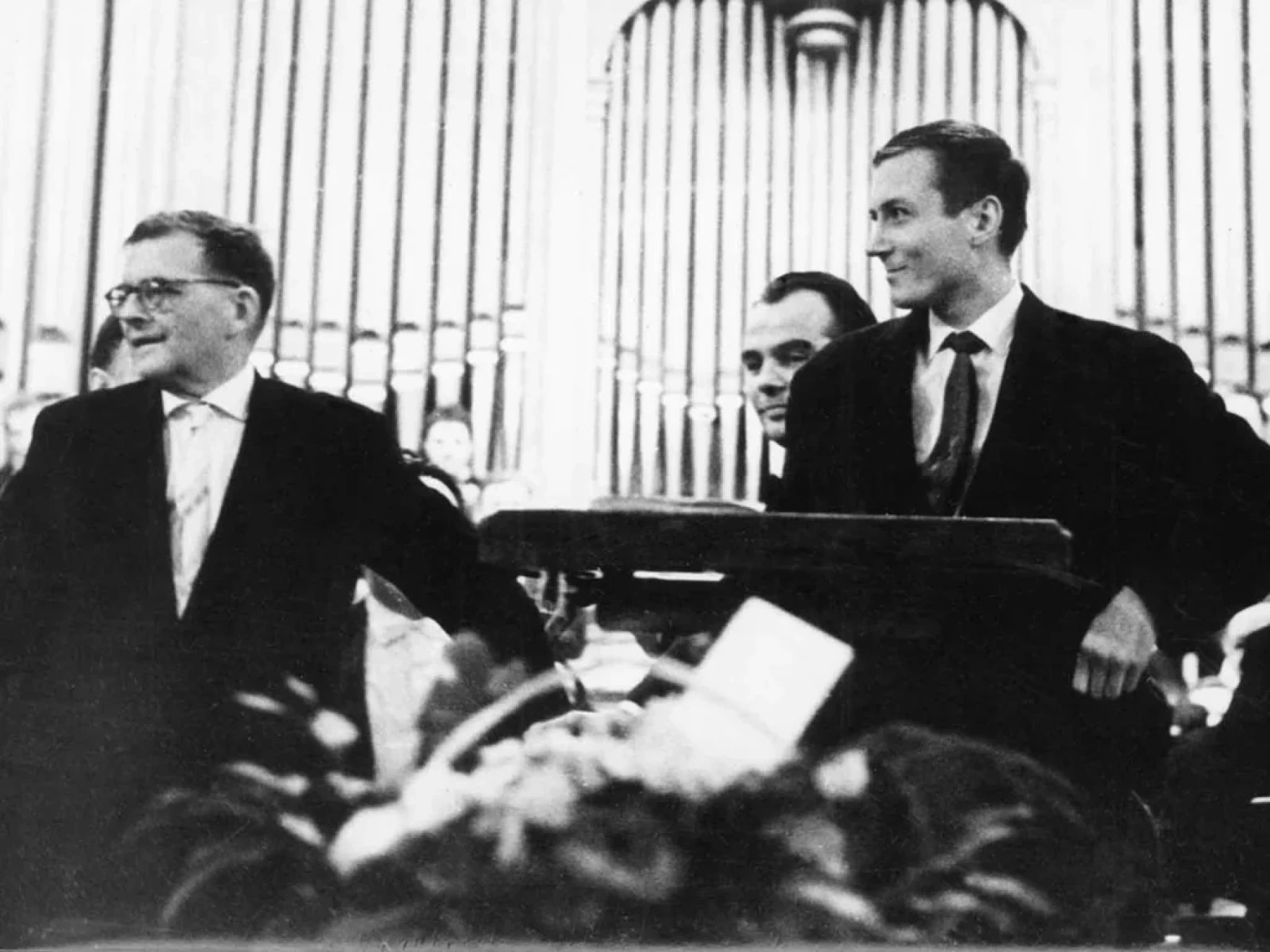
And this is what happened that evening.
I walked down Tverskoy Boulevard and turned left towards the Conservatory. Even from a distance I could see an extraordinary crowd. As I came closer, I realised that a police unit had been brought in and had cordoned off the Great Hall. Only ticket holders were being admitted, and their tickets were carefully inspected.
For once, I was rather pleased to have a proper ticket instead of the usual complimentary pass from the chief administrator, Vladimir Yemelyanovich Zakharov. I got through the cordon without difficulty. Behind me, however, the crowd broke through it. People were prepared to sit on the stairs or hang from the chandeliers – anything to get into the premiere.
Among the many familiar faces in the audience, the foreigners stood out: diplomats and journalists in dinner jackets and bow ties. Everyone was so excited about what was to come that they listened only half-heartedly to the Mozart symphony in the first half and could hardly wait for the interval to end.
What happened in the second half can best be compared to a religious service, whether in a church or a synagogue, so reverent was the silence in the hall: not a single person coughed, sniffed or shuffled a foot.
Shostakovich’s music sounded at once like a memorial prayer for all the innocent victims and like a mighty bell tolling for them, warning that the tragedy must never be allowed to happen again. (Incidentally, Hemingway’s novel, though it had been written twenty years earlier, was still not widely known in our country. It was first published in the Soviet Union in 1962 by the Foreign Languages Publishing House, in a small print run intended only for distribution among people whose names appeared on a special list approved by the Central Committee of the Communist Party.)
The ovation lasted fifty minutes. My palms were already aching, but I could not stop applauding either, because we had witnessed the triumph of Art over all the contortions of ideology. Or at least that was what we sincerely believed.
When I got home, I still could not calm down and decided to listen to the ‘voices’. All of them spoke of the premiere in superlatives, but warned that the symphony’s future was now under threat. There had been no broadcast on Soviet radio, supposedly because the authorities thought that if the obedient Soviet people heard the slogan ‘Beat the Yids. Save Russia!’ in the first movement, they might actually reach for their axes. You hardly knew whether to laugh or cry!
Unfortunately, the ‘voices’ proved prescient. Yevgeny Yevtushenko gave in to the pressure and rewrote the poem, which became much longer and considerably weaker than the original.
What was Shostakovich to do: rewrite the first movement or abandon the entire symphony? Kondrashin proposed a solution ingenious in its simplicity: leave the music untouched and alter the text slightly. In effect, this became the only concession made to the authorities. As a result, the text was changed in two places. Here they are.
Originally (translated by George Reavey):
I see myself now
a Jew.
Here I plod through ancient Egypt.
Here I perish, crucified, on the cross,
and to this day I bear the scars of nails.
Revised (translated by Andrew Huth):
Here I stand as if at the fountain head
That gives me faith in brotherhood.
Here Russians lie, and Ukrainians
Together with Jews in the same ground
Originally:
And I myself-
one massive, soundless scream
above the thousand thousand buried here-
I am
each old man
here shot down.
I am every child
here shot down.
Revised:
I think of Russia’s heroic deed
In blocking the way to fascism.
To the smallest dew drop she is close to me
In her very being and her fate.
The fact that the word ‘Jews’ remained at all was itself an act of courage whose significance is difficult to overstate.
In this ‘corrected’ form, the symphony was performed twice more in Moscow in February of the following year, 1963, and then three times in Minsk. After that, further performances were deemed ‘inadvisable’, while some fool of a woman accused Shostakovich of having failed to understand ‘what society needed’.
He, in fact, understood everything perfectly. It was ‘society’ that did not.”
P.S. The Russian Tenor Solomon was published in Russian by Vremya in 2025. It can be ordered in Russia and Europe through the usual online retailers. The French translation by Marianne Gourg-Antuszewicz will be published by the Swiss publishing house Éditions Noir sur Blanc in autumn 2027. As for an English translation, for now I can only dream of one – and would be delighted to hear from anyone who might be interested.






Лазарь Фрейдгейм September 18, 2026
Sikorsky September 18, 2026