As part of Geneva’s Black Movie film festival, a documentary by Ukrainian director Sergei Loznitsa will be screened.
When I introduced the programme of the Black Movie film festival a few days ago, I drew your attention to the strong presence of films from the former Soviet Union: there are no fewer than nine of them. The festival opened with Fire by Aizhan Kassymbek, about the life of the “little man” in contemporary Kazakhstan, while today and tomorrow Swiss audiences will be able to immerse themselves in a Soviet past that we would so like to forget, but which refuses to let us go.
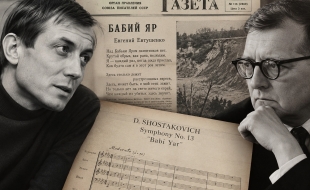
Director Sergei Loznitsa continues to do what he spoke about in 2019: he is trying to tell the whole truth, without holding anything back. After Victory Day and State Funeral, he has taken on another painful subject: antisemitism in the USSR, both in everyday life and at state level. He explores it through one of the tragic episodes of the Second World War that went down in history as Babi Yar, making this area in north-western Kyiv, between Lukyanivka and Syrets, infamous throughout the world as a site where civilians, above all Jews, were massacred by the Nazis and Ukrainian collaborators.
One word in the title of Sergei Loznitsa’s film, which premiered at the Cannes Film Festival in 2021 and was awarded the Special Jury Prize by the L’Œil d’or (Golden Eye) jury, is particularly important: “context”, because Loznitsa shows not only the tragedy itself, but also what happened in Ukraine before and after it. Like State Funeral, which I reviewed at the time, Babi Yar. Context is made entirely from documentary footage found in state and private archives in Russia, Germany and Ukraine and runs for two hours without a single word of commentary from the director. This only makes what we see more powerful.
For those wondering whether the film might be too distressing to watch, I can only say that this is no “horror movie”. But what Sergei Loznitsa and his team managed to find and so masterfully edit cannot, of course, leave any decent human being unmoved, while the imagination readily fills in what the camera does not show.
...It all begins with an explosion. Then another, and another... Billowing black smoke blots out the sky. Buildings are ablaze, while the few passers-by simply carry on down the street, seemingly taking no notice. Then, on Mickiewicz Boulevard, a crowd gathers around a loudspeaker and listens to the painfully familiar voice of Yuri Levitan announcing that “today, at four o’clock in the morning”... Enemy aircraft are in the sky, enemy tanks in the streets. But what is this? Ukrainian children are bringing flowers to the tank crews and receiving a polite “Danke” in return. This was not something we were taught in Soviet history lessons. And immediately afterwards, men in Soviet army tunics are walking somewhere with their hands raised, in a column with no end in sight. Many look into the camera; someone cracks sunflower seeds; no one smiles.
In the next shot, a crowd of men sits on the ground waiting to be loaded into lorries, twenty-five souls to a truck. A German soldier counts them aloud: twenty-five per truck, everything accounted for... A grandmother in a white headscarf weeps amid the ashes of her home... Bodies lie in the summer grass...
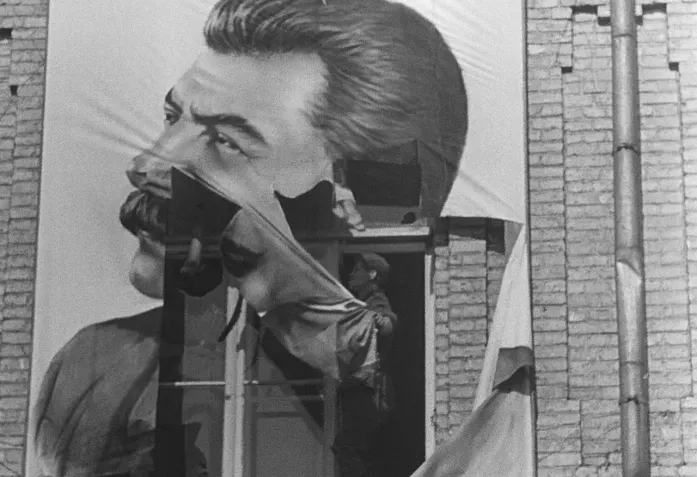
Contrary to everything we were taught at school, we see with our own eyes how the German occupiers are welcomed in Lviv on 30 June 1941: flowers, applause, portraits of Stalin torn down from the façades of buildings. Watching in disbelief, you wonder whether the Germans might have staged it for propaganda purposes. Yet the very next day, 1 July, on the orders of the German authorities, the Ukrainian militia herds local Jews into a prison where the bodies of inmates hastily shot by the NKVD before abandoning the city are still lying.
What are the Jews accused of? Collaborating with the Soviet authorities and the NKVD. Then come bodies, bodies, bodies. Unable to wash the bodies according to tradition, the women use brooms to clean them. Some are beaten with sticks. Several naked people, men and women, are driven through the streets. Hundreds of women dig a trench, an enormous trench. Children play among anti-tank obstacles. Men build barricades out of sandbags. Everyone is so shabbily dressed that you might think the war had been going on for years, yet it has only just begun! Loznitsa’s film is hypnotic. It is impossible to tear your eyes from the screen, and at some point you forget you are watching archive footage.
...Just a month later, on 1 August, Lviv has become Lemberg once and for all. People march with banners reading “Long Live Bandera”, the Germans are showered with flowers, pretty girls in wreaths and embroidered blouses offer them bread and salt, German signs and swastikas are everywhere, and German marches fill the streets...
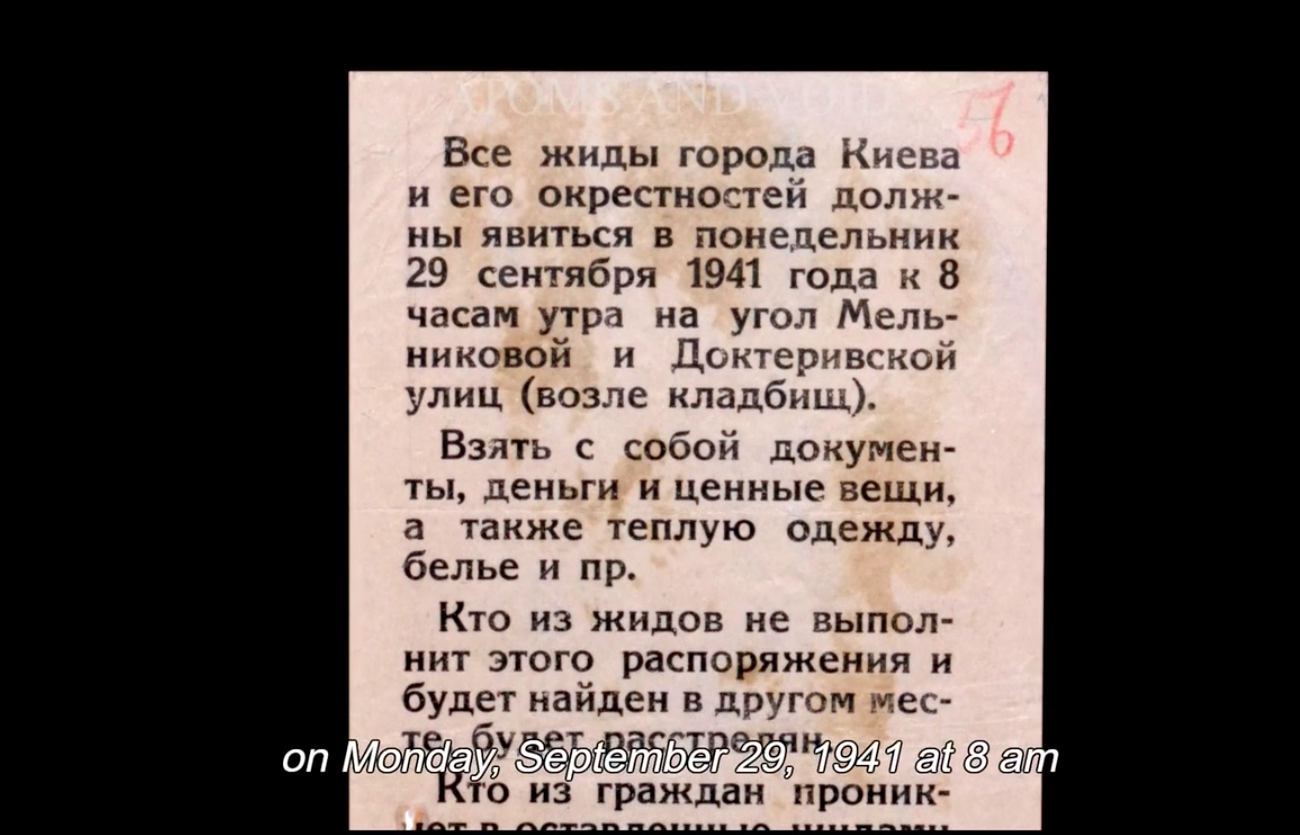
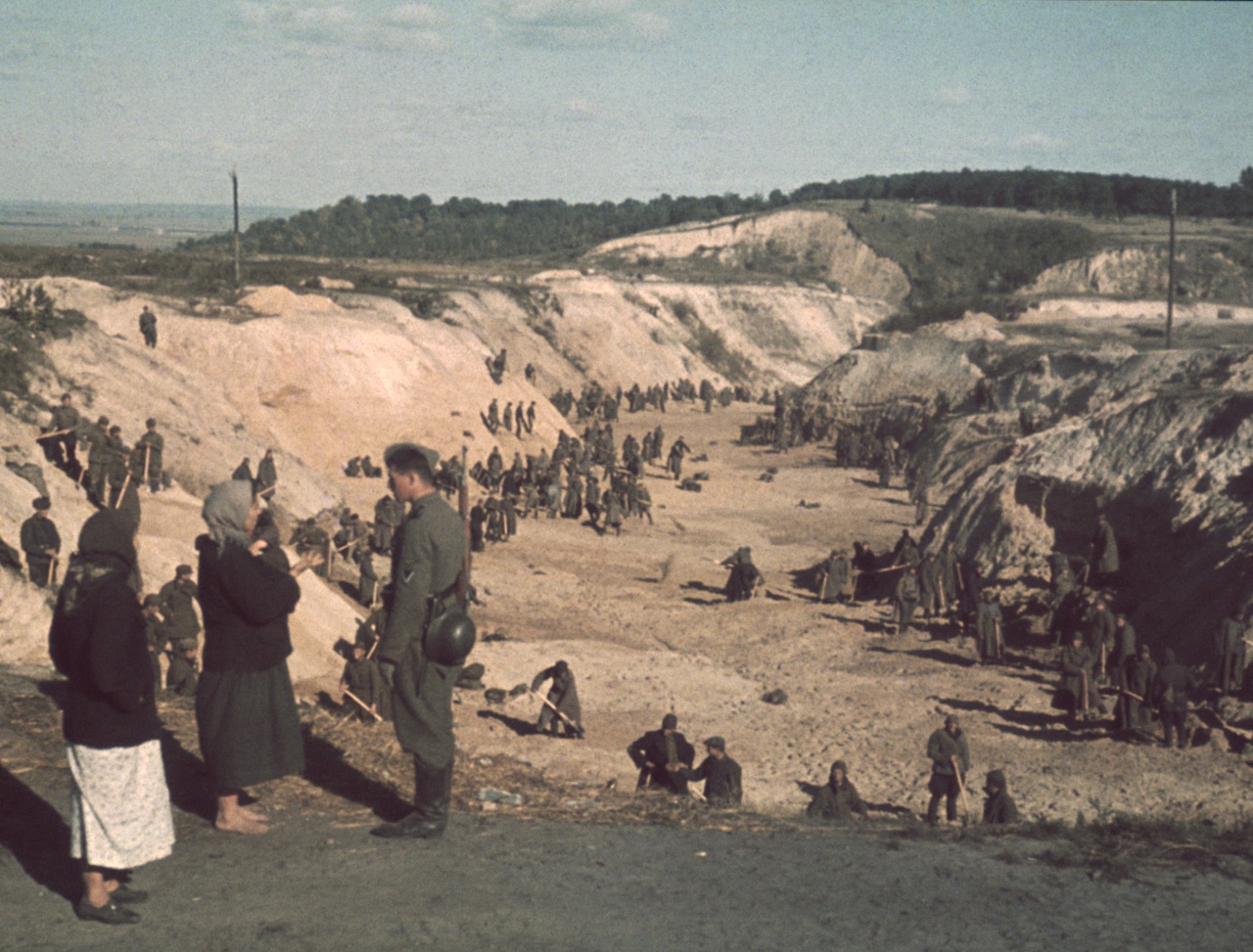
On 19 September, Kyiv is occupied. The same scenes: the population welcomes Hitler as a liberator. Five days later, a wave of explosions sweeps through the city. Who is to blame? The Jews! As punishment, the Nazis decide to exterminate the city’s entire Jewish population, using deception: all Jews are ordered to report to the Jewish cemetery, bringing their documents, warm clothes and valuables. And they dutifully came. What followed is well known: over two days, 29 and 30 September 1941, 33,771 Soviet citizens of Jewish nationality were shot at Babi Yar, without any resistance from the local population and even with assistance from some of them.
Speaking about his work on the film, Sergei Loznitsa recalled that two works helped him grasp the full scale of what had happened: Anatoly Kuznetsov’s Babi Yar: A Documentary Novel and Vasily Grossman’s essay Ukraine Without Jews. In the former Soviet Union, this heartbreaking essay was published in full in Russian only once, in the Riga Jewish magazine Vek in 1991. The film uses a passage from it, “simply” a list of those who ended up in the layers of bodies piled into the ravine: bakers, teachers, dentists, librarians, tailors, musicians, grandmothers, those who knew how to make apple-and-walnut strudel and those who did not, parents and their babies... The text moves quickly across the screen and not everyone will have time to read it, but fortunately it is now easy to find in full.
This list affected us profoundly and led to one of the main questions, if not the main one, that Babi Yar forces us to confront: how is it possible that people who had lived alongside others for years, buying bread from them, having their suits and wedding dresses made by them, borrowing salt and books from them, having their teeth treated by them and taking music lessons from them, could suddenly watch them die a martyr’s death with indifference, or even help it happen?! Of course, we are not talking about everyone, but about that terrible majority known as the Crowd.
Every film, even a documentary, needs a twist, a key turning point. Babi Yar has one too. From the moment the Soviet Army begins, step by step, to liberate Ukraine from the Germans, it feels as though the film itself is being wound backwards, recording the same reality in reverse. Now the machinery of the “other” propaganda, “ours”, kicks into gear. In 1943, at Babi Yar, American journalists carefully write down the words of a Soviet representative explaining how between 50,000 and 80,000 “Soviet citizens” were exterminated there. A few minutes later, a brisk little man is already talking about 100,000 and complaining that “the fascist monsters forced us to build furnaces” in which the bodies were burned. The word “Jew” is not used. At all.
Columns of men now move across the screen in the opposite direction. These are German prisoners, and the expressions on their faces are the same as those of the Russians at the beginning. And when several Germans are publicly hanged, the crowd pushes and shoves to get a look. The same Crowd, always ready for a spectacle.
In 1944, Soviet troops enter Lviv. General jubilation. Portraits of Stalin go back up, German signs are replaced by Russian ones, girls in wreaths once again smile as they offer bread and salt, only now to Red Army commanders, while Soviet marches sound in the streets. Is there any limit to human mimicry?
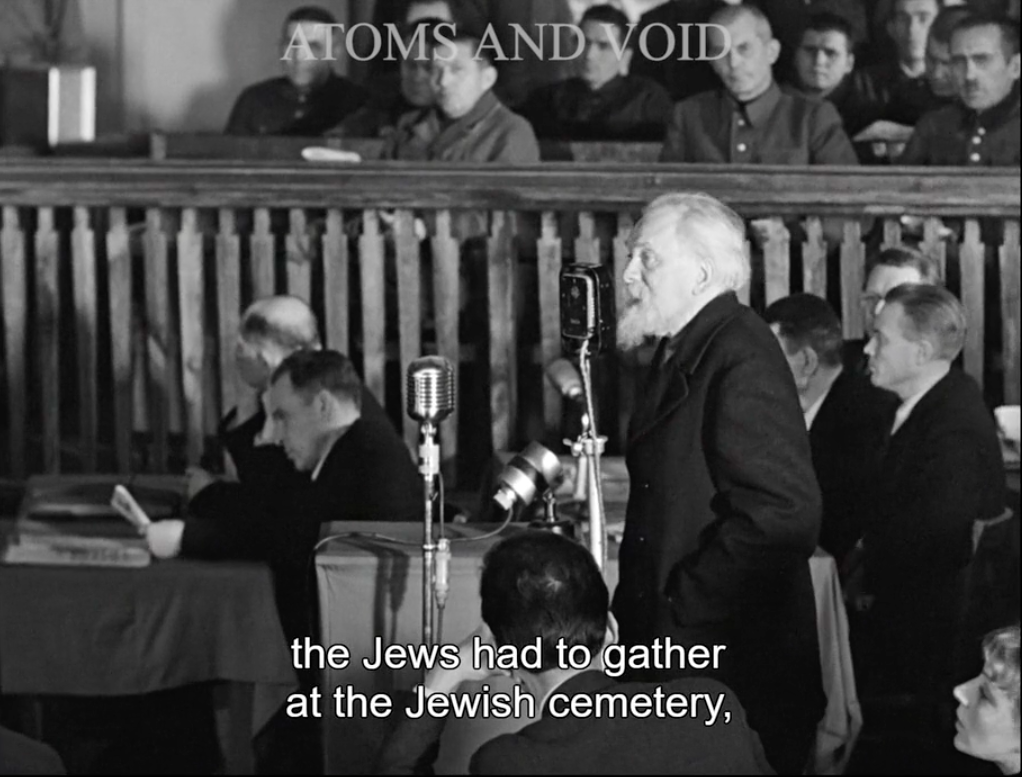
Another crucial element of the film is the eyewitness testimony at the 1946 trial in Kyiv. It is astonishing that not one of them sheds a tear as they recount the horrors they experienced or witnessed, yet this makes their stories no less powerful: Professor Artobolevsky’s description of the despair of an old woman, her grey hair streaming in the wind, is worthy of a Greek tragedy.
...In 1952, the Kyiv authorities decide to dump waste from a nearby brickworks into the Babi Yar ravine...
“Human consciousness has an unfortunate, or perhaps fortunate, quality: when we read in a newspaper or hear on the radio that millions have died, we cannot grasp or comprehend what has happened; we cannot picture it, see it in our mind’s eye, measure the depth of the tragedy,” wrote Vasily Grossman, author of the brilliant novel Life and Fate, in 1943. “This limitation is the fortunate quality of human consciousness: it protects people from moral torture and madness. But this limitation is also the unfortunate quality of our consciousness: it makes us thoughtless and allows us, if only for a moment, to forget the greatest crime in the world.”
Babi Yar. Context is Sergei Loznitsa’s personal mea culpa. There is something symbolic about the fact that it will be shown in Geneva tomorrow, on International Holocaust Remembrance Day, which has been observed since 2005. The relevant resolution was adopted by the UN General Assembly on the initiative of Israel, Canada, Australia, Russia and the United States, with a further 90 states joining as co-sponsors.
The word Holocaust comes from the Greek holokauston: “a whole burnt offering”, something consumed entirely by fire, a sacrifice. Was the sacrifice justified?