Not long ago, I wrote about a book on Daniil Harms by the Geneva Slavist Jean-Philippe Jaccard and his Russian colleague Andrei Ustinov, published by the European University at St Petersburg. Professor Jaccard spoke then of his desire to work with “normal people”. It is good to know that he is not alone in feeling this way, and that cooperation continues in both directions. I am pleased to give another example.
Back in 1988, Nadezda Plavinskaia, now a senior researcher at the Centre for Eighteenth-Century Studies at the Institute of World History of the Russian Academy of Sciences, defended her dissertation on “The Fate of Montesquieu’s Ideas during the French Revolution”. She has continued to work on the subject ever since, focusing, among other things, on the reception of Montesquieu’s ideas in Russia. This research formed the basis of her work on Catherine II’s Nakaz, a programmatic philosophical and legal text of 1767 intended to guide the Legislative Commission in preparing a new code of laws. The Nakaz was a unique attempt by the supreme authority of the Russian Empire to introduce certain ideas of the European Enlightenment into its legislative practice. The research and translation work was carried out with the support of the Institute of World History of the Russian Academy of Sciences.
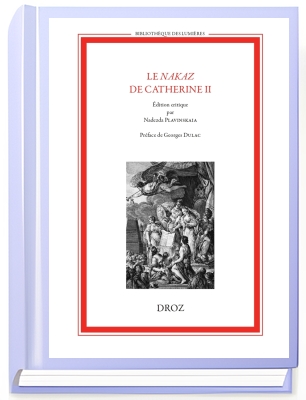
And a few months ago, a new critical edition of the Nakaz was published by Droz, which celebrated its centenary in 2024, as part of its Bibliothèque des Lumières series, devoted to the Enlightenment. The edition was prepared with the support of the Richard Lounsbery Foundation (USA), as part of the École normale supérieure de Lyon (IHRIM) programme “From ‘enlightened prince’ to ‘enlightened despot’: from Montesquieu to Catherine II”.
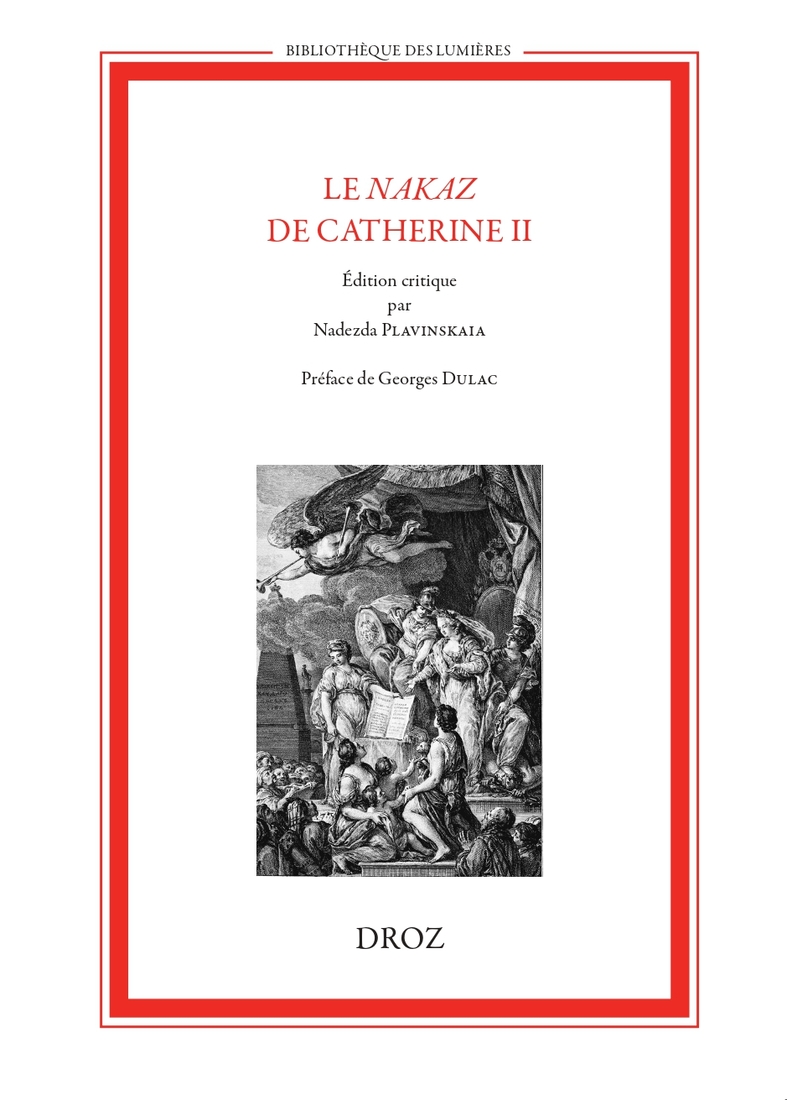
Having a high-quality French translation of the study already available made the publisher’s task considerably easier. As Charles Senard, head of Droz since April 2024, told me, he received the text from Myrtille Méricam-Bourdet, Professor at Lumière University Lyon 2 and a recognised specialist in eighteenth-century French literature, and was delighted to accept it for publication considering it “intellectual work of a very high standard”. The study is preceded by a preface by Georges Dulac, a leading specialist in the Enlightenment and in eighteenth-century Franco-Russian cultural relations. And the joy that everyone involved in the project must have felt on discovering a 1778 engraving by Pierre-Philippe Choffard, after a 1777 drawing by Charles Monnet, an allegory of Empress Catherine II with the text of the Nakaz that was quite simply perfect for the cover, can probably only be fully appreciated by those who have agonised over the covers of their own books!
I am not a specialist in the eighteenth century, but I am well aware of the importance of Catherine II’s reign for Russian history and for Russia’s relations with Europe. And I must admit that I was struck by how strongly some provisions of the Nakaz of 1767 resonate with our own reality. So I decided to give the floor to Nadezda Plavinskaia: no one can speak about this research better than its author.
Nadezda, Georges Dulac writes in his preface about the innovative nature of your work. What aspects of the history of how the Nakaz came into being seemed to you insufficiently explored? And how many years did this research take?
My doctoral dissertation was on the fate of Montesquieu’s ideas during the French Revolution. Later, I became interested in the response those ideas received in Russia. Catherine’s Nakaz is the most obvious example of such a response, and at the same time a striking example of cultural transfer and the circulation of ideas: having absorbed the achievements of European Enlightenment thought, it reworked them and then brought them back into the public debate that unfolded in Europe in the second half of the eighteenth century. The document has, of course, been extensively studied, but historians have been primarily interested in its ideological and political content. I tried to ask different questions. How exactly did the Empress write the Nakaz? What were her original intentions? How did they change as she worked on the text? How can we discern in the Nakaz the dividing line between Catherine’s own ideas and those she drew from the books of other authors? Why do the various translations of the Nakaz differ so much from one another? Who published these translations, and why? And so on. The research took many years. The Russian version of the book was published in Moscow in 2018.
Most readers encounter only the final version of a text. You, however, have studied a vast body of preparatory material and shown how the Nakaz came into being. What did this journey from drafts to the final text reveal that cannot be seen by reading the Nakaz alone?
By studying the drafts, we are, as it were, looking into Catherine’s study. We gain a better understanding of exactly how she formulated her thoughts as she wrote the Nakaz.
We can see that Catherine approached Montesquieu’s work critically. In taking notes on The Spirit of the Laws, she concentrated primarily on the need for legislation to correspond to the general spirit of the nation, on the principles governing the administration of justice, and on questions of encouraging trade and regulating population size. She was also receptive to Montesquieu’s reflections on political liberty. By contrast, neither the theory of climates nor the theory of the separation of powers interested her at all, while she revised the classification of the principal forms of government that provided the structural backbone of Montesquieu’s treatise. The drafts even reveal a direct “censorship” of the work that the Empress called her “breviary”. For example, she deliberately avoided the sections of The Spirit of the Laws dealing with Russia and refused to use the word “despotism”, one of the key terms in Montesquieu’s political philosophy.
What discoveries did you make while working in the archives? Was there a document that made you reconsider your own ideas about Catherine or the Nakaz? Did working with her manuscripts make you feel that you had come to understand Catherine herself better?
It was the “first draft” of the Nakaz, the earliest notes from Montesquieu’s The Spirit of the Laws accompanied by Catherine’s own comments, that allowed me to immerse myself in the Nakaz.
“Discoveries” sounds rather too grand a word to my ear. Everything new that I was able to learn about how Catherine read Montesquieu, how she composed the Nakaz, and how the Nakaz was received by her contemporaries in Europe, I have tried to set out in the book. Did this lead me to revise my ideas about Catherine? Probably not. But immersing myself in her manuscripts did broaden my understanding of her somewhat.
“It is the greatest Happiness for a Man to be so circumstanced, that, if his Passions should prompt him to be mischievous, he should still think it more for his Interest not to give Way to them.”
Catherine II, Nakaz, 1767. Chapter V.
We are living through a particularly difficult period. The current political climate has severely strained relations between Russia and Europe, but European interest in Russian history and culture has not disappeared. Was it difficult to find a publisher? How did the process of preparing the book for publication unfold? Did you have to add or reformulate anything for a non-Russian-speaking readership?
Nothing needed to be reformulated, but there is one addition: for the French edition, I wrote a new, previously unpublished section on how Catherine edited the chapter of the Nakaz dealing with serfdom. The edition was prepared and published as part of an international research project devoted to how Enlightenment ideas were put into practice under “enlightened absolutism”. Scholars from France, the United States, Italy, Hungary and other countries also took part in it. The project included a webinar and a colloquium, archival research, and the publication of a collection of articles as well as my book. It was led by colleagues at the École normale supérieure de Lyon. They were the ones who proposed to Droz that a critical edition of the Nakaz be published in French.
In Catherine’s time, the Nakaz aroused enormous interest in Europe, as demonstrated by the translations of this highly complex text into various languages and its numerous editions. Why is it worth returning to it almost 260 years later? What can today’s reader find in the Nakaz and in your study?
First, most foreign-language editions of the Nakaz were initiated by the Russian government. Second, my book is addressed less to the general reader than to scholars of the eighteenth century: it contains analytical sections and also makes available to researchers certain documents that had never previously been published in full, including the “first draft” of the Nakaz and the manuscript De la servitude (On Serfdom), as well as research tools that may be useful to historians, such as an article-by-article list of the sources of the Nakaz and a chronological list of its translations. That said, I find the text of the Nakaz itself a highly engaging read. It provides a wealth of material for understanding the period. The original Russian text, of course, sounds extremely archaic today and is difficult for the modern reader. In French, it is easier to read.
The Nakaz was written as a text addressed simultaneously to Russia and to Europe. In your view, how important was it to Catherine herself that Russia should be seen as part of the European intellectual world?
In Article 6 of the Nakaz, Catherine stressed, following Montesquieu, that Russia was a European power. This fact, self-evident to her, was intended to justify the sweeping and comprehensive modernisation of the empire under her rule that she envisaged in the Nakaz. The Nakaz had a practical purpose: it was intended to serve as a guide for the deputies of the Legislative Commission. Catherine, however, never neglected an opportunity to influence public opinion, and the Nakaz therefore also reflects her desire to cultivate a positive image of the sovereign in the eyes of her subjects, and of her empire in the eyes of Europeans.
Catherine II is often portrayed as a pupil of the French Enlightenment thinkers. After so many years working with the sources, do you see her primarily as an attentive reader of European philosophy, or as an independent political thinker?
I do not think it is particularly useful to ask which of the two she was “primarily”. As I have already said, both qualities were present in her. She was certainly an attentive reader. I would note in passing that Enlightenment thinkers were not all French (Beccaria was Italian, Bielfeld German, Blackstone English…), and that her reading was very wide-ranging and by no means confined to philosophy. Having come to the throne as a result of a coup d’état, Catherine, particularly at the beginning of her reign, consciously sought to improve her image and win over public opinion, both in Russia and abroad. In doing so, she made active and skilful use of a variety of instruments and practices characteristic of the age and culture of the Enlightenment: inviting European artists and scholars to Russia; inviting foreign settlers and establishing free agricultural settlements; convening a commission to draw up a new code of laws and composing the Nakaz; pursuing a policy of religious toleration and secularising Church property; and bringing the question of serfdom into the public debate, which did not prevent her from later extending serfdom to Ukraine…
The reform of serfdom, with the possibility of its abolition, appears to have been a matter of paramount importance to Catherine II. Yet it was precisely this chapter that provoked the fiercest resistance from those around the Empress. Why, in your view?
I would not say that this was the most important issue for her. Nevertheless, she did think about it. But any steps towards addressing the problem of serfdom would inevitably impinge on the interests of those who owned serfs. Naturally, this included people in Catherine’s own circle.
In the end, Catherine II substantially softened the chapter on serfdom that she had already written. This may surprise the modern reader: does it mean that her power was not, after all, as absolute as is generally assumed?
In its original version, the Nakaz contained a fairly explicit condemnation of serfdom, but Catherine subsequently edited the text, leaving only muted hints at the possibility of abolishing the system. Even so, I do not think that resistance from those around her was the only reason for revising the chapter. The Empress’s own doubts and caution played an equally important part, as she gradually abandoned some of her initial ideas about the prospects for reforming the system of serfdom. But I do not see this as evidence of any limitation on absolute power.
Do you think Catherine was ahead of her time?
No, she was a person of her time. A brilliant person.
It is often said that centuries of serfdom shaped Russian political culture and even accustomed society to submission to authority. How convincing are such direct links between past and present from a historian’s perspective?
Every country’s past is always reflected, in one way or another, in its present.
Today, Catherine II is viewed far less unequivocally than she was only a few decades ago. For some, she remains a symbol of the Enlightenment and Russia’s modernisation; for others, she embodies imperial expansion, serfdom and colonial policy. Why have assessments of her changed so dramatically?
Catherine has never been viewed unequivocally. Not even by her contemporaries. Judgements of any historical figure are always shaped by the standpoint of the person making them.
Catherine II was convinced that autocratic monarchy remained the form of government best suited to Russia. How enduring did that idea prove to be? Can we speak of a persistent tradition of personalised power in Russian political culture?
Catherine’s convictions were shaped by the time in which she lived, the place in which fate had put her, the actual circumstances in which she operated as a political figure, and her own experience. The idea of autocratic monarchy can hardly be embraced today.
How did you react to the removal of the monument to Catherine II in Odessa? Is it possible at all to separate an eighteenth-century historical figure from contemporary political conflicts?
I am far more saddened by the removal of monuments to Pushkin or Bulgakov. But campaigns against monuments have taken place at all times, everywhere, and under all manner of pretexts. From 1789 onwards, the revolutionaries in France attacked monuments that embodied the power of the Crown. And how many magnificent châteaux they destroyed! How many feudal archives, valuable to historians, they burned! From 1917 onwards, the Bolsheviks attacked monuments embodying tsarist power. From 2017 onwards, the campaign against Confederate memorials began in the United States… In Britain today, activists are demanding the removal of monuments to figures “implicated” in the spread of racism and colonialism and in the slave trade, including Captain Cook, Admiral Nelson and even Columbus. The examples are legion. And yet no act of removal can erase historical figures from history. Even after the removal of her monument in Odessa, Catherine will not disappear from the history of that city. Interpretations and assessments of her and her policies have changed before and will continue to change in the future.
A historian should be concerned less with passing judgement on people of the past than with trying to reconstruct the motives behind their actions and the contexts in which they made particular decisions. This, of course, must be based on the study of their ideas and actions.
What, in your view, are the prospects for relations between Russia and Europe in general and for academic ties between Russian and European historians in particular? Is a return to full academic cooperation possible regardless of the political situation?
I would not venture to predict the future of relations between Russia and Europe. Institutional academic ties have unfortunately broken down; that is obvious and understandable. Many Russian scholars, however, have maintained personal contacts with colleagues abroad. And, as history demonstrates, the political situation invariably changes sooner or later.
If a modern reader were to read just one chapter of the Nakaz, which would you recommend, and why?
Chapter V: among other things, it deals with political liberty.
And if Catherine II were to read your book, what do you think she would like most? And what would she like least?
I really have no idea.
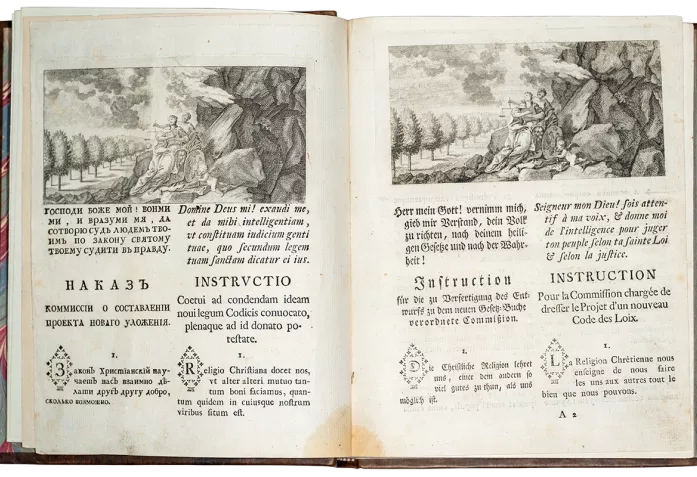
P.S. Dear friends, I realise that getting through the entire study is not easy for a non-specialist. But perhaps we could take on Chapter V, which contains, for example, this thought: “The Equality of the Citizens consists in this; that they should all be subject to the same Laws.” Incidentally, the fifth section of Nadezda Plavinskaia’s book reproduces the Russian and French texts of the Nakaz from the quadrilingual edition published in St Petersburg in 1770. The French text is accompanied by an appendix in which selected articles of the Nakaz are presented in five different French translations.