
Anna Politkovskaya, Twenty Years After: Revenge or Retribution?

Twenty years ago, on 7 October 2006, Anna Politkovskaya was murdered in the stairwell of her apartment building in Moscow. By an extraordinary coincidence – if it was a coincidence – it happened on Vladimir Putin’s birthday. There is something sinister about 7 October, don’t you think? The Russian president, who was visiting Dresden at the time, reacted to the news by describing the murder as ‘a disgustingly cruel crime’ and declaring that it had done far more damage to Russia and its government than the journalist’s publications. In the final years of her life, Politkovskaya had concentrated on investigating what was happening in Chechnya.
I remember only too well the horror I felt at the time, and I understand equally well why those who knew Anna Stepanovna cannot forget her. She was a remarkable woman, a talented, principled and courageous journalist. In the twenty years since her tragic death, numerous books have been written about Anna Politkovskaya and several plays have been staged, not only in Russia but also in France, Italy, Sweden, Bulgaria and elsewhere. Of these productions, I find one of the earliest particularly interesting: A Woman Beyond Re-education (Donna non rieducabile), by the Italian playwright Stefano Massini, who gave Anna back her voice drawing primarily on her reporting, articles and personal accounts. First staged during the 2007–08 season, the play has been revived this season. In October 2011, its French adaptation, directed and performed by Mireille Perrier, was presented in Geneva at Maison Saint-Gervais. I interviewed Mireille Perrier at length at the time, and she told me that Anna never ceased to astonish her.
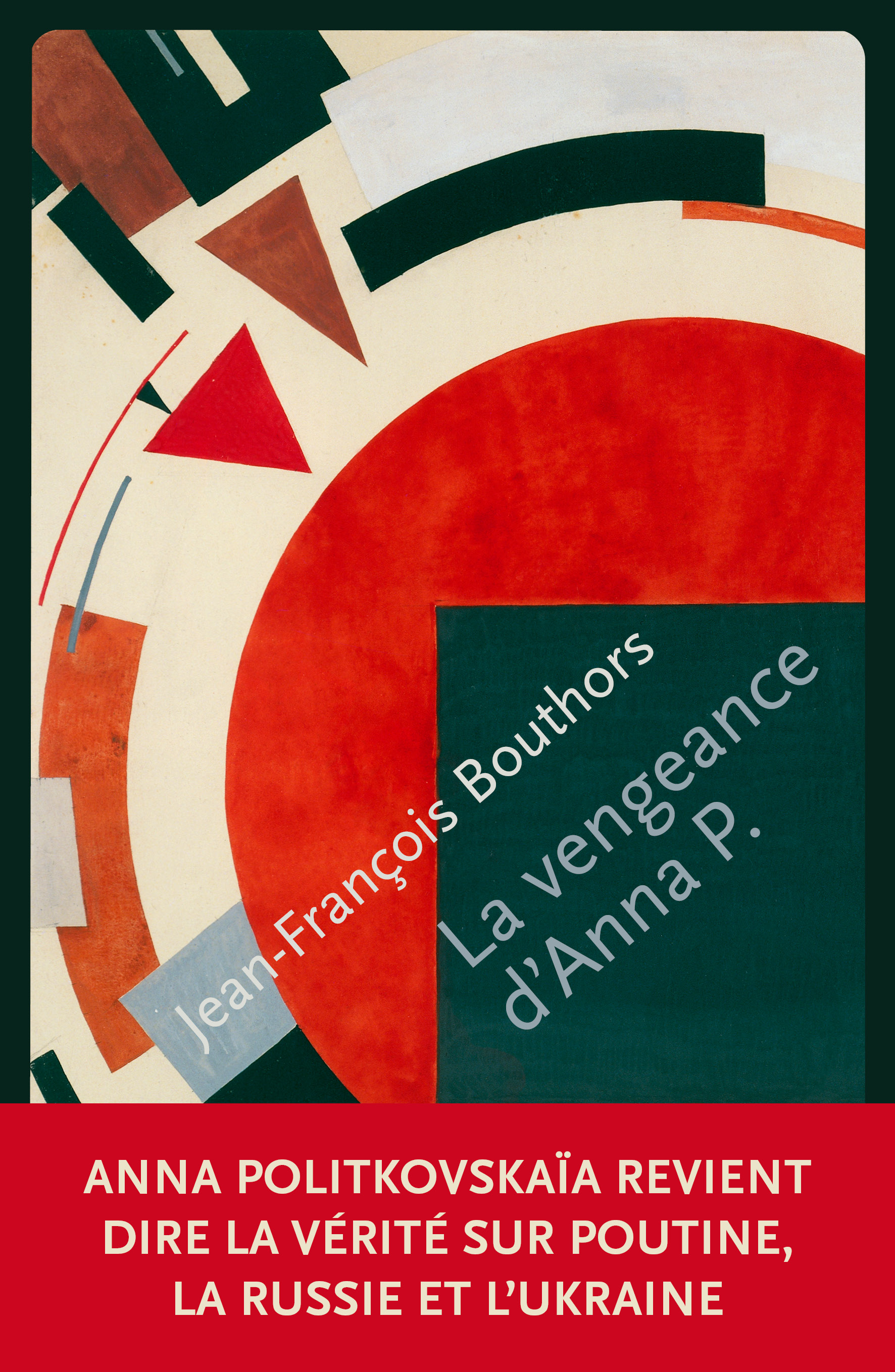
And now, twenty years after her tragic death, the French writer and journalist Jean-François Bouthors, who had previously edited Anna Politkovskaya’s books for the French publisher Buchet/Chastel, has published La Vengeance d’Anna P. (Anna P.’s Revenge), a first-person novel that seems intended to give the murdered journalist the opportunity to tell us herself what has happened to Russia and the rest of the world since then.
This was where I encountered my first difficulty with the book. Not because I object in principle to the supernatural in literature. Fiction allows for the most improbable conventions, including conversations with the dead. But I know how difficult it is to inhabit another person’s mind, particularly when one has not known them especially well, and I am not convinced that Jean-François Bouthors has entirely succeeded. To my mind, it is his own voice that comes through more strongly in the novel, making sweeping pronouncements on contemporary politics. The impression is that Bouthors is using Politkovskaya primarily as a moral authority, lending additional weight to his own reflections on contemporary Russia and the war in Ukraine, which occupies a central place in the narrative.
I had a second reservation, this time about the literary device itself. After the much-discussed novel The Wizard of the Kremlin by Giuliano da Empoli, to which Bouthors himself refers, portraying Putin’s Russia through fictional characters with readily recognisable real-life counterparts no longer seems particularly original. But there is a fundamental difference between the two novels: da Empoli invites us to view contemporary Russia through the eyes of a fictional character close to the Kremlin’s centres of power, whereas Bouthors gives a voice to a victim of that power, a woman who really lived, wrote and was murdered. And it is precisely this that makes Jean-François Bouthors’s literary experiment more questionable in my eyes.
Still, let us give him his due: it takes a certain courage – if that is the word – to have his heroine comment on society’s reaction to her own murder. This is how it appears in the novel: ‘My death, from two bullets fired into me in the stairwell of my building, did not provoke so much as the shadow of a mass protest – merely a few sorrowful, very orderly gatherings, because everyone knew that the first person to lift a finger would, at best, be sent to enjoy the fresh air of a police cell, complete with all the unpleasant surprises they know how to devise there.’
Can we really claim that Anna Politkovskaya would have shown such understanding towards the indifference of the majority to the ultimate sacrifice she had made? I, for one, would not presume to take such a liberty.
As I read the novel, I found myself recalling the lectures given by Elizaveta Petrovna Koutchborskaya, who taught both Politkovskaya and me classical literature. Yes, Anna Politkovskaya and I both studied at the Faculty of Journalism of Moscow State University. Anna Stepanovna had graduated five years before I arrived. But we had the same professors. Koutchborskaya, a legend at Moscow University, drew us into the world of ancient Greece, which she loved so dearly, from our very first year. She spoke with infectious passion about gods and heroes, the Pythia, through whom Apollo spoke, the Erinyes, goddesses who did not merely call for retribution but exacted it themselves, and Cassandra, the Trojan prophetess who foresaw catastrophe but was doomed never to be believed.
And I increasingly felt that Bouthors was turning Anna Politkovskaya into a curious blend of the Pythia, an Erinys and Cassandra: an all-knowing prophetess calling for retribution. But Anna was no mythological figure. She was a journalist confronting the harshest realities of her time, seeking truth and justice not in the afterlife but here on earth, in places torn by conflict. Truth and justice, but not revenge. I do not know whether Anna Stepanovna was religious or believed in an afterlife, but even if she did, there is no reason to assume she would have identified with this voice from beyond the grave that Bouthors had invented for her, delivering lectures to the novel’s very much living characters.
For that is precisely Jean-François Bouthors’s premise: Anna Politkovskaya addresses the living from beyond the grave. First and foremost, she speaks to a certain Oleg Karamzin, born in Bashkiria and a ‘namesake’ of the celebrated historiographer of the Russian imperial court who, among his other achievements, did much to introduce Russian readers to Switzerland, or Helvetia. Oleg is a journalist close to the Kremlin, and it is not difficult to recognise the real-life figure on whom the character appears to be based: Pavel Zarubin, presenter of the programme Moscow. Kremlin. Putin, who was born in Beloretsk, Bashkiria. Yet a recognisable model does not necessarily make for a convincing literary character. For a professional propagandist, he seems remarkably sensitive.
From time to time, Anna Stepanovna also addresses her ‘dear readers’, rather than the fictional Oleg, and occasionally speaks directly to Vladimir Putin, whom she familiarly calls Vova. These passages addressed to Putin are set in italics. But it is perfectly clear that Jean-François Bouthors wrote his book for a Western audience, and more specifically for readers with little familiarity with the realities of life in Russia. So everything has to be explained to them in detail, practically from scratch, and in the simplest possible terms.
And here I encounter another difficulty, this time with the novel’s title and particularly its translation into Russian, a language that allows for distinctions in meaning that French does not convey in quite the same way. ‘Месть Анны П.’ (Anna P.’s Revenge) would be the literal and most natural Russian translation. But the Russian word месть, ‘revenge’, suggests a personal grievance, a desire to settle scores with someone who has wronged you. Applied to Politkovskaya, the word takes on a petty resonance that does little justice to her moral stature. ‘Возмездие Анны П.’ (Anna P.’s Retribution) has a far more solemn, almost biblical resonance. It suggests not personal revenge but punishment for an evil committed, for a crime. The judgement of a higher power. And there are the Erinyes again. And Dostoevsky along with them. Which brings me to yet another difficulty, this time a literary one.
Anna Politkovskaya genuinely knew and loved literature. The abundance of literary references in the novel might therefore seem entirely appropriate. But abundance gradually becomes excess and begins to interfere with the reading experience, even for a literature enthusiast like me. Quotations, allusions, writers’ names and literary parallels follow one another so relentlessly that they sometimes obscure the very subject under discussion, creating the impression that the author is eager to display his erudition while also attempting to broaden his readers’ cultural horizons, attributing both ambitions to his heroine. Ultimately, the novel begins to resemble less a work of fiction than a lecture or an extended political and historical essay, with Anna Politkovskaya’s voice serving as a kind of literary framework. The voices of the fictional characters contribute to the same effect: Oleg, his wife Lena, whose work in the service of the regime is concealed behind a business selling luxury-brand handbags, and his temporary lover Lyudmila, a teacher of literature who sets out to put Oleg back on the straight and narrow. What they say often sounds more like declamation than natural human speech. This is particularly jarring in the so-called ‘intimate scenes’. Sorry, but I simply don't buy it!
As for literature, while describing Vladimir Putin in all manner of unflattering terms, Anna most frequently calls him Akaky Akakievich. This is not Jean-François Bouthors’s invention. Anna Politkovskaya entitled an entire chapter of her book Putin’s Russia (2004) ‘Akaky Akakievich Putin II’, drawing a direct parallel between the Russian president and Gogol’s Bashmachkin, that famous ‘little man’ from The Overcoat, from which, according to the familiar saying, all subsequent Russian literature emerged. Incidentally, the celebrated remark traditionally attributed to Dostoevsky appears in Le Roman russe (1886), by the French diplomat and literary critic Eugène-Melchior de Vogüé, who attributes it to an unnamed Russian interlocutor.
There is an interesting twist to this literary parallel. In an interview with the British newspaper The Independent, published on 15 October 2004, Anna Politkovskaya said: ‘Putin is like Gogol's Akaky Akakievich. He is a small grey person who really wants not to be grey. Putin had a historic chance to be great and not to be grey but he is still grey.’
Yet in the Russian translation of the interview, published on NEWSru.com, the meaning is reversed: it says that Akaky Akakievich actually wants to remain grey. Now that is what I call ‘lost in translation’!
I find it hard to believe that the real Anna Politkovskaya would have said the following:
‘You seem to have noticed my love of Gogol, without whom one can understand very little about Russia. Essentially, leaving aside the women poets of the Silver Age, Akhmatova and Tsvetaeva, I have three masters in Russian literature. Set aside your beloved Dostoevsky, undoubtedly a genius, though his writing is ponderous, and an antisemite, nationalist and Slavophile to boot; abandon Tolstoy, that egocentric devourer of women, a thoroughly odious fellow – though I will grant you The Death of Ivan Ilyich – and read Gogol, Chekhov and Bulgakov. We shall discuss Pushkin another day… I cannot forgive him Poltava and his contemptuous hatred of Mazepa, whose echoes can still be heard in the prose of our Dictator, Doctor of History.’
And yet, besides the writers already mentioned, the book also features Lermontov, Grossman, Pasternak, Mandelstam (Lyudmila, a great admirer of Mandelstam, even bears the patronymic Osipovna), Rilke, Romain Gary, Philip Roth, Paul Éluard, Vasyl Stus, whom Georges Nivat introduced to French-speaking readers only at the beginning of this year, and many others, each of whom, in their own way, sought to make sense of their own times or turned to the past.
… By the end of the novel, both women in the life of Karamzin, a journalist and Kremlin propagandist, are dead: Lena, apparently killed by the FSB after she comes to disagree with its views, and Lyudmila, killed by a Russian Iskander-M missile. As for Oleg, he not only begins hearing voices but seems even to hear the voice of the actress Alisa Freindlich delivering the final monologue of the Stalker’s wife in Andrei Tarkovsky’s film. Yet, as we immediately discover, Bouthors’s character has never seen the film and has not even heard of it! Here is how the scene unfolds in the novel:
‘Yet that morning, as dawn was barely breaking and he was still asleep, suspended on the intangible threshold of waking, he distinctly heard those final words from the film, spoken by the guide’s wife, who had waited for him for so long: “I knew there would be much suffering, but bitter happiness is better than a grey, dreary life… When he simply came up to me and said, ‘Follow me’, I followed him and I have never regretted it. Never…” And he thought he recognised the delicate timbre of his “Mila’s” voice. I must find her, he thought. Find her and follow her. He was ready to run away in search of you, dear Lyuda.’
In seeking to give Anna Politkovskaya back her voice, to allow her once again to address the living and reflect on events she did not live to witness, Bouthors was undoubtedly motivated by noble intentions. Equally beyond doubt is that Anna Stepanovna would have opposed the war in Ukraine by every means available to her. But I was not convinced by the literary device the author chose. I sincerely hope that Anna Politkovskaya’s memory will live on for many, many years, and that others will carry forward the work for which she gave her life: the pursuit of truth and justice. As for predicting how long Jean-François Bouthors’s book will hold readers’ interest, I would not venture to do so, since I have no idea how long the present political situation will last. I have no intention of playing Cassandra.