
“Russians in the Air” and the British Salamander
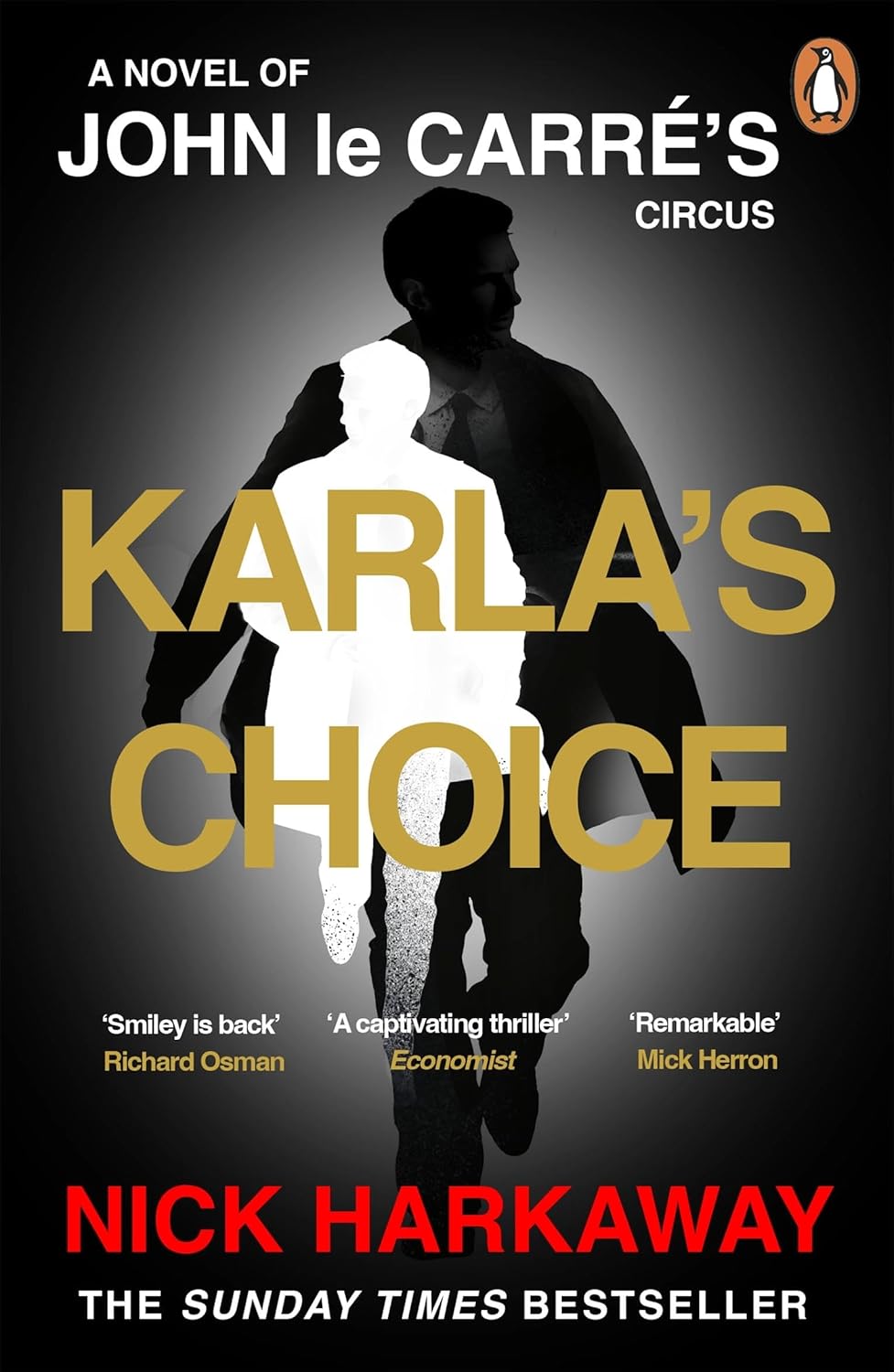
This is the second time recently that I have wanted to write about a book by the son of a famous father. Not long ago, I reviewed Ben, or the Art of Escape by the Swiss writer Micha Lewinsky, son of the acclaimed novelist Charles Lewinsky. My subject this time is Karla’s Choice, a new novel set in the world of John le Carré (1931–2020). It was written by his son Nick Harkaway with the approval of the estate and draws on his father’s archive, which he surely knows better than almost anyone. It was Harkaway who prepared le Carré’s final novel, Silverview, for publication after the author’s death; it appeared in 2021. Gallimard published the French translation the following year under the title L’Espion qui aimait les livres (The Spy Who Loved Books). There is still no Russian translation.
The two novels could hardly be more different in conception. While Micha Lewinsky follows his own path, Nick Harkaway faced an entirely different task. He had not merely to write a good book, but to return to one of the finest literary worlds of the twentieth century, bring the British intelligence officer George Smiley and his eternal adversary Karla, the head of Soviet foreign intelligence, back to life and do so convincingly enough for the reader to believe that this really was a John le Carré novel.
The book will, I think, be especially rewarding for those who know le Carré’s Karla trilogy: Tinker Tailor Soldier Spy (1974), The Honourable Schoolboy (1977) and Smiley’s People (1979). Readers unfamiliar with the trilogy will inevitably miss part of the pleasure of Karla’s Choice: many of its characters and allusions depend on the memory of the earlier books.
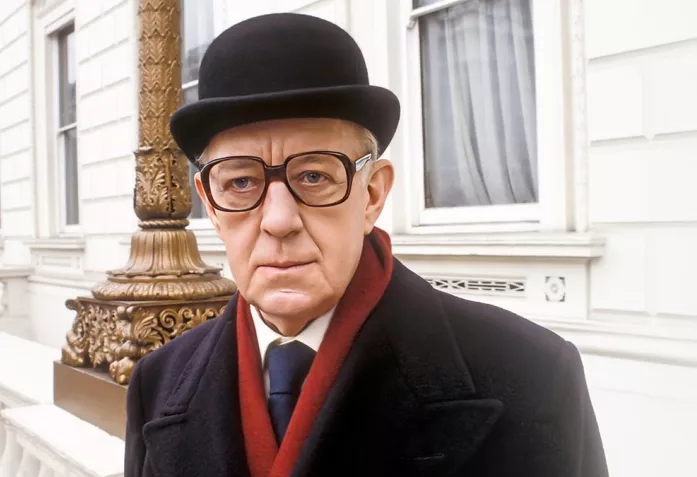
George Smiley retains all his charm, his old methods and his role as the moral centre of the novel. “Smiley believed not in ideology but – against all evidence – in people, which was a sin no one in the secret world could afford.” That, perhaps, is the essence of his character. Karla, who does not appear until page 205, remains just as mysterious. The reader learns nothing new about him: his real name, biography and nationality are still unknown. He is not so much a man as the invisible centre of an immense system.
(Reading this, I found myself thinking about how differently the words spy and intelligence officer are perceived in Russian. In my Soviet childhood there was a simple rule: if they were “theirs”, they were spies; if they were “ours”, they were intelligence officers. English, by contrast, can use the same word, spy, for both sides.)
The novel is set in 1963, shortly after the events of The Spy Who Came in from the Cold. At the beginning of the story, George Smiley has left “the Circus” – le Carré’s name for MI6 – disillusioned by its methods and by the consequences of the operation that cost his colleague and friend Alec Leamas his life. One of the most memorable scenes shows Smiley choosing clothes for Leamas’s funeral: “I could not shake the idea that Alec did a lot of standing around waiting, and he needed comfortable shoes and a good winter coat.”
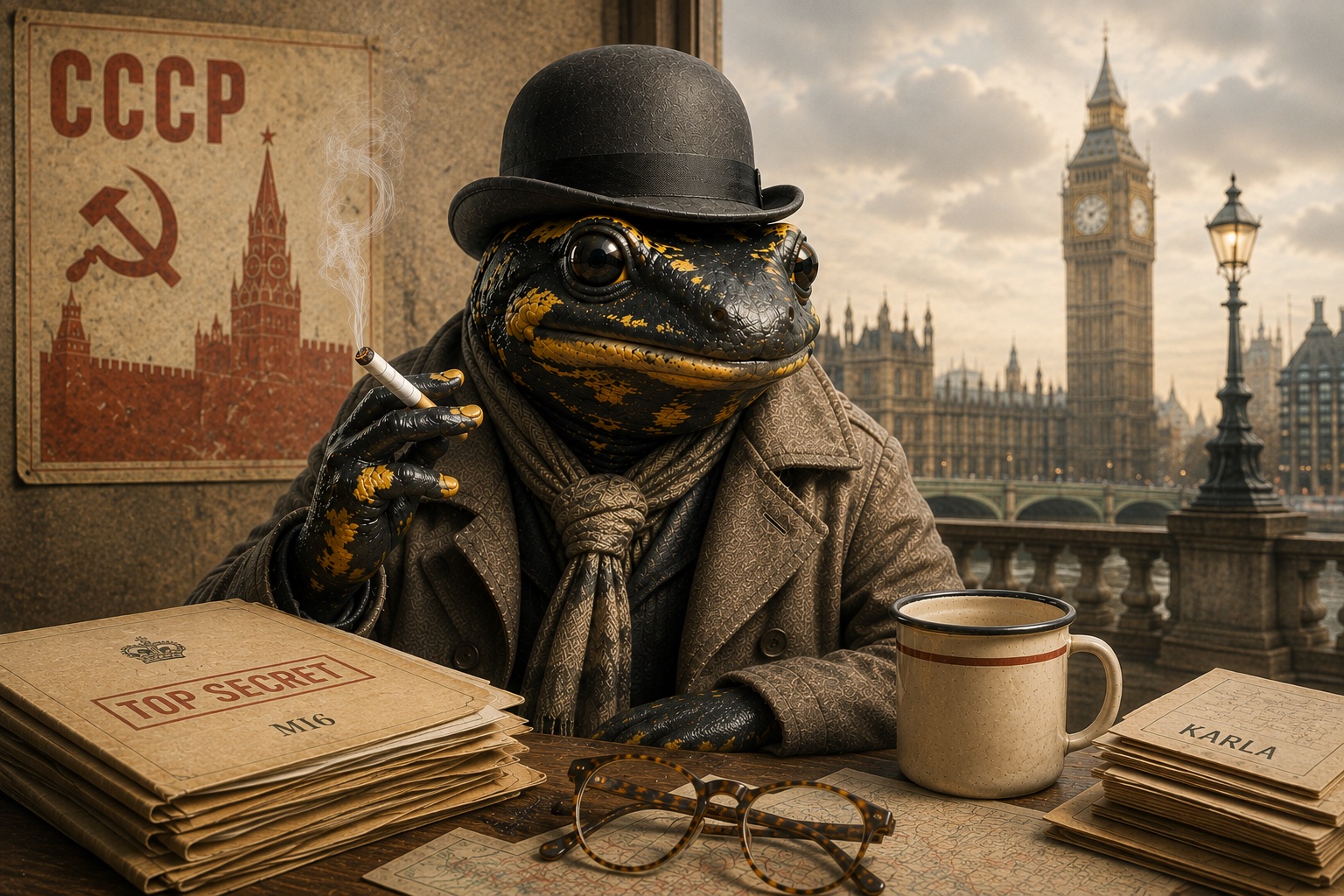
Smiley's own attitude to his profession is equally revealing: “I served you for twenty-five years and more, but all that creates is a greater obligation to keep going. The salamander lives in the fire because it has forgotten how to live any other way.”
Smiley now hopes to devote himself to books and to a family life that has finally begun to settle. Meanwhile, a Hungarian named Miki Bortnik walks into the London office of the literary agent László Bánáti. Sent from Moscow to kill Bánáti, he unexpectedly refuses to carry out the order, surrenders to the British and confesses that his greatest dream is to appear in a Peter Sellers film.
This strange episode leads the Circus to suspect that the modest literary agency conceals a much larger operation. I was also struck by the way two seasoned British agents describe Bánáti: “an enemy spy”, but “an anti-fascist first”. Smiley’s retirement proves brief: his former superiors call upon him for help.
The key figure in the investigation is Bánáti’s twenty-three-year-old assistant, Susanna Gero. She fled Hungary after Soviet troops crushed the 1956 uprising, travelling along roads scarred by the “rutted tracks of Russian tanks”. She managed to begin a new life in England, but never escaped the feeling of exile, and her reflections on patriotism sound strikingly relevant today.
Unlike many of le Carré’s female characters, Susanna is no mere observer. She shows remarkable composure during her first encounter with the would-be assassin and gradually becomes a full participant in the operation. Through her story, Harkaway shows not only the world of intelligence but also the fate of Hungarian émigrés, for whom their homeland remains both a lost home and a place of fear: “She wanted to say she was going home, but home should not be somewhere that made you afraid.” Reading these pages, I could not help thinking of Marisol’s wooden sculpture Hungarians, which I wrote about recently, and Harkaway’s brief description of the Stalin era brought to mind a book by another British writer, Giles Milton: “In Stalin’s time you could not trust your weight to anything over there. One day you are a prince, the next you’re a villain, and nothing in between. No law, no evidence, just fear.”
The investigation leads Smiley into Bánáti’s past, the Hungarian underground and a network of people whose ties were forged during the Second World War, the 1956 Revolution and the repression that followed. It becomes clear that Bánáti’s disappearance relates to a woman named Irén, who remained in Budapest, and her son Leo. To bring her to the West, Susanna must return to the country she once fled. Together with the former soldier Tom Lake, she finds herself in a city where people are watched, documents are checked repeatedly, and the slightest hesitation or misplaced gesture can betray a foreigner. Their carefully prepared extraction plan collapses, forcing them to improvise a route to the border.
The Hungarian storyline gives the novel particular historical depth. Harkaway convincingly conveys the atmosphere of communist Hungary: the constant presence of the state, the oppressive expectation of a check, the fear of border guards and the sense of being watched from every direction. Take my word for it: the Hungarians were by no means alone.
Budapest is not merely an effective backdrop for a chase. Susanna’s return becomes a confrontation with her own memory and, at the same time, her first real test as an intelligence officer. Here it becomes clear that she possesses not only courage but also the ability to observe, make quick decisions and recognise danger that Smiley values so highly. Many readers will also notice, I am sure, Harkaway’s description of how intelligence services recruit agents among refugees. More than half a century later, one suspects that the method has changed very little.
Behind this local story, the larger figure of Karla gradually comes into view. The operation centred on Bánáti turns out to be part of a struggle within Soviet intelligence and a stage in the consolidation of Karla’s power. The novel both fills the chronological gap between le Carré’s earlier books and leads the reader towards the Karla trilogy. The title itself refers not only to a particular decision that a Soviet intelligence officer must make, but also to the central moral question of le Carré’s world: where does loyalty to one’s convictions end, and where does the willingness to sacrifice living people to the system begin? And what is the price of that choice? In a way, Georges Smiley offers a reply:
"What would he say to Alec?
That he had not, in the end, been prepared to risk much to do the right thing. That he preferred his comfortable retirement, and the Sercombe banking connections. That he had allowed Susanna to act according to her conscience, and in the worst case considered her an acceptable loss in the name of the same greater struggle which had expended Leamas and preserved Mundt. The struggle to which he personally no longer subscribed. That instead of following the road to its end, he found at the last that he was the sort to wave others on their way."
Like Silverview, Karla’s Choice is available to French readers. Le Seuil published it in November 2025 under the title Le Choix de Karla. Russian readers, however, are still waiting for a translation.
I read the novel in English and smiled at Harkaway’s skillful use of familiar Russian expressions and sayings in the speech of British intelligence officers – or simply spies, to use the same word for both sides. They have evidently become fashionable long before Ronald Reagan appeared on the political stage. On page 99 alone, Harkaway offers three delightfully literal translations: “to work with one’s sleeves down”, “to leave someone with a nose”, and “to show someone where the crayfish spend the winter”. Even more amusing is his version of the Russian folk, or barge-haulers’, song Ey, Ukhnem sounds in English: “Let’s all go OOOF now…”
But not everything in the novel made me smile.
My heart sank at Harkaway’s remarkably convincing description of the world behind the fictional Moscow Hotel Tourmaline:
“In the twenties and thirties, Soviet Russia had become a hub for leftist émigrés from Germany and the new Eastern nations created in the Treaty of Trianon, which ended the First World War between the Allies and Hungary. Activists and poets who might otherwise occupy the jails of Miklós Horthy or Adolf Hitler took themselves to Moscow, which pronounced itself their natural home. There, above the Filippov Café in Tverskaya Street, once-time supplier of patisseries to the Tzars, stood the venerable Hotel Lux, whose long-term inmates – or what was left of them, after Stalin’s extreme weeding of suspected traitors – were sent home in triumph after the next war, to be rulers of their satellite nations.”
I should add that in the period described by Harkaway, Tverskaya Street was called Gorky Street. This was where I spent my childhood and youth, with almost daily visits to Filippov’s bakery, adjoining the café mentioned in the novel. I suspect this was not a mistake but a deliberate choice: the author uses the modern name, immediately recognisable to an international reader, a common practice in English-language historical writing.
The strong “Russian Accent” in a Cold War spy novel did not surprise me. What I did not expect was to encounter the country that welcomed me almost thirty years ago – and on the very first page. The readers learns that, out of an old military habit, Mr Bánáti rose early every morning and “performed a series of ludicrous exercises devised by a Swiss”.
Whether Harkaway had Émile Jaques-Dalcroze in mind, I cannot say but Switzerland appears several more times: in connection with a society party in Geneva that Smiley is unable to attend with his wife to because of work; with a dead body discovered in Zurich; and with the office of a counterfeiter specialising in Swiss francs, located in Spiez, “half an hour from the Swiss capital”.
I will not recount every twist and turn of the plot – who needs spoilers? Let me instead try to sum up and answer the essential question: has Harkaway succeeded?
In my view, Karla’s Choice is a very good book as it is not only about espionage, but also about love, for which even the most cautious person may at some point be ready to take an extraordinary risk. Yet I understand both the critics who have greeted it with enthusiasm and those those who remain unconvinced.
The former, because Nick Harkaway has achieved something close to the impossible. He brilliantly recreates the atmosphere of the Cold War, its language, tone and narrative rhythm. George Smiley is once again recognisable down to the smallest detail. The novel offers the same unhurried intellectual pleasure that le Carré always gave his readers.
The latter, because one is nevertheless left with the feeling that something is missing. Perhaps it is the moral ruthlessness towards his own characters – and towards himself – that made John le Carré’s books not merely outstanding spy novels but great literature. Harkaway treats the world created by his father with immense respect. Perhaps even too much. At times, it seems that this very reverence prevents him from taking risks. Yet it is precisely risk that gives rise to the inner freedom without which true masterpieces cannot be created.
P.S. Dear readers, as a bonus I invite you to listen to Ey, Ukhnem (“Let’s all go OOOF now…”), performed by Leonid Kharitonov and the Alexandrov Ensemble. The recording dates from 1965, almost exactly the period in which the events of Karla’s Choice take place.