
La Forza del destino, or War in a Neutral Country

If we accept the view that negative publicity is still publicity, then Anna Netrebko got the full treatment. And the result is clear: tickets for the five performances in which she appears were sold out long before the premiere on November 2. To my knowledge, no cultural event in Switzerland has ever been preceded by so many rumors, controversies, joyful anticipation on the one hand, and outright hostility on the other. Several articles appeared in the Swiss press recalling the singer's past sins and mistakes (in their authors' opinion), but without any clear accusations against her today; only hints, speculations, and assumptions accompanied by an abundance of subjunctive moods. Don Basilio's aria about slander, famous “Callunnia”, keeps spinning around in my head. But that's from The Barber of Seville. And here we have The Power of Fate – La forza del destino.
Let's briefly recap for those who are not in the know. Yes, on February 6, 2012, Anna Netrebko was officially registered as a representative of the candidate for President of the Russian Federation Vladimir Putin. Yes, on December 7, 2014, she donated a million rubles to restore the Donetsk opera theater, which had been damaged by the fighting, and was photographed with one of the leaders of the Novorossiya separatists, Oleg Tsarev holding the flag of Novorossiya in his hands. This photo was widely circulated by many media outlets, while the singer later explained that she was allegedly unaware of who she was photographed with or what the flag was. Is it possible to believe in such naivety from a star who is used to signing autographs and taking selfies with strangers? Hardly. But can we rule out the possibility that she has since realised a lot?
On March 30, 2022, Netrebko published a post on Facebook in Russian and English, stating that she is against the war, is not an ally of any Russian leaders or political parties, and that her previous statements had been misinterpreted. She added: “It is wrong to force artists or any public figures to publicly express their political views and condemn their homeland.”
Her statements against the war, whatever her reasons for making them, were enough for cultural institutions in Russia, starting with the Novosibirsk Opera and Ballet Theatre, to terminate their contracts with the singer, who has not performed in Russia since. But it was not enough to prevent Anna Netrebko from being subjected to obstruction in the West. Yes, some theaters, led by the Metropolitan Opera in New York, terminated their contracts with her. But not all of them, and each of her appearances in the West – in Milan, where she opened last season in the role of Leonora, in Vienna, Paris, Berlin, and London – becomes an event, even if there are protest rallies in front of the theater on the day of the premiere: in September this year, Netrebko performed the role of Floria Tosca at Covent Garden in London, in front of which pro-Ukrainian activists stood with placards reading “While Netrebko sings, Ukraine bleeds.”
But the next day, there are usually no protesters, and the hall is still full, so what else does management need? I myself witnessed something similar last summer in Vienna, where Anna Netrebko sang Lisa in The Queen of Spades. (Incidentally, she sued the Met, and an American judge, recognizing the validity of her claims, ordered the opera house, according to the New York Times, to pay her $200,000 in compensation for 13 canceled performances.)
Switzerland did not remain on the sidelines either.
Back on March 26, 2022, the Tages Anzaiger newspaper published an article titled “The Silenced Diva” with the teaser: “She condemns aggressive war, but not Putin: will we ever see the great Russian opera singer on the Western stage?” The answer to this question has long been known: we have already seen her, and more than once.
In March 2022, the Zurich Opera House, Opernaus Zürich, announced that Anna Netrebko would not appear on its stage in the opera Macbeth on the announced dates – she was replaced by another Russian, Veronika Dzhiova, from whom no one demanded a stand. I analyzed this situation in the article “Whose side are you on, masters of culture?” https://nashagazeta.ch/blogpost/30991, noting that the Zurich theater's management accompanied its decision with a detailed explanation written in the most respectful tones. Yes, there is a lot that can be said, even things that are not very pleasant, or even completely unpleasant, but the question is how. It can be assumed that Anna Netrebko appreciated the restraint shown, which allowed her to return to Zurich.
Back in 2023, the new director of the Zurich Opera, Matthias Schulz, dared to invite Anna Netrebko to the Berlin opera house Unter den Linden, which he was heading at the time, notwithstanding a wave of indignation. Two years later, upon taking up his new position in Zurich, he confirmed his position in an interview he granted me, saying: "Anna Netrebko is undoubtedly the best Leonora in the world, and we want to hear her in this role in La forza del destino. In Berlin, I had the opportunity to talk to her on several occasions, get to know her better, and appreciate her impeccable conduct and the enormous success she has brought to the theater."
The Swiss website Bleu News, which reported the news ten days before the Zurich premiere, also acknowledged that “from an artistic point of view” the Russian singer is “impeccable” and noted that “protests against Anna Netrebko do not affect her Swiss fans: tickets for five performances by the controversial Russian soprano at the Zurich Opera House are sold out.”
But Daniel Koch, former head of the infectious diseases department, whom we all remember as “Mr. Corona” during the coronavirus pandemic and who now writes a column on the nau.ch website, went so far as to call on the Federal Council to comment on the singer's performance in Zurich. Anna Netrebko should probably take such attention to her person as a compliment.
The French-language newspaper Le Temps joined in, dedicating three articles to Anna Netrebko and the Zurich production last Friday and calling on Ukrainian Ambassador Iryna Venediktova as a witness. The Ambassador’s position on this issue is as understandable as it is predictable. Not a single word was said about the singer's professional qualities, nor was a single fact of her “reprehensible behavior” over the past four years cited. Instead, readers learned that the Ukrainian embassy had asked the mayor of Zurich to display the Russian Shahed drone shot down by the Kiev army in the city. I did not see it there.
On Friday evening, RTS channel contributed by posting a clearly not-so-fresh photo of Anna Netrebko with Vladimir Putin on its feed, quoting Ambassador Venediktova's words that "Anna Netrebko is a weapon. She is the Kremlin's showcase," and providing a direct link to Ms. Venediktova's open letter of October 28, in which she demands, on behalf of Ukraine, the cancellation of the Russian singer's performances in Zurich.
The respected TV channel then quoted Roger Nordmann, a former national advisor from the Socialists of the canton of Vaud, who signed the above-mentioned letter: "This soprano is one of 500 people who signed the electoral list so that Vladimir Putin could run for re-election. This means that she is one of 500 Russians who most strongly support Vladimir Putin." Let us clarify once again that this was in 2012 (!), which is when the photograph used today as evidence of the singer's ideological closeness to the Russian president was taken.
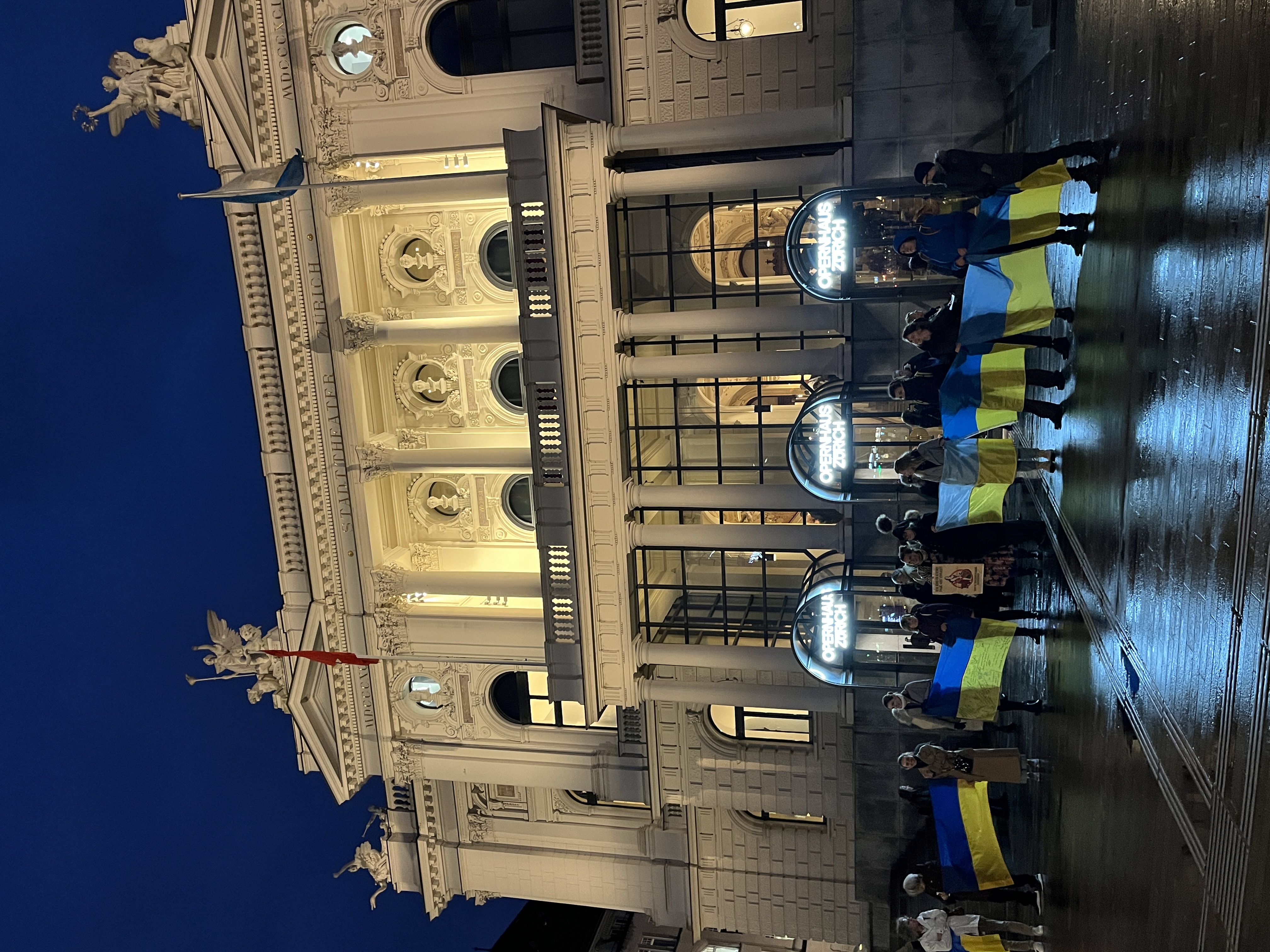
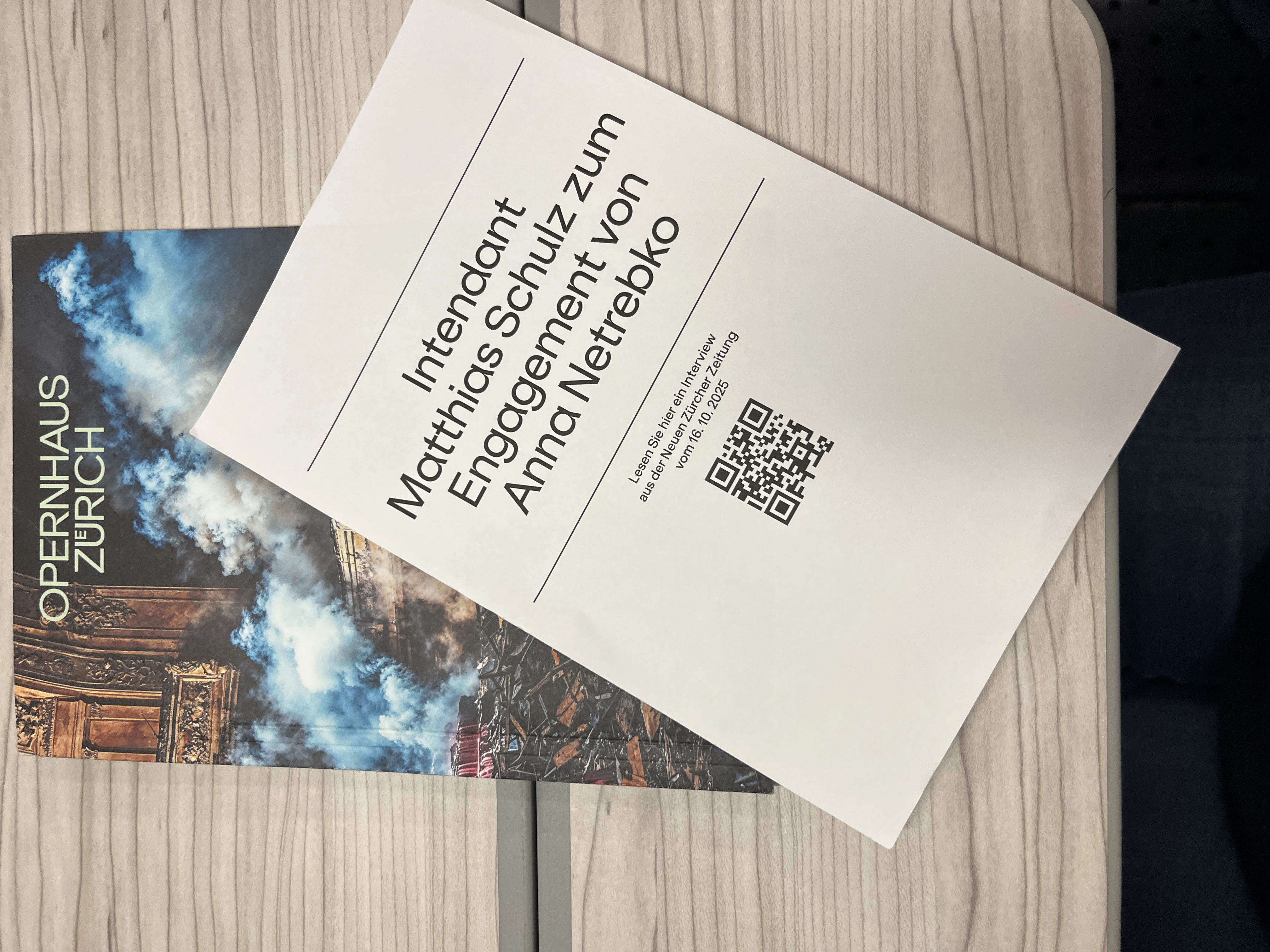
... I shall not dwell upon the legal and moral legitimacy of all these judges, who so like to throw stones, but this is the informational and emotional baggage with which I went to the premiere of La Forza del destino in Zurich. Before entering the theater, I was met by 15-20 people with Ukrainian flags, who informed me, in German, that “Anna Netrebko is a tool of the Kremlin.” A leaflet with a QR code was inserted into the program, allowing anyone who wanted to do so to familiarize themselves with the theater manager's position on inviting the Russian singer. I did not notice any special security measures.
It is worth remembering that this opera by Giuseppe Verdi has a very direct connection to Russia, not only because of the Russian performers participating in the Zurich production – in addition to Anna Netrebko, these include Elena Guseva (the second Leonora) and Stanislav Vorobyov (Marquis Calatrava), and some might add to the list an Azerbaijani tenor Yusif Eyvazov. The fact is that its creation, in today's terms, was the result of a Russian state commission. In January 1861, just weeks before the abolition of serfdom in Russia, Giuseppe Verdi responded positively to a request from Tsar Alexander II, set out in a letter from the then autocrat, which was conveyed to the great composer by the famous Italian tenor of the time, Enrico Tamberlik.
Verdi had actually planned to write an opera based on Victor Hugo's play Ruy Blas, but it was banned in Russia at the time because of its freedom-loving ideas, which were considered dangerous. On June 3, 1861, the composer accepted as his literary basis the drama Don Alvaro, or The Force of Destiny by the Spanish writer and politician Marquis Angel Saavedra, which had been suggested to him by the Imperial Theater, and commissioned Francesco Maria Piave to write the libretto. The music was written between June and November of that year, and in December Verdi arrived in St. Petersburg to participate in the first rehearsals. He almost terminated the contract due to the illness of soprano Emma La Grou, but in the end a solution was found, and after six weeks of rehearsals, on November 10, 1862, the opera premiered at the Bolshoi (Stone) Theater (now the Mariinsky) with the Imperial Italian troupe, directed by Enrico Tamberlink, who sang the part of Don Alvaro, and with sets by Andreas Roller. (Note that on the original poster, Giuseppe Verdi is somehow named Joseph). It was not until February 27, 1869, that La forza del destino, in its second revision and with a libretto reworked by Antonio Ghislanzoni, was performed at La Scala in Milan. It should be noted that at the time of that first production in St. Petersburg, the Russian public failed to appreciate the beauty of Verdi's music due to external factors: some were outraged by the fact that the opera had been commissioned from a foreign composer when there were domestic geniuses available, while others were offended by the enormous amount of money spent on the production.
The main themes of this opera are quite traditional for this genre in general and for Verdi in particular: the contrast between love and hate, the clash of true feelings with social prejudices, to which racial prejudices were added this time. Here is a brief summary. The aristocrat Leonora di Vargas falls in love with Don Alvaro, a descendant of Peruvian Indians, albeit from an ancient family. An alliance with a man of a different faith, and a dark-skinned one at that, is impossible, and the Marquis di Calatrava, Leonora's father, orders her to forget about her suitor. Finding Alvaro in his daughter's room, he showers him with insults and accuses him of dishonoring his daughter. Alvaro does not want to resort to weapons and demonstratively throws away his pistol, but... a shot rings out, an accidental shot, fatally wounding the marquis, who curses his daughter before he dies. She goes to a convent – what else can she do? Her brother Don Carlos (in Zurich, beautifully performed by Romanian baritone George Petean) searches for her and Alvaro to take revenge. Having lost hope, he joins the army under a false name – the male equivalent of a convent. One day, seeing robbers attack a stranger, he rescues him and, unaware that the rescued man is Don Alvaro, swears eternal friendship to him. Later, realizing who he is, he challenges him to a duel. Alvaro goes to the convent where Leonora is hiding – he does not want more bloodshed. But Don Carlos finds him there and forces him to take up arms. Alvaro wounds Carlos. Leonora leans over her wounded brother, and he kills her – the beautiful aria-prayer “Madre, pitosa Vergine,” in which Leonora asks to be protected from her brother, does not help. According to the first version of the opera, Alvaro then committed suicide, but Verdi later removed this suicide, apparently deciding that it would be too much.
So, what did I see and hear at the Zurich Opera House after all?
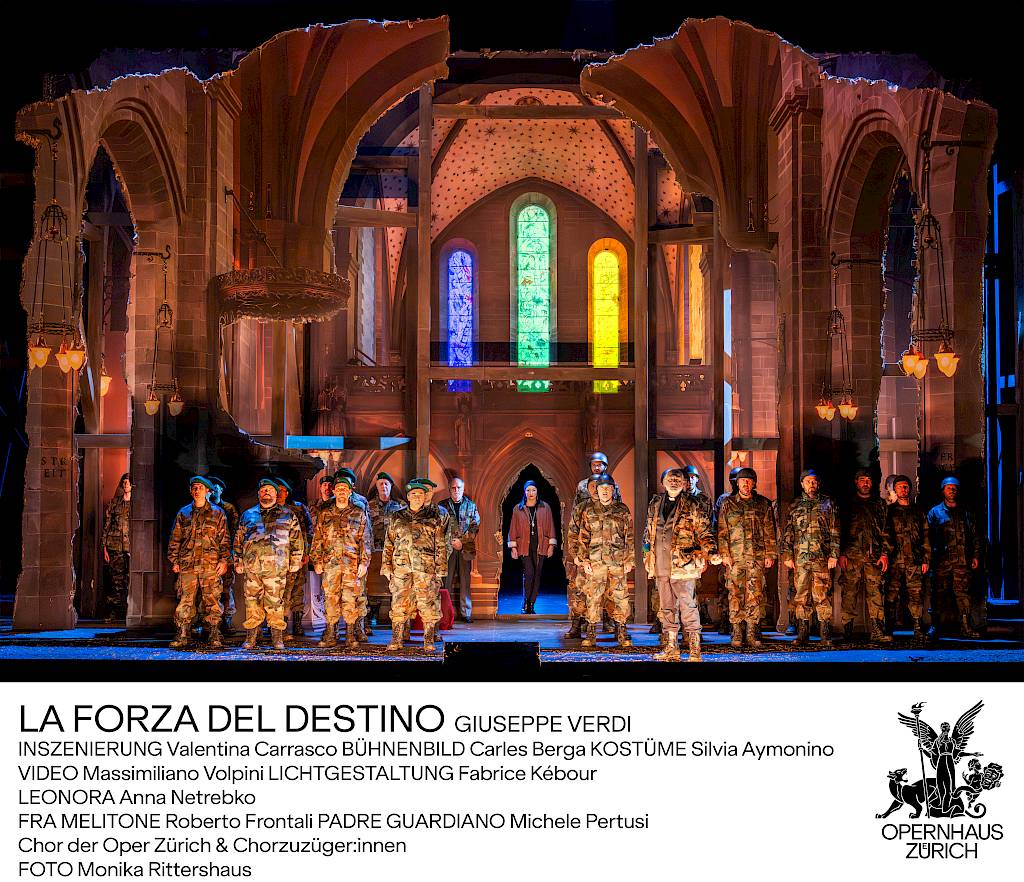
While the first St. Petersburg opera lovers saw Gothic interiors of family castles, gloomy rocky landscapes, and medieval monasteries – which is logical, since the action takes place in Spain and Italy in the second half of the 18th century – the Zurich audience saw completely different images, with only a hint of stained glass in the monastery scenes reminiscent of the original production.
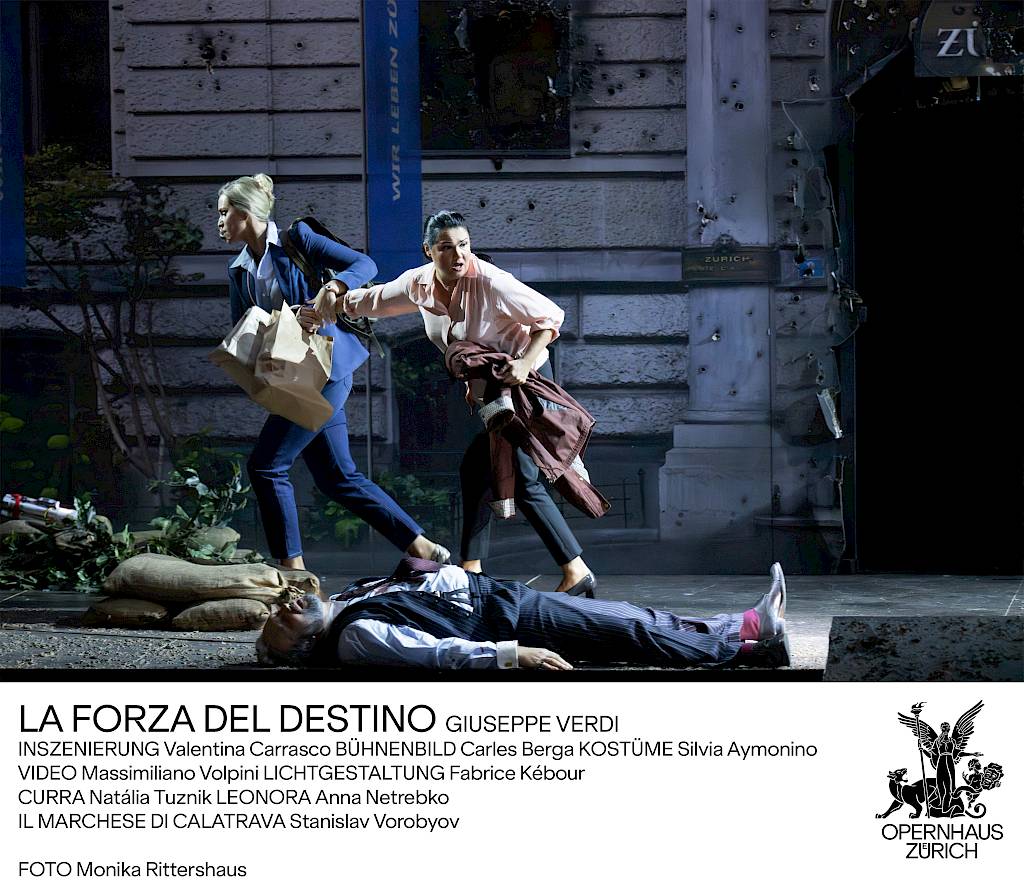
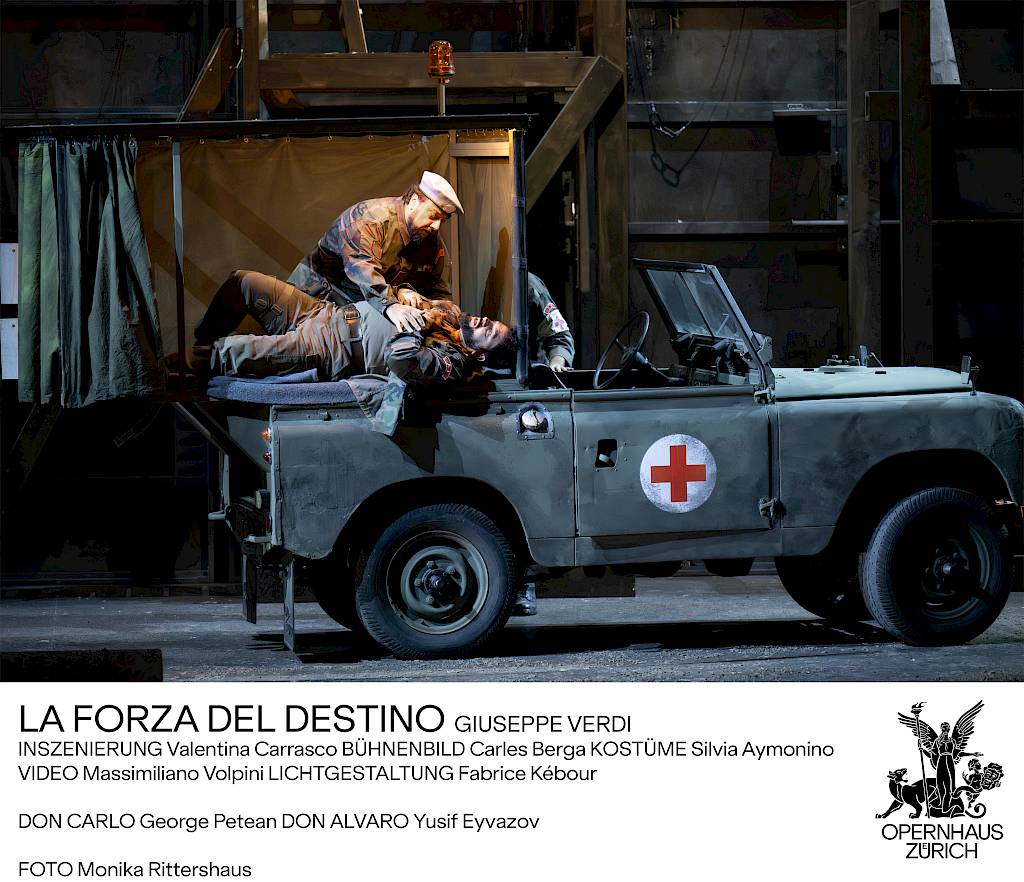
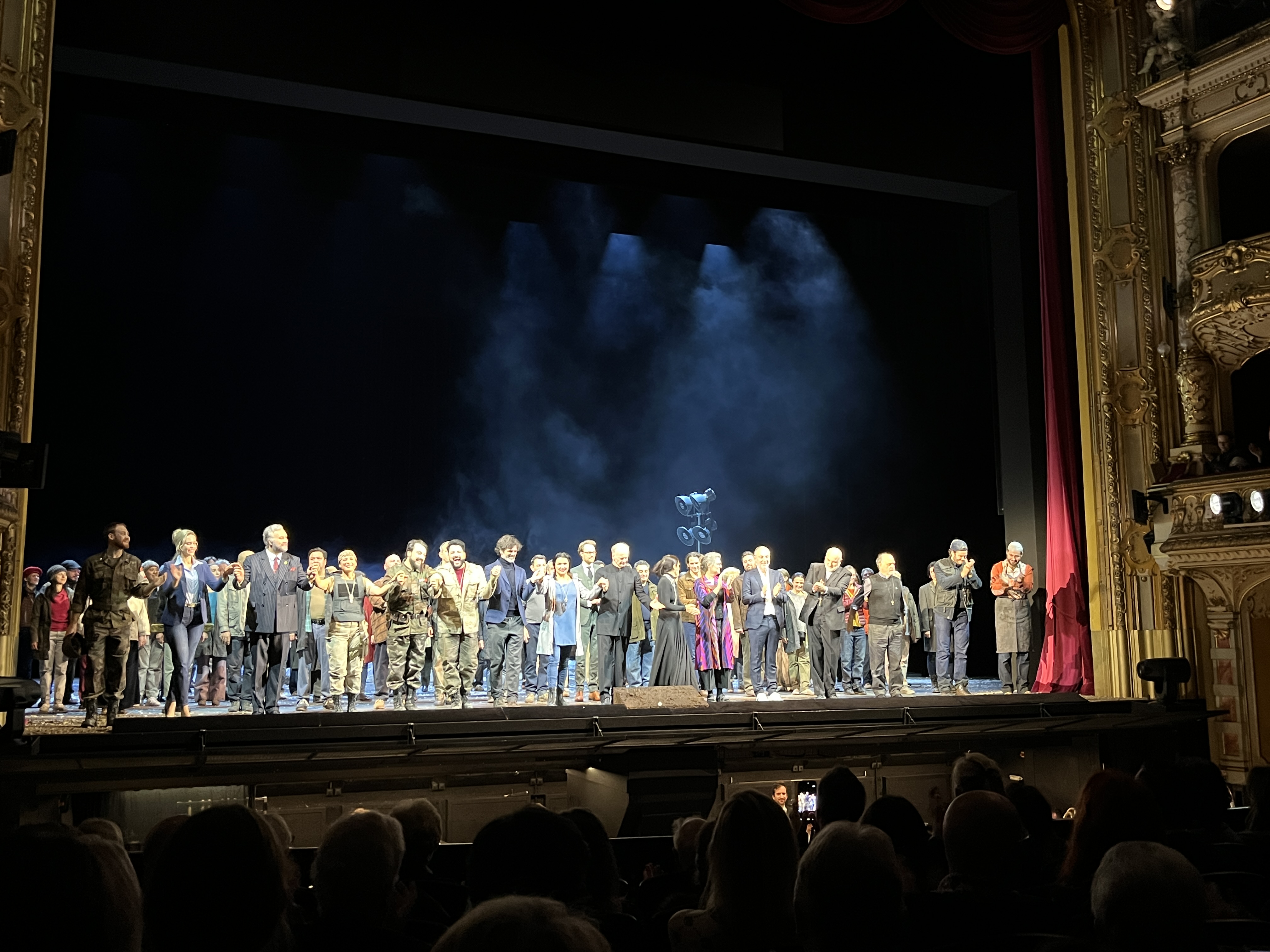
The author of the production, Argentinian director Valentina Carrasco, collaborated with the Catalan theater troupe La Fura dels Baus, known for its unexpected scenography and blurring of the boundaries between artists and audience, from 2000 to 2020, and participated in numerous opera productions, including Mozart's Don Giovanni in the Russian town of Perm and Rachmaninoff's Aleko and Francesca da Rimini in German Kiel. In a short interview posted on the Zurich Opera House website, Valentina Carrasco explains that the most important thing for her in La forza del destino is the constant presence of war in the lives of the main characters. The director did not exaggerate: war is indeed constantly present, even when, according to the libretto, it should not be. Thus, in the scene where Leonora arrives at the convent, not only is her hair cut off, but she is also tattooed on her arm, given a bulletproof vest and handed a rifle. Perhaps some of the audience considered this to be overkill, which explains the distinct “boo” that rang out in the hall when the production team came out for the final curtain call at the end of the performance; All the soloists, who did not deserve it equally, as well as the choir and conductor Gianandrea Noseda, were greeted with thunderous applause that turned into an ovation.
Taking on La forza del destino in Zurich, Valentina Carrasco dared an interesting move – to transfer the action not just to some imaginary country ravaged by war, but specifically to neutral Switzerland. Against the backdrop of the magnificent overture with its famous theme of fate, the audience sees a map of Switzerland on a giant screen with a poorly lit night road shining through it, lined with destroyed houses. Where does this road lead? It leads to war.
The last notes of the overture fade away, and we see a luxurious Zurich mansion decorated with white and blue flags reminiscent of the canton's flag. In one of the windows are Leonora and her father. I don't know if all the audience noticed that this particular window is different from the others – it has been blown open by a shell. Those who did notice could see this as a warning from the director to the Swiss people: if you continue to observe so-called neutrality, the war will catch up with you too. Perhaps there is some truth in this interpretation, but I saw something else in the production.
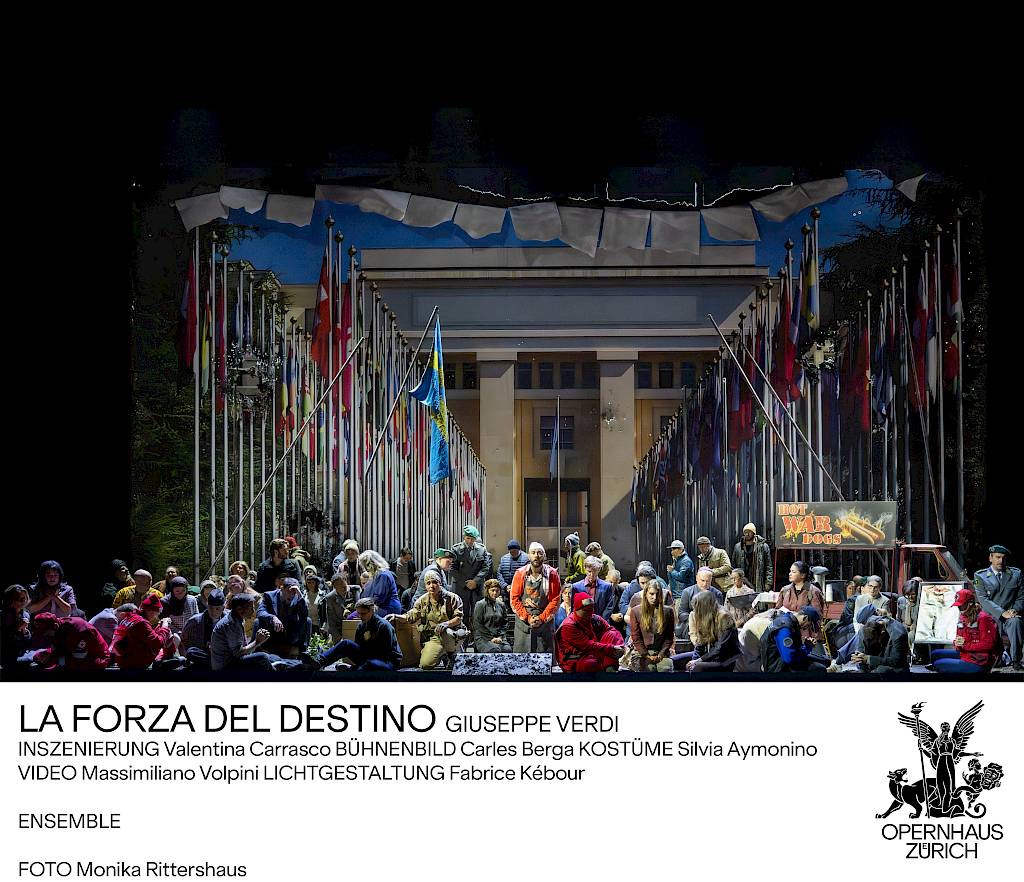
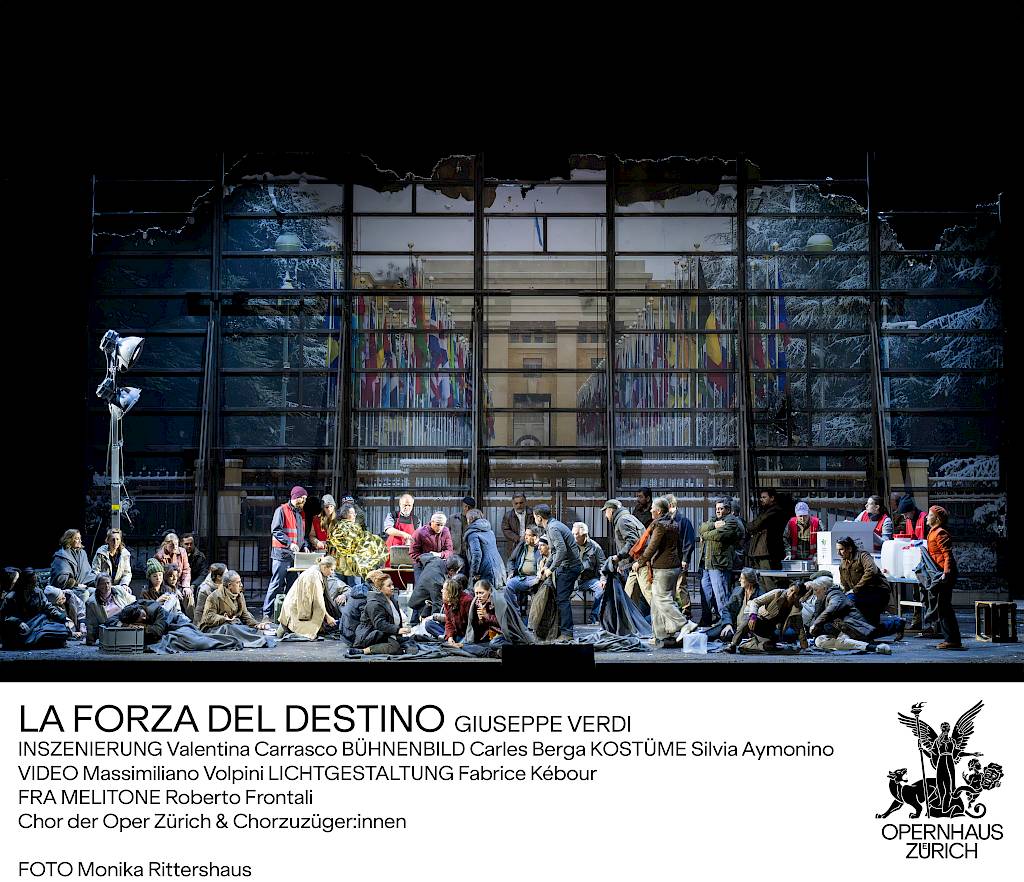
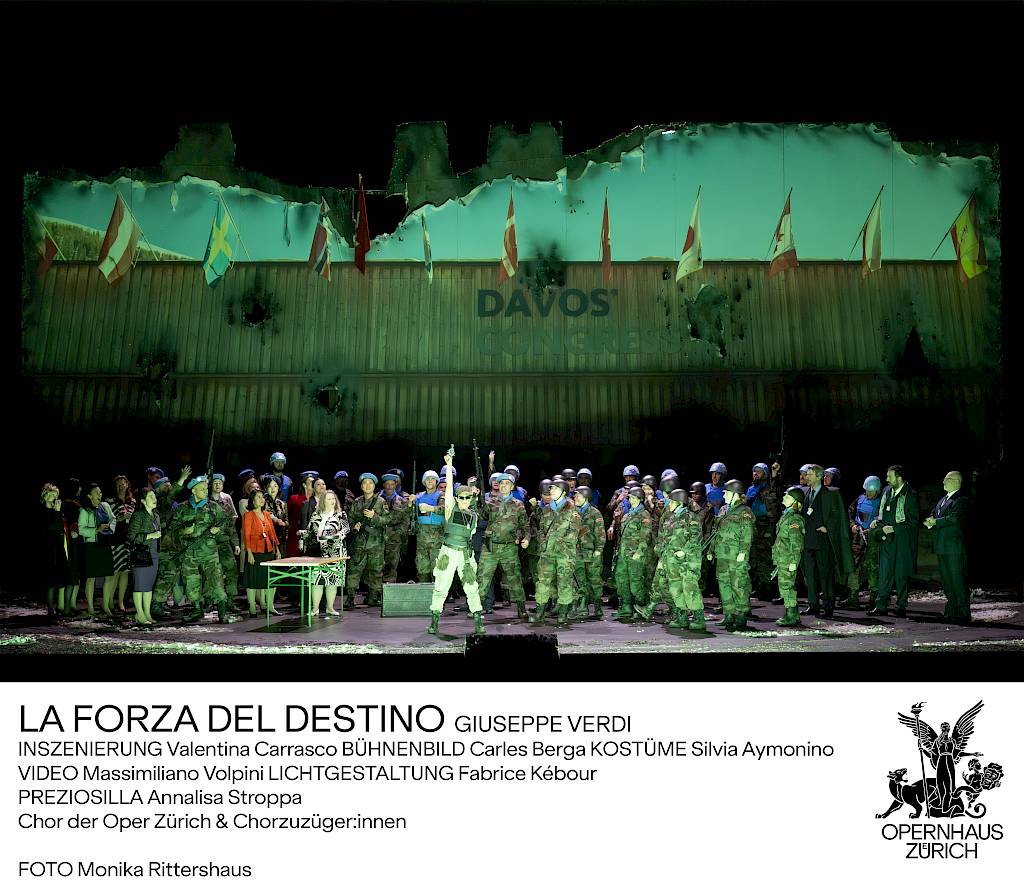
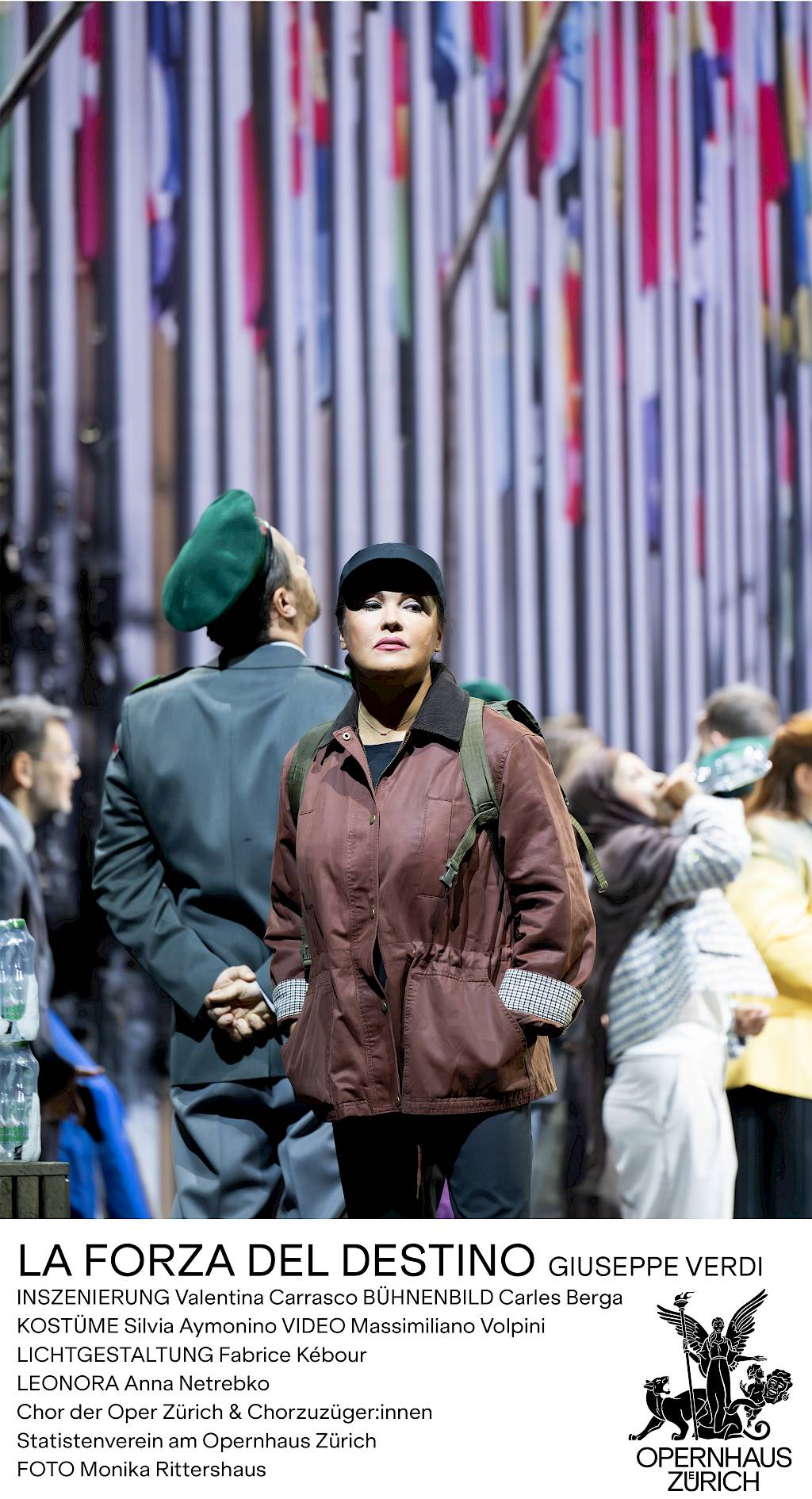
In my opinion, Valentina Carrasco sought to emphasize as much as possible the inherent senselessness of the war, which began with a misunderstanding, with an accident - after all, it is known for certain that Alvaro did not dishonor Leonor and did not want to kill the old marquis! – and continues because of a thirst for revenge and an inability to stop, because of the pride of some and the greed of others. In the scene in front of the Palace of Nations in Geneva, it is not only “hot war dogs” that are being sold; the fortune teller Preziosilla (played beautifully by Italian mezzo-soprano Annalisa Stroppa) literally calls on the young men to enlist in the army to the sound of drums (" Al suon del tamburo “), she glorifies war, and predicts a bright and secure future for everyone, including Don Carlos, disguised as a war correspondent: "If you want to get rich, go where there is war," she sings.
But it is rare for soldiers to get rich in war; much more often, it is certain politicians and arms dealers, whom we see in the scene “Congress in Davos” (apparently, the word ‘congress’ replaced “forum” for copyright reasons, but everything is clear anyway). It would be funny if it weren't so sadly recognizable: Fra Melitone (the magnificent and very artistic Italian baritone Roberto Frontali), on behalf of the Red Cross, serving soup to refugees who obviously thoroughly annoy him.
In my opinion, the main message of the authors of the production to the audience is contained in the famous aria “Rase, pace mio Dio,” performed by Anna Netrebko shortly before the stage death of her character. I found that it was performed magnificently, and the fact that the 54-year-old singer's voice has become more mature today only added depth to this performance. Taking into account everything one saw on stage earlier, it is perceived not simply as a plea for peace for Leonora herself, but as a prayer for peace in general. And knowing that in Russia today a priest could be defrocked for such a prayer makes the effect of the aria even stronger. According to the authors' concept, it is performed in a room resembling a UN meeting hall – perhaps the Security Council’s room? But how can we ensure that this prayer is heard by those who really have the power to change things? Is it true that we cannot escape our fate, or are we its masters?
PS: The opera “La Forza del destino” will be performed nine more times at the Zurich Opera House. All practical information can be found here.