Bookshelf

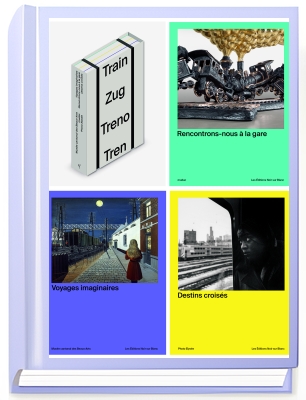
Train Zug Treno Tren. Editions Noir sur Blanc, 16 juin 2022. 176 pages (chaque catalogue) • 90 Euros • 95 CHF (le coffret)

Catalogue 1. Voyages imaginaires (beaux-arts) Catalogue 2. Destins croisés (photo)
Catalogue 3. Rencontrons-nous à la gare (design). Disponibles séparément. Sous la direction de Camille Lévêque-Claudet, Marc Donnadieu et Marco Constantini

Dès l’été 2022, le nouveau quartier des arts Plateforme 10 contribuera à faire de Lausanne une capitale culturelle de premier plan. « Train Zug Treno Tren » constitue l’exposition inaugurale de Plateforme 10, organisée conjointement par les trois musées (Beaux-Arts, Photo, Design). Pluridisciplinaire et transversale, l’exposition explore les liens de parenté́ entre l’espace des musées et celui des gares (lieux de passages, de croisements et de rencontres) d’une part, entre l’expérience de la visite de l’exposition et celle du voyage en train (fenêtre sur le monde) d’autre part. Elle réveille le passé de Lausanne, étape du mythique Venise-Simplon-Orient-Express, et elle annonce son futur de nœud ferroviaire majeur au cœur de l’Europe. L’exposition est accompagnée de trois catalogues complémentaires, richement illustrés, disponibles séparément ou en coffret. Des textes d’historiennes et historiens de l’art, de la photographie et du design portent des éclairages originaux sur la thématique du chemin de fer.

Camille Lévêque-Claudet, conservateur au MCBA (Musée cantonal des Beaux-Arts), est le commissaire de l’exposition « Voyages imaginaires ». Marc Donnadieu, conservateur en chef à Photo Elysée (Musée cantonal pour la photographie), est le commissaire de l’exposition « Destins croisés ». Marco Costantini, directeur adjoint du mudac (Musée cantonal de design et d’arts appliqués contemporains), est le commissaire de l’exposition « Rencontrons-nous à la gare ».

About the author

Nadia Sikorsky

Nadia Sikorsky grew up in Moscow where she obtained a master's degree in journalism and a doctorate in history from Moscow State University. After 13 years at UNESCO, in Paris and then in Geneva, and having served as director of communications at Green Cross International founded by Mikhail Gorbachev, she developed NashaGazeta.ch, the first online Russian-language daily newspaper, launched in 2007.

In 2022, she found herself among those who, according to Le Temps editorial board, "significantly contributed to the success of French-speaking Switzerland," thus appearing among opinion makers and economic, political, scientific and cultural leaders: the Forum of 100.

After 18 years leading NashaGazeta.ch, Nadia Sikorsky decided to return to her roots and focus on what truly fascinates her: culture in all its diversity. This decision took the form of this trilingual cultural blog (Russian, English, French) born in the heart of Europe – in Switzerland, her adopted country, the country distinguished by its multiculturalism and multilingualism.

Nadia Sikorsky does not present herself as a "Russian voice," but as the voice of a European of Russian origin (more than 35 years in Europe, 25 years spent in Switzerland) with the benefit of more than 30 years of professional experience in the cultural world at the international level. She positions herself as a cultural mediator between Russian and European traditions; the title of the blog, "The Russian Accent," captures this essence – the accent being not a linguistic barrier, not a political position but a distinctive cultural imprint in the European context.

Events
Most read

What can one expect from a film about real people whose fate we already know? Quite a lot, as it turns out. Over three and a half hours, the viewer follows the protagonists of Rays and Shadows, Xavier Giannoli’s latest film, along the road to hell paved with good intentions, or, more precisely, along the path from the pacifist illusions of the post-war period to active collaboration during the Nazi occupation of France.

For the first time in my journalistic career, I want to tell you about a concert I have no intention of attending. And the reason, of course, has nothing to do with the brilliant composers whose works appear on the programme, nor even with the performers. The problem is the “packaging”, which deeply shocked me.

A tribute in ballet form to the great Russian dancer, created by Kirill Serebrennikov, Yuri Possokhov and Ilya Demutsky, is currently being performed on the stage of the Berlin State Opera. But it was conceived for the stage of the Bolshoi Theatre in Moscow, where I had the good fortune to see it several years ago. So I can compare my impressions.