
From Gutenberg to Gagarin

Like anyone who loves literature, I cannot help loving the Bodmer Foundation. For me, it is one of those places I want to return to again and again, lingering over an open book or manuscript. I must admit that I had missed the museum during the years it was closed for renovation. Having attended the official reopening on 17 September, I returned a few weeks later, when things were quieter.
As my readership is international, and not all of you have visited Geneva or are familiar with the Foundation, it is worth recalling that Martin Bodmer’s (1889–1971) collection, the Bibliotheca Bodmeriana, assembled between 1916 and 1971, has been included in UNESCO’s Memory of the World Register since October 2015. Its founder sought to bring together not merely rare and expensive books, but the most significant testimonies to humanity’s spiritual and intellectual history. He based his library on five great names and works: Homer, the Bible, Dante, Shakespeare and Goethe, the pillars upon which world literature rests. Fortunately for us visitors, his original vision expanded considerably over time to encompass centuries of great writing.
Designed by the Swiss architect Mario Botta and opened in 2003, the museum is largely underground. Following an extensive renovation by the architectural firm Archilab, it has become more comfortable and accessible for visitors. A new central staircase now connects the two levels of the permanent exhibition, while modern multimedia facilities have been introduced, including a digital guide in ten languages. Yet the documents themselves remain the main attraction. They are kept at a temperature no higher than 19°C, so even in hot weather the museum stays cool.
The new exhibition comprises some 250 objects, approximately 80 per cent of which have never been displayed before, and spans five thousand years of the history of writing. Take a moment to absorb that figure! In other words, a visit to the Foundation offers an opportunity to trace how humanity learnt to preserve and transmit knowledge, how handwritten books gave way to printed ones, how the means of disseminating ideas changed, and what role the written word played in religion, literature, science and politics.
I have followed the Bodmer Foundation’s exhibitions for many years and written about them on several occasions, so I know that its collection has a ‘Russian accent’. But either I had never noticed, or it had slipped my mind, that this connection extends to one of the museum’s greatest treasures: a copy of the Gutenberg Bible, one of the earliest major achievements of European printing, produced in Mainz around 1455.
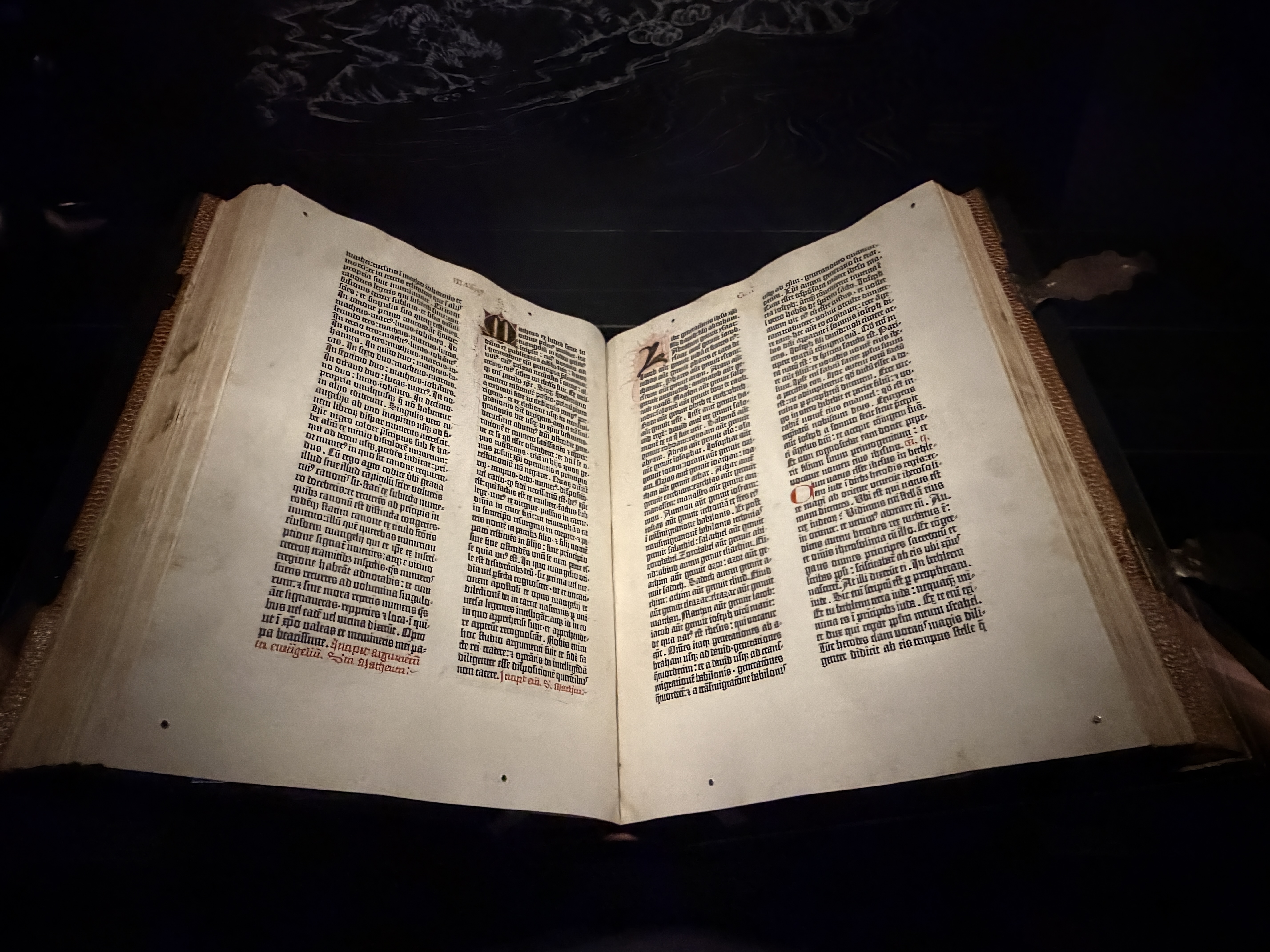
The copy belonging to the Bodmer Foundation is remarkable not only for its exceptional rarity but also for the extraordinary journey it has made. For several centuries it was kept at Rottenbuch Abbey in Bavaria, before finding its way to Munich and, in 1803, following the secularisation of monastic property, entering the Bavarian Court Library, the predecessor of today’s Bavarian State Library. As the Russian historian Evgeny Nemirovsky explains in his book Johannes Gutenberg, citing the Report of the Imperial Public Library for 1858, the Bible was put up for auction in Augsburg: the Munich library had decided to dispose of it as a duplicate. On learning of the forthcoming sale, Afanasy Bychkov, curator of the Department of Manuscripts and Early Printed Books at the Imperial Public Library, succeeded in persuading Alexander II to allocate funds for the purchase of this exceptionally rare edition. As a result, in May 1858 the two-volume Gutenberg Bible was bought for 2,336 guilders and entered the Imperial Public Library in St Petersburg.
There it survived the fall of the monarchy, the Bolshevik Revolution and the first decades of Soviet rule. In 1931, the Soviet authorities sold it to the celebrated London antiquarian booksellers Maggs Bros, reportedly on Stalin’s personal orders. How did this come about? In the early 1930s, the Soviet government, desperately in need of foreign currency to finance industrialisation, was selling off national cultural treasures abroad. In April 1931, two representatives of Maggs Bros, Ernest Maggs and Maurice Ettinghausen, travelled to the USSR. The firm still regards this acquisition as one of its greatest achievements. Interestingly, according to its own account of the transaction, a buyer had been found even before the deal was completed: the Bible was sold to the Swiss collector Martin Bodmer… ‘by telegram’, meaning that the agreement was reached through telegraphic correspondence. Just imagine the legal red tape such a transaction would involve today! And so one of the greatest achievements of European culture, having passed through Tsarist Russia and Stalin’s sale of cultural treasures, found a new home on the shores of Lake Geneva.
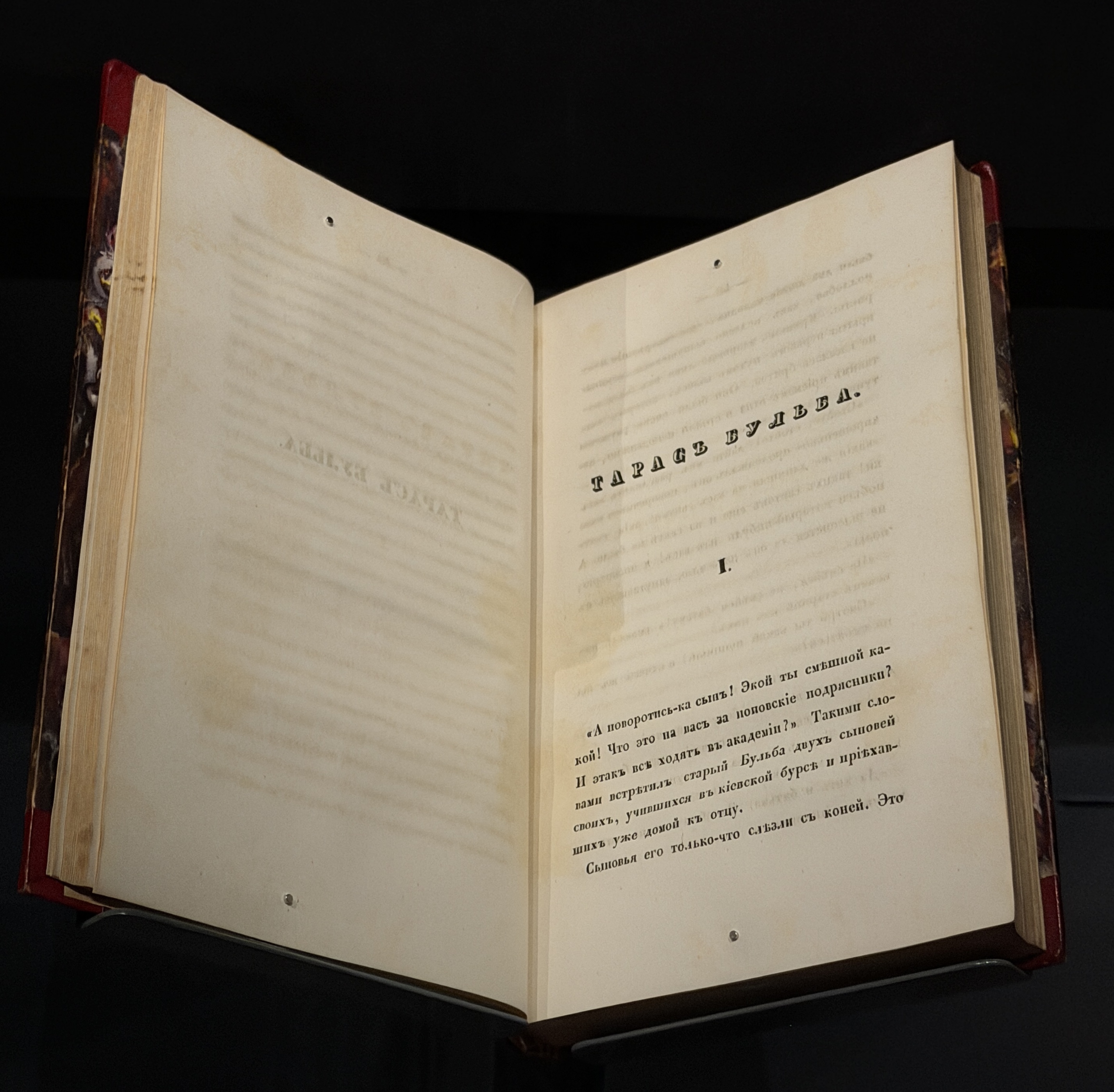
Russian literature is represented in the collection by works without which it would be difficult to imagine the history of nineteenth-century European letters. Among them is the first edition of the revised version of Nikolai Gogol’s Taras Bulba, published in St Petersburg in 1842 as part of a four-volume collection of the writer’s works. The novella was first published in 1835, but seven years later Gogol substantially expanded and reworked it, giving the narrative a broader historical and epic dimension. Both versions were written in Russian, although the action takes place among the Ukrainian Cossacks and the text is rich in Ukrainian cultural and linguistic references. Ukrainian translations appeared later. The first one, by Petro Holovatsky, was published in Lviv in 1850 and was based on the 1842 version. The title page indicates the language of the translation as ‘Galician-Russian’, the term used in Galicia at the time for the local Ukrainian written language. The translator, the younger brother of the well-known philologist Yakiv Holovatsky, preferred to conceal his identity behind a cryptonym. In 1874, another translation, by Mykhailo Lobodovsky, appeared in Kyiv, becoming the first Ukrainian edition of the novella published within the Russian Empire. The translator not only rendered the text into Ukrainian but also altered some of Gogol’s expressions: for example, ‘Russian strength’ became ‘Ukrainian strength’. The book initially passed censorship but subsequently caused a scandal. Mikhail Yuzefovich, one of the instigators of restrictions on Ukrainian-language publishing, explicitly referred to this translation in his memorandum of 1875, which preceded the Ems Ukaz of 1876. The Kyiv edition is held by the Yaroslav the Wise National Library of Ukraine, while the 1842 edition displayed at the Bodmer Foundation lies open at the beginning of the first chapter, with words familiar to generations of readers: ‘Turn round, my boy! How ridiculous you look!’ (translation by Isabel F. Hapgood).
© Fondation Martin Bodmer. Photo © N. Sikorsky
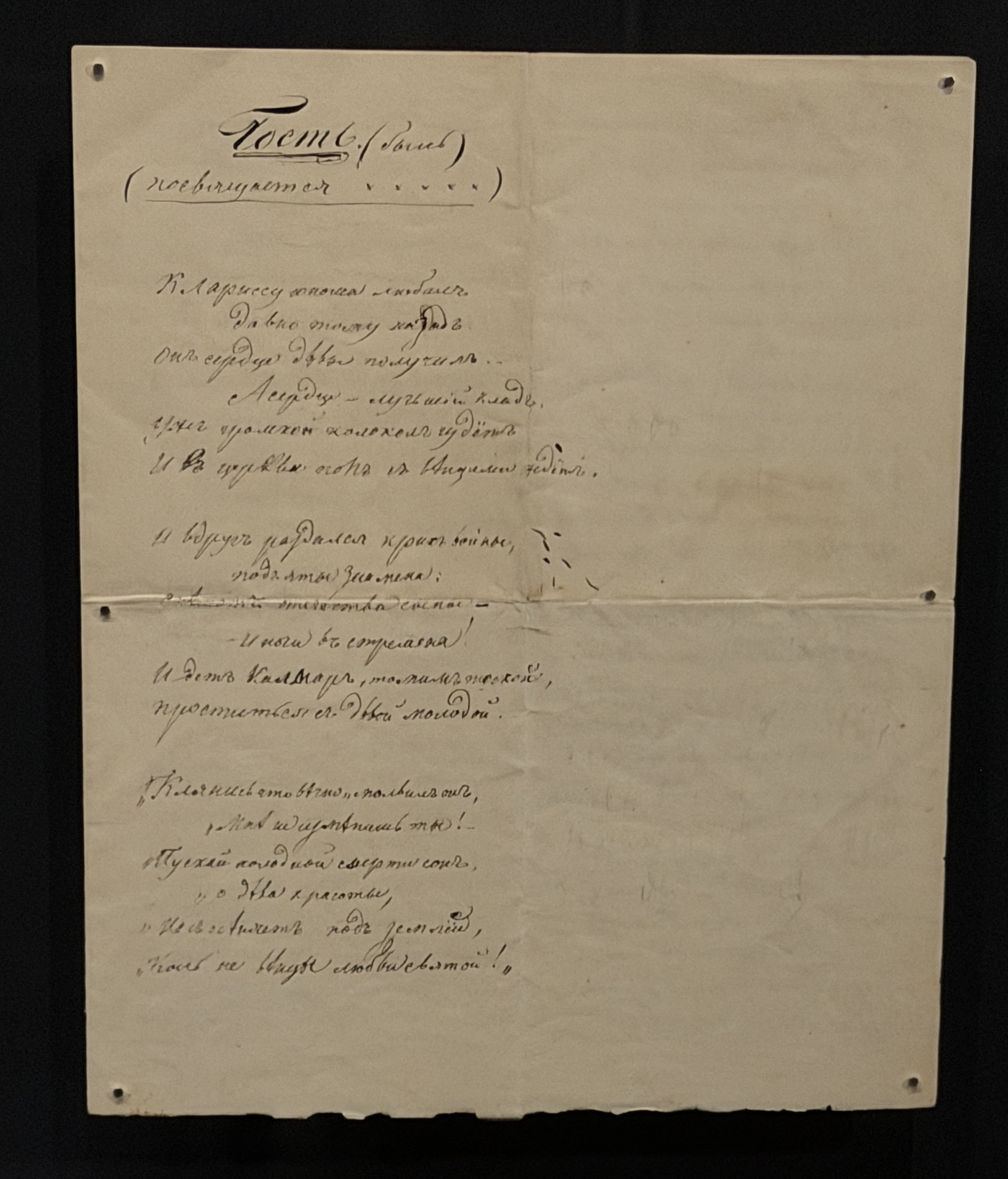
Nearby is Mikhail Lermontov’s handwritten Гость (Быль) (The Visitor: A True Story), which begins with a line about a young man in love with Clarissa. The ballad is usually dated to 1831, but its precise date remains a matter of scholarly debate. The label at the Bodmer Foundation gives 1830–1832. Unlike Gogol’s printed volume, here we are looking at the direct trace of the poet’s hand. This closeness to the process of literary creation is, of course, one of the particular charms of the Bodmer Museum.
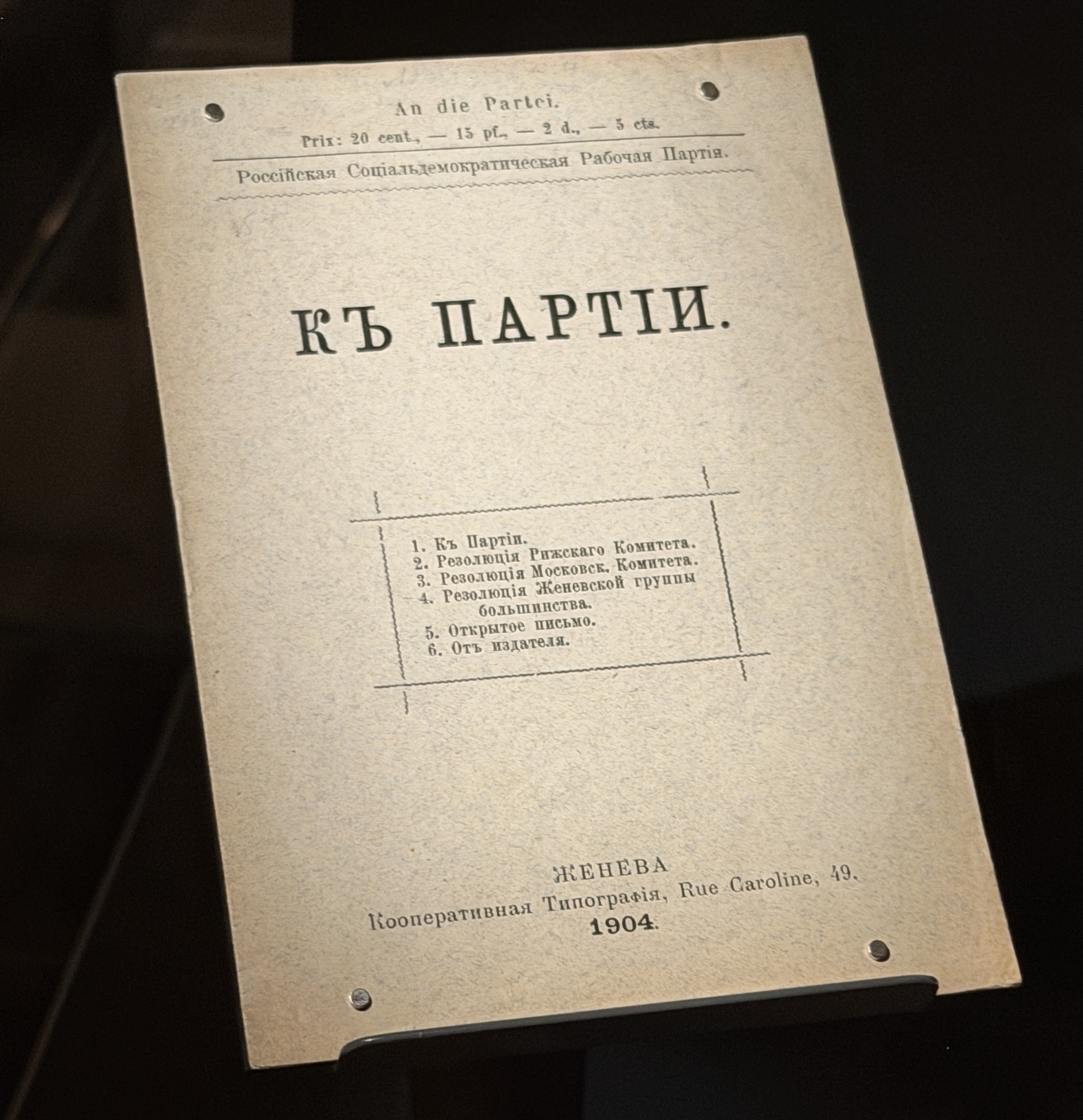
The Russian theme is not confined to classical literature. In the section devoted to the turbulent twentieth century, documents bear witness to ideological conflicts, revolutions and world wars. Particularly striking is Lenin’s pamphlet To the Party, printed in Geneva in 1904 at the Cooperative Printing House on Rue Caroline. It brings together material relating to the internal struggles of the Russian Social Democrats, including resolutions adopted by the Geneva group of Bolsheviks. The document is thus also a reminder of the role Geneva played in the history of the Russian revolutionary movement.
A very different voice of the age can be heard in Louis Aragon’s poem Le Musée Grévin (The Grévin Museum), published in 1943 under the pseudonym François la Colère (‘François the Angry’). Written during the German occupation of France, it became part of the poetry of the French Resistance. (Aragon’s wife, Elsa Triolet, a French writer of Russian origin, also took part in the struggle against the occupying forces.) Its title refers to the Paris wax museum, but instead of harmless celebrities, the reader encounters a sinister gallery of people and events from the war years. Nearby are manuscripts and editions associated with other witnesses to and participants in the century’s upheavals, ranging from Mussolini’s autobiographical manuscript of 1911 and a handwritten speech by Hitler from 1937 to Charles Péguy, Federico García Lorca and Jean-Paul Sartre. This part of the exhibition bears the eloquent title Un siècle de fer et de feu (A Century of Iron and Fire).
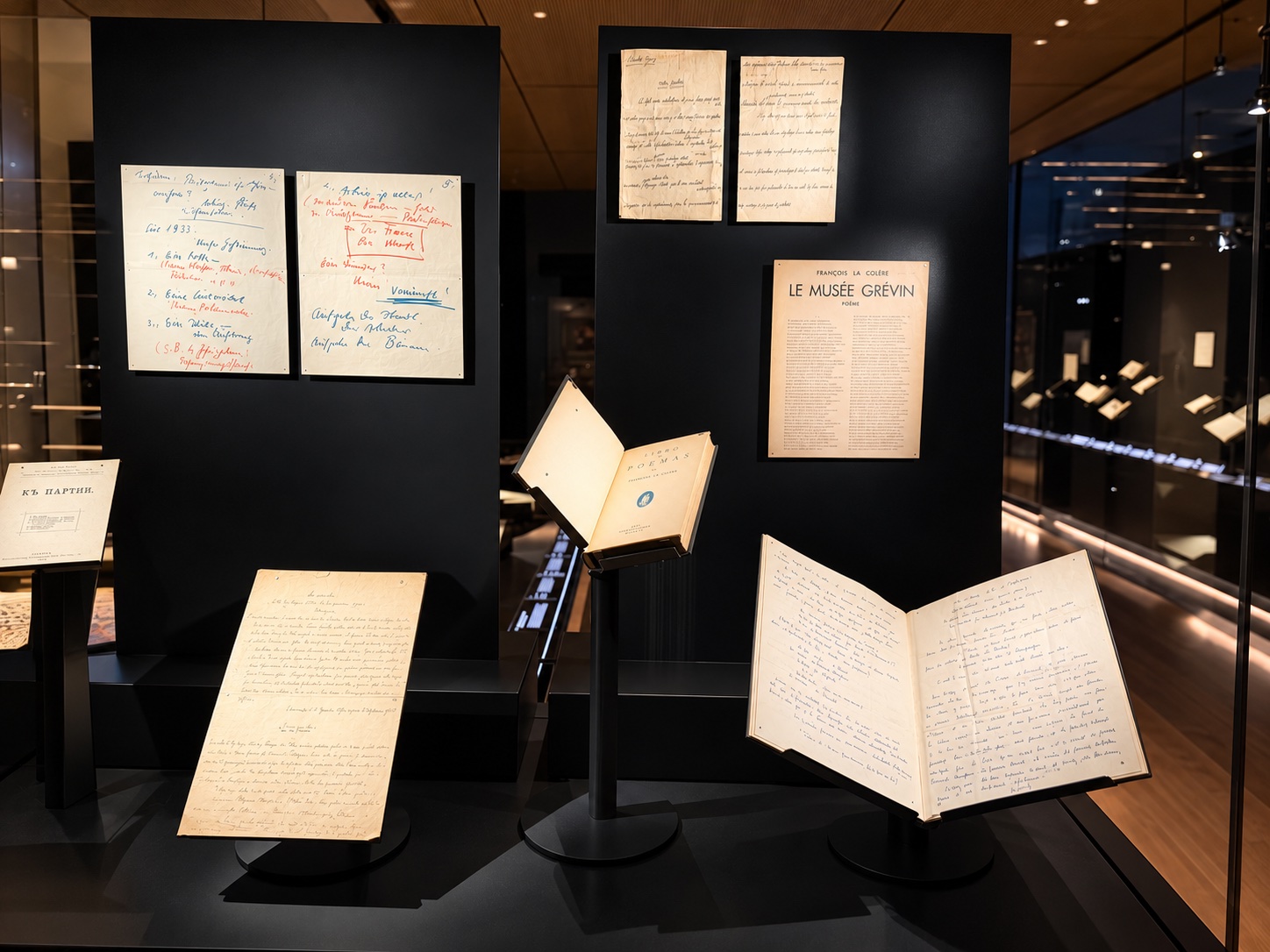
The name of Benito Mussolini is associated with another story, this one directly connected with Switzerland. As a young man, the future Italian dictator lived in Lausanne, where he attended lectures by the celebrated sociologist Vilfredo Pareto and the economist Pasquale Boninsegni. It was the latter who, having subsequently become a committed Fascist and head of the School of Social and Political Sciences at the University of Lausanne, took the initiative to award a man who had once attended his lectures an honorary doctorate in social and political sciences. On 21 November 1936, the School’s council approved the proposal: only one member of the teaching staff, Professor Jean Wintsch, voted against it. On 8 April 1937, a university delegation presented Mussolini with the diploma in Rome. The official justification praised him for having ‘conceived and established in his homeland a social organisation that has enriched sociological science and will leave a profound mark on history’. Let me remind you that by then Mussolini had been presiding over a Fascist dictatorship for more than a decade, Italy had invaded Ethiopia, and the Rome–Berlin Axis had become a political reality. Nevertheless, the Swiss professors regarded the system of government he had created as an outstanding scientific achievement. Most astonishing of all, Mussolini has still not been stripped of his honorary degree. In 2022, the University of Lausanne officially condemned its predecessors’ decision, acknowledging that it was incompatible with academic values, but chose not to annul the diploma. Instead, it decided to investigate and publicly examine this chapter of its own history. In 2024, it even devoted a special exhibition to the subject, Docteur Mussolini. Un passé sensible (Doctor Mussolini: An Uncomfortable Past). Thus, nearly ninety years after honouring the dictator, the university has condemned the award while continuing to allow him to retain the title it conferred. It would be hard to find a more striking reminder that education and academic authority are no guarantee of either political judgement or moral independence.
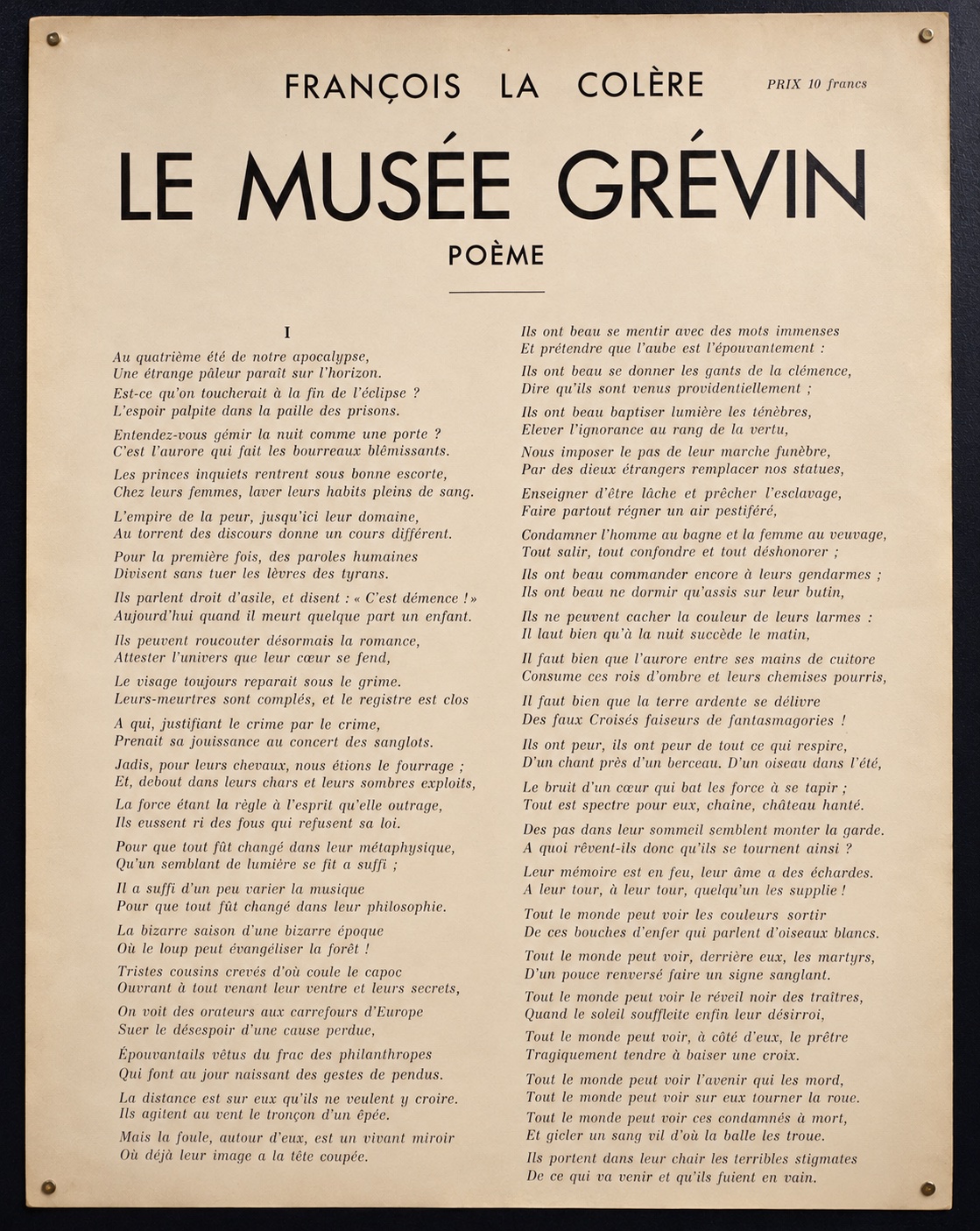
Indeed, the exhibition offers an opportunity to reflect not only on the crimes of dictators but also on the misjudgements of brilliant minds. Aragon himself, who fearlessly denounced the Nazis and proclaimed that ‘woman is the future of man’ (a truth made famous by Jean Ferrat in his 1975 song), remained a staunch supporter of the Soviet Union for many years, unwilling to acknowledge the full truth about Stalin’s regime. Is the poet always right? Nor was Jean-Paul Sartre immune to political illusions. He defended the USSR in the early 1950s, although he later condemned the Soviet suppression of the Hungarian uprising. It seems that literary talent, philosophical insight and personal courage do not always protect people from ideological blindness.
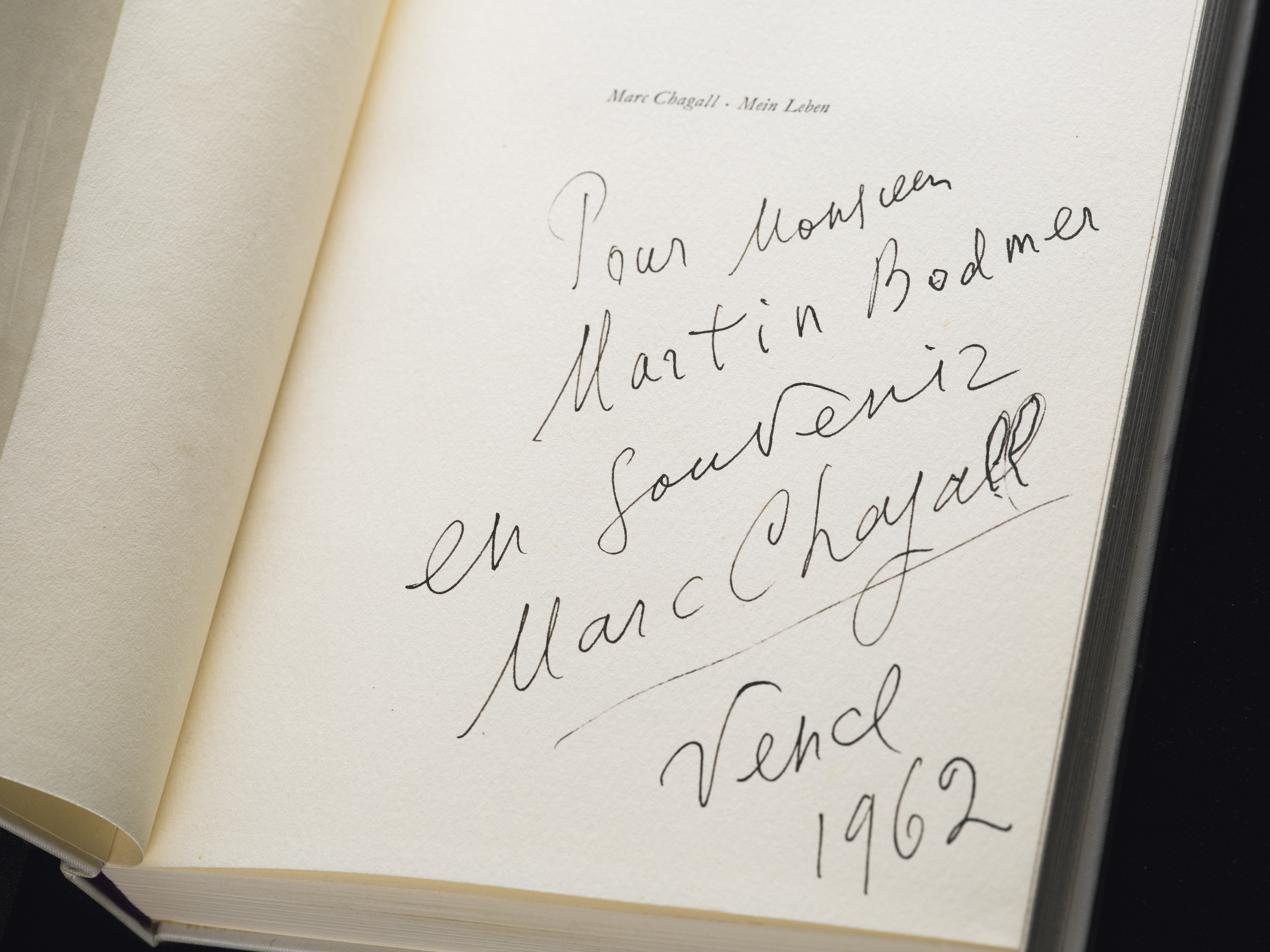
‘To Mr Martin Bodmer, as a keepsake. Marc Chagall. Vence, 1962.’ Photo: © Fondation Martin Bodmer.
The next exhibit is of an entirely different character: Marc Chagall’s My Life, published in Stuttgart in 1959. On its title page, the artist left a dedication to Martin Bodmer: ‘Pour Monsieur Martin Bodmer en souvenir. Marc Chagall. Vence 1962.’ (‘To Mr Martin Bodmer, as a keepsake. Marc Chagall. Vence, 1962.’) Did they ever meet in person? I put this question to Nicolas Ducimetière, Deputy Director of the Martin Bodmer Foundation. He kindly explained that he had been unable to find any correspondence between Chagall and Bodmer in the archives, but that the catalogue record did confirm that the book was a gift from the artist himself. ‘I am therefore inclined to think that the copy was handed over in person during a meeting in Vence, which I can date to March 1962. It is a pity, though, that we have no further information about this meeting…’ Mr Ducimetière wrote. A pity indeed. But the book is remarkable for its own history too. Originally written by Chagall in Russian, his autobiography was first published in Yiddish in 1925, followed by a French edition in 1931, translated by his wife Bella. It did not reach Russian readers until 1994, in a translation from French!
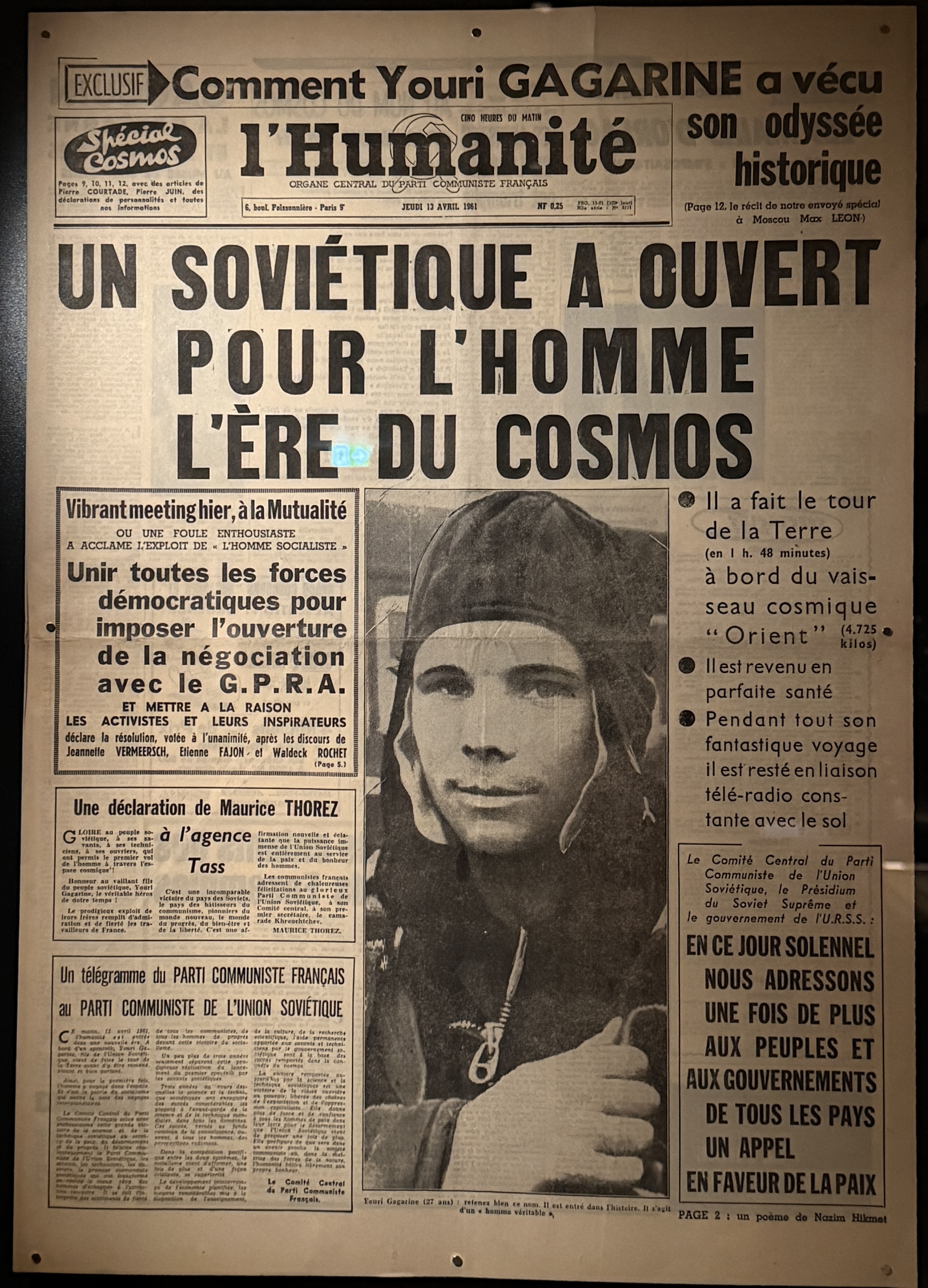
© Fondation Martin Bodmer. Photo © N. Sikorsky
Russian connections sometimes emerge in the museum where one least expects them. For instance, alongside documents devoted to the history of science and technology is an issue of the French Communist newspaper L’Humanité, dated 13 April 1961, reporting Yuri Gagarin’s flight. The event that ushered in the era of human spaceflight appears here in its original newspaper form, conveying the excitement inspired by the first human journey into space. ‘Un Soviétique a ouvert pour l’homme l’ère du cosmos’ (‘A Soviet citizen has opened the space age for humanity’), proclaims the front-page headline. Maurice Thorez, General Secretary of the French Communist Party, calls Yuri Gagarin ‘the true hero of our time’ and presents his flight as a victory for the country that is building communism. It is particularly interesting today to see how genuine enthusiasm for a great human achievement is intertwined on these pages with the ideological rhetoric of the Cold War. I should add that in 1964 the Moscow State Pedagogical Institute of Foreign Languages was named after Maurice Thorez, who died that year. The institution changed its name several times, but the French political figure was not forgotten: in 2006, the Maurice Thorez Institute of Foreign Languages, comprising three faculties, was re-established within Moscow State Linguistic University (MSLU).
To avoid accusations of cultural imperialism, I hasten to point out that the Bodmer Foundation’s treasures are by no means limited to those connected with Russia. For obvious reasons, I simply found it difficult to pass them by. But now it is time to broaden our horizons and take a look at some other display cases. Believe me, there is plenty more to marvel at.
There are, for example, exceptionally rare fragments of Homer’s Odyssey dating from the second century BC, discovered in the cartonnage of an Egyptian mummy. I wonder whether Christopher Nolan came here before filming his much-talked-about The Odyssey? There is also a sixteenth-century portrait of the mythical Chinese emperor Shennong, attributed to the Japanese artist Kanō Motonobu; the manuscript of Jean-Jacques Rousseau’s Letter to d’Alembert on the Theatre of 1758, in which the philosopher opposed the establishment of a theatre in Geneva; and a magnificent four-volume illustrated edition of Cervantes’ Don Quixote, printed in Madrid in 1780 by the celebrated printer Joaquín Ibarra for the Royal Spanish Academy.
There are musical autographs too, including a handwritten score by Johannes Brahms, and scientific manuscripts by Albert Einstein, such as his 1931 text devoted to cosmological problems in general relativity. As we know, Einstein’s career was not without its Swiss paradoxes either. After graduating from the Zurich Polytechnic in 1900, the future Nobel laureate tried in vain to secure a university assistantship. Eventually, he was employed as a third-class technical expert at the Swiss Federal Patent Office in Bern. There he examined other people’s inventions, while making discoveries of his own in his spare time, discoveries that would transform our understanding of the Universe. It was in Bern, in 1905, that Einstein developed his special theory of relativity. Today, his former apartment at 49 Kramgasse houses a museum. The Swiss universities may not have recognised a genius straight away, but the Patent Office proved more far-sighted.
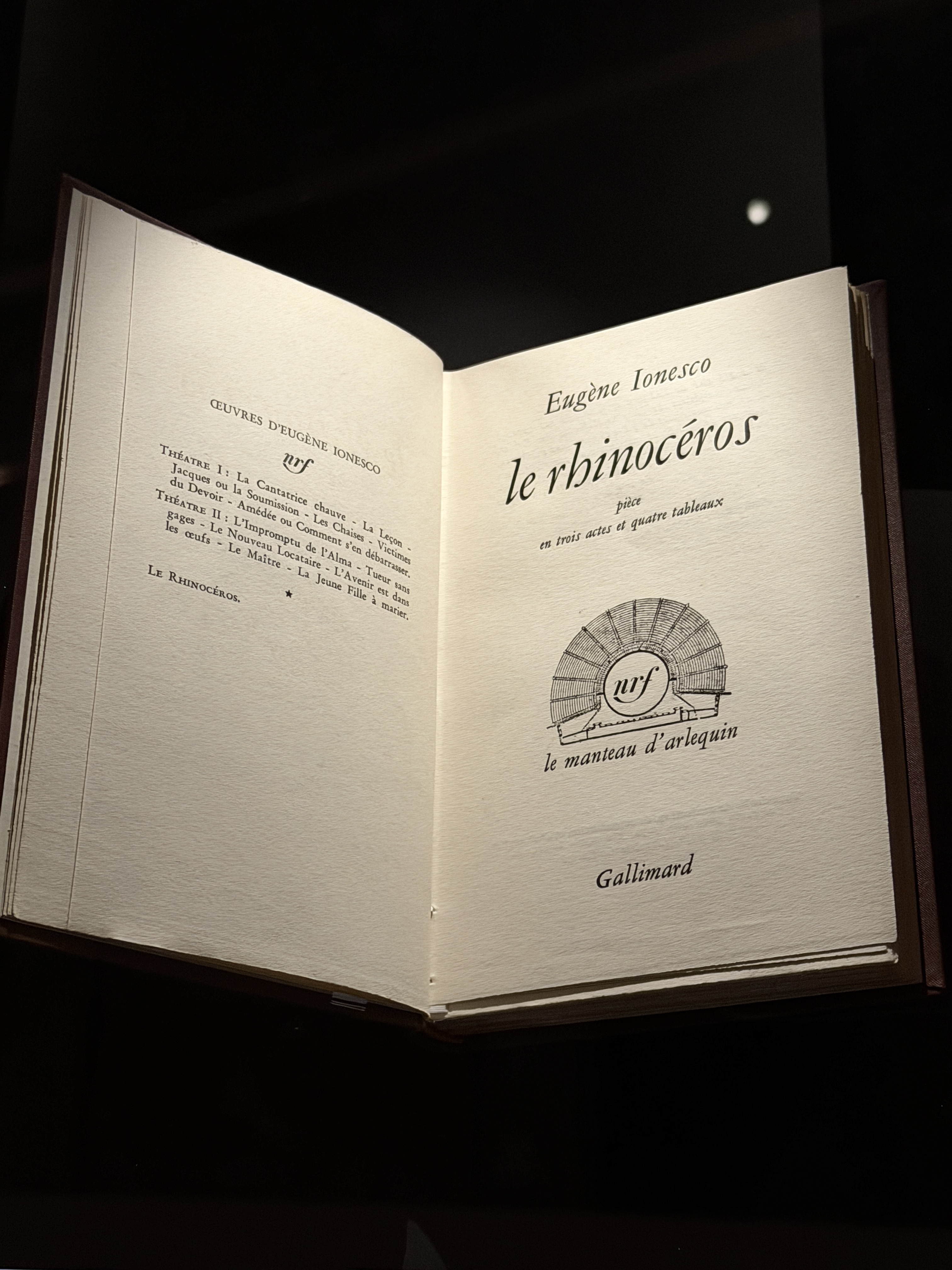
Eugène Ionesco. Rhinoceros (published in French as Le rhinocéros). First edition of the play, written in French. Paris, Gallimard, 1959.
© Fondation Martin Bodmer. Photo © N. Sikorsky
A special pleasure is encountering familiar works in their first or rare editions. Here is a French translation of Henryk Sienkiewicz’s Quo Vadis from 1900; here is John Steinbeck’s The Grapes of Wrath, published in New York in 1939. My favourite professor, Yassen Nikolayevich Zassursky, an outstanding Soviet scholar of American studies, used to lecture us on this novel. And here is Eugène Ionesco’s Rhinoceros (published in French as Le rhinocéros), issued by Gallimard in 1959. The story of the inhabitants of a small town who turn into rhinoceroses one after another has been performed on stages around the world. Curiously, the world premiere of this play, written in French, took place in Düsseldorf in the autumn of 1959, in German. In was only in January 1960, Jean-Louis Barrault presented it to French audiences at the Odéon in Paris. I did not, of course, see either of those productions, but I remember an excellent staging by Ivan Popovski at Moscow’s Pyotr Fomenko Workshop Theatre. So many decades have passed, yet the ease with which people adapt to circumstances, abandon their own opinions and so readily turn into rhinoceroses never ceases to amaze me. Ionesco surely wrote one of the most enduring plays about human nature.
The museum in Cologny, now reopened, invites us not only to admire rare treasures but also to reflect on the fate of the written word. Books travel between countries, change owners, survive revolutions and wars, sometimes disappear for centuries and then come to light again. And they continue to tell their stories to those willing to read them. Shall we?
P.S. I cannot resist inviting you to listen to Jean Ferrat’s beautiful song La femme est l’avenir de l’homme. Time has preserved what matters most in it, leaving historians to untangle the evolution of the French Communist Party, with which both Aragon and Ferrat were closely associated.