
‘Beg for Money and Chains’, or Three Tragedies in One Tragicomedy
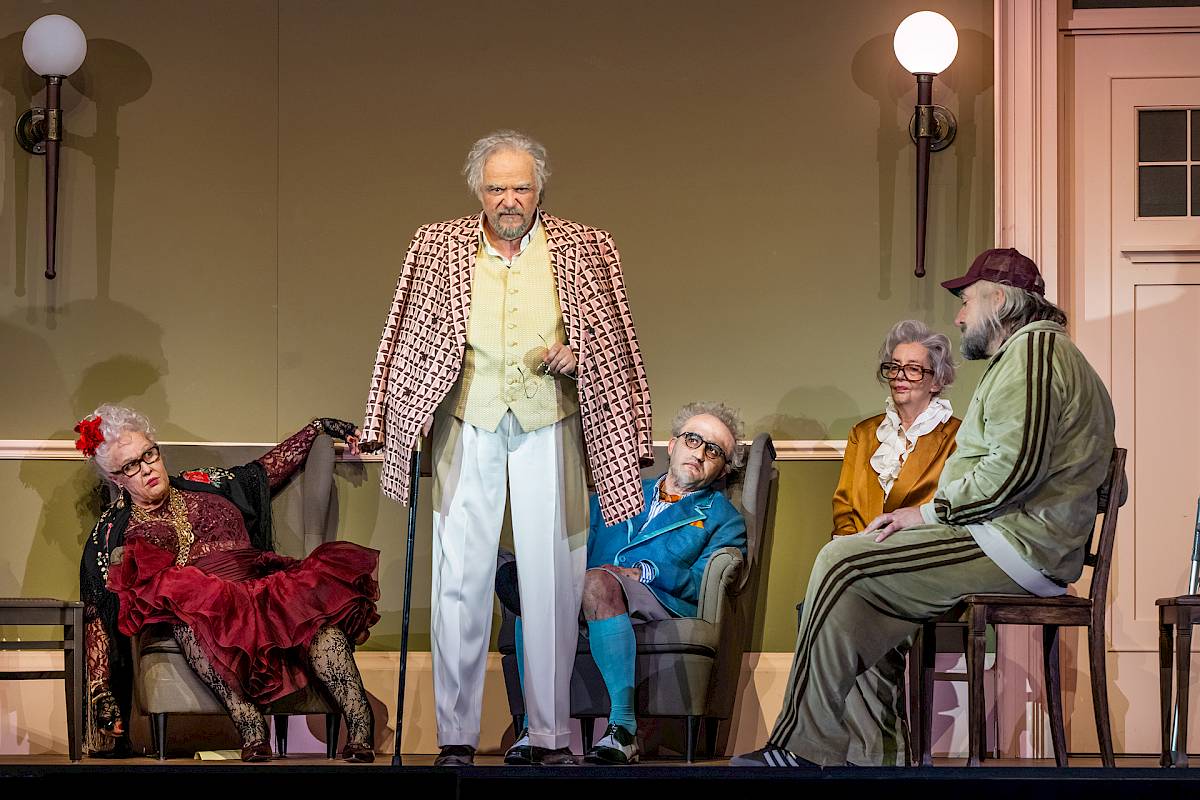
Three operas in one evening: an offer hard to refuse. Especially when the composer is Sergei Rachmaninov, one of my absolute favourites, whose piano concertos and symphonic works have long been heard in concert halls around the world, while his operas remain relatively rare visitors to the stage. I had never seen The Miserly Knight performed, and had heard Aleko and Francesca da Rimini only in concert versions.
As you know, the literary sources of operas matter a great deal to me, and I am wary of directors taking liberties with classical texts. And here we are dealing with Pushkin and Dante. So allow me a few words of background.
Aleko (1892) was the graduation composition of the nineteen-year-old Rachmaninov, based on Pushkin’s 1824 poem The Gypsies. The libretto was written by Vladimir Nemirovich-Danchenko, the future co-founder of the Moscow Art Theatre, who was already an established playwright and theatre teacher. The Bolshoi Theatre immediately took up the young composer’s work. The premiere took place in the spring of 1893 and, just imagine, Tchaikovsky was in the audience! As Rachmaninov himself recalled, ‘when the opera was over, he leaned out of the director’s box and applauded with all his might’. Afterwards, Tchaikovsky suggested presenting Aleko on the same evening as his own Iolanta. Alas, his death that autumn prevented the plan from being realised. The central conflict of Aleko is between his professed belief in freedom and his refusal to grant that same freedom to another person.
When composing The Miserly Knight in 1903–1905, Rachmaninov used the text of Pushkin’s little tragedy of the same name almost without alteration. Their Baron is not merely a miser like Gogol’s Plyushkin. His gold embodies power over people and circumstances, the illusion of absolute independence. He values wealth above human relationships and effectively sacrifices his own son to it. Francesca da Rimini (1904–1905), based on an episode from Canto V of Dante’s Inferno, received its premiere on the same evening as The Miserly Knight, in 1906. Its libretto was written by Modest Tchaikovsky, the great composer’s brother.
And how could one not think of Rodin, who was also inspired by the love story of the young Paolo and Francesca, whose downfall was brought about by… a book! Rodin initially conceived the couple for his monumental Gates of Hell, a copy of which can be seen outside the Kunsthaus Zürich, a ten-minute walk from the Opera House. But he eventually abandoned the idea: their blissful, sensual embrace contrasted too sharply with the sombre conception of the Gates as a whole. The book, however, has remained in Paolo’s left hand, behind Francesca’s hip: the very romance of Lancelot and Guinevere that the lovers began reading before their fateful kiss and never finished. The difference is that Rodin extracted a moment of love from Dante’s tragedy, while Rachmaninov concentrated on its fatal consequences.
Thus, only thirteen years separate the first and last of these operas, but for Rachmaninov they marked a journey from a youthful graduation work to full artistic maturity. And although their plots belong to different periods and literary traditions, they reveal an unexpected kinship: all three tell of people seeking to possess what cannot belong to them absolutely: a loved one, wealth or another person’s fate. I suspect it was this ‘kinship’ that gave Dmitri Tcherniakov his idea.
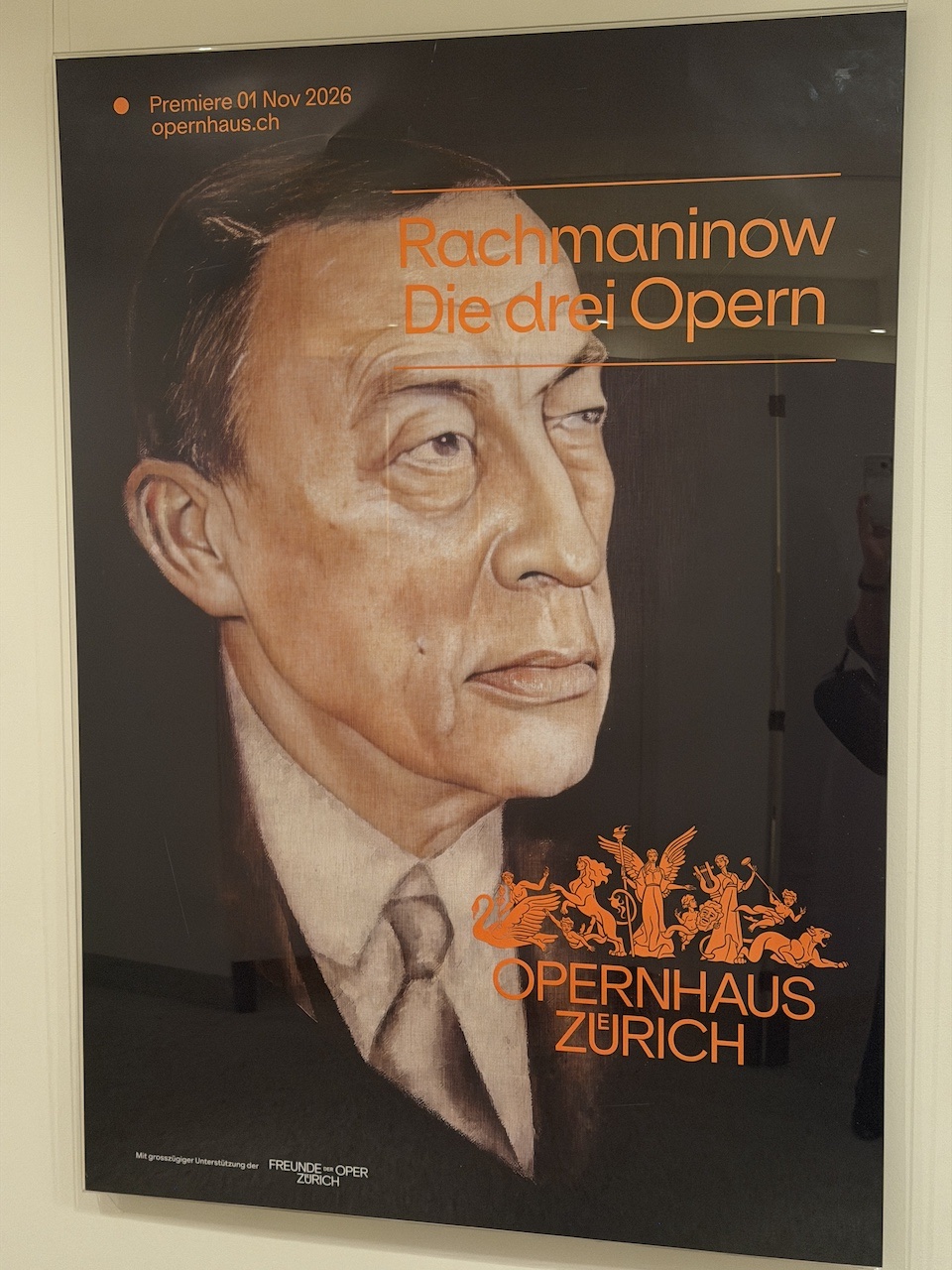
Photo © N. Sikorsky
I am sure my readers need no introduction to one of the most sought-after opera directors of his generation, a seven-time winner of Russia’s Golden Mask award, a four-time winner of the International Opera Awards and recipient of other international theatre prizes. Born in Moscow in 1970, he graduated from GITIS, the Russian Academy of Theatre Arts, in 1993 and has since worked at practically every major opera house in the world. Tcherniakov has long been a familiar figure at the Zurich Opera House, where he has already staged four productions: Janáček’s Jenůfa (2012), Debussy’s Pelléas et Mélisande (2016), Janáček’s The Makropulos Affair (2019) and Korngold’s Die tote Stadt (2025). And now the director, who made his debut abroad in 2005 with Boris Godunov at the Berlin State Opera, conducted by Daniel Barenboim, is presenting Russian repertoire in the city on the River Limmat for the first time.
Dmitri Tcherniakov has made his name by uncovering contemporary psychological dramas beneath historical and mythological plots. His determination to reinterpret the circumstances and relationships of the characters, even when seeking to preserve the inner logic of their human conflicts, does not appeal to everyone. His productions frequently provoke debate and have sometimes caused outright scandals. In 2006, for example, Galina Vishnevskaya refused to attend his production of Eugene Onegin, dedicated to her eightieth birthday, calling it a ‘desecration of national treasures’.
Given all this, one could hardly expect a straightforward approach from him this time either.
From an interview on the Opernhaus Zurich website, I had already learnt that Tcherniakov had combined the three operas into the story of a single man who, gradually losing touch with reality, relives or imagines events while assuming different identities. Whether this would prove convincing remained to be seen at the premiere. As did the answers to two other questions. Would Pushkin, Dante and Rachmaninov himself disappear behind the director’s concept? And what would Tcherniakov do with the women, given that Zemfira and Francesca are entirely different heroines?
True to his usual practice, Dmitri Tcherniakov took on two roles himself, as both director and set designer. But the other participants in the production, many of whom had developed as artists within the Russian or post-Soviet operatic tradition, also had to experience a splitting, or even a tripling, of their personalities.
Belarusian baritone Vladislav Sulimsky, a graduate of the St Petersburg Conservatoire, was chosen to provide the link between the three operas, performing all three central roles: Aleko, the Baron and Lanciotto. Russian soprano Elena Stikhina sings Zemfira and Francesca, while Bekhzod Davronov, born in Samarkand, appears as the Young Gypsy and Paolo. Ukrainian tenor Dmytro Popov sings Albert, and Estonian bass Ain Anger plays the Old Gypsy in Aleko and Virgil in Francesca. The cast also includes Pavel Yankovsky (the Duke), Alexey Dolgov (the Moneylender and Dante), Stanislav Vorobyov (Ivan) and Dominika Stefańska (the Old Gypsy Woman).
On the podium is Gianandrea Noseda, Music Director of the Zurich Opera House, faced with the task of bringing three very different scores together into a single musical whole.
But let us return to the literary sources. In preparation for the premiere, I dutifully reread The Gypsies, The Miserly Knight and Canto V of Dante’s Inferno. Armed with these texts and a swarm of themes and associations that I was already eager to share with you, I set off for Zurich. Here are just a few of them.
Take Pushkin’s theme of freedom and slavery, for example. Aleko despises urban society, where people ‘beg for money and chains’, yet demands obedience from Zemfira. The Baron, intoxicated by the power of gold, serves it himself, in his son’s words, ‘like an Algerian slave, like a dog on a chain’. Lanciotto regards Francesca as his property. All three dream of possessing something that cannot belong to them. And all three become slaves to their own passions.
Or consider their attitudes towards infidelity. The Old Gypsy tells Aleko how his wife Mariula once left him. He took revenge on neither her nor her lover: ‘Why should I? Youth is freer than the birds. Who can restrain love?’ Aleko, by contrast, murders Zemfira and the Young Gypsy. And how can we forget that Dante consigned Francesca and Paolo to Hell for a love that violated marital fidelity? Pushkin’s Old Gypsy refuses to punish an unfaithful wife, while Dante’s lovers are condemned to eternal torment.
And how much there would be to say about The Miserly Knight! About Albert’s poverty, which forces him to humiliate himself before the moneylender; about the Baron’s wealth, built on other people’s tears, blood and sweat; about his relationship with his own conscience. About how easily the thirst for money becomes a thirst for power, and the thirst for power becomes a willingness to control other people’s destinies. Even Russia’s present war against Ukraine inevitably makes us hear Pushkin’s lines about poverty driving men to war to display their ‘soldiers’ valour’ in a different way.
Finally, The Gypsies itself, with its Bessarabia, its recollection of a time when ‘the Muscovite had not yet threatened the Danube’, and its words about ‘our old double-headed eagle’ still proclaiming its former glory, reads quite differently today from just a few years ago. That, too, was something I wanted to discuss.
But it became clear almost immediately that all my preparations had been, to put it mildly, somewhat beside the point.
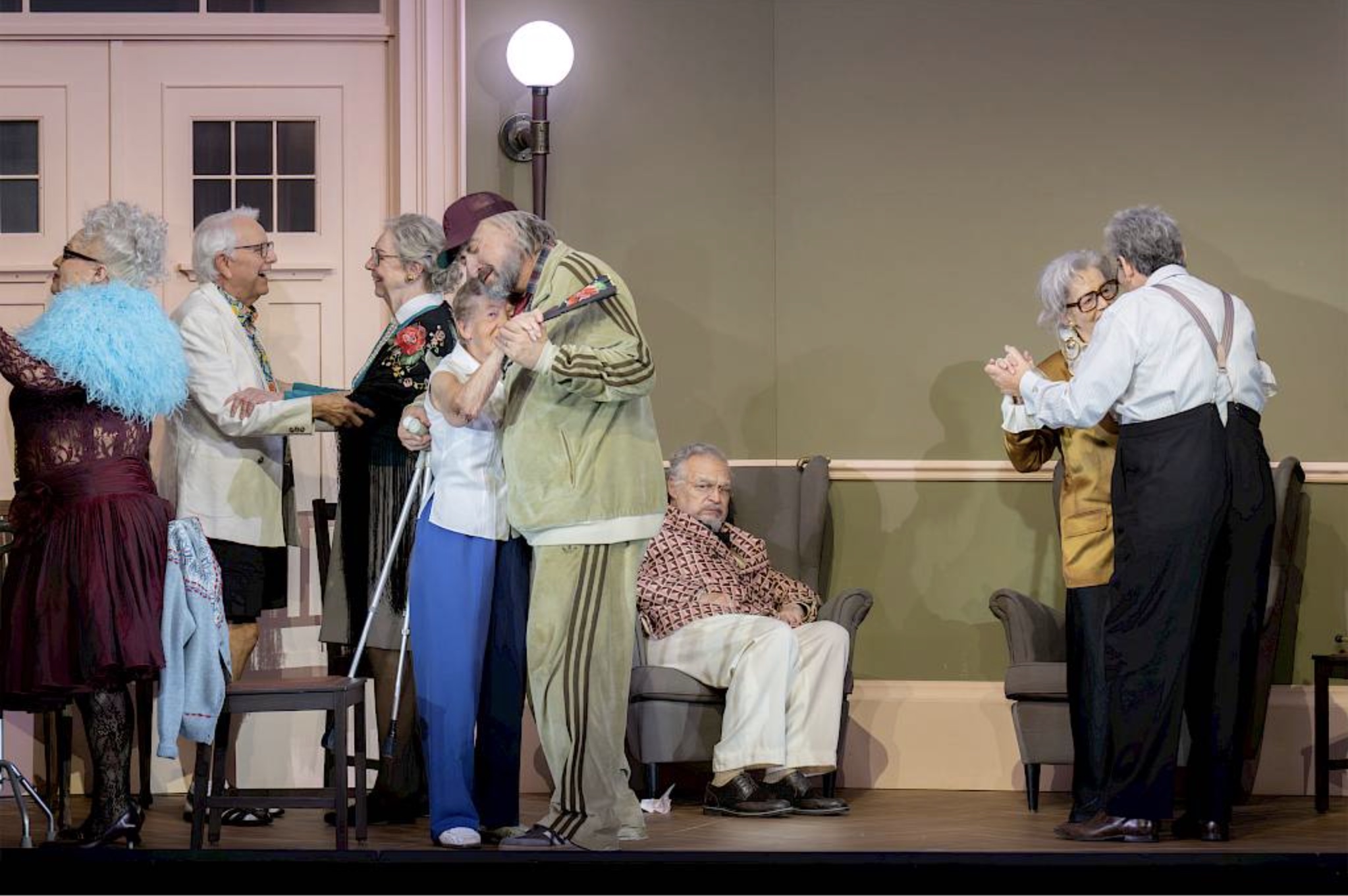
‘In noisy crowds the gipsies bold / Their way through Bessarabia tramp’, begins Pushkin’s poem. In Tcherniakov’s production, this noisy throng shuffles across the stage to Rachmaninov’s music, supporting one another and leaning on walking sticks, crutches and walking frames. Rather briskly too, I must say. Here is our ‘noisy crowd‘! Except that it wanders not through Bessarabia but along the corridors of a decidedly comfortable retirement residence. Instead of ‘brightly coloured rags‘, its residents wear equally colourful, though thoroughly modern and sometimes even elegant clothes. And if anyone hopes that passions finally subside with age, Tcherniakov’s production offers no such reassurance. Jealousy, the thirst for power and old grievances never go away. Pushkin’s ‘fatal passions’, it seems, pursue us to the grave.
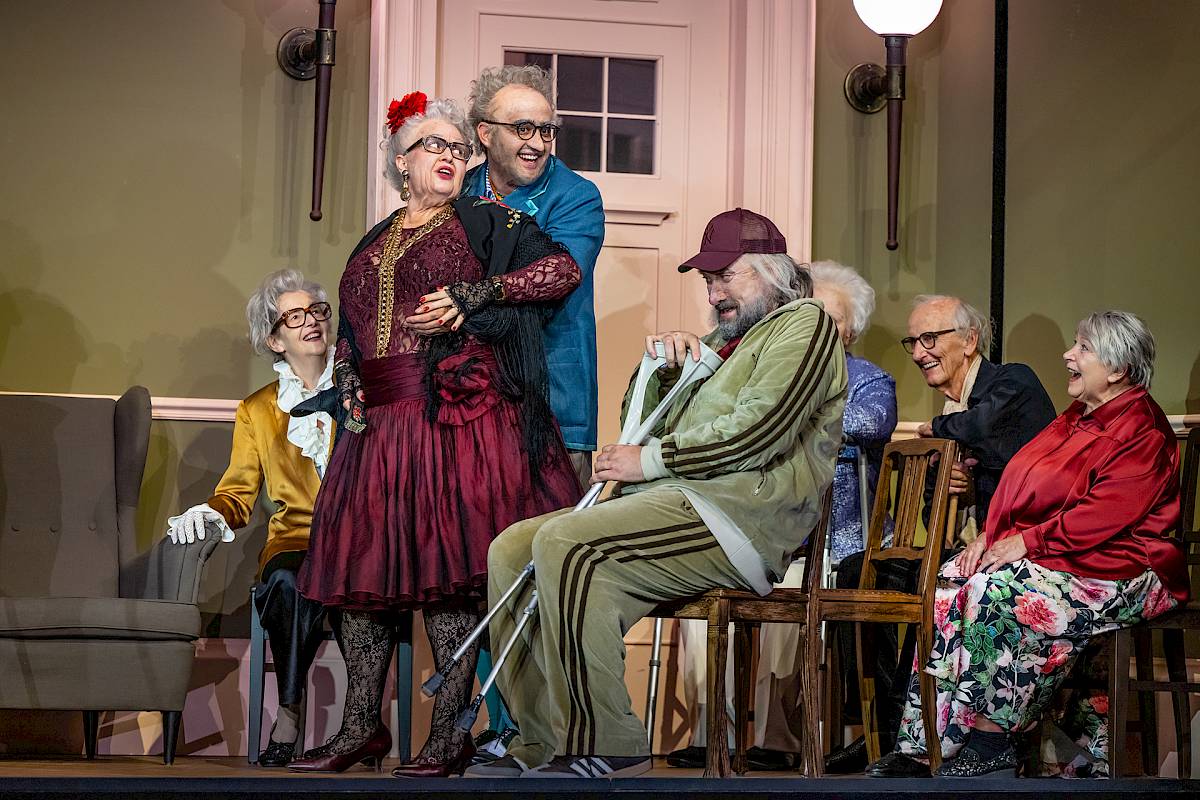
This setting remains with us throughout the evening. The residents get together, tell one another stories and act out scenes from the past. Or rather, it is not always clear whose past they are revisiting: their own or an imagined one. The others willingly play along with the storytellers, while the staff discreetly keep an eye on what is happening. The words of Francesca in Dante’s Inferno come to mind:
‘There is no greater sorrow
Than to be mindful of the happy time
In misery.’
‘Nessun maggior dolore
che ricordarsi del tempo felice
ne la miseria…’
Thus, instead of three tragedies, Tcherniakov offers us a single tragicomedy of old age. And at times this tragicomedy comes dangerously close to farce.
Here is Aleko, performed by Vladislav Sulimsky, recalling his love for Zemfira. But an elegant silver-haired lady wearing a blue feather boa, played by Elena Stikhina, makes it abundantly clear to everyone around her, through expressive gestures, that the old man is talking complete nonsense: nothing of the sort ever happened between them. That is why everyone bursts out laughing at the words ‘Zemfira is unfaithful’, even though they clearly cause Aleko anguish. Rachmaninov’s music tells of passionate love, while on stage we see a man who may have invented the whole affair in his old age. Zemfira, incidentally, looks wonderful, and I can readily believe that in her youth she could have turned more than one Aleko’s head. And when Stikhina sings ‘Old husband, stern husband’ with such brilliance, one cannot help remembering that in the second half of the evening she will become Francesca, who also fell in love with another man rather than her husband.
The Young Gypsy, who will later become Paolo, appears in Bermuda shorts, blue knee-high socks and a jacket of the same colour. Bekhzod Davronov will have to live through quite a few dramatic moments in this outfit.
After the first half, my neighbour, a German music critic, was absolutely delighted. He shouted ‘Bravo!’ and declared that Tcherniakov had found a completely original approach to the classics by addressing the highly topical subject. Without specifying which.
I decided not to pursue the matter.
‘Have you read Pushkin?’ I asked.
‘No. Have you?’
‘Yes, I have. And that’s my problem.’
By then it had become clear that Tcherniakov had not merely mixed up the three operas but had also ‘cut’ The Miserly Knight in half. The first half ended before the Baron’s famous monologue about gold as a source of limitless power, and the second began with that very monologue. Thus The Miserly Knight became not only the psychological but also the structural centre of the entire evening.
Indeed, I found it difficult to reconcile the tragic music with what was happening on stage. Especially when it became funny. Laughing at old people, their weaknesses and their obsessions? After all, every one of us will grow old, if we live long enough. And I must confess that I would not want to spend the last years of my life in an institution like this, however comfortable it might be.
But gradually I began to notice something far more disturbing lurking behind the comic situations.
In The Miserly Knight, another resident of the retirement home, magnificently acted and sung by Dmytro Popov, imagines himself to be Pushkin’s Albert. He talks about a broken helmet and a knightly tournament as though it had all happened to him only yesterday. We immediately realise that this is a man who has lost the ability to distinguish fantasy from reality. That is why the person listening to him is not Ivan, his servant in Pushkin’s play, but a care attendant. He listens attentively to his charge, summons other participants in the imaginary story and then, leaving him alone with Solomon the moneylender (Alexey Dolgov), continues to watch them discreetly through a half-open door, ready to intervene if things take a dangerous turn. The meeting between the Baron and the Duke becomes almost a psychiatric consultation: an elderly man talks about his relationship with his son, while the person listening patiently tries to make sense of his accusations.
Yet the Baron’s monologue becomes no less terrifying as a result. On the contrary, his obsession with gold, his fear of his son, his hatred of conscience and his inability to love acquire an additional dimension. We see a man who has lived a long life but has never managed to free himself from what tormented him before.
Another inspired directorial idea is the scene of the Baron’s death: his heart cannot withstand the confessions he has made. Attendants rush to his aid and try to resuscitate him, while those around him freeze in a tableau of mourning. The music announces his death. And suddenly Sulimsky gets up quite calmly, blows kisses to everyone and walks away. Is this his soul leaving his body? If so, I have never seen a more unexpected depiction of a departing soul.
In Francesca da Rimini, the theatrical game becomes entirely explicit. Lanciotto, again played by Sulimsky, tears pages out of a book (!) and hands them to Francesca and Paolo, who begin acting out the roles he has assigned them. A play within a play, a theatre within a retirement home. At this point Shakespeare inevitably comes to mind: ‘All the world’s a stage, / And all the men and women merely players.’ And of course Jacques’s famous speech in As You Like It ends precisely with old age, the last of the seven ages of man!
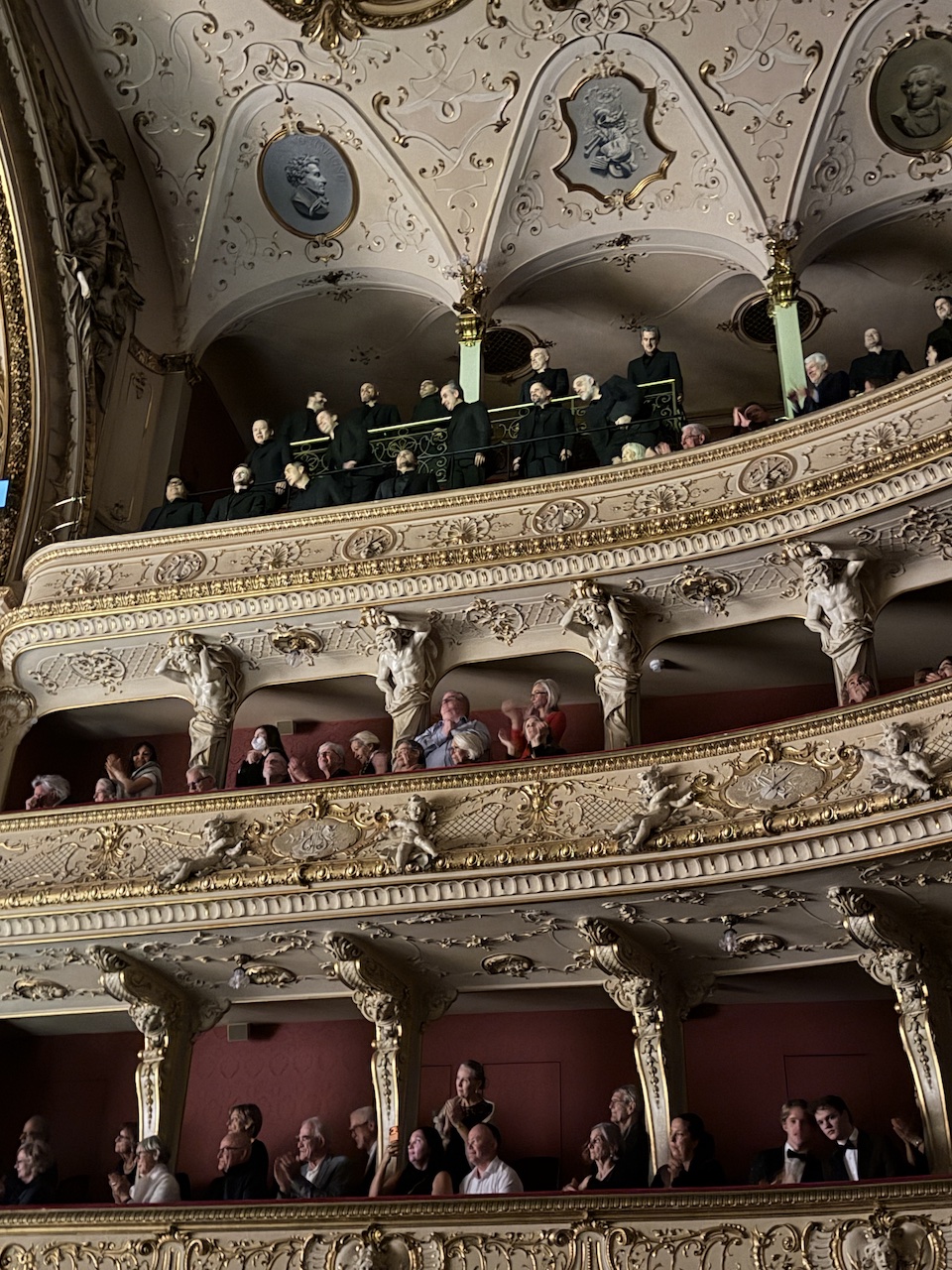
But the music never allows us to forget that this is a tragedy. Especially when the chorus, divided into male and female groups, sings from the uppermost tier of the auditorium. The voices come from somewhere high above, surrounding Lanciotto, who clutches his head and tries to cover his ears but cannot escape them. And once again I thought of Pushkin’s Baron, for whom conscience is a ‘clawed beast scratching at the heart’, an ‘uninvited guest’ from whom there is nowhere to hide. Does this chorus become the voice of conscience, pursuing a man to the very end? And perhaps beyond?
The magnificent duet between Francesca and Paolo, sung by Elena Stikhina and Bekhzod Davronov, also unexpectedly brings us back to the literary source. The lovers hope that, if they cannot be united on earth, they will meet in heaven. But we know that Dante has prepared a very different address for them in the afterlife: the second circle of Hell, reserved for carnal sinners. And once again we remember Pushkin’s Old Gypsy, who, unlike Dante, did not condemn his unfaithful wife or seek revenge for her love of another man.
And how wonderfully Davronov sings in this scene! I must admit that the Young Gypsy’s romance in Aleko, earlier in the evening, did not make quite such a strong impression on me, perhaps because part of it was sung ‘offstage’: the tenor, as befits his role, was entertaining the audience in the adjoining room. (Incidentally, in Pushkin’s poem it is the Old Gypsy, Zemfira’s father, who recites the words of the romance.) But in the final part of Francesca, the young tenor came into his own. Stikhina was magnificent in both roles: her Zemfira was at once charming and mocking, while her Francesca was touching in her willingness to relive her tragic love story.
Indeed, every single member of the cast proved to be not only an excellent singer but also a fine dramatic actor. This is particularly important in a production where everyone has to play several roles, sometimes even portraying someone who imagines themselves to be somebody else.
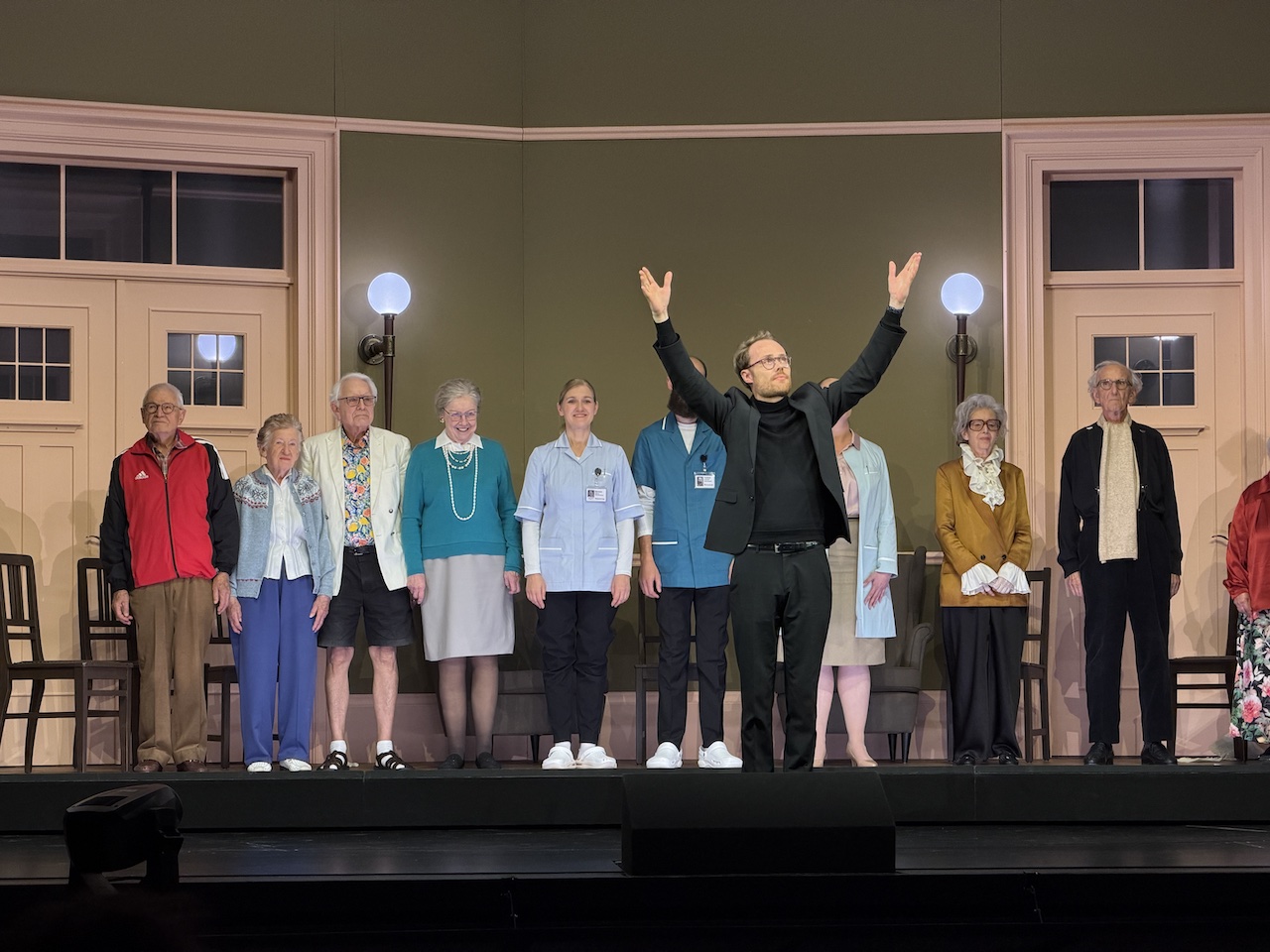
No less impressive was the work of conductor Gianandrea Noseda. He has been Music Director of the Zurich Opera House since the 2021/22 season and was previously Principal Guest Conductor of the Mariinsky Theatre, so Russian music is familiar territory to him. Zurich audiences had already had an opportunity to appreciate Noseda’s particular affection for Rachmaninov’s music in 2023, when the Zurich Opera House and the Tonhalle Orchestra joined forces for a concert cycle marking the 150th anniversary of the composer’s birth. Noseda has an exceptional feeling for Rachmaninov, for his lyricism, passion and tragic intensity. In Aleko, the music retains its youthful spontaneity; in The Miserly Knight, it acquires an almost unbearable psychological sharpness; and in Francesca, it unfolds into a grand symphonic drama. Despite the differences between the three scores, everything comes together as a single musical whole.
But the undisputed star of the evening was Vladislav Sulimsky. A real tour de force! In the course of a single evening, he had to suffer two heart attacks, die once and even portray his own departing soul. And all this without ever ceasing to sing magnificently. Three demanding roles, three different characters, a continuous presence on stage, an immense vocal and acting workload, and not the slightest sign of fatigue. His Aleko, Baron and Lanciotto truly become three incarnations of a single man, haunted by memories, jealousy, fear and guilt. But why, after all, choose precisely this kind of man?
I think the answer gradually emerges from the stage setting itself. Outside the windows of the retirement home, the weather changes: snow falls in Aleko, the wind bends the trees in The Miserly Knight as though it were about to break them, and in Francesca a fiery inferno appears. But nothing changes inside. The stage revolves, bringing us back to the same corridors and rooms. There is movement, but no way out.
It was then that I realised I might have been wrong to think Tcherniakov had abandoned the central themes of Pushkin and Dante. Freedom and slavery, money and chains have not disappeared. A person remains chained to their own past, to deeds that can no longer be undone, to grievances they have been unable to forget, to guilt they will not or cannot acknowledge.
That is why the residents of this strange home tell one another their stories again and again. Each of them is trying at last to speak their mind, to unburden their soul, to hear a word of understanding or forgiveness from someone else. But what can one do if the person to whom one needed to confess is no longer there?
In Pushkin’s Boris Godunov, there is the terrifying image of ‘And bloody boys revolve before the eye.’ Of course, not all of us have committed a crime. But is there anyone who has never hurt another person and later regretted what they did?
I felt this particularly strongly in the scene of Aleko’s expulsion. Zemphira’s father,the Old Gypsy, sings on crutches: ‘But we will not live with a murderer.’ And Aleko is cast out of the little community: while everyone else remains in the communal sitting room, he finds himself alone, without his ‘camp’.
And suddenly I felt sorry for him. Genuinely sorry. But why? He is a murderer! He is the one who killed Zemfira and the Young Gypsy! Can he possibly be excused?
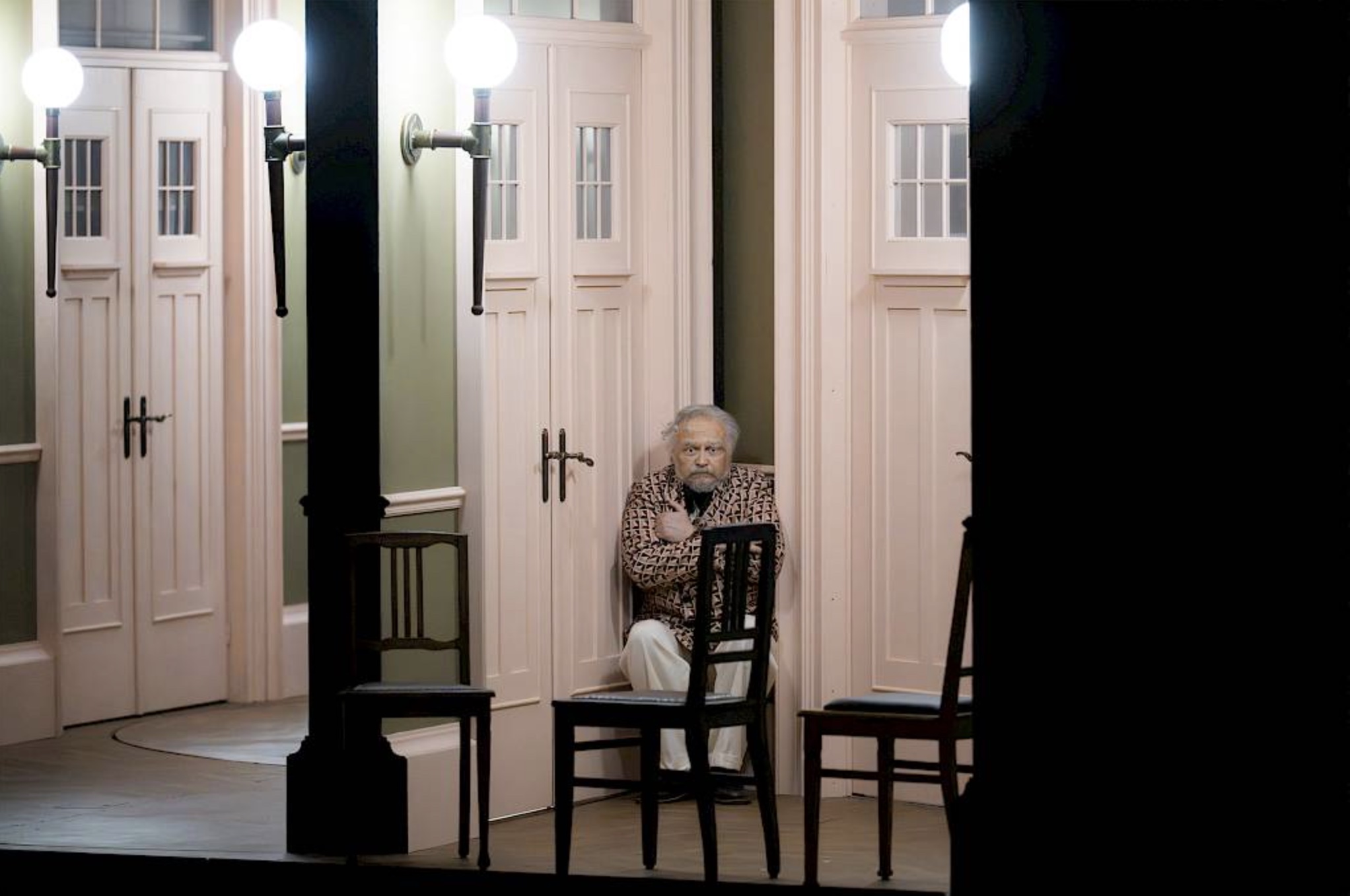
No, he cannot. But it is possible to condemn someone for the evil they have done and at the same time feel compassion for their loneliness. My own unexpected reaction made me reflect on how frightening it must be to grow old without anyone in whom one can confide. Today people seek such a listener in psychologists, and increasingly even in artificial intelligence. I would not be surprised if this subject, too, soon found its way onto the operatic stage.
Yet being listened to and being forgiven are not the same thing. And I cannot agree with an unconditional call to forgive everyone, always. In my view, the person at fault must first find the courage to acknowledge their guilt, repent and ask for forgiveness. And do so in time, while there is still someone left to forgive them.
At the end of the performance we hear words that go back to Dante: ‘Quel giorno più non vi leggemmo avante’ (‘That day we read no more’). The lovers never finished the story of Lancelot and Guinevere. I suspect that most of the audience had not read Dante either, let alone Pushkin. But I now realise that without them I would not missed half of what I discovered in this production.
Knowing my attitude towards contemporary opera direction, one might reasonably have expected me to dislike Tcherniakov’s production. And dislike it categorically. After all, what could be further removed from Pushkin’s The Gypsies and the medieval story of Francesca da Rimini than a retirement home with its corridors, walking frames and care attendants?
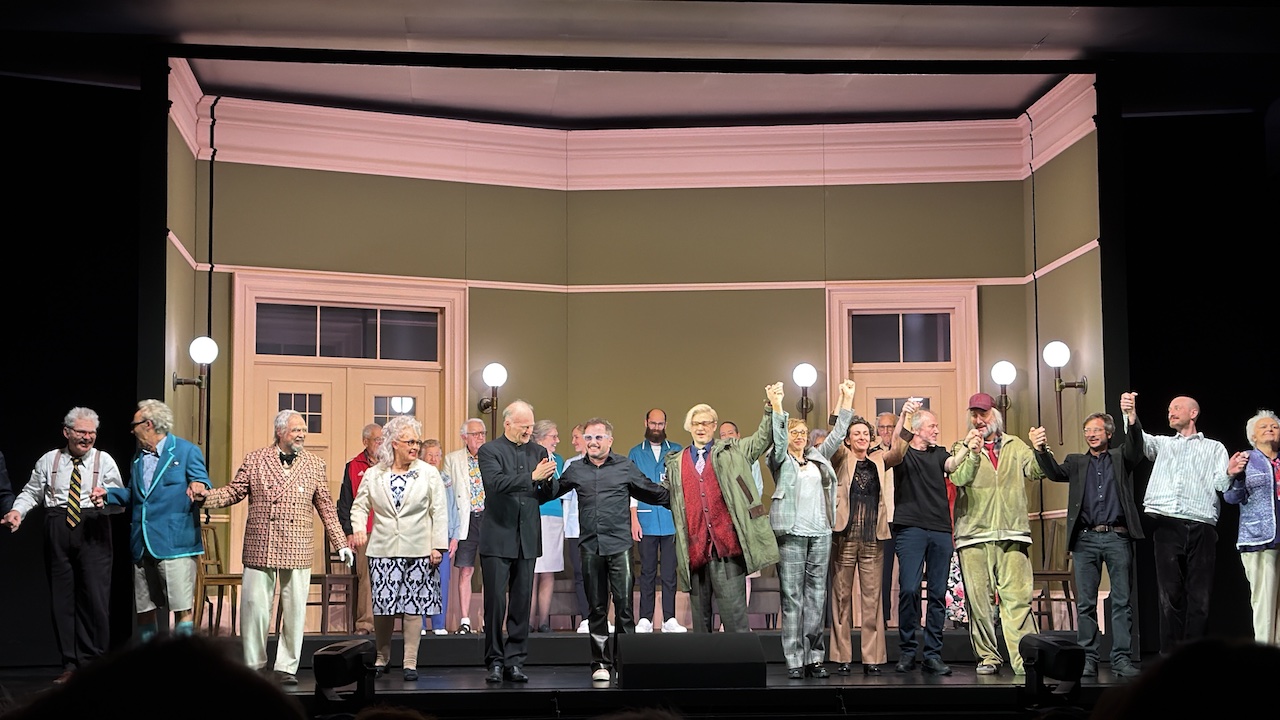
Photo © N. Sikorsky
But when I woke up the following morning, I was surprised to discover that my impressions of the performance remained extraordinarily vivid. And positive.
Gradually, I understood that the strength of this production lies in more than its original directorial concept. Tcherniakov makes the audience look beyond the outward appearance of farce and examine themselves. Why do I feel sorry for a villain? Why, where I ought perhaps to find something funny, do I feel anxiety rather than amusement? Why do these old people, acting out other people’s tragedies, suddenly seem so close to me?
We are accustomed to showing others above all the things we can be proud of. Social media makes it particularly clear how carefully people select the happy moments of their lives, leaving pain, fear and loneliness outside the frame. Tcherniakov has brought onto the stage precisely what is usually kept hidden. And he has done so in a way that allows the performance to live on in the mind long after the music has ended. Behind the comedy on stage lies the tragedy of people who have less and less time left to make peace with their own past.
And if a production makes its audience reflect on these things, listen to their own unexpected reactions and question their habitual judgements, is that not evidence of a great director’s talent? But to understand and acknowledge this, we need to free ourselves from our own preconceptions, if only briefly, if only for the three and a half hours of the performance. Even when those preconceptions have been shaped by our great and beautiful classical heritage.
P. S. Finally, allow me to share with you a recording of the Young Gypsy’s romance, made almost a hundred years ago by the tenor who remains my favourite: my grandfather, Solomon Khromchenko.