
Masks and Faces at the Barbier-Mueller Museum

The modestly sized Barbier-Mueller Museum, in the heart of Geneva’s Old Town, has a remarkable gift for showing its exceptionally rich collections of so-called primitive art in an unexpected light, introducing visitors to the symbolism of scarification on one occasion and African rituals on another. Here, works by contemporary artists have already entered into dialogue with objects created centuries ago in different corners of the world, together exploring spirituality, beliefs and the invisible connections between cultures. But the new exhibition, Masques à démasquer (Masks to Unmask), is unlike any of its predecessors. This time, visitors are invited not only to look, compare and reflect, but also to conduct their own investigation.
The museum staff, led by Laurence Mattet, who for nearly forty years has been not a mask but a familiar face to regular visitors to this exceptional collection, have decided to play a rather unusual game with their visitors. During the exhibition’s first month, some exhibits are accompanied by deliberately mismatched labels. In other words, the familiar museum convention whereby reading a label is enough to establish an object’s origin, age and purpose has been deliberately overturned. Visitors must identify the discrepancies for themselves, examine the materials, shapes and facial expressions, compare what they see and try to distinguish truth from deception.
There is more to this approach than a desire to entertain the public. We are so accustomed to trusting museum labels that we sometimes read them before taking a proper look at the works themselves. Here, we are encouraged to look first, compare what we have seen and only then find out more. And, in the process, to consider how easily we can be mistaken when we rely on outward similarities and preconceived notions about unfamiliar cultures.
The exhibition’s title thus acquires a double meaning. The French verb démasquer means ‘to remove a mask’ or ‘to unmask’ in the figurative sense. But what exactly are we supposed to unmask: a museum deception, the person concealed behind a mask, or our own prejudices?
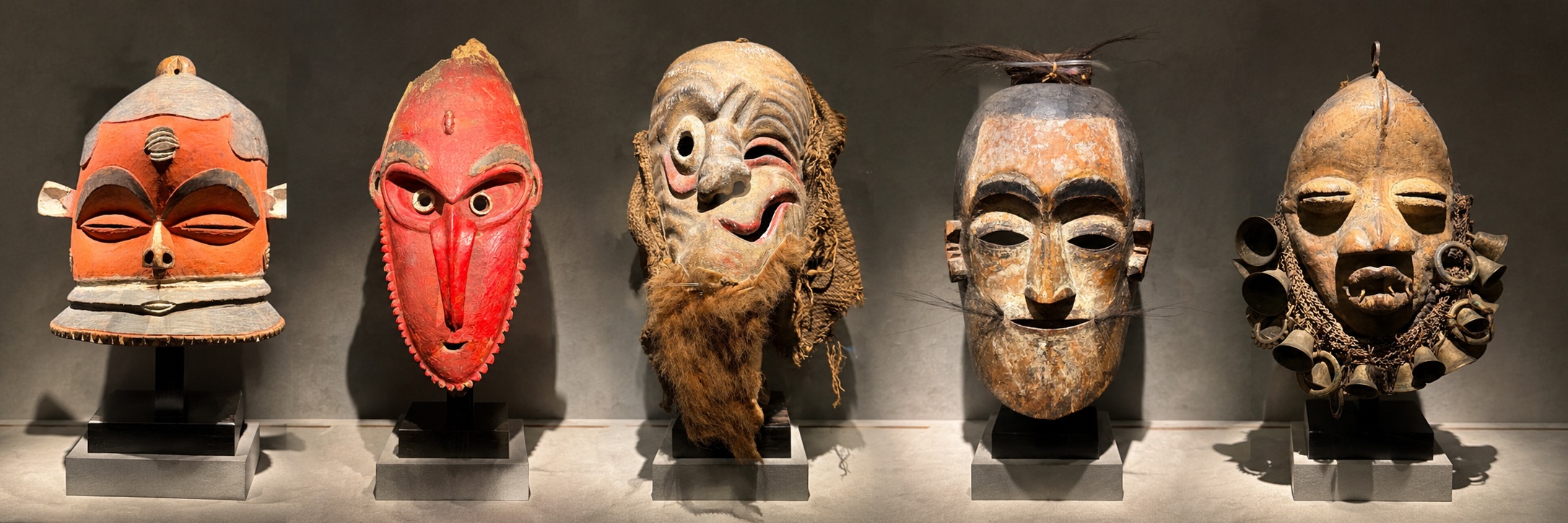
The exhibition brings together 84 works from Africa, Asia, Europe, Oceania and the Americas. Rather than arranging them geographically or chronologically, the curators have brought together objects that, at first glance, seem to have nothing in common. There is room for cinema and contemporary art, as well as exhibits that are not, strictly speaking, masks at all.
What, then, unites all these objects? Why have people felt the need, for thousands of years, to cover their faces, change their appearance and portray someone else? A mask can protect or intimidate, conceal a person’s identity or, conversely, emphasise it. It can serve as an intermediary between the world of the living and the world of spirits, help an actor transform into a character, or allow a carnival participant to escape their usual social role for a while. It can be a sacred object, a work of art, a piece of working equipment or part of a sports kit. And someone who covers their face is by no means always trying to remain unrecognised.
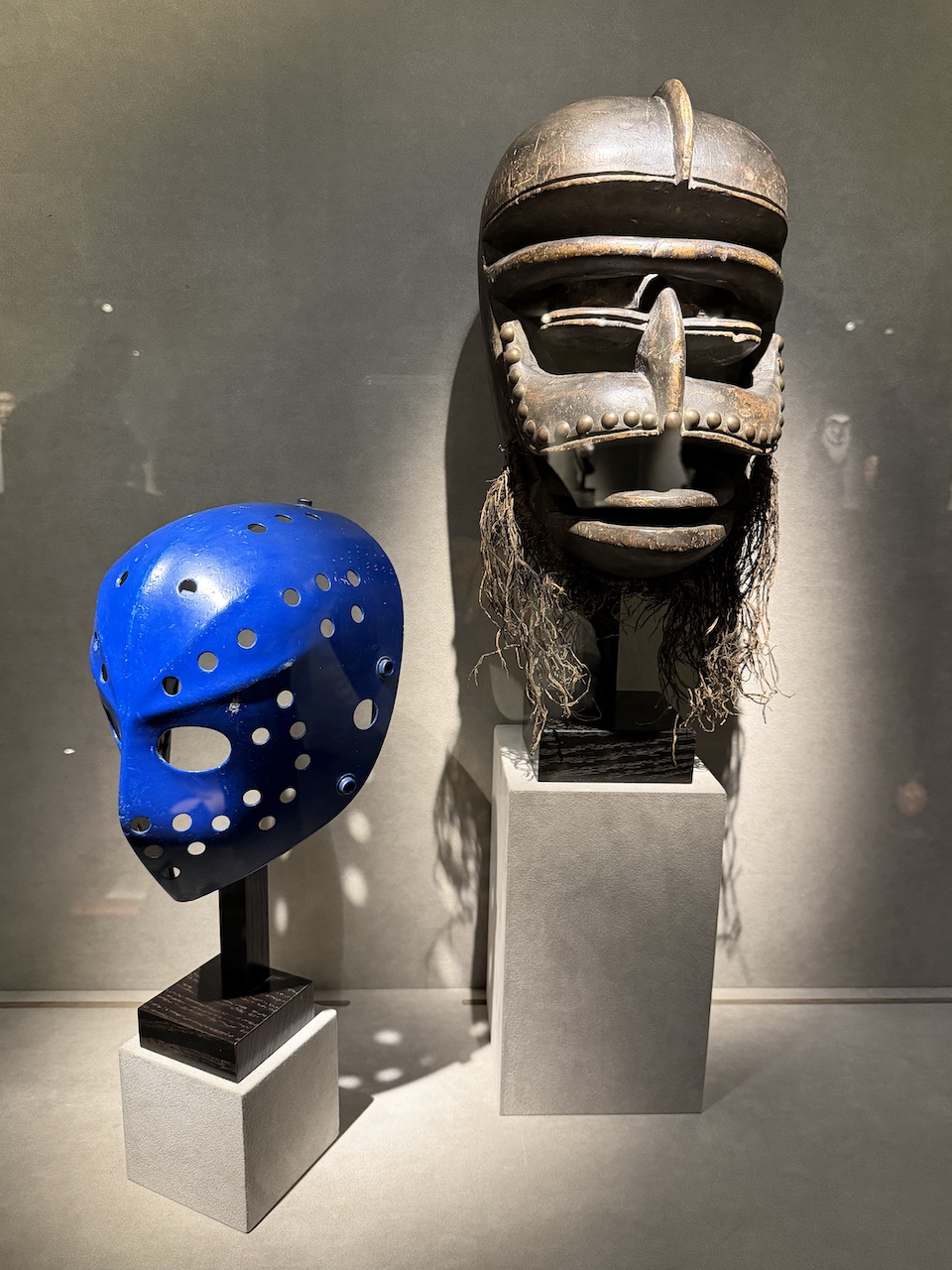
Right: Face mask (Masque facial). Côte d’Ivoire, Bété people. Dark brown wood, metal nails, plant fibres. Photo © N. Sikorsky
Even without taking part in the museum’s detective game, there is plenty here to surprise and amuse. What do you make, for example, of a blue ice hockey goalkeeper’s mask, made in North America in the 1970s or 1980s, displayed alongside a wooden mask of the Bété people of Côte d’Ivoire? Which looks more frightening? And which of the two needs protection more? Notice that, despite their very different origins and purposes, both conceal the face, although one is primarily intended to protect it from a hockey puck, while the other belongs to an entirely different world of beliefs and rituals.
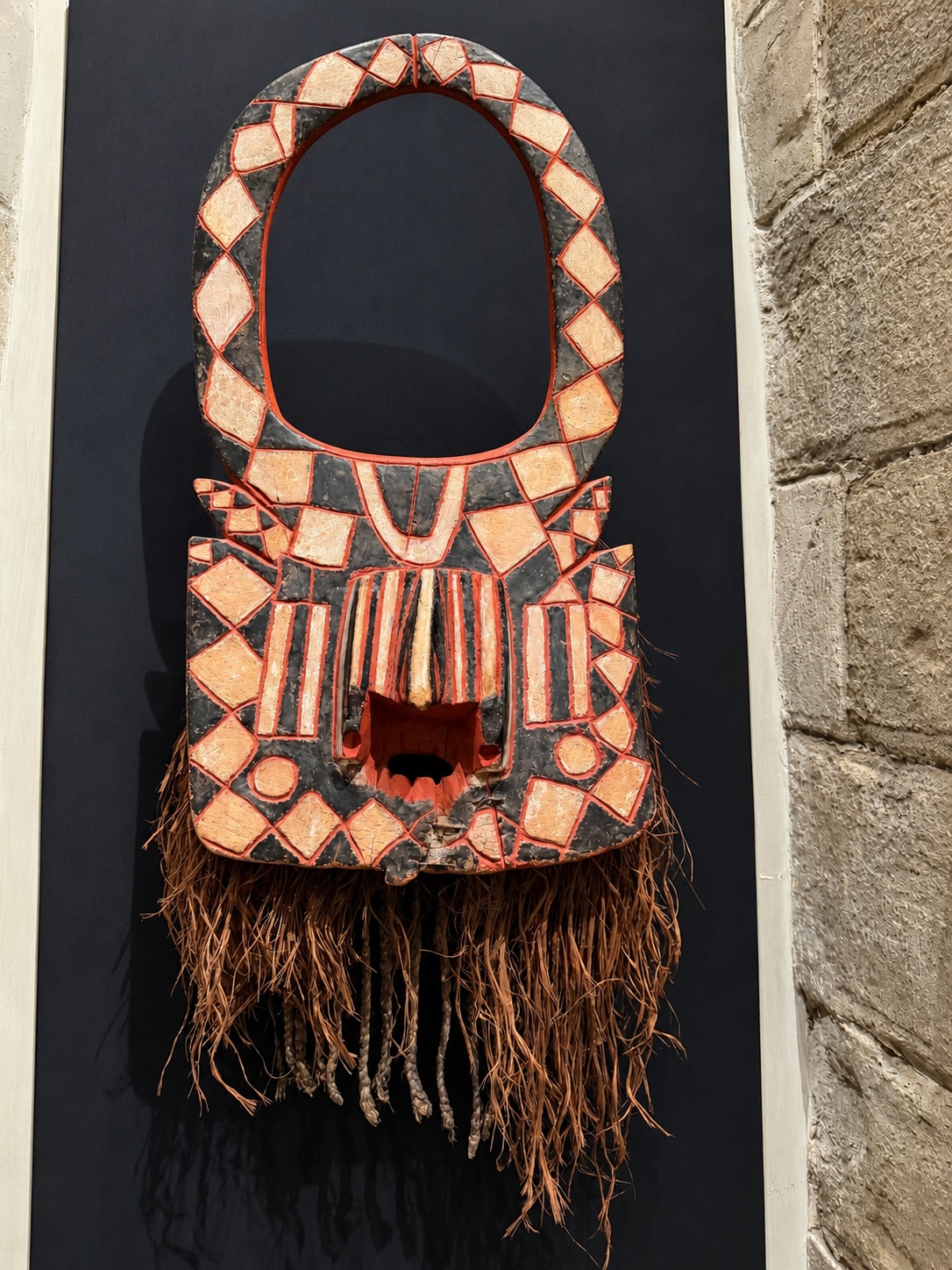
Photo © N. Sikorsky
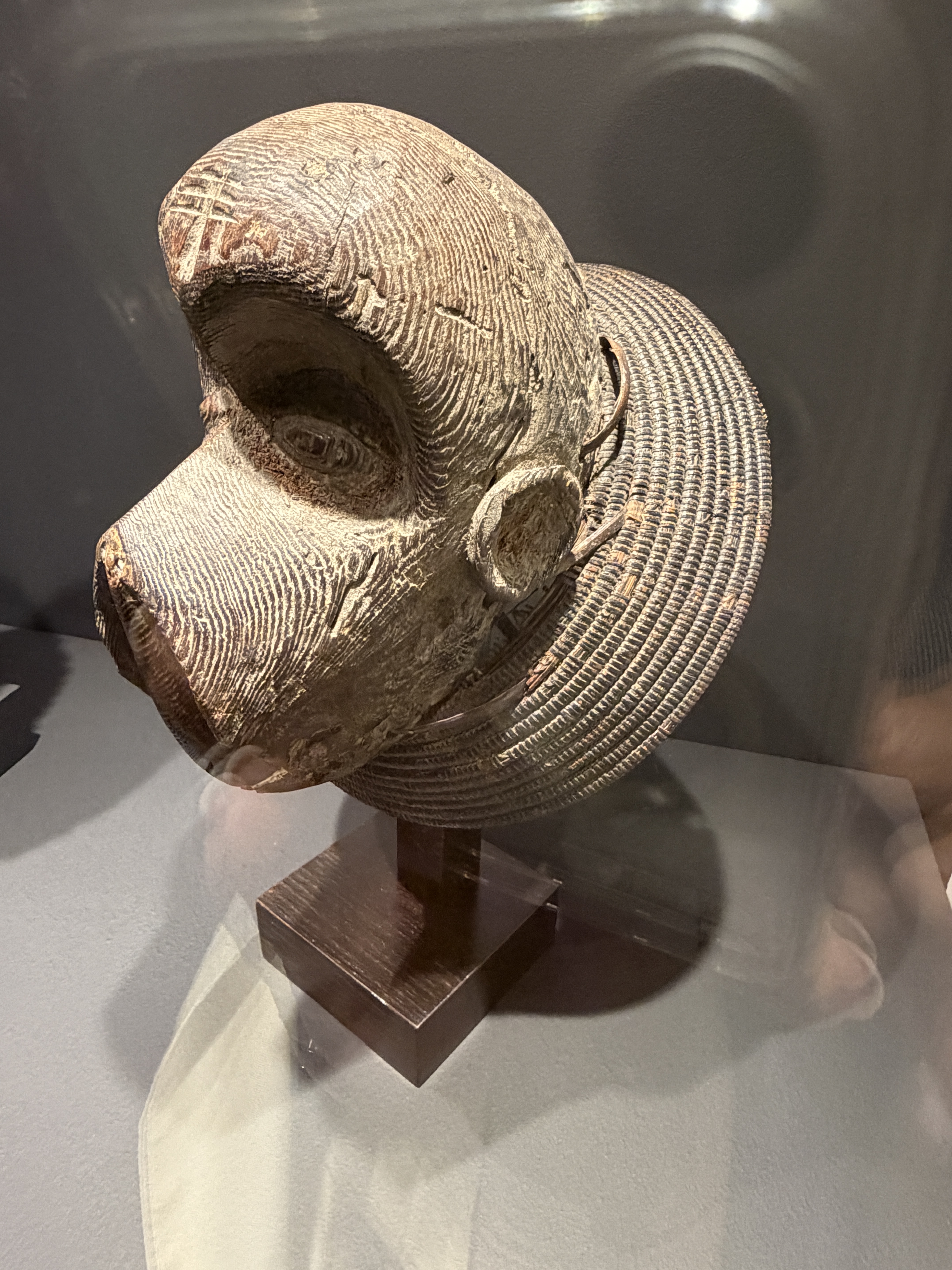
And here is something to inspire designers of women’s accessories: a mask from Burkina Faso that bears a striking resemblance to an extravagant handbag. Its maker, however, took inspiration not from Parisian fashion but from… a buffalo. But who says the two are incompatible? And the handbag is not the end of it. There is a matching hat, too: an elegant Cameroonian model with a wide, circular brim that any fashion-conscious woman would envy. I confess I would happily wear it myself! All that remains is to discover which famous couturier will be the first to send such an ensemble down the catwalk, retaining its name: ‘Zoomorphic Mask’!
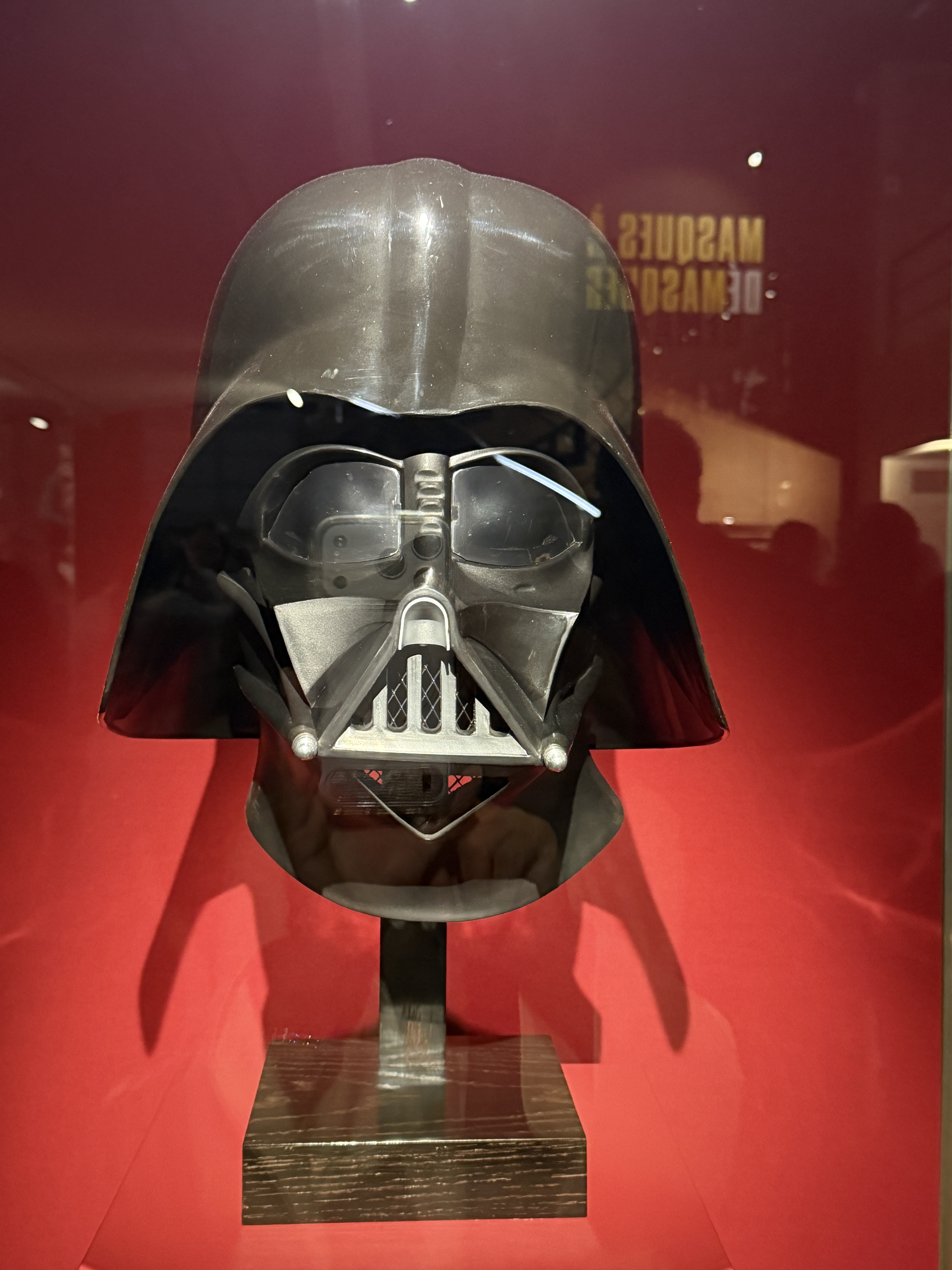
And in the neighbouring display case we find Darth Vader himself, one of the principal villains of the famous Star Wars film saga. His black helmet and menacing mask, which conceals his face, have long been instantly recognisable symbols of world cinema. Yet the museum label attributes a rather unexpected past to this lord of the dark side. George Lucas would surely be surprised!
Perhaps the most cheerful exhibit is the bright red mask that is the first to greet visitors. With its wild mane and long fringe, it resembles a carnival jester, an exotic bird and a character from some madcap theatrical production all at once. Who would have thought that its creator was none other than Jean Tinguely?
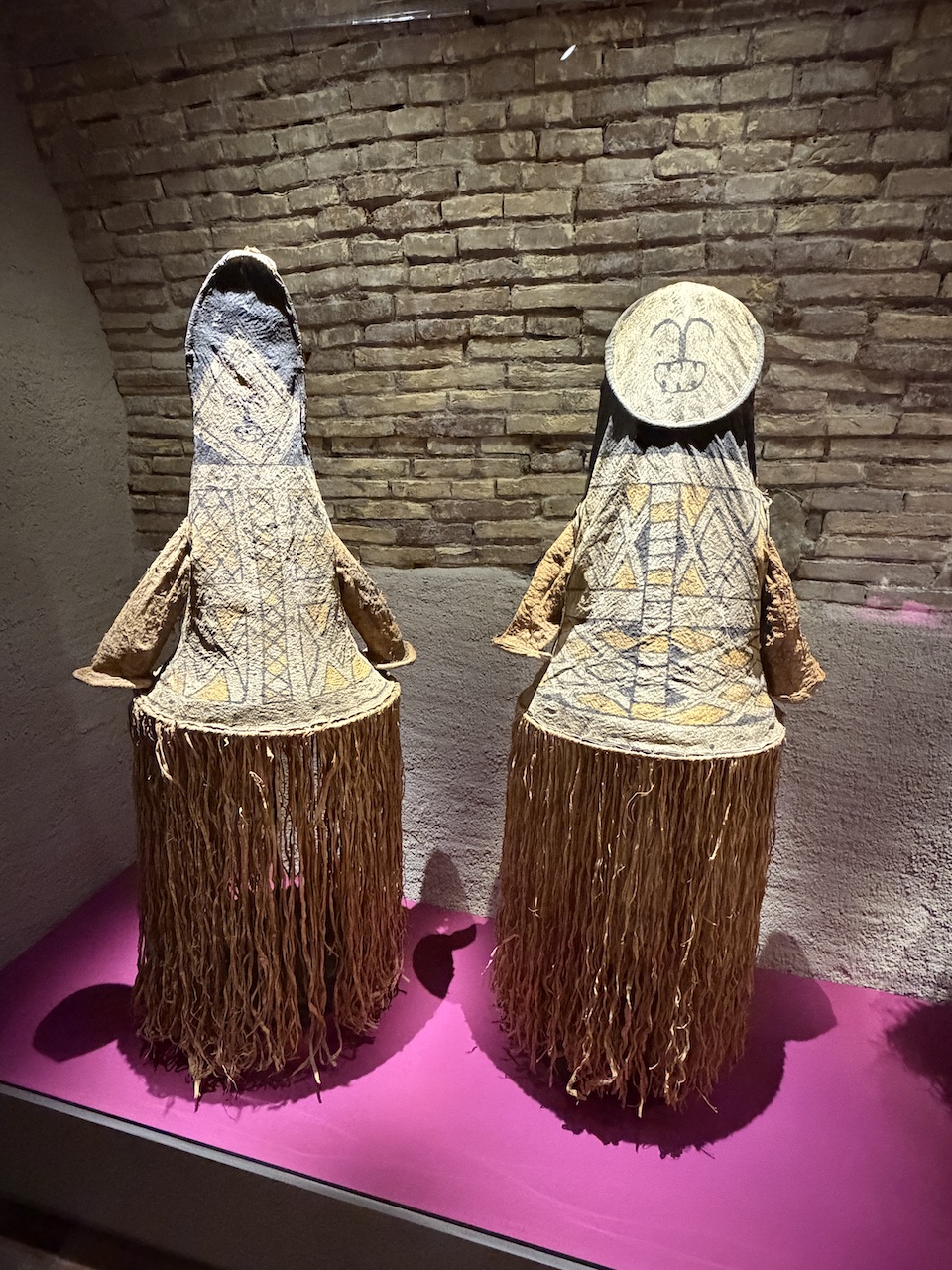
The name of this Swiss artist, one of the most prominent figures of Nouveau Réalisme, is associated above all with his fantastic machines, moving sculptures and mechanisms that creak, clatter and sometimes destroy themselves. What, one might wonder, has any of this to do with traditional masks? Quite a lot, as it turns out. Born in Fribourg, Tinguely was a passionate enthusiast of the famous Basel Carnival, the Basler Fasnacht, and regularly took part in it with the Kuttlebutzer carnival group, making his own costume and mask. One day, while visiting the Barbier-Mueller Museum’s storerooms, he stopped in front of a helmet mask made by the Pende people of the Democratic Republic of the Congo and was struck by its resemblance to his own creation.
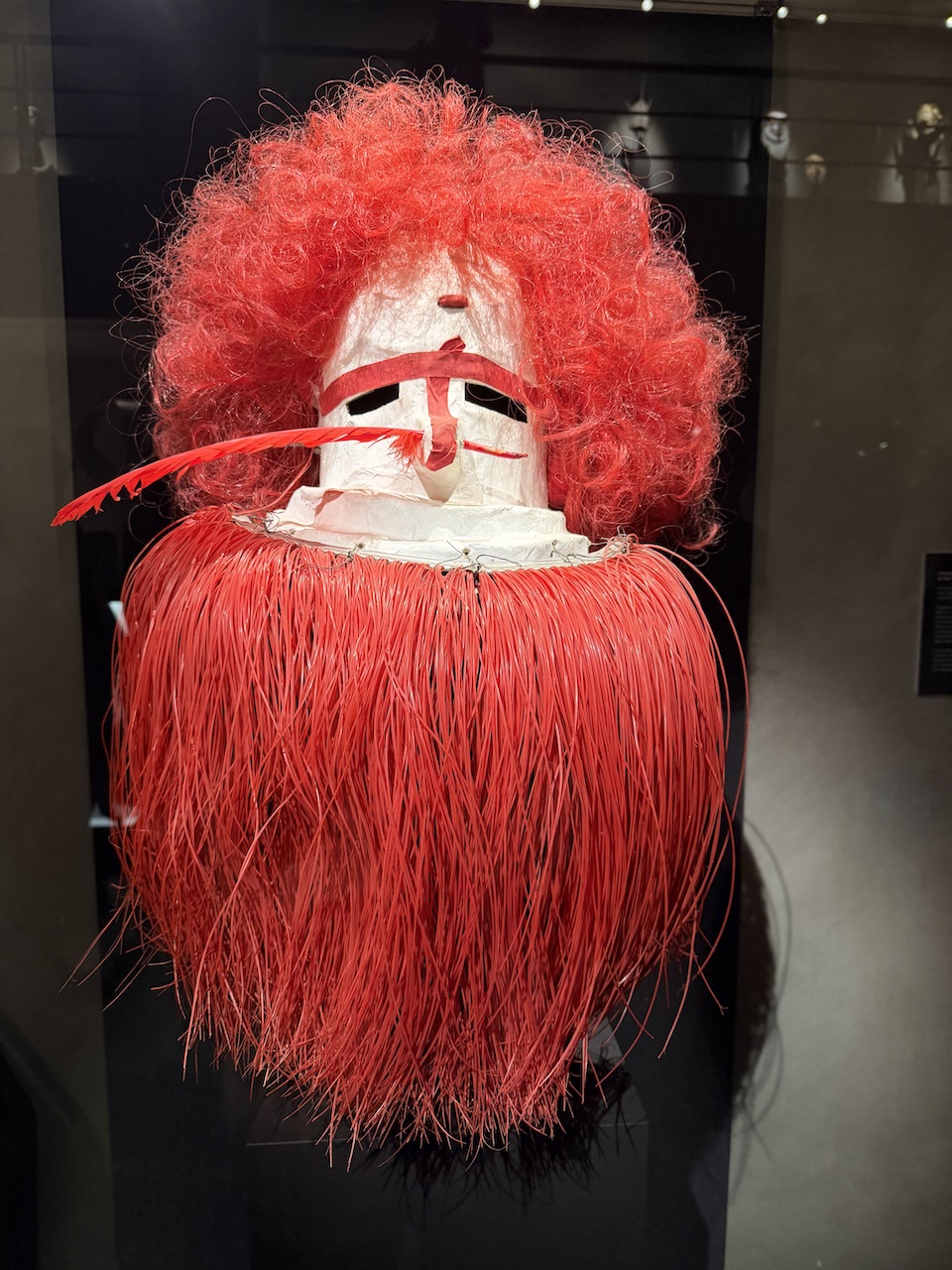
‘I must have seen it here, or perhaps in a dream! The mask I made for the last carnival bore a striking resemblance to it,’ he exclaimed. Tinguely was so convinced that the two objects belonged together that he donated his mask to the museum. And so a mask fashioned from a builder’s hard hat, plaster and feathers found itself beside a much older work by an African craftsman who had lived thousands of kilometres from Basel. This story perhaps explains the exhibition’s concept better than any amount of theoretical discussion.
Equally unexpected is the presence of Michel Butor (1926–2016), the French writer, poet and essayist, and one of the leading figures of the Nouveau Roman, or New Novel. Readers familiar chiefly with his literary work may be surprised to learn that the masks in the Barbier-Mueller collection inspired him to write an entire cycle of poems. One of them, Le seul plaisir que je connaisse (The Only Pleasure I Know), has found a natural place between a red mask worn by an ice hockey goalkeeper in the United States or Canada in the late 1960s and another red mask, representing a demonic spirit from the Japanese ritual theatre of kagura, made during the Edo period, in the seventeenth or eighteenth century, using polychrome painting and gilded copper.
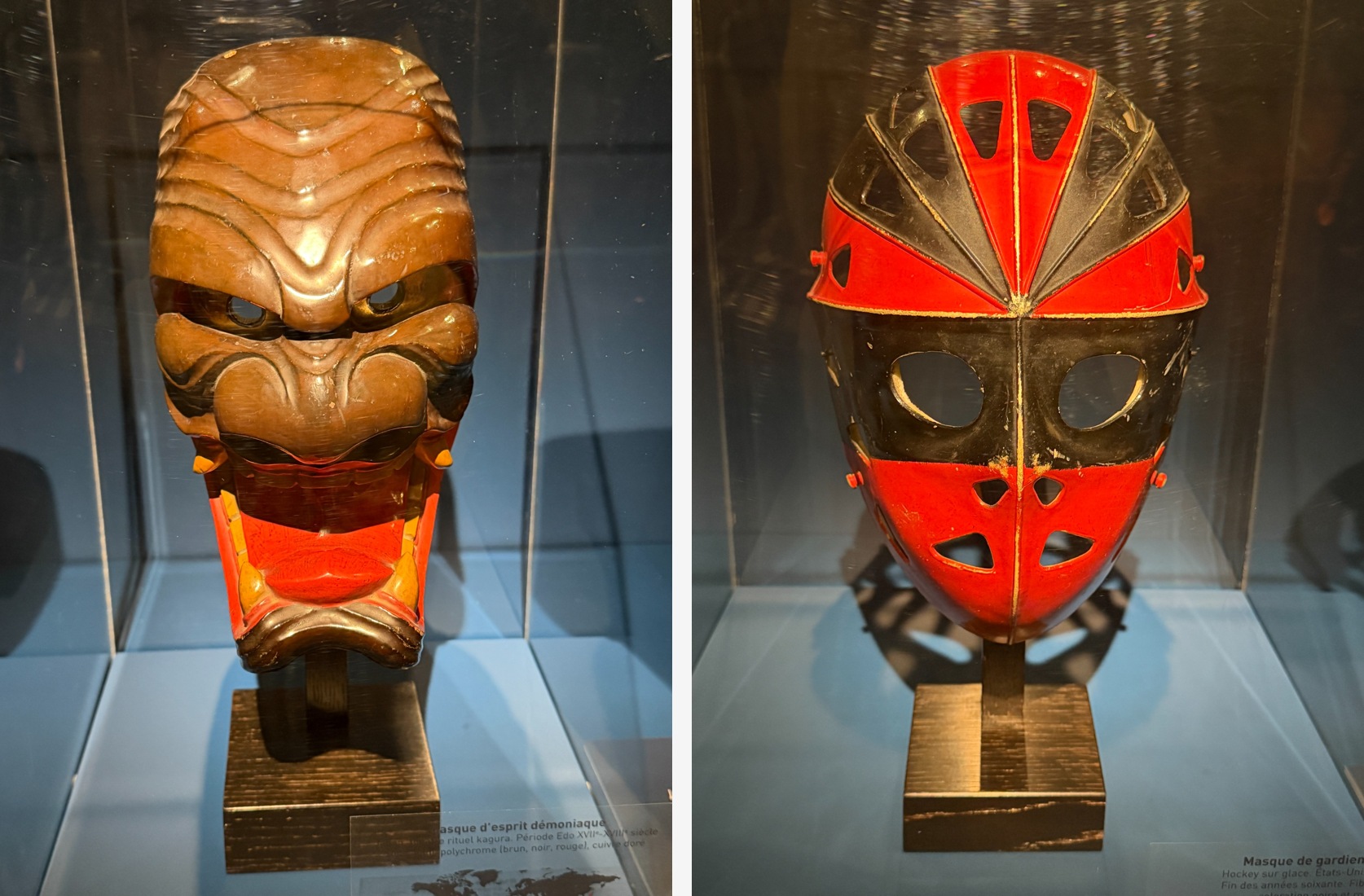
Left: Demonic spirit mask (Masque d’esprit démoniaque). Japan, kagura ritual theatre. Edo period, seventeenth–eighteenth centuries.
Right: Goalkeeper’s mask (Masque de gardien de but). United States or Canada. Late 1960s. Photo © N. Sikorsky
In this poem, the narrator, more monster than human, confesses that his only pleasure is to gaze into his victims’ eyes and savour the terror he inspires in them. He no longer needs to tear their bodies apart with his fangs: it is enough that he can tear their souls to pieces.
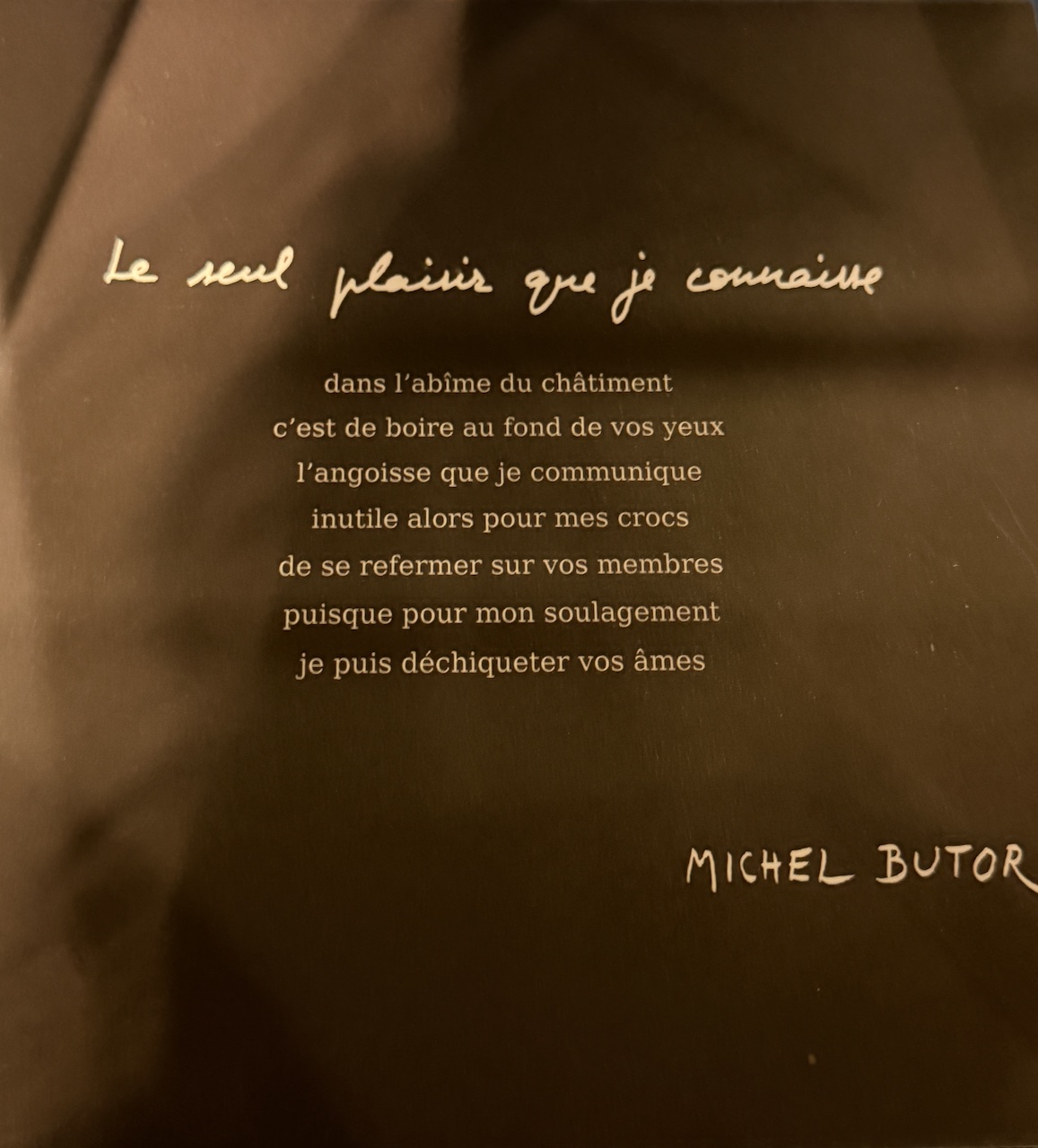
As we can see, Michel Butor was not trying to replace an art-historical description with a literary commentary, or to explain the significance of a particular ritual object. He was interested in something else: how to make a silent mask speak, how to establish a dialogue between an object and words. So while Tinguely had discovered an unexpected kinship between his own carnival creation and an African mask, Butor sought to cross another boundary: that between the visible and the expressible in words, between visual form and the literary word.
The exhibition is not confined to these two stories. Visitors can also see works by the contemporary Beninese artist Romuald Hazoumè, who creates masks from discarded plastic jerrycans and other everyday objects. In his creations, a traditional form becomes a means of addressing present-day concerns, including consumption, the environment and human identity. And once again the question arises: what makes a mask a mask? Its material, its shape, its purpose, or the meaning we give it?
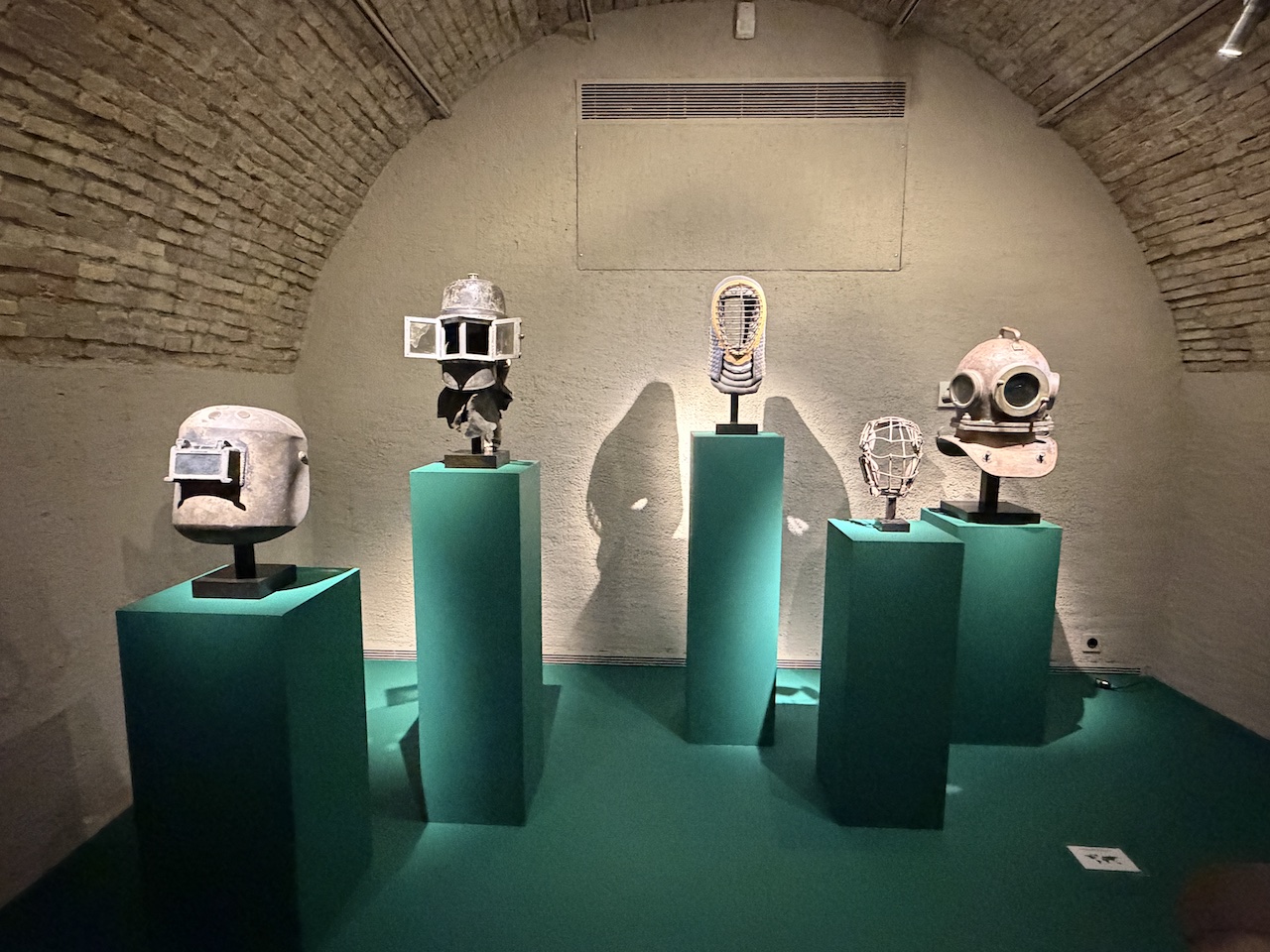
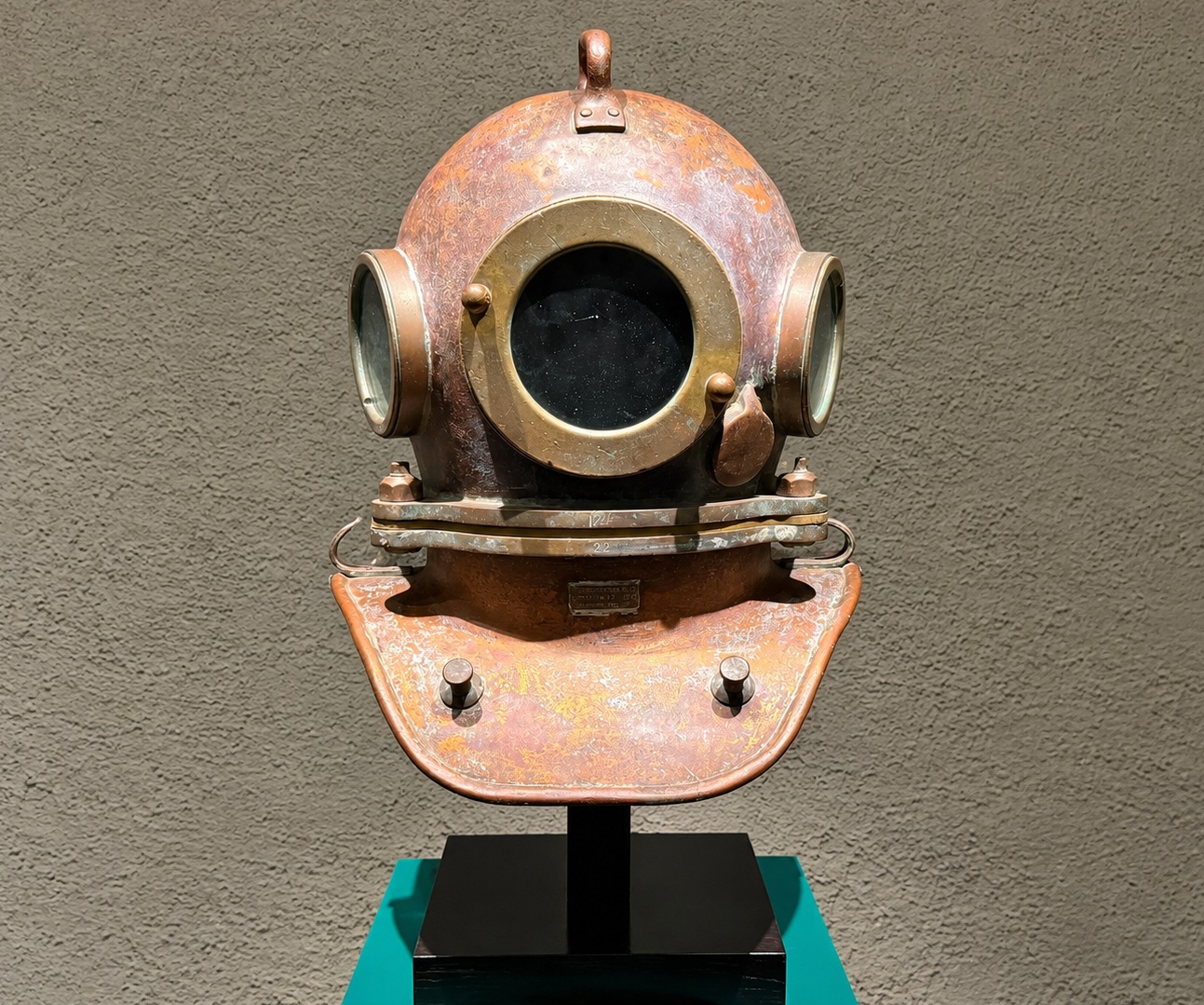
And finally, a small personal delight. Descending into the museum’s basement gallery, I discovered… a “Russian accent”! And in the most unexpected company. Among protective helmets and sports masks stood a diving helmet from Russia, made of copper and brass in 1976, according to its label.
It looked as though it had stepped straight out of a Jules Verne novel: a massive metal dome with round portholes through which the diver could survey the underwater world. But the most astonishing thing was its date of manufacture. By 1976, humans had already walked on the Moon, underwater explorers were using scuba gear, yet Soviet divers were still descending beneath the surface in equipment whose design dated back to the nineteenth century. And not out of nostalgia: heavy diving suits supplied with air from the surface remained reliable equipment for ship repairs, underwater construction and emergency rescue operations.
Air was supplied to this type of helmet through a hose from the surface, while the diver walked along the seabed in heavy boots, with weights attached to the chest and back. The complete equipment could weigh around eighty kilograms, although underwater its weight was, of course, felt differently. Particularly well known is the Soviet trekhboltovka, or ‘three-bolt’ diving suit, named after the three bolts used to fasten the helmet to the diving suit. I have not, however, been able to establish whether the example on display in Geneva belongs to this particular type.
In any case, this copper-and-brass newcomer from the Soviet past found itself alongside objects designed to protect the human face from fire, blows and water pressure. After all those encounters with spirits, demons and mythical creatures, the exhibition suddenly reminded us of the mask’s most prosaic purpose: sometimes we wear one not to become someone else, but simply to stay alive.
The richly illustrated catalogue Masques à démasquer, published by the museum as far back as 2012, is once again being offered in conjunction with the exhibition. It includes a foreword by Erik Orsenna, a member of the Académie française, an introductory essay by the writer Éric-Emmanuel Schmitt, and a short story by the Ivorian writer and playwright Koffi Kwahulé. Thus, writers join the conversation between artists, ethnographers and museum specialists, each offering a different perspective on the nature of the mask.
I hope you will have the opportunity to visit this fascinating exhibition, which runs until 28 February 2027. And try to work out who is looking at whom.