
Run or Stay?

Let's start with the name itself. Lewinsky is one of many Ashkenazi (Yiddish) Jewish surnames. It is a West Slavic variant of Levi, a name derived from the biblical Tribe of Levi. Over the centuries, many Jewish families living in, or moving across, the territories of the Russian Empire, Ukraine and Poland adopted surnames such as Lewinsky, Lewin and Wilensky.
Micha Lewinsky is the son of the celebrated Swiss novelist Charles Lewinsky, whose work I have long admired. For generations, Charles Lewinsky's ancestors belonged to Jewish communities in Switzerland and the neighbouring regions, and they appear again and again throughout his novels. The best known of them, Melnitz, follows a Jewish family in Switzerland from 1871 to 1945. Gerron, a biographical novel about the German actor and film director Kurt Gerron, who was deported to the Theresienstadt concentration camp, poses a painful moral question: where does the instinct to survive end, and where does collaboration with Evil begin?
Micha Lewinsky takes up the same theme in his own way, and his father is not his only point of reference. His protagonist bears the surname Oppenheim, immediately bringing to mind Lion Feuchtwanger's 1933 novel The Oppermanns. Curiously, its first edition appeared under the title The Oppenheims, and it was under that name that the novel entered cinema history through Grigori Roshal's 1938 adaptation. Faced with the rise of Nazism, the Oppermann family confronts a terrible dilemma: should they flee? If so, when? And what happens if they stay? And is there still room for hope?
In Micha Lewinsky's novel, Ben Oppenheim, the heir to that same cultural tradition, lives in the twenty-first century. A not particularly successful, self-absorbed writer, he is obsessed with the memory of the Holocaust and is torn between his ex-wife, their two children and his new partner, Julia.
If you enjoy Woody Allen at his best, chances are you will enjoy Micha Lewinsky's novel as well. Not simply because its protagonist is Jewish, but because of his neuroses, his self-deprecating irony, his constant expectation of impending disaster, his complicated family life, his intellectual humour, and his way of making serious things sound funny.
If Woody Allen changed the tone of Jewish cinema, Micha Lewinsky's debut novel may well represent an attempt to do something similar in Jewish literature. The epigraphs, quoting Stefan Zweig and Leon Uris, seem to hint at exactly that. It would be difficult to imagine two more different Jewish writers.

Changing a tradition is no small undertaking, especially when you are not just any a writer, but as "Charles Lewinsky's son". Being the son of one of Switzerland's best-known contemporary authors cannot be easy, particularly if you choose the same profession. People tend to expect either far too much from such children or nothing at all.
That is why it is such a pleasure to discover that Micha Lewinsky, best known until now as a film director, has found a distinctive voice in fiction as well. His cinematic background is evident throughout the novel. It is intensely visual. The short chapters read like scenes. The characters are vividly drawn. Dialogue takes precedence over authorial commentary. Even the leopard on the cover of the book seems to wink at the reader. As the symbol of the Locarno Film Festival and its highest honour, the Golden Leopard, it almost invites us to imagine the novel on screen.
Perhaps that is reading too much into it, but his fictional hero dreams of just such a success, and it is hard not to notice Micha Lewinsky's own autobiographical echoes in him.
Ben Oppenheim lives in Zurich. The son of a famous and successful father, he is a quintessential left-wing European intellectual. As a schoolboy, he campaigned for the abolition of the Swiss army. Today he worries about the fate of the Amazon rainforest and refuses to let the waiter ("the only Black person in the restaurant") wipe up the wine he has just spilled. Ben is not as successful as his father. That does nothing to dent his confidence in his own talent or his conviction that a screenplay about the Holocaust will finally bring him the glory he has been hoping for.
The very first lines of the novel give us a good sense of him: "Benjamin Oppenheim believed he was ready to flee. Not in any practical sense: he was far too impractical for that. Psychologically, though. For years he had been preparing for the worst. He had played the scenario over in his mind hundreds of times. Yet when the moment finally came, it caught him completely by surprise."
How many people like Ben Oppenheim I have met in real life!
“Preparing for the worst”. Every Jew knows that feeling. In Jewish families, it is handed down almost like an inheritance. The voices of previous generations keep whispering their warnings, never allowing you to let your guard down or simply forget.
For Ben Oppenheim, however, "the worst" turns out, much to his own surprise, to be the war in Ukraine. Hearing a radio report about an explosion at a depot near the Belarusian border, he immediately follows the chain of events through to what he sees as its inevitable conclusion: nuclear war is no longer unthinkable. It is only a matter of time.
His almost ex-wife, Marina, reaches exactly the same conclusion. The only reason they are still living under the same roof is that they simply cannot afford two apartments in Switzerland's most expensive city. So Bulgakov's famous housing problem, it turns out, did not plague Soviet citizens alone.
Just as Woody Allen is forever poking fun at New York, Micha Lewinsky enjoys teasing Zurich: "In Zurich, smiling is regarded as a form of free politeness. Only rude people don't smile. So people are forever baring their teeth. Newcomers often mistake this carefully displayed friendliness for genuine warmth. Only later do they realise that the Zurich smile has nothing to do with warmth or cordiality. It is a perfectly polished façade behind which there is no sense of humour. Here, if people joke at all, they do so only within the family, after dinner, over a glass of wine, and strictly one at a time: the father always speaks first."
Be that as it may, the Oppenheim family, gripped by a panic constantly fuelled by the media, finds itself facing the age-old Jewish question: flee or stay? They decide to flee. And immediately. Not to Israel, not to America, but to Brazil.
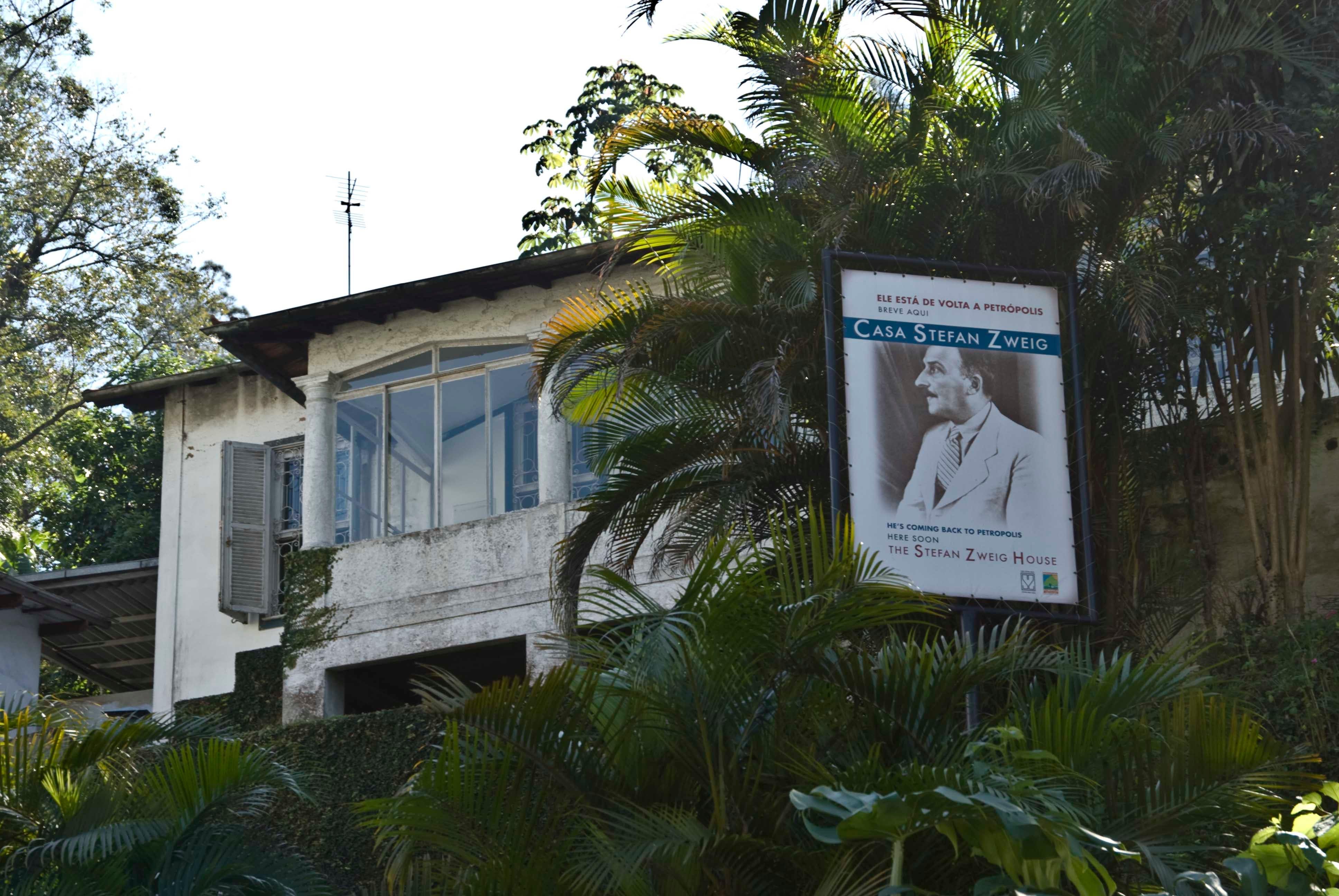
Ben is inspired by the example of Stefan Zweig, who sought refuge from the Nazi regime in Petrópolis, outside Rio de Janeiro. A devoted admirer of Zweig, Ben knows perfectly well that even geographical distance from Europe's tragedy could not save the Austrian writer. On 22 February 1942, Stefan Zweig and his wife took a fatal dose of Veronal and were found dead, hand in hand, in the house that is now the Casa Stefan Zweig.
But even this does not stop Ben. However, what is tragedy for Lion Feuchtwanger, Stefan Zweig, Charles Lewinsky and many other writers becomes tragicomedy in Micha Lewinsky's novel.
Hilarious is Ben's father's outrage when he discovers that the plot beside his parents' graves has been occupied by a Russian oligarch who made his fortune trading in raw materials. Then there is the tarantula. And Ben's "battle" with a German over a chair. And the fake séance of spiritualism staged for gullible tourists in search of something exotic. The list could go on.
Micha Lewinsky writes with humour not because war is funny. He does so because his hero turns his own anxiety into a comedy. Every international event seems to him the beginning of a catastrophe. He analyses everything obsessively, makes absurd decisions, and the reader laughs along while recognising that his fears are not imaginary.
At the same time, the comedy does not diminish the seriousness of the subject. On the contrary, it grows out of historical memory, which enables Ben Oppenheim to recognise danger before anyone else.
Like Ben himself, the reader is constantly torn between one conclusion and another. Is he merely an alarmist? Or someone whom generations of accumulated experience have taught never to ignore the warning signs?
"A single 'Nu' was enough to express all the pain in the world, from the Exodus to the Holocaust. But for that 'Nu' to be understood, you had to say it to another Jew."
Or perhaps not only to another Jew?
The idea of escape runs through the novel in several different ways: physical flight, inner withdrawal, the search for freedom, the refusal to accept roles imposed by others. Gradually, Ben comes to realise that you can run away from almost anything. Except yourself.
An excellent book for light summer-holiday reading, and for serious reflection afterwards.
Run or stay? Everyone answers that question differently. Micha Lewinsky offers no ready-made answer. Instead, he reminds us that laughter is sometimes the best way to speak about the darkest things. As Nikolai Gogol wrote, through the laughter seen by the world shine tears unseen by it”.