
Kolkhoz: Poignant and Merciless

I am no admirer of Emmanuel Carrère. I liked My Life as a Russian Novel, published in 2007, in another life, the life ‘before’, only moderately. Limonov (2011) even less. As for Kirill Serebrennikov’s film adaptation, Limonov: The Ballad, I walked out twenty minutes after it began, mainly, I suspect, because I find the man himself deeply repellent. Nor did I care for the way Carrère, as co-screenwriter, adapted Giuliano da Empoli’s The Wizard of the Kremlin.
So, over six months ago, largely out of professional duty, given my website’s name and editorial focus, I bought his weighty new book, which has since won several prizes. But it took a holiday before I finally tackled it.
Let me make one thing clear: Carrère’s Kolkhoz is not about the forced collectivisation of the Soviet countryside, which gave rise to the collective farms known as kolkhozes and led to the dispossession of the peasantry, mass deportations, famine and the deaths of millions.
The title comes from a family ritual. ‘That night, the three of us gathered around our mother and did kolkhoz for the last time,’ we read on the back cover. A fuller explanation appears on page 261, where Carrère recalls with infinite tenderness how much he and his sisters loved all going to sleep beside their mother: ‘Our mother had a name for this dormitory ritual: doing kolkhoz. We loved doing kolkhoz.’
But the word clearly resonates far beyond this intimate family memory. It becomes an ironic symbol of the family’s Russian and Georgian roots, of collective memory and of the impossibility of separating personal history from the sweep of History.
That impossibility lies at the heart of this sprawling autobiographical family saga. And as in all such sagas, Sigmund Freud is never very far away. All the more so because the point of departure here is the death of the author’s mother, Hélène Carrère d’Encausse, née Zourabichvili, the daughter of a Russian aristocrat and a Georgian émigré suspected of collaboration who vanished in mysterious circumstances.
A distinguished scholar of Russia and the Soviet Union, Hélène Carrère d’Encausse was born stateless in Paris in 1929. She acquired French citizenship in 1950, was elected to the Académie française in 1990 and, in 1999, became the first woman to hold the post of its Perpetual Secretary, a position she retained until her death on 5 August 2023. At the same time, she was the mother of three children whom she loved deeply and to whom she was close, even though she stopped speaking to her son for two years after the publication of My Life as a Russian Novel. She was also the wife of a man from whom she had long since grown apart, while continuing to maintain the outward appearance of family harmony.
Carrère writes about his father, Louis Carrère d’Encausse, whose fascination with the family history of his illustrious wife bordered on obsession, with great sympathy but also a certain condescension. His condescension surely had deeper roots than the mere fact that Louis, who worked for an insurance company, looked like a prince consort beside his regal wife. An ordinary man in the shadow of a remarkable woman. Perhaps, as an adult, the son came to understand the sacrifice his father had demanded of his wife when he threatened to kill himself if she left him? That did not, however, prevent the father from later taking a mistress, in the strictest secrecy, of course. But Hélène found out.
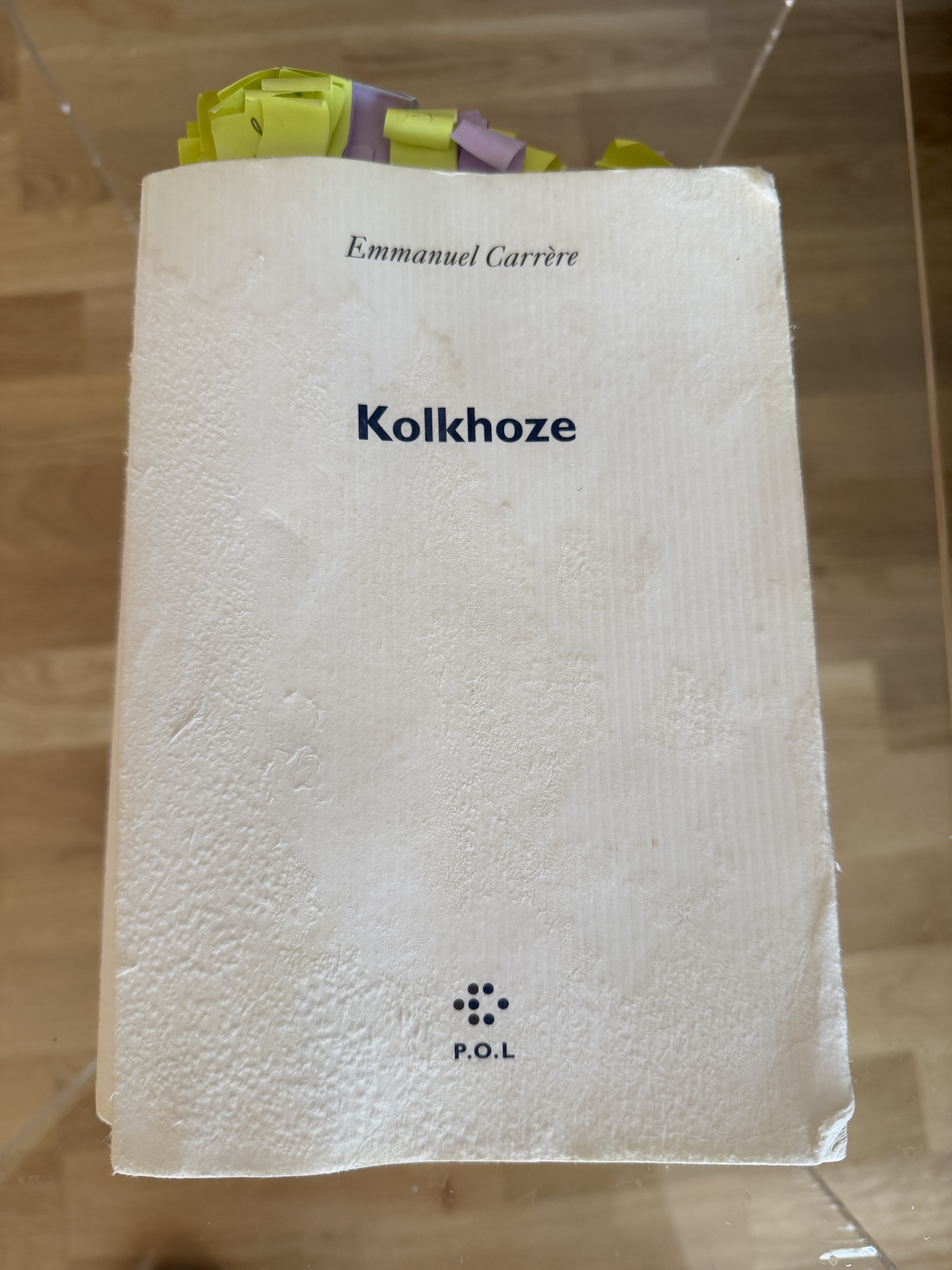
Strangely, whenever I try to sum up my overall impression of the book in a single sentence, what emerges sounds more like a diagnosis: a public psychotherapy session running to 560 pages, combined with the dissection of an entire family, conducted with a surgeon’s coldness and precision. No one is spared. Leo Tolstoy, whom Hélène’s father, Georges Zourabichvili, hated as fiercely as her mother, Natalia von Pelken, adored, put it perfectly: ‘All happy families are alike; each unhappy family is unhappy in its own way.’
To some extent, the book continues My Life as a Russian Novel, which is rather irritating, as are its frequent chronological leaps and repetitions. The crucial difference is that the mother, previously a commanding presence in the background, now becomes the central character. It is as though Carrère had waited for her death to say everything he had been unwilling, unable or afraid to say while she was alive.
Hélène Carrère d’Encausse is indeed a fascinating figure, as much for her ambition, perseverance, determination and intransigence as for her capacity to love, to be generous and modest, and to ‘do the job’ to the very end. Her son writes about her with a mixture of admiration, irony, resentment and jealousy. He directs barbs both large and small at her, displaying merciless insight and unmistakable love despite all their differences, a love that, he admits, frightened him.
I am not sure that Mme Carrère d’Encausse would have appreciated either this book or its naked, unabashed display of all the skeletons she had so carefully hidden throughout her long life in cupboards where, I imagine, perfect order reigned. But that, after all, is a matter for the Carrère family.
More amusing is the fact that, while striving to demonstrate how different he is from his mother, Carrère begins his narrative with the national tribute paid to her after her death. This suggests that narcissism was one trait they shared. I wonder, incidentally, how he reacted to the condolences President Putin sent to him and his family, which were also published on the Kremlin website.
I will not dwell here on the complicated relationships within the Carrère d’Encausse family. Readers hungry for intimate revelations will be amply rewarded.
For others, and for me, the book’s interest lies elsewhere. Through the history of this Russian-Georgian-French family, we are offered a different perspective on the Russian Revolution, emigration, Soviet and then contemporary Russia and its relationship with the West, but also on the willingness to compromise with power and the tenacity with which people continue to defend their convictions even in the face of evidence that has proved them wrong.
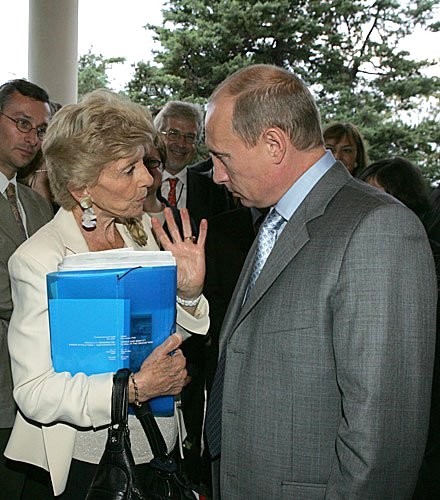
For Hélène Carrère d’Encausse, an acknowledged authority on the history of Russia and the Soviet Union, was often seriously mistaken both in her judgements of President Putin and in her predictions about Russia’s future, right up to 24 February 2022.
‘Her love of Russia is real, visceral. The trouble is that it turned into indulgence towards Putin, and for twenty years she never ceased carrying the Kremlin’s message to the Élysée, repeating to Chirac, Sarkozy, Hollande, Macron and their successive foreign ministers that Russia is a great country that cannot be judged by our standards, and that Putin is a man of peace, provided, of course, that he is not humiliated,’ her son writes.
It would, however, be too easy to leave Hélène Carrère d’Encausse with a monopoly on blindness or, if you prefer, short-sightedness. Her son readily mocks his mother’s delusions, bluntly calling her a liar on the authority of his uncle Nicolas. He also mocks her fascination with Russian power and her stubborn conviction that Vladimir Putin remained, despite everything, someone with whom reasoned dialogue was possible.
Yet he is not immune to a certain idealisation of Russia either. His is simply of a different kind, less political than literary and cultural, though it too is clearly inherited from his mother. The man whose mother introduced him to Dostoevsky’s The Idiot at fourteen also professes his love for Nabokov. It is therefore even more surprising to find so many clichés about Russia and Russians in his own writing.
And clichés there are in abundance. This is not to say that they are all false: clichés rarely arise from nothing. But their accumulation ultimately transforms a complex family history into a kind of Russian mythology composed of instantly recognisable images, from the babushka to the kotletki.
Carrère knows how to deconstruct his mother’s Russian novel, but he remains trapped in his own. In his writing, Russia often appears less as a real, contradictory and changing country than as an imaginary territory populated by people prone to excess and steeped in tragic destinies, secrets, madness, violence, fatalism and nostalgia.
To simplify somewhat, Hélène Carrère d’Encausse idealised the power, historical continuity and supposed rationality of the Russian state, whereas Emmanuel Carrère tends to idealise the chaos, excess and drama that turn Russia into a ready-made novel. He is merciless towards his mother’s errors of judgement but does not always subject his own fascination with the country to the same degree of scrutiny.
Perhaps this is also because Russia has long been one of the driving forces of his work: not merely a family inheritance, but literary material, almost a signature. This, incidentally, deeply irritated his mother, who did not want her son encroaching on ‘her’ territory.
A more troubling question then arises: can Emmanuel Carrère reproach his mother for preferring a certain idea of Russia to its reality when he himself turns that reality into a novel?
In Kolkhoz, the family’s past constantly intrudes upon our present. The stories of White Russian émigrés, stripped of everything and consumed by nostalgia, resonate with particular force today: ‘But what they dreamt of, deep down, was not their estates but the land itself. It was not money, for they had grown used to having none. It was the language.’ Equally poignant today is the naivety of some of those who returned to the Soviet Union after the Second World War, the ‘returnees’.
My heart ached when I read, in French, the final words of Chekhov’s Uncle Vanya, which I know by heart in Russian and which Rachmaninov set so beautifully in his song We Shall Rest. Do we not all long to rest, if only for a while, from the oppressive reality around us, to hear the angels and see the sky glittering with diamonds?
The past can also force us to reconsider recent experiences. Two years ago in Tbilisi, I was hurt when some Georgians refused to speak Russian to me. But after reading a passage that takes us back to the 1920s, nearly a century and a half after Georgia, so beloved of Russian poets, ‘placed itself under Russia’s protection in order to escape the Ottoman Empire’, I came to see that refusal in a different light: ‘In their colonised country, Russian is compulsory. On pain of a fine, officials must speak to the public in Russian, even if neither the official nor the person they are addressing speaks Russian. Bookshops stock only Russian literature, foreign literature translated into Russian, and even their own literature, which Georgians are expected to read in Russian.’
And that is without even mentioning the Russo-Georgian War of 2008.
The book also, of course, addresses the war in Ukraine, along with a question that so many people ask themselves today: ‘What do the Russian people think? Do they support Putin? To what extent?’ The answer follows: ‘There is no answer to this question, because statistics in Russia are worthless.’
But are statistics the only thing that is worthless? What are memories, family legends, official versions, the convictions of an eminent historian and the truth of a writer who turns those closest to him into characters worth? Kolkhoz does not answer these questions. It adds new ones: how far can one go in seeking the truth about those one loves? Does literature permit everything? And does love excuse the cruelty with which that truth is sometimes brought to light?
By the end of these 560 pages, we may be no closer to solving the mystery of Emmanuel Carrère’s mother, the mystery of Russia, or even the mystery of the author himself. But he has succeeded in turning their contradictions into a book that is at once irritating and poignant, narcissistic and generous, merciless and full of love.
I opened it without much enthusiasm, almost out of professional duty. I closed it deeply moved, with questions that continue to trouble me and remain unanswered.
P.S. John Lambert’s English translation of Kolkhoz was published by Fern Press on 3 September 2026. The quotations from the book in this article are my own translations from the French original and may therefore differ from those in the published English edition.