
Zuleikha, Don’t Close Your Eyes!

A scandal has erupted in Russia over the television adaptation of Guzel Yakhina’s novel Zuleikha, whose final episode was broadcast yesterday on Rossiya 1. The accusations levelled at the production team strike us as symptomatic of Russian society.
Let me begin from afar. On 17 April, two days after the crush in the Moscow Metro, the consequences of which have yet to be assessed, the Russian media reported that the Federation Council had approved moving the Day of the End of the Second World War from 2 to 3 September. The group behind the initiative argued that the change would ‘preserve historical justice for the victors of the Second World War’. We found no reaction to the news: the date had been changed, and that was that.
On 13 April, Rossiya 1 premiered a television series directed by Egor Anashkin and based on Guzel Yakhina’s novel. Here, the argument was the preservation of historical justice for the victims of Stalinist repression, in this case the victims of dekulakisation and collectivisation. A scandal erupted in the press after the very first episode, eventually leading to direct threats against Chulpan Khamatova, who plays the title role.
What, then, is the difference between these two attempts to preserve historical justice?
Let me recall that Guzel Yakhina’s novel was published in 2015 by Elena Shubina Editions, part of the AST publishing group, with a foreword by Lyudmila Ulitskaya. The forty-year-old author’s debut immediately rose to the summit of the Russian literary world. In 2015, it won the Big Book, Yasnaya Polyana and Book of the Year awards, followed in 2017 by the Readers’ Prize. By that year, the novel had been translated into eighteen languages, including French, in an edition published by Noir sur Blanc in Lausanne.
Soon afterwards, I had the opportunity to meet Guzel Yakhina and publish an interview with her in which she discussed the relationship between documentary fact and invention in her work, her personal reasons for writing the novel and her view of history. Readers of Nasha Gazeta were among the first to learn that the book would be adapted for the screen. That adaptation has now arrived, with the unexpected, or perhaps entirely predictable, effect of a bomb going off.
The Communists of Russia party is demanding that the series be taken off air for ‘blackening the past’. The Spiritual Assembly of Muslims of Russia is awaiting an apology from its creators. Those objecting to the series invoke ‘academic circles’ in support of their case. An unfamiliar YouTube channel with the telling name Aurora, for example, has posted a twenty-minute video featuring the historian Evgeny Spitsyn. He turns out to be the author of textbooks and lecture courses on Russian history and the recipient of the Russian Writers’ Union’s 2016 Imperial Culture Prize. Discussing the series, this learned gentleman has no hesitation in declaring that he ‘made an incredible effort to force himself to watch this nonsense’, before admitting: ‘I don’t know what the novel is like, but I don’t imagine it is a masterpiece either.’ Who could possibly suspect a scholar of bias?
This is not, of course, a matter of ‘film criticism’. Perhaps it is time to invent a term such as ‘series criticism’, since television drama is a genre in its own right. The outraged viewers, whose feelings have once again been offended, care little about either the series’ artistic merits or its shortcomings; in our view, it has both. Everything comes down to politics and to conflicting readings, or should that be viewings, of our shared past. They differ so radically that one is tempted to ask whether that past was ever truly shared and, if it was, whether society is now suffering from collective amnesia.
A screen adaptation, particularly of a good book, very rarely surpasses its source, whether that book is War and Peace, Life and Fate or The Master and Margarita. I therefore decided to turn to the author of the original, Guzel Yakhina, to discuss what was happening.
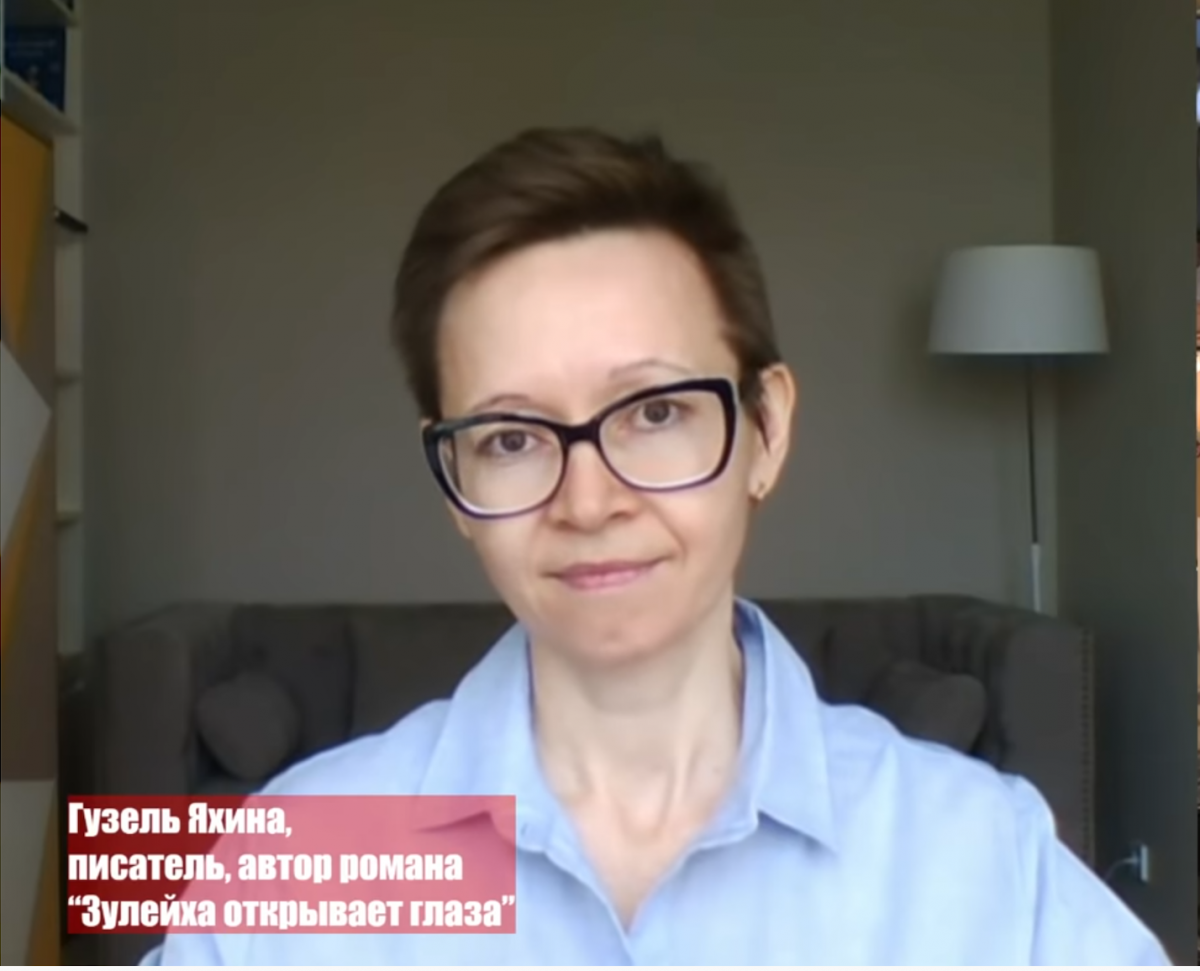
Guzel, since our conversation this time was prompted by a television series, let us begin with why you declined to write the screenplay, or at least take part in writing it. You trained as a screenwriter, so you must surely have received such offers.
Yes, of course. We discussed it at the very first meeting with representatives of the All-Russia State Television and Radio Broadcasting Company, when we met to talk about the contract, especially as I had already completed my screenwriting course by then. I immediately declined, for several reasons.
First, I would have found it difficult to cut my own story into eight pieces and fit them into the rigid framework of a television series. I decided it would be better to leave that to professionals who could approach it with greater detachment.
For you, it would have meant cutting into living flesh?
Of course. Second, I did not want to spend several more years, which is how long it takes to make a series, living with Zuleikha. I already felt that I was merging with her, and if that process had continued, I might never have been able to write anything else. I preferred to write a new story, particularly as it was already taking shape in my mind.
The onslaught of criticism directed at you and the creators of the series has shown, with extraordinary clarity, how alive the Soviet past remains in Russian society. We have been through all this before: ‘I haven’t read Pasternak, but I have an opinion’; the unmistakable sense of a crowd waiting for the command to attack; and Lenin’s eternally enduring assertion that cinema is the most important of all the arts. You would surely agree that the response to the book was much calmer than the reaction to its screen adaptation.
You know, the book also received very different responses when it appeared. I suppose it was initially bought by people who wanted to read it and were interested in the subject. That was why there were so many positive reviews and, yes, why it won awards as well.
But negative voices were heard from the very beginning. I heard them because people wrote to me or expressed their views at public events, and those views were sometimes diametrically opposed. The novel was criticised very harshly in Tatarstan. The criticism did not concern its literary qualities, but the way it portrayed everything ‘Tatar’: the culture and the language. These voices were quite loud and came mainly from members of the Tatar intelligentsia.
The novel was accused of blackening the image of the Tatar woman and the Tatar mother. It was called ‘a bomb planted beneath national consciousness’ and ‘a piece of meat stuffed with needles’. There were many colourful metaphors. I understood why those voices could be heard so clearly: they were angry, and angry voices are usually the loudest.
At the same time, I received many kind messages from Kazan and felt that support. In practical terms, Tatarstan did everything it could to support the book. A Tatar translation appeared only twelve months after the Russian original. At the same time, the Kazan authorities began supporting the screen adaptation, and it was largely thanks to them that a great deal was accomplished quickly and efficiently.
I also heard people say that the Russian people were shown in an unfavourable light: the Tatar woman, they claimed, was virtuous and inspired empathy, while the Russian woman was portrayed as promiscuous.
But the Russian people are also represented by Ivan Ignatov, who likewise inspires affection and empathy, and by other ‘positive’ characters.
Absolutely! That is obvious to me, but apparently not to everyone. Some people said the novel was anti-Stalinist, which I do not deny. Others, by contrast, considered it pro-Stalinist because everything was described too gently, without sufficient harshness, and thus amounted to a fictionalisation of the repressions. The fact that the heroine finds happiness within the Gulag system was interpreted as a justification of the regime.
I understood even then that an enormous range of opinions existed. I concluded that criticism often tells us more about the critic than about the object being criticised.
But perhaps such a passionate response is not entirely a bad thing. Is not the most important thing for any work of art that it should leave no one indifferent? If so, both the book and the series have achieved their purpose.
(She sighs heavily.) I cannot say that I am pleased about the scandal. But the subject clearly does leave no one indifferent. Perhaps this is one of the strange forms taken by our attempts to come to terms with our history.
We should also remember, of course, that the strain of isolation and quarantine has made every controversy twice as intense. Some things are felt far more acutely and seen as though through a magnifying glass.
Yes, we have noticed the same thing in some unexpected responses from our own readers. What do you think it says about contemporary Russian society that the Muslim clergy and the Communists of Russia have found themselves on the same side of the barricades?
(She laughs.) It really is astonishing! I would not venture to say what it means. Let people watch the series and discuss it. Its ratings are excellent, which must at least offer some consolation to its creators, who can hardly have expected such a fierce and disproportionate reaction.
One cannot help feeling terribly sorry for Chulpan Khamatova, whose beautiful eyes express more than any words could…
I agree. Chulpan has played this very difficult role quite brilliantly. I think the decision to make the heroine silent was inspired.
And logical, since in the novel we are largely reading the inner monologue of this downtrodden, subjugated woman. Some way had to be found to convey it on screen.
Exactly. It was both beautifully conceived and beautifully executed. I would also like to single out Ramil Sabitov, who plays Murtaza. In the first episode, he and Chulpan Khamatova conduct an extraordinary ‘dialogue with their eyes’.
In the final episode, by contrast, she speaks and makes decisions. We see a completely different woman, with an entirely different outlook. It is a profound transformation, and Chulpan conveys it brilliantly, in my view. I believe it is one of her finest roles, if not the finest, although I can allow myself to be biased here.
As for the attacks on Chulpan herself, they are, of course, both strange and barbaric, for the simple reason that she is playing a role. In real life, Chulpan is an extraordinary person. She does more good than many people could ever imagine. What she does for sick children deserves the deepest admiration. Only a savage could throw a stone at Chulpan.
Sadly, there are quite a few such savages.
I am sorry to see all this criticism spill out of the realms of literature and cinema into the vulgarity of the marketplace. Watching that happen fills me with both pain and bitterness.
Your book has enjoyed enormous success not only in Russian but also in French, where the reviews have been exceptionally enthusiastic. French-speaking audiences are unlikely to see the Russian series, but echoes of the scandal surrounding it may nevertheless reach the West. They may well add fuel to the debate about Russian society’s inability to confront its own history, an inability that obstructs its development, unlike in Germany, for example, where there has been a clear and unequivocal reckoning with the past. What would you say to foreign readers whose view of Russia is shaped, among other things, by translations of its contemporary authors?
Yes… I am, of course, terribly sorry that this situation has arisen. I can say only one thing, which I have been repeating for several years now: I am afraid we simply need more time.
I should also repeat that I feel an immensely powerful wave of warm support. Unfortunately, it cannot make itself heard above the angry one.
So you remain optimistic after all and, even in this difficult situation, perceive a certain balance between good and evil?
I would not use the word ‘optimistic’. I am trying to view the situation calmly, if only because I expected some reaction, although not on this scale.
Yes, the responses are diametrically opposed, and it is mainly the negative ones that spill into the media. But believe me, there is also a great deal of goodwill and support.
Editor’s note: The creators of the series summed up its message in the following slogan: ‘Even the greatest sorrow may contain the seed of future happiness.’ Anton Khitrov, a critic for Meduza, believes that ‘the paradoxical story of empowerment is the most valuable thing in the novel’. We disagree with this ‘synthesis’, and not only because the Russian phrasing resorts to a gratuitous English loanword.
In our view, the most valuable thing in both the novel and its screen adaptation is their insistence that even in the most inhuman conditions, it is possible to remain human. Provided, of course, that one was human to begin with.
My advice to readers remains unchanged: read the book, watch the series, form your own opinion and listen to no one.