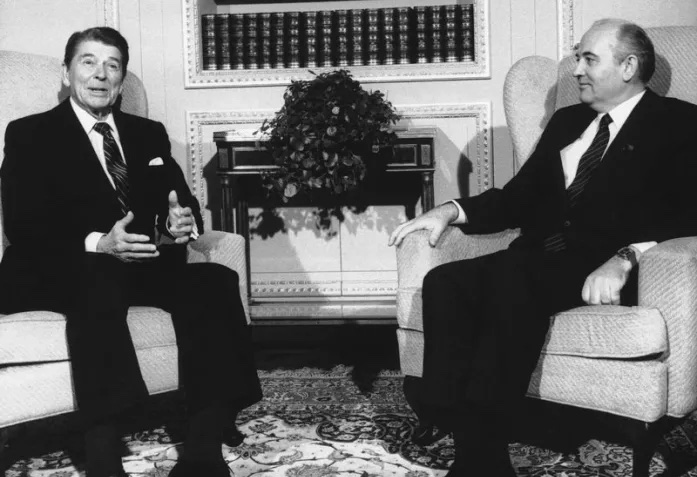
Reagan Returns
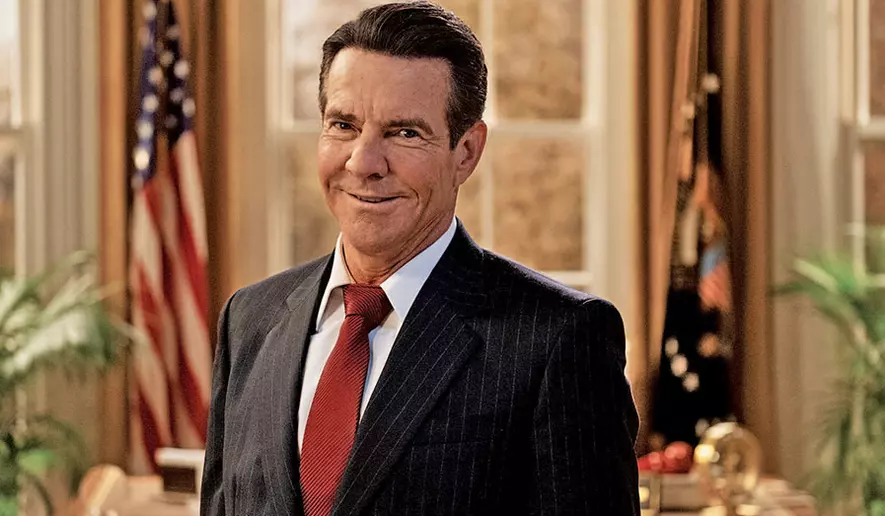
...Then I remembered a joke that was immensely popular in the Soviet Union in the mid-1980s, during my school and university years. A Russian and an American are standing in Red Square. The American says: “We have freedom of speech in America. You don’t.” “Why not?” asks the Russian. “Because I can stand outside the White House and shout, ‘Reagan is an idiot!’ and nothing will happen to me.” “So can I,” replies the Russian. “I can stand outside the Kremlin and shout, ‘Reagan is an idiot!’ and nothing will happen to me either.”
Ronald Reagan (1911–2004), the former Hollywood actor and Governor of California, became the 40th President of the United States and served two terms, from 1981 to 1989. During those eight years he outlasted three Soviet leaders – Leonid Brezhnev, Yuri Andropov and Konstantin Chernenko – and witnessed Gorbachev’s perestroika, and even, to some extent, became one of its participants. At the beginning of his presidency, he adopted a hard-line policy towards the Soviet Union and initiated a major arms build-up, including the Strategic Defense Initiative. Later, however, largely thanks to his personal rapport with Mikhail Gorbachev, he signed the historic Intermediate-Range Nuclear Forces Treaty (INF Treaty).
For millions of Soviet citizens, Reagan was little more than a caricature. His name was mentioned almost exclusively in connection with “aggressive imperialism”, the arms race, “Star Wars” and the threat of nuclear conflict. On 11 August 1984, while testing his microphone before his weekly radio address and believing he was off air, Reagan joked: “My fellow Americans, I’m pleased to tell you today that I’ve signed legislation that will outlaw Russia forever. We begin bombing in five minutes.” The remark triggered an international outcry.
Then, in the 1990s, the pendulum swung the other way. Reagan came to be seen by many as the man who had won the Cold War. Today, both images seem equally simplistic.
Ronald Reagan also entered history through two memorable phrases. It was he who famously described the Soviet Union as an “evil empire”, and later made the Russian proverb “Trust, but verify” famous worldwide. He repeated it regularly during his meetings with Gorbachev whenever arms control agreements were discussed. Its meaning was perfectly straightforward: we are prepared to trust your intentions, but every agreement must be backed by rigorous verification. That principle lay at the heart of negotiations over inspections of nuclear facilities – an issue that had remained a major stumbling block for decades.
The most famous exchange took place on 8 December 1987 in Washington, during the signing of the Intermediate-Range Nuclear Forces Treaty. Reagan once again repeated his favourite proverb, stressing the need for mutual inspections. Gorbachev smiled and remarked: “You repeat that at every meeting.” Reagan replied instantly: “I like it.”
It almost sounds like another joke today, doesn't it?
Yet nostalgia was only one reason I decided to watch Reagan. Every event depicted in the film left its mark not only on my own life, but on the life of my entire generation.
From an artistic point of view, however, Reagan has little to offer. It is a thoroughly conventional Hollywood biopic: a linear narrative, carefully constructed mythology, very little psychological ambiguity and an abundance of solemn rhetoric. Dennis Quaid faithfully reproduces Reagan’s distinctive voice and mannerisms, yet the film rarely ventures beyond the limits of an illustrated biography, remaining firmly anchored in the historical record, as the documentary footage and photographs shown over the closing credits make clear.
Had Reagan appeared fifteen or even ten years ago, it might simply have been seen as a belated tribute to one of America’s most influential twentieth-century presidents. In the summer of 2026, however, it looks very different, because it is ultimately less about the past than about the world we inhabit today.
Watching the film, one cannot escape the feeling that what unfolds on screen is not merely a meeting between two political leaders, but between two worlds that no longer exist.
In the late 1980s, the words “Trust, but verify” symbolised the first signs of trust. Verification was necessary precisely because both sides genuinely wanted an agreement. Today the phrase sounds almost tragic. Its first half seems to have disappeared. In international politics, increasingly, only “verify” remains – or simply mistrust.
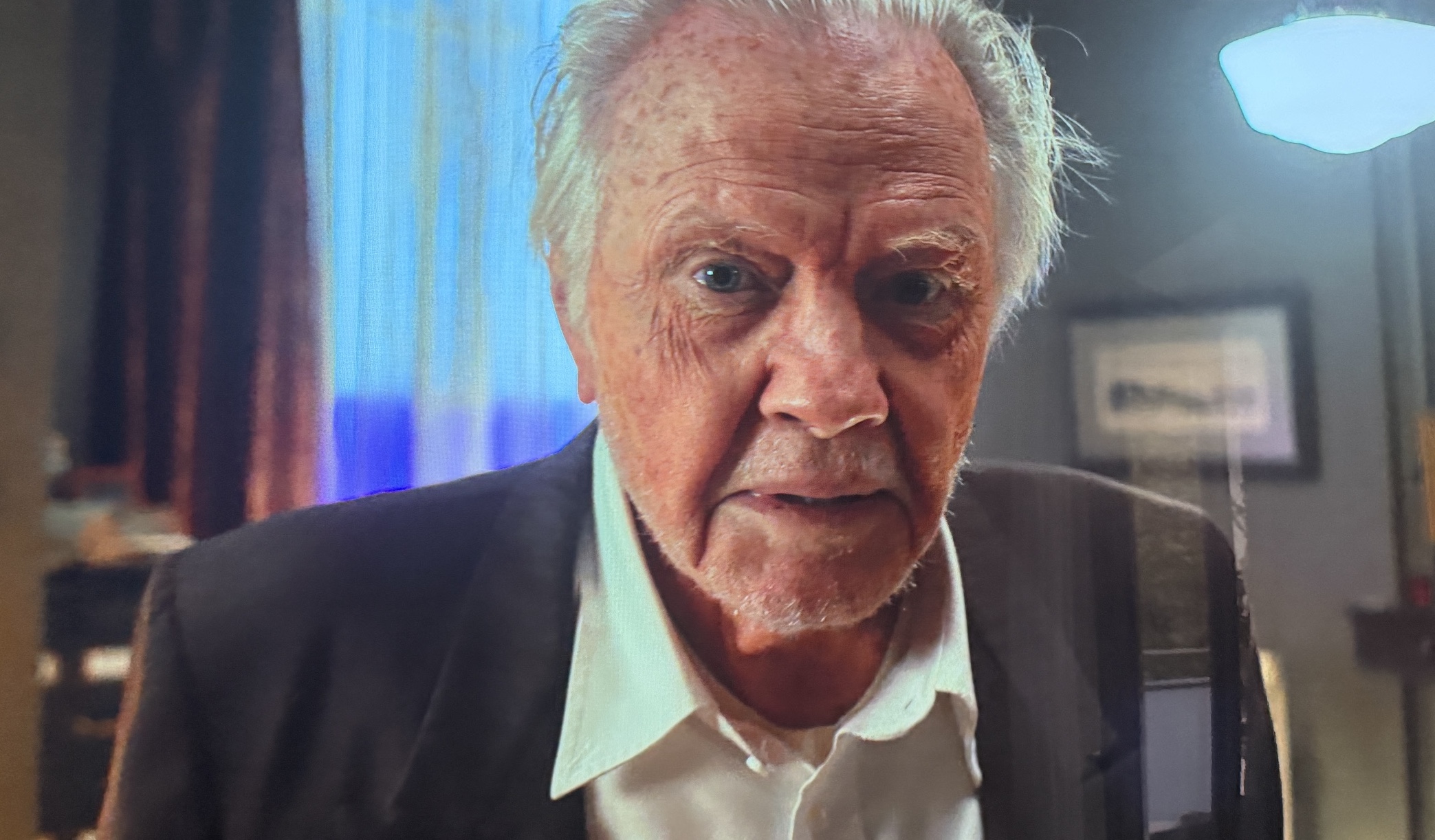
According to the film’s narrative, Reagan’s entire life story – and, indeed, the story of the Soviet Union’s collapse – is recounted by a retired KGB officer named Viktor Petrovich to a younger colleague. During the Cold War, this Victor Petrovich had overseen the infiltration of Soviet agents into Hollywood. One of the people placed under his surveillance was the young Ronald Reagan, who, according to the film, had been assigned the KGB codename “Crusader”. To the Soviet leadership, Reagan was seen as a man who viewed the struggle against Communism not merely as a political contest but as an almost moral, even civilisational, mission.
The retired Soviet spy is played by Jon Voight, and he delivers one of the film’s strongest performances, even speaking with a surprisingly convincing Russian accent. Some lines, however, are unintentionally amusing. “Communism is not our homeland,” he says, pointing towards portraits of Turgenev, Chekhov and Tolstoy hanging in his apartment. “They are.” Likewise, Stalin’s portrait would never have been hanging in a Kremlin office neither under Brezhnev nor under Gorbachev. That, however, is hardly Voight’s fault. That is on the screenwriters.
Seeing him again on screen, I could not help thinking how much Jon Voight had changed since I first met him almost forty years ago.
He came to Moscow as part of the first major Soviet-American film exchange of the perestroika era. At the Oktyabr Cinema on Kalinin Prospekt, Coming Home was screened for Soviet audiences. Voight’s portrayal of a Vietnam veteran left paralysed by war had earned him the Academy Award, and it is not difficult to imagine what Soviet viewers must have felt while watching the film against the backdrop of the ongoing war in Afghanistan.
At the very same time, Washington hosted the first American screening of Alexander Askoldov’s masterpiece The Commissar, based on Vasily Grossman’s short story In the Town of Berdichev. Declared “ideologically harmful” in 1967, the film had spent two decades banned from release.
For a while, it seemed that the Cold War was ending not only at negotiating tables, but in cinemas too. Just look at the smiles in this photograph from my personal archive!
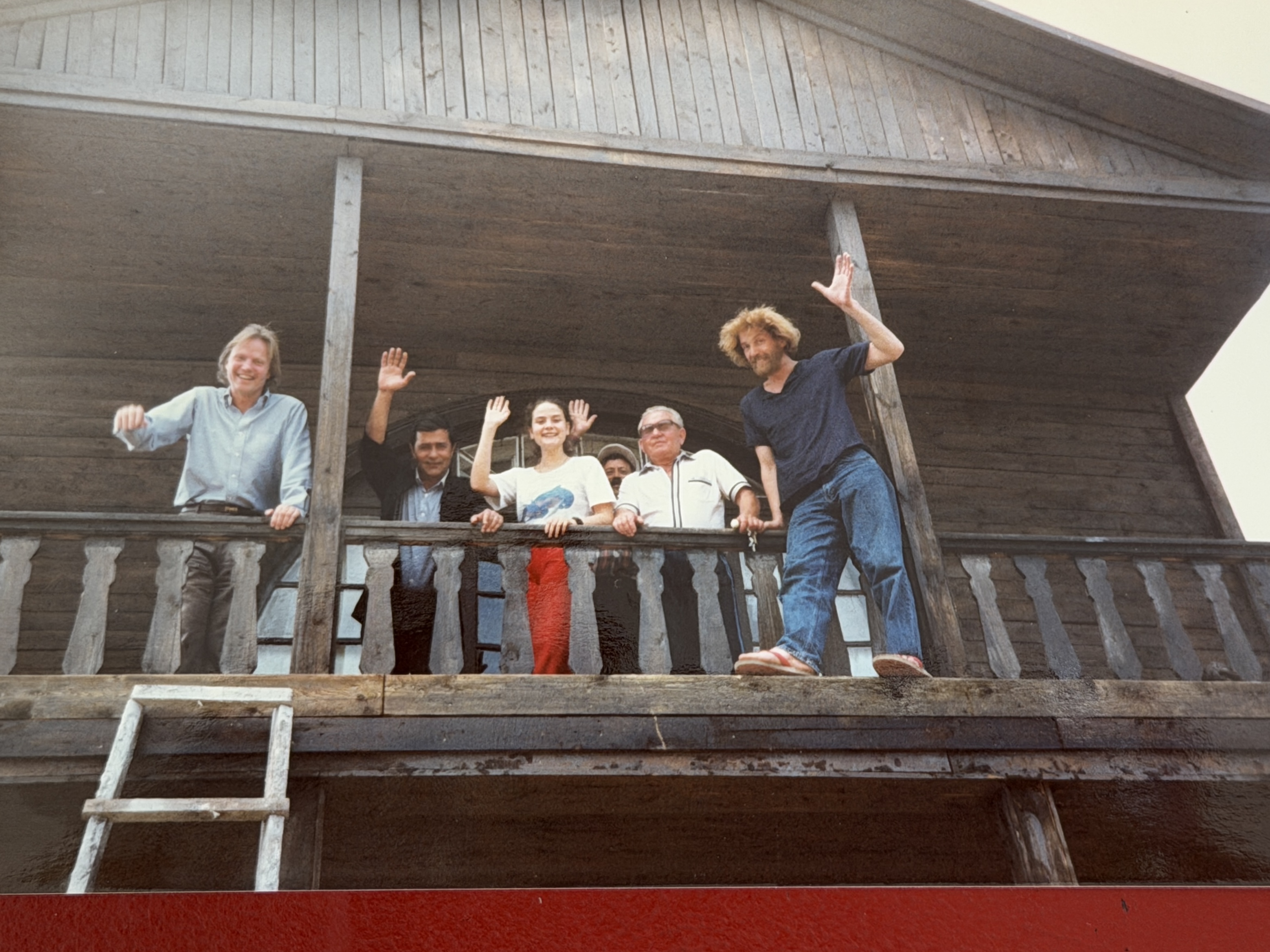
And now the same Jon Voight tells the story of the Cold War as a chapter of history already closed. Yet after watching the film, one cannot help asking: did it really? My own answer, I am afraid, is far from reassuring.
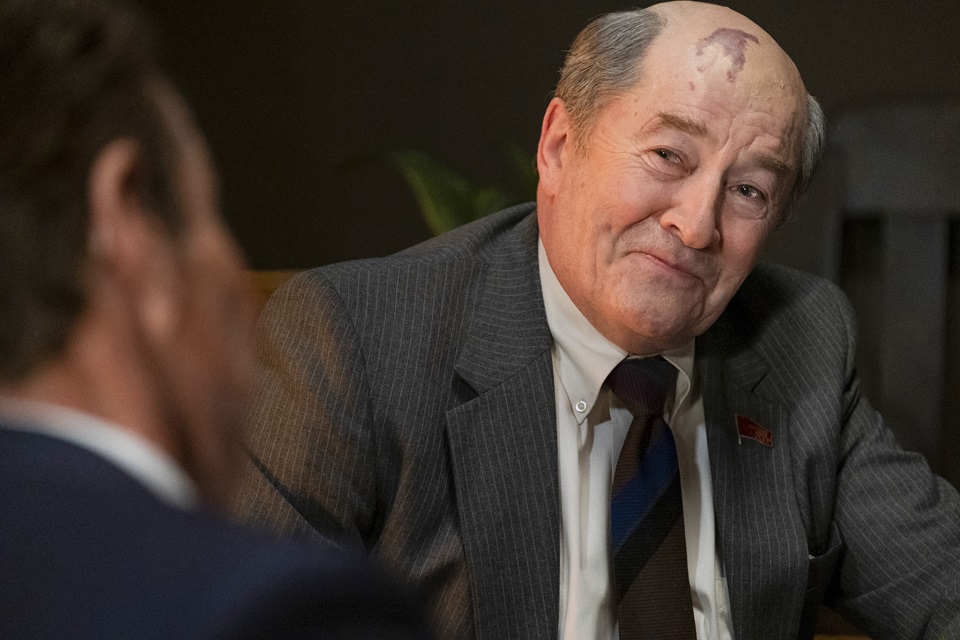
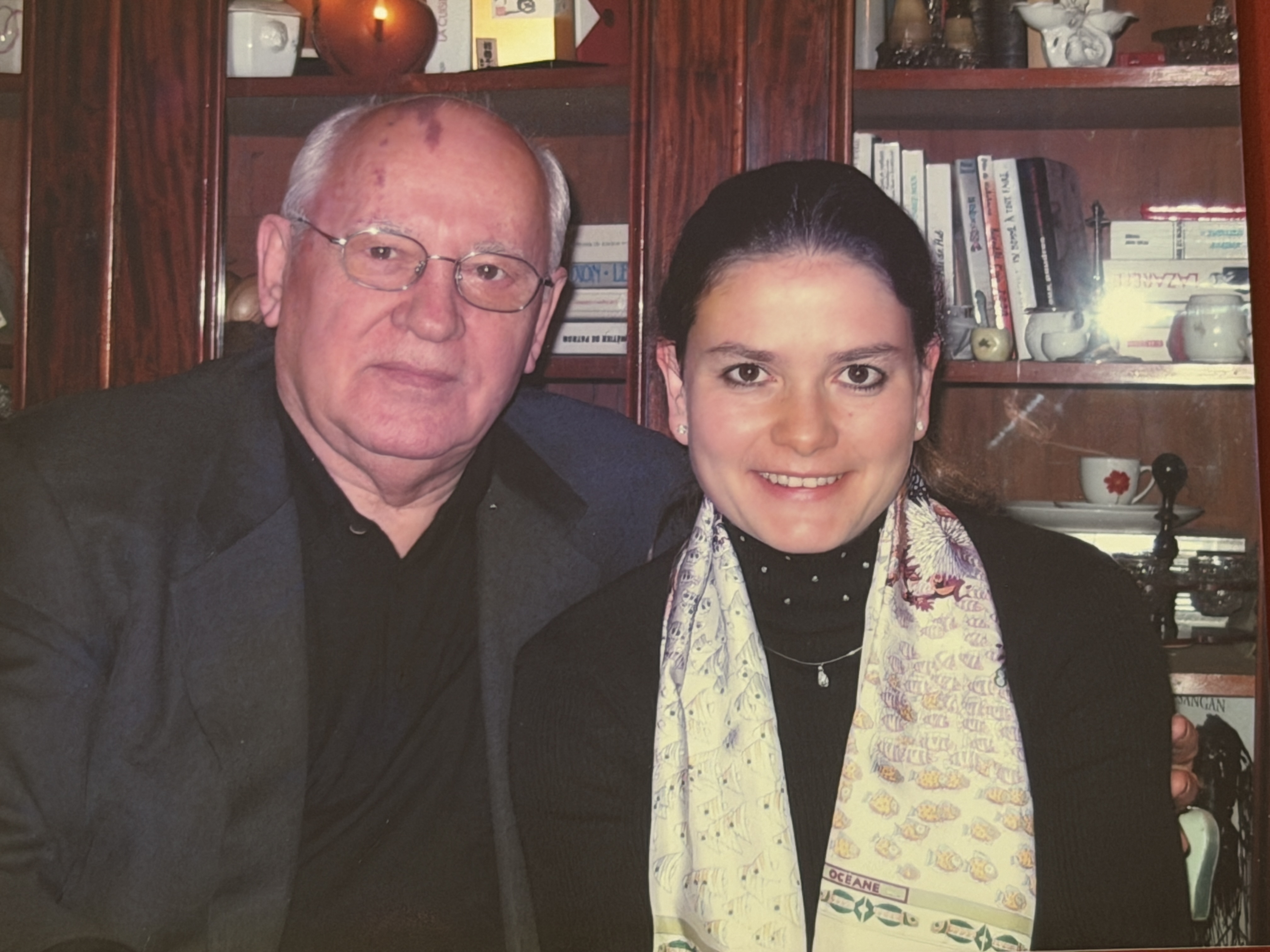
As it happens, I also had the opportunity to meet another of the film's protagonists – Mikhail Gorbachev himself – in the early 2000s. He is played by the Polish actor Olek Krupa. To be honest, had it not been for Gorbachev's unmistakable birthmark, I might not have recognised him straight away.
Interestingly, while Reagan was being filmed in 2021, Krupa wrote a fascinating essay for The Wall Street Journal entitled I Despised Gorbachev Until I Played His Role. In it, he explains that, having grown up in communist Poland, he had long viewed Gorbachev with hostility, seeing him as part of the Soviet system. Preparing for the role, however, changed his perspective. He came to realise that Gorbachev was a far more complex – and ultimately more tragic – figure than he had previously imagined.
It shows.
In the film, Gorbachev is perhaps the only Soviet leader whom the filmmakers allow to retain his dignity. While Brezhnev is portrayed as the embodiment of a decaying system, Gorbachev emerges as someone with whom Reagan can conduct a serious dialogue. That does not mean the film places them on equal footing – it is, after all, an American production! – but it does acknowledge Gorbachev as a worthy counterpart. For a film so openly sympathetic to Reagan, that is an important distinction.
Geneva also makes its appearance, with our Jet d'Eau filling the screen. It was here, in 1985, that Ronald Reagan and Mikhail Gorbachev met for the first time, an event that was fittingly commemorated thirty years later.
The talks began on the morning of 19 November at the private villa where Reagan was staying – Château Fleur d'Eau in Versoix – and continued the following day at the Soviet mission. After a brief meeting with their respective delegations, Reagan and Gorbachev withdrew for a private conversation. It is in Geneva that Reagan says to Gorbachev in the film: "We don't mistrust each other because we're armed; we're armed because we mistrust each other."
A Soviet diplomat once told me that, on the flight back to Moscow, Gorbachev described Reagan as "stubborn and very conservative", but "not entirely hopeless". Former US Secretary of State George Shultz later recalled that, after his first meeting with Gorbachev, Reagan told him simply that they had "got along well".
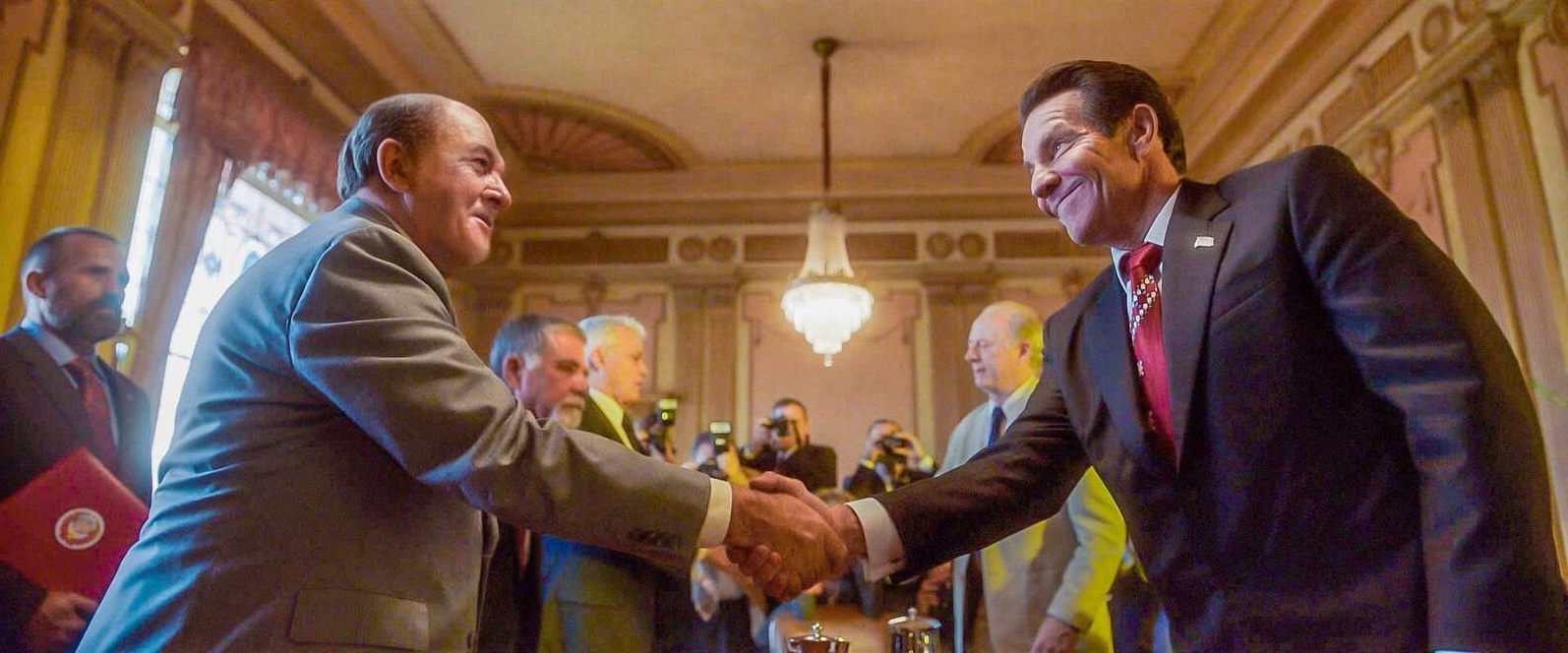
Despite this, Reagan did not alter his strategy. Instead, he made a bold political move. Take, for example, his reply to Shultz when, on the eve of the President's visit to Berlin, the Secretary of State tries to dissuade him from making provocative remarks and publicly humiliating Gorbachev – "our best friend in the last seventy years".
Reagan's answer is brief: "Clarity is power. We are here to win." What follows is his famous speech at the Brandenburg Gate on 12 June 1987: "General Secretary Gorbachev, if you seek peace, if you seek prosperity for the Soviet Union and Eastern Europe, if you seek liberalisation, come here to this gate. Mr. Gorbachev, open this gate. Mr. Gorbachev, tear down this wall!"
Two and a half years later, at the end of 1989, the Wall was dismantled. Ten days later, I left for Paris. At last, I had been allowed to leave.
Despite all its artistic shortcomings, Reagan is still worth watching through to the end. The closing scenes are more powerful than many of the earlier episodes. The caricatured opposition between "good" and "evil" quietly fades away, giving place to an encounter between two statesmen, each fully aware of the historical significance of the moment.
What struck me most was the documentary footage of Ronald Reagan's funeral used in the film. In 2004, gathered to pay their final respects to Ronald Reagan were Margaret Thatcher, Mikhail Gorbachev, Prince Charles, Tony Blair, Helmut Kohl, Lech Wałęsa and many other political leaders who shaped the second half of the twentieth century. It was more than a state funeral. It was a farewell to an entire era.
Eighteen years later, on 30 August 2022, Mikhail Gorbachev died. With one exception, no serving world leader attended his funeral. That exception was the then Hungarian Prime Minister Viktor Orbán. For him alone, it seemed, the war in Ukraine was not an insurmountable obstacle. The President of Russia, the president of the successor state to the Soviet Union, did not come to pay his respects to the man who had been the first – and last – President of the USSR. He had more pressing engagements that day.
The memory of states is not the same as the memory of history. States may turn their backs on their former leaders. History does not always do so. To me, that is ultimately what Reagan is about: not only Reagan, but Gorbachev as well.
For all its unmistakable sympathy towards one of them, the film ultimately acknowledges the historical significance of both, even if one ended his life widely regarded as the victor of the Cold War, while the other died viewed by many in his own country as the man responsible for its defeat.
The end of the Cold War turned out to be an event that never became a shared celebration. Each side wrote its own history and created its own mythology. In both narratives, however, there were there gradually less and less room for the man without whom that history might have unfolded very differently.
It is difficult to escape a number of questions. What really motivated Reagan in Berlin in 1987? Was it a genuine desire for peace, or a determination once again to demonstrate strength and push his adversary — or perhaps his negotiating partner — even further?
What if, during the decisive months of 1991, Western leaders had seen in Mikhail Gorbachev not merely the head of a rapidly disintegrating superpower, but a statesman worth supporting and keeping in office, rather than placing their hopes in Boris Yeltsin who appeared to them to be the stronger leader? Did the West do everything it could to prevent Gorbachev from being forced out of the political arena? And can we truly say that the Cold War is over if, more than three decades later, we once again find ourselves living in a world that increasingly resembles its final decades?